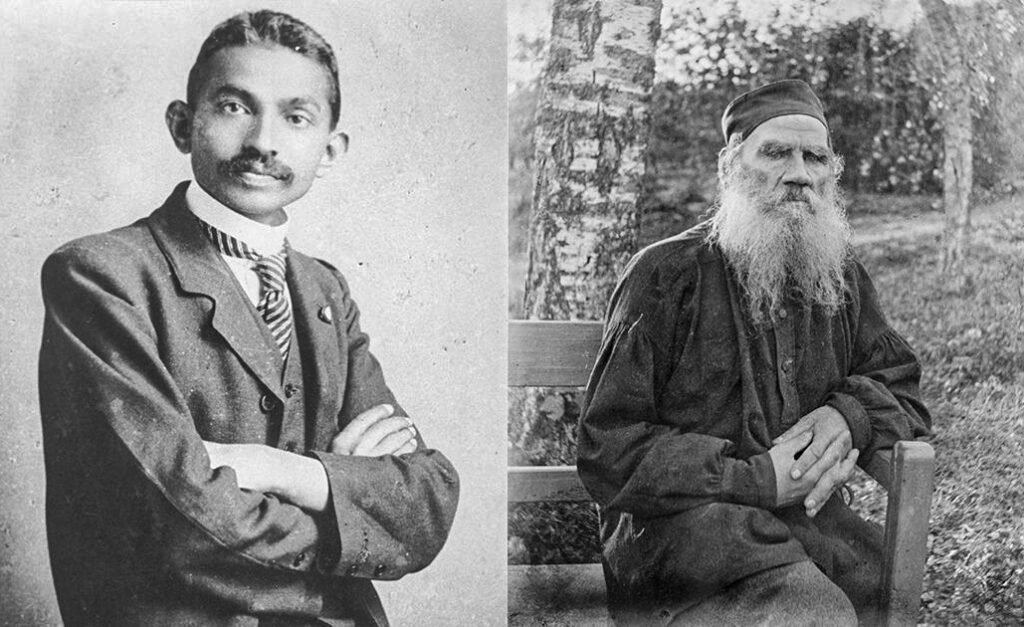
Tolstoy and Gandhi: light as darkness approached

René Wadlow

September 16, 2020

“We possess a single infallible guide, the Universal Spirit that lives in men as a whole, and in each one of us, which makes us aspire to what we should aspire: it is the Spirit that commands the tree to grow toward the sun, the flower to throw off its seed in autumn, us to reach out towards God, and by so doing, become united to each other.”
— Leo Tolstoy (9 Sep1828 – 20 Nov 1910)

November 20 marks the death of Leo Tolstoy in 1910 when he left his estate Yasnaya Polyana and walked to a railroad station at Astopovo, a journey with no set destination.  As Isaiah Berlin writes at the end of his well-known essay on Tolstoy’s philosophy of history, The Hedgehog and the Fox:

At once insanely proud and filled with self-hatred, omniscient and doubting everything, cold and violently passionate, contemptuous and self-abasing, tormented and detached, surrounded by an adoring family, by devoted followers, by the admiration of the entire civilized world, and yet almost wholly isolated, he is the most tragic of the great writers, a desperate old man, beyond human aid, wandering self-blinded at Colonus.”
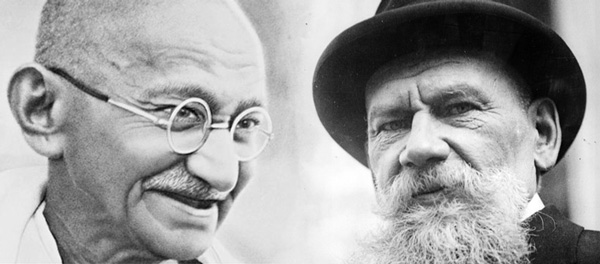
Originally posted on Transcend Media on September 7, 2020

Yet the darkness of the final two years of Tolstoy’s life was enlightened by his written contacts with Mohandas Gandhi (not yet called Mahatma).  Gandhi had read Tolstoy’s fundamental spiritual-political work The Kingdom of God is within You. Shortly after it was published in English in 1893 and had been much moved by it.  Gandhi had his friends translate the book into his native language, Gujarati.

Gandhi had read earlier in London Helena Blavatsky’s The Voice of Silence, published in 1889, which elaborated the doctrine of liberation through service to others with the Buddhist concept of bodhisattva — the enlightened being who postpones indefinitely entry into nirvana in order to serve others. The voice of the silence is the inner voice of the Higher Self or the soul. There is also developed the idea ‘to render good for evil’.

Thus Gandhi was well prepared to react positively to Tolstoy’s vision even if the vocabulary was largely Christian.  Christ’s teaching, writes Tolstoy, differs from other teachings in that it guides humans not by eternal rules but by an inward consciousness of the possibility of reaching divine perfection. Tolstoy stresses the Middle Way, which led the French writer E.M. de Vogue to write that Tolstoy had the soul of an Indian Buddhist.  Tolstoy had discovered that nonviolence must have a spiritual foundation, most clearly expressed for him in the Gospels.

Leo Tolstoy and Gandhi never met, but they corresponded with each other during the final two years of Tolstoy’s life, 1909 and 1910. Tolstoy had read Hind Swaraj (1909) where Gandhi set out his vision of a liberated India, the means to reach liberation, and what an independent India could mean for the world. It was Gandhi’s plan of action before he set out to put it in practice.  Gandhi had listed some of Tolstoy’s books in a list of supplementary readings to Hind Swaraj in particular The Kingdom of God is within You and Letter to a Hindoo, Tolstoy’s reply to an Indian revolutionary who had proposed a violent uprising.

Tolstoy wrote to Gandhi:

“I read your book with great interest because I think that the question you treat in it — the passive resistance — is a question of the greatest importance not only for India but for the whole humanity.”

Tolstoy had also read Joseph Doha’s 1909 biography of Gandhi An Indian Patriot in South Africa, the first biography of Gandhi to be written.  In August 1910, Gandhi wrote to Tolstoy to announce the creation of his ashram in South Africa called Tolstoy Farm.

Gandhi’s efforts in South Africa were signs to Tolstoy that nonviolence based on the importance of personal virtue could be put into practice.  Much of the last years of Tolstoy’s life was a harsh struggle against darkness as represented by the State, its war-making power, its ideologies, and the social thinking that structured the State. Colonialism, imperialism and the oppression of the indigenous races were the hallmark of the State. He saw the forces at work that would lead to the First World War and the Russian Revolution. By 1901 he had been excommunicated from the Russian Orthodox Church — not that he expected much light to come from Church-State relations. The Church did insist that no prayers be said at Tolstoy’s funeral.

For Tolstoy as for Gandhi, nonviolence was an expression of ‘soul force’ — the outward expression of the Inner Kingdom.

Please help TFF remain truly independent by contributing if you benefited from this article

[paypal-donation]
René Wadlow is a member of the TRANSCEND Network for Peace Development Environment. He is President of the Association of World Citizens, an international peace organization with consultative status with ECOSOC, the United Nations organ facilitating international cooperation and problem-solving in economic and social issues, and editor of Transnational Perspectives.

Notes (added by the editor)

You can read the Tolstoy-Gandhi correspondence here.
Tolstoy and Gandhi: From nonviolence to climate change

Why we hurt each other

Share

Leave a Reply

Your email address will not be published. Required fields are marked *

Related Posts

Jan Oberg, TFF director April 28, 2026 In this third TFF Peace Pulse, I make the important distinction between the violence and the conflict that violence is a symptom of. If you want peace, focus on the underlying conflict because that is the key to resolution, peacemaking, and a better future for the parties. The West is obsessed with violence, just look around you – and 90+ per cent of the public debate is about military issues and other violence – totally wasted for peace. These Peace Pulses will only be published here a few times. You will also not find them on YouTube and Vimeo because both platforms have blocked TFF and me; you know, peace is dangerous these days. Most TFF’s videos since 2007 are now on Rumble.
In contrast to most, we’ll bring alternatives, solutions, hope and strategies for a better future. Times are dangerous, yes, but that only intensifies the need for constructive thinking and action! Jan Oberg, TFF director April 13, 2026 The new TFF Peace Pulse uses video messages in a new way: Max 3-5-minute-long comments, ideas or perhaps mini-lectures, all about peace – positive peace. We launch them today on April 13, 2026 with a carefully crafted visual aesthetic fitting the content. We hope to publish them regularly from now on. We launch Peace Pulse (PP) – for a number of reasons. The world is in chaos, and there are countless reasons to feel concerned, frustrated, even angry. The atmosphere is saturated with doom and gloom, with negative energy and rear‑mirror thinking, while vision, imagination, alternatives, strategies and genuine future‑mindedness remain in short supply. And without them, we simply can’t save the world. Looking at problems from a hundred angles will...
PART II — Publishing Peace in a System That Prioritises Militarism Jan Oberg, TFF director April 10, 2026 How TFF Maintains a Daily Voice in a Digital World Built for Noise This article is part of the series “TFF at 40″ and it invites you to learn about Four Decades of Publishing Peace. It takes a look at how a small, people‑financed peace foundation has communicated across four generations of technology — from wax stencils and fax machines to mass email and Substack — and why TFF continues to publish every single day in a system that rewards noise, conflict, and militarism. ◆ What it means to publish peace every single day in a digital system built for 24/7 news and other noise, confrontation, and militarism. How TFF’s independence, continuity, and global readership defy algorithms, donor cycles, and Western media censorhip — and why the Majority World keeps listening. When the...

Recent Articles

Jan Oberg May 15, 2026 Go to this Fox News page and scroll the whole way down: President Donald Trump tells the world that his meeting with President Xi Jinping yielded a lot of very concrete political and economic results – of course, only where the Chinese side, according to him, agreed with him. He does not mention the Taiwan issue, but Secretary of State, Marco Rubio, says that it did not feature prominently in their talks and that the US policy on Taiwan has not changed. Then go to China Daily – or Global Times – and you will see that for the Chinese it is framework, principles, structure of cooperation etc. that matters – all embedded in the overall idea of “constructive bilateral relationship of strategic stability.” Nowhere is any concrete agreement or deal – all that Trump refers to – mentioned. At the general level, this gives you insights into the very different social...
Lena Petrova of “World Affairs In Context” with more than half a million subscribers on YouTube wanted to explore what a peace researcher like me has to say about, among other things, the First and the Second Cold War and why eethics has disappeared from politics. I am particularly happy about this conversation that also yielded an amazing number of very appreciative comments on YouTube. No doubt, people are longing for alternatives, including peace perspectives.
The MIMAC – Military-Industrial-Media-Academic Complex – drives the world’s rampant militarism and wars without end. Here is a short reflection of how it works against all interests of humanity. #5 deals with why there is no real enemy or threat images/analysis. It’s all ex-post constructions. And, btw, theTFF Peace Pulse is now on Rumble.

TFF on Substack

Discover more from TFF Transnational Foundation & Jan Oberg.

Most Popular

Jan Oberg May 15, 2026 Go to this Fox News page and scroll the whole way down: President Donald Trump tells the world that his meeting with President Xi Jinping yielded a lot of very concrete political and economic results – of course, only where the Chinese side, according to him, agreed with him. He does not mention the Taiwan issue, but Secretary of State, Marco Rubio, says that it did not feature prominently in their talks and that the US policy on Taiwan has not changed. Then go to China Daily – or Global Times – and you will see that for the Chinese it is framework, principles, structure of cooperation etc. that matters – all embedded in the overall idea of “constructive bilateral relationship of strategic stability.” Nowhere is any concrete agreement or deal – all that Trump refers to – mentioned. At the general level, this gives you insights into the very different social...
Lena Petrova of “World Affairs In Context” with more than half a million subscribers on YouTube wanted to explore what a peace researcher like me has to say about, among other things, the First and the Second Cold War and why eethics has disappeared from politics. I am particularly happy about this conversation that also yielded an amazing number of very appreciative comments on YouTube. No doubt, people are longing for alternatives, including peace perspectives.
The MIMAC – Military-Industrial-Media-Academic Complex – drives the world’s rampant militarism and wars without end. Here is a short reflection of how it works against all interests of humanity. #5 deals with why there is no real enemy or threat images/analysis. It’s all ex-post constructions. And, btw, theTFF Peace Pulse is now on Rumble.
Read More
Screenshot-2026-05-15-103534
Jan Oberg May 15, 2026 Go to this Fox News page and scroll the whole way down: President Donald Trump tells the world that his meeting with President Xi Jinping yielded a lot of very concrete political and economic results – of course, only where the Chinese side, according to him, agreed with him. He does not mention the Taiwan issue, but Secretary of State, Marco Rubio, says that it did not feature prominently in their talks and that the US policy on Taiwan has not changed. Then go to China Daily – or Global Times – and you will see that for the Chinese it is framework, principles, structure of cooperation etc. that matters – all embedded in the overall idea of “constructive bilateral relationship of strategic stability.” Nowhere is any concrete agreement or deal – all that Trump refers to – mentioned. At the general level, this gives you insights into the very different social...
Screenshot-2026-05-12-104023
Lena Petrova of “World Affairs In Context” with more than half a million subscribers on YouTube wanted to explore what a peace researcher like me has to say about, among other things, the First and the Second Cold War and why eethics has disappeared from politics. I am particularly happy about this conversation that also yielded an amazing number of very appreciative comments on YouTube. No doubt, people are longing for alternatives, including peace perspectives.
Screenshot-2026-04-13-154551 (2)
The MIMAC – Military-Industrial-Media-Academic Complex – drives the world’s rampant militarism and wars without end. Here is a short reflection of how it works against all interests of humanity. #5 deals with why there is no real enemy or threat images/analysis. It’s all ex-post constructions. And, btw, theTFF Peace Pulse is now on Rumble.
Screenshot-2026-04-13-154551 (1)
Jan Oberg, TFF director April 28, 2026 In this third TFF Peace Pulse, I make the important distinction between the violence and the conflict that violence is a symptom of. If you want peace, focus on the underlying conflict because that is the key to resolution, peacemaking, and a better future for the parties. The West is obsessed with violence, just look around you – and 90+ per cent of the public debate is about military issues and other violence – totally wasted for peace. These Peace Pulses will only be published here a few times. You will also not find them on YouTube and Vimeo because both platforms have blocked TFF and me; you know, peace is dangerous these days. Most TFF’s videos since 2007 are now on Rumble.
Screenshot-2026-04-13-154551
In contrast to most, we’ll bring alternatives, solutions, hope and strategies for a better future. Times are dangerous, yes, but that only intensifies the need for constructive thinking and action! Jan Oberg, TFF director April 13, 2026 The new TFF Peace Pulse uses video messages in a new way: Max 3-5-minute-long comments, ideas or perhaps mini-lectures, all about peace – positive peace. We launch them today on April 13, 2026 with a carefully crafted visual aesthetic fitting the content. We hope to publish them regularly from now on. We launch Peace Pulse (PP) – for a number of reasons. The world is in chaos, and there are countless reasons to feel concerned, frustrated, even angry. The atmosphere is saturated with doom and gloom, with negative energy and rear‑mirror thinking, while vision, imagination, alternatives, strategies and genuine future‑mindedness remain in short supply. And without them, we simply can’t save the world. Looking at problems from a hundred angles will...
IMG_5165 (1)
PART II — Publishing Peace in a System That Prioritises Militarism Jan Oberg, TFF director April 10, 2026 How TFF Maintains a Daily Voice in a Digital World Built for Noise This article is part of the series “TFF at 40″ and it invites you to learn about Four Decades of Publishing Peace. It takes a look at how a small, people‑financed peace foundation has communicated across four generations of technology — from wax stencils and fax machines to mass email and Substack — and why TFF continues to publish every single day in a system that rewards noise, conflict, and militarism. ◆ What it means to publish peace every single day in a digital system built for 24/7 news and other noise, confrontation, and militarism. How TFF’s independence, continuity, and global readership defy algorithms, donor cycles, and Western media censorhip — and why the Majority World keeps listening. When the...