
The world needs to understand what is wrong with America

A demonstrator raises a fist after clashes with police in the US city of Seattle on 8 June (AFP)

As calls for racial justice reverberate across the country, the field of American Studies requires a radical rethink – namely, the active engagement of people around the globe at the receiving end of US militarism. 

By Hamid Dabashi

September 15, 2020

“The majority lives in the perpetual practice of self-applause, and there are certain truths which the Americans can only learn from strangers or from experience.” 

– Alexis de Tocqueville, Democracy in America

“Americans are the unhappiest they’ve been in 50 years,” according to recent polls. “It’s been a rough year for the American psyche.”   

The deeply troubling presidency of Donald Trump has led to severe consequences of the coronavirus pandemic in the US, where the per-capita mortality rate is among the highest in the world, exacerbated by claustrophobic despair over lockdowns and social distancing, alongside a massive uprising against racism and police brutality.

Americans are at a loss.   

Originally published at middleeasteye.net

Dysfunctional empire

Calls for racial justice reverberate from one end of the US to the other. Police brutality against African Americans has been caught on tape; statues of racist Confederate generals, and even US presidents, are coming down. The massive uprising in the aftermath of George Floyd’s murder in May announced Black Lives Matter as a new and unprecedented phase in contemporary US history.  

It is too early to tell where, if anywhere, this uprising will lead, and whether it will result in any enduring changes. “Police reform” and electoral politics are the two immediate lullabies that seek to lull and derail this uprising.

Barack and Michelle Obama are leading the way to compromise and stall the momentum of the Black Lives Matter uprising, by repeating the centrist mantra of “protest peacefully and vote in all elections”, thus implying the protests are not peaceful, and there are not far more radical prospects of change than just voting for the Democratic party’s presidential candidate Joe Biden. 

On their own, many Americans are unable to fathom the depth of the calamity that they face – and which, in turn, they have imposed upon the larger world. As the fragile republican centre of a dysfunctional empire, what happens in the US happens to the rest of the world.

Critical lenses from around the world are therefore essential in understanding what is happening in the US. That necessity creates its own epistemological challenges and opportunities. 

Orientalism and post-Orientalism

For more than two centuries of modern history, the world has been at the receiving end of the “Western gaze” – being looked at, examined, ethnicised, anthropologised, the circumference of their skulls measured, put into zoos and museums to be studied by the white masters who roamed the globe and conquered and colonised the earth.    

In his seminal book, Orientalism, Edward Said laser-beamed in on a particular episode in the history of this mode of colonial knowledge production that called itself “Orientalism” – a mode of knowledge at the service of colonial domination. Said’s text inaugurated an entire field of postcolonial studies to reverse that colonial gaze. 

In my Post-Orientalism, I took Said’s insights and moved beyond the structural limitations of one particular episode of colonial knowledge production, examining the relationship between knowledge and power into the later periods of area studies and think tanks.

I examined their mode of “disposable knowledge”, as in the preparatory stages of the invasion and occupation of Afghanistan in 2001 and Iraq in 2003.        

By and large, Eurocentric modes of knowledge production have remained operative even after Said’s seminal text, and disciplines such as anthropology have continued to extend their deeply racist epistemologies to the farthest corners of the earth.   

Vantage point of white Americans

The field of American Studies is one such area, which has been by and large the domain of Americans themselves, though mostly from the vantage point of white people – until more recently, when Native Americans, African Americans, Latinx Americans and other immigrant communities began to reverse that internalised gaze, altering the way we read America.  

But today, the field requires an even more radical reversal – namely, the active engagement of non-Americans, or more precisely those people around the globe at the receiving end of US militarism.  
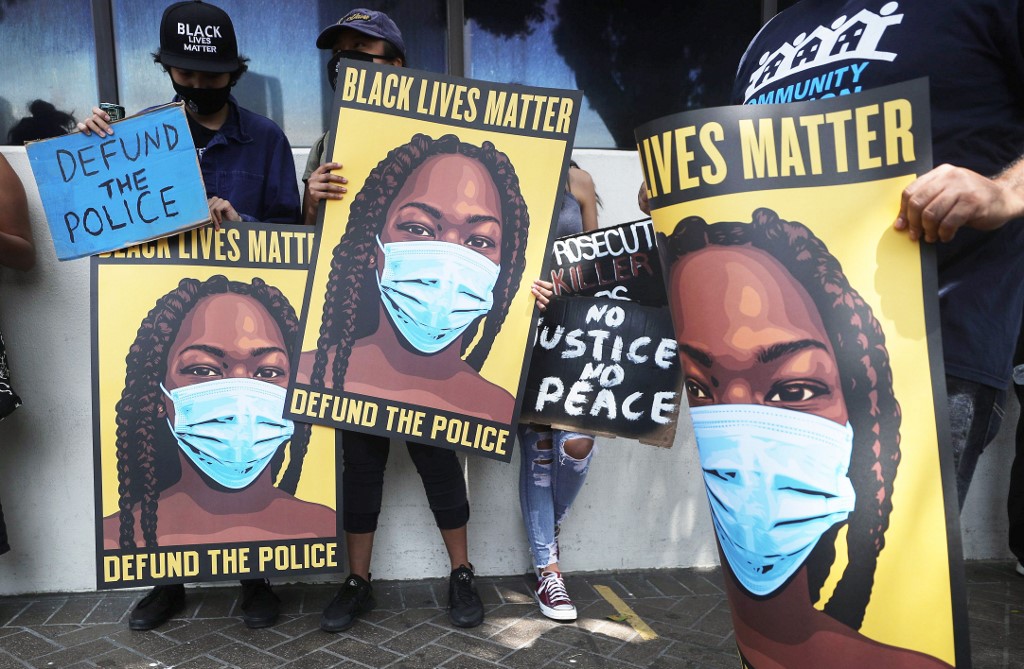
Black Lives Matter supporters protest in Los Angeles on 23 June (AFP)

In his Representations of the Intellectual, Said theorised that the empowering position of exile, the refugee, the expatriate – all whether factual or figurative – were definitive to the critical stance of intellectuals, whether native or foreign to a land.  

The theoretical basis of this crucial text should be the cornerstone of a new generation of American Studies that links the progressive forces among Native, Black and Hispanic American Studies to the larger non-American community of scholars, critical thinkers, artists, filmmakers, etc.  

Predicated on a critical reappraisal of Said’s insights, the field of American Studies must go global, liberated from a country where Betsy DeVos, the sister of the mercenary merchant of death, Erik Prince, is the secretary of education.

‘A human problem’

The globalisation of American empire has put the world at the receiving end of American violence. But the world does not have a say in whom US citizens choose as their president. Black and other racialised communities in the US are as much at the mercy of the militarised and racist police as the world is at the mercy of the US military.  

The roots of racism against African Americans in the US extends to the ruling white supremacist attitude towards Africa – “the shithole countries”, as Trump calls them – and by extension to Asia and Latin America. 

Recently, lawyers representing the Floyd family made an appeal to the United Nations Human Rights Council, as they should. The origin of this goes back to when Malcolm X argued that the case of the ruling racism against Black Americans must be taken to the UN. 

The problem of the Black person in the US, he argued, “is beyond America’s ability to solve. It is a human problem, not an American problem, or a Negro problem, and as a human problem or a world problem, we feel that it should be taken out of the jurisdiction of the United States government and the United States courts and taken into the United Nations.”   

Echoing Malcolm X’s thoughts, today, African nations correctly seek a UN investigation into the manner in which the ruling racism in the US is the principal source of racist violence against its own citizens.  

Electoral seesaw

This is not to ignore that the UN is a morally compromised space, a toothless tiger that could investigate the Jamal Khashoggi murder to identify the main culprit, but had no way of bringing him to justice.  

But still, one crucial consequence of this move is to put the entire structure of vicious racism, definitive of the US historical experience, on trial beyond its own compromised jurisdiction for the whole world to see.  

Bringing the endemic and enduring structure of US racism to the world’s attention is a crucial framework towards creating both a forum and an entire field of American Studies liberated from the compromising institutions of US-based scholarship and critical thinking by people trapped inside the useless seesaw electoral politics of Republicans versus Democrats – the Pepsi and Coke choices that Americans are free to make, both equally dangerous to their health, every two to four years. 

Originally published at middleeasteye.net

About the Author

Hamid Dabashi is Hagop Kevorkian Professor of Iranian Studies and Comparative Literature at Columbia University in the City of New York. His latest books include Reversing the Colonial Gaze: Persian Travelers Abroad (Cambridge University Press, 2020), and The Emperor is Naked: On the Inevitable Demise of the Nation-State (Zed, 2020).
His forthcoming book, On Edward Said: Remembrance of Things Past, is scheduled to be released by Haymarket Books later this year.
Here is his virtual home.

If you appreciate this article, please show it here. Thanks!

[paypal-donation]

Share

Leave a Reply

Your email address will not be published. Required fields are marked *

Related Posts

Jan Oberg May 15, 2026 Go to this Fox News page and scroll the whole way down: President Donald Trump tells the world that his meeting with President Xi Jinping yielded a lot of very concrete political and economic results – of course, only where the Chinese side, according to him, agreed with him. He does not mention the Taiwan issue, but Secretary of State, Marco Rubio, says that it did not feature prominently in their talks and that the US policy on Taiwan has not changed. Then go to China Daily – or Global Times – and you will see that for the Chinese it is framework, principles, structure of cooperation etc. that matters – all embedded in the overall idea of “constructive bilateral relationship of strategic stability.” Nowhere is any concrete agreement or deal – all that Trump refers to – mentioned. At the general level, this gives you insights into the very different social...
The MIMAC – Military-Industrial-Media-Academic Complex – drives the world’s rampant militarism and wars without end. Here is a short reflection of how it works against all interests of humanity. #5 deals with why there is no real enemy or threat images/analysis. It’s all ex-post constructions. And, btw, theTFF Peace Pulse is now on Rumble.
Jan Oberg, TFF director April 9, 2026 I was recently invited to have a good, long talk about the world – and, of course, about peace too – with Boris Malagurski on his Weight of Chains Channel on YouTube. It was a real joy and seems to have been greatly appreciated by the viewers too. Mr Malagurski and I shall of course be grateful if you share this conversation in your circles – of course, only if you like what you see and hear  And remember that this one – like hundreds of others with TFF Associates – can be enjoyed at our TFF Video Collection.

Recent Articles

Jan Oberg May 15, 2026 Go to this Fox News page and scroll the whole way down: President Donald Trump tells the world that his meeting with President Xi Jinping yielded a lot of very concrete political and economic results – of course, only where the Chinese side, according to him, agreed with him. He does not mention the Taiwan issue, but Secretary of State, Marco Rubio, says that it did not feature prominently in their talks and that the US policy on Taiwan has not changed. Then go to China Daily – or Global Times – and you will see that for the Chinese it is framework, principles, structure of cooperation etc. that matters – all embedded in the overall idea of “constructive bilateral relationship of strategic stability.” Nowhere is any concrete agreement or deal – all that Trump refers to – mentioned. At the general level, this gives you insights into the very different social...
Lena Petrova of “World Affairs In Context” with more than half a million subscribers on YouTube wanted to explore what a peace researcher like me has to say about, among other things, the First and the Second Cold War and why eethics has disappeared from politics. I am particularly happy about this conversation that also yielded an amazing number of very appreciative comments on YouTube. No doubt, people are longing for alternatives, including peace perspectives.
The MIMAC – Military-Industrial-Media-Academic Complex – drives the world’s rampant militarism and wars without end. Here is a short reflection of how it works against all interests of humanity. #5 deals with why there is no real enemy or threat images/analysis. It’s all ex-post constructions. And, btw, theTFF Peace Pulse is now on Rumble.

TFF on Substack

Discover more from TFF Transnational Foundation & Jan Oberg.

Most Popular

Jan Oberg May 15, 2026 Go to this Fox News page and scroll the whole way down: President Donald Trump tells the world that his meeting with President Xi Jinping yielded a lot of very concrete political and economic results – of course, only where the Chinese side, according to him, agreed with him. He does not mention the Taiwan issue, but Secretary of State, Marco Rubio, says that it did not feature prominently in their talks and that the US policy on Taiwan has not changed. Then go to China Daily – or Global Times – and you will see that for the Chinese it is framework, principles, structure of cooperation etc. that matters – all embedded in the overall idea of “constructive bilateral relationship of strategic stability.” Nowhere is any concrete agreement or deal – all that Trump refers to – mentioned. At the general level, this gives you insights into the very different social...
Lena Petrova of “World Affairs In Context” with more than half a million subscribers on YouTube wanted to explore what a peace researcher like me has to say about, among other things, the First and the Second Cold War and why eethics has disappeared from politics. I am particularly happy about this conversation that also yielded an amazing number of very appreciative comments on YouTube. No doubt, people are longing for alternatives, including peace perspectives.
The MIMAC – Military-Industrial-Media-Academic Complex – drives the world’s rampant militarism and wars without end. Here is a short reflection of how it works against all interests of humanity. #5 deals with why there is no real enemy or threat images/analysis. It’s all ex-post constructions. And, btw, theTFF Peace Pulse is now on Rumble.
Read More
Screenshot-2026-05-15-103534
Jan Oberg May 15, 2026 Go to this Fox News page and scroll the whole way down: President Donald Trump tells the world that his meeting with President Xi Jinping yielded a lot of very concrete political and economic results – of course, only where the Chinese side, according to him, agreed with him. He does not mention the Taiwan issue, but Secretary of State, Marco Rubio, says that it did not feature prominently in their talks and that the US policy on Taiwan has not changed. Then go to China Daily – or Global Times – and you will see that for the Chinese it is framework, principles, structure of cooperation etc. that matters – all embedded in the overall idea of “constructive bilateral relationship of strategic stability.” Nowhere is any concrete agreement or deal – all that Trump refers to – mentioned. At the general level, this gives you insights into the very different social...
Screenshot-2026-05-12-104023
Lena Petrova of “World Affairs In Context” with more than half a million subscribers on YouTube wanted to explore what a peace researcher like me has to say about, among other things, the First and the Second Cold War and why eethics has disappeared from politics. I am particularly happy about this conversation that also yielded an amazing number of very appreciative comments on YouTube. No doubt, people are longing for alternatives, including peace perspectives.
Screenshot-2026-04-13-154551 (2)
The MIMAC – Military-Industrial-Media-Academic Complex – drives the world’s rampant militarism and wars without end. Here is a short reflection of how it works against all interests of humanity. #5 deals with why there is no real enemy or threat images/analysis. It’s all ex-post constructions. And, btw, theTFF Peace Pulse is now on Rumble.
Screenshot-2026-04-13-154551 (1)
Jan Oberg, TFF director April 28, 2026 In this third TFF Peace Pulse, I make the important distinction between the violence and the conflict that violence is a symptom of. If you want peace, focus on the underlying conflict because that is the key to resolution, peacemaking, and a better future for the parties. The West is obsessed with violence, just look around you – and 90+ per cent of the public debate is about military issues and other violence – totally wasted for peace. These Peace Pulses will only be published here a few times. You will also not find them on YouTube and Vimeo because both platforms have blocked TFF and me; you know, peace is dangerous these days. Most TFF’s videos since 2007 are now on Rumble.
Screenshot-2026-04-13-154551
In contrast to most, we’ll bring alternatives, solutions, hope and strategies for a better future. Times are dangerous, yes, but that only intensifies the need for constructive thinking and action! Jan Oberg, TFF director April 13, 2026 The new TFF Peace Pulse uses video messages in a new way: Max 3-5-minute-long comments, ideas or perhaps mini-lectures, all about peace – positive peace. We launch them today on April 13, 2026 with a carefully crafted visual aesthetic fitting the content. We hope to publish them regularly from now on. We launch Peace Pulse (PP) – for a number of reasons. The world is in chaos, and there are countless reasons to feel concerned, frustrated, even angry. The atmosphere is saturated with doom and gloom, with negative energy and rear‑mirror thinking, while vision, imagination, alternatives, strategies and genuine future‑mindedness remain in short supply. And without them, we simply can’t save the world. Looking at problems from a hundred angles will...
IMG_5165 (1)
PART II — Publishing Peace in a System That Prioritises Militarism Jan Oberg, TFF director April 10, 2026 How TFF Maintains a Daily Voice in a Digital World Built for Noise This article is part of the series “TFF at 40″ and it invites you to learn about Four Decades of Publishing Peace. It takes a look at how a small, people‑financed peace foundation has communicated across four generations of technology — from wax stencils and fax machines to mass email and Substack — and why TFF continues to publish every single day in a system that rewards noise, conflict, and militarism. ◆ What it means to publish peace every single day in a digital system built for 24/7 news and other noise, confrontation, and militarism. How TFF’s independence, continuity, and global readership defy algorithms, donor cycles, and Western media censorhip — and why the Majority World keeps listening. When the...