By Swiss Propaganda Research (SPR)

March 19, 2020

Largely unbeknownst to the general public, executives and top journalists of almost all major US media outlets have long been members of the influential Council on Foreign Relations (CFR).

Originally posted on Swiss Propaganda Research’s official
website on July 2017 (updated December 2019) here

Established in 1921 as a private, bipartisan organization to “awaken America to its worldwide responsibilities”, the CFR and its close to 5000 elite members for decades have shaped US foreign policy and public discourse about it. As a well-known Council member famously explained, they transformed the American republic into a global empire, albeit a “bene­volent” one.

Based on official membership rosters, the following illustration depicts for the first time the extensive media network of the CFR and its two major international affiliate organizations: the Bilderberg Group (mainly covering the US and Europe) and the Trilateral Commission (covering North America, Europe and East Asia), both established by Council leaders to foster elite cooperation at the global level.
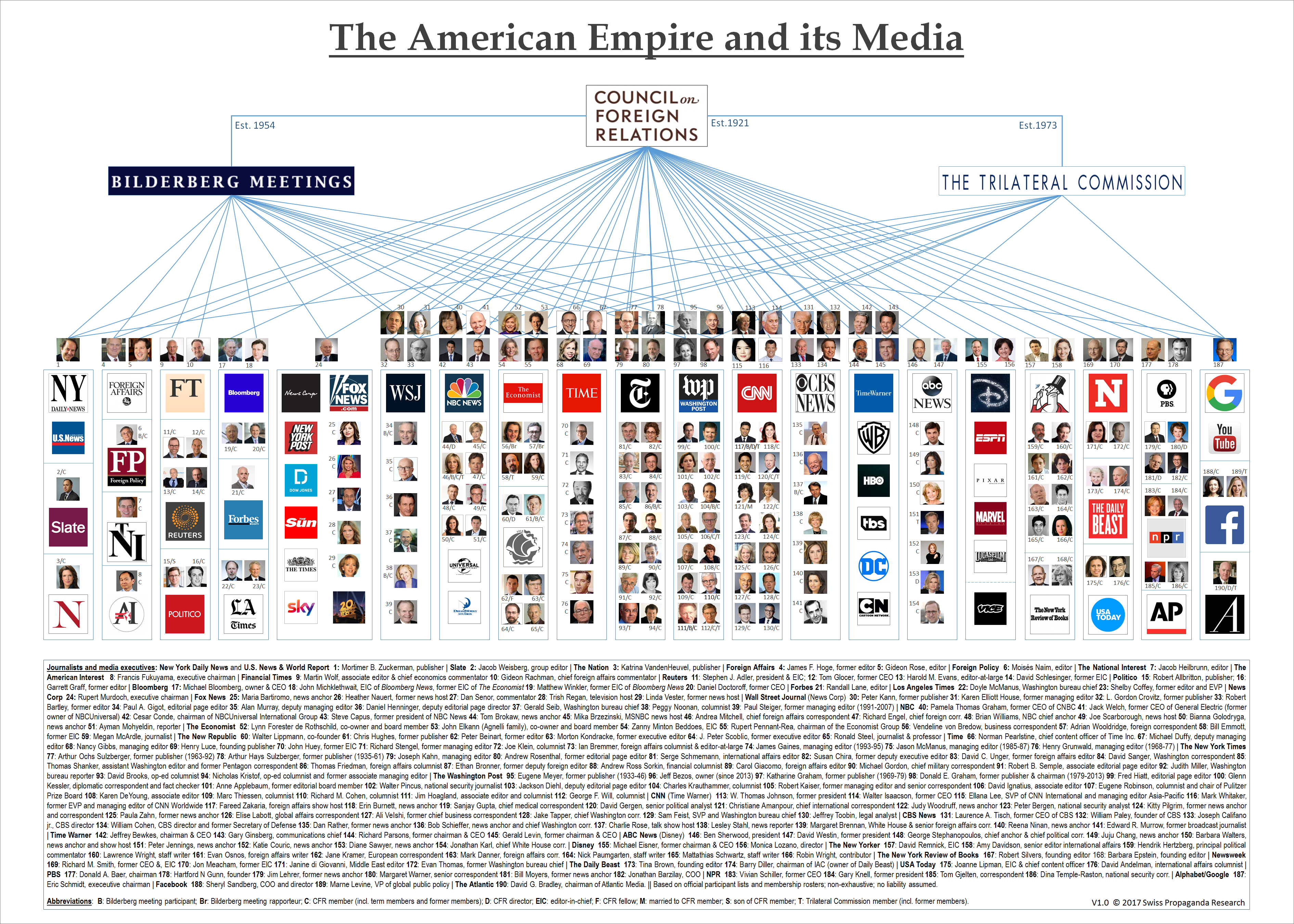
CFR Media Network

Click to enlarge

In a column entitled “Ruling Class Journalists”, former Washington Post senior editor and ombudsman Richard Harwood described the Council and its members approvingly as “the nearest thing we have to a ruling establishment in the United States”.

Harwood continued: “The membership of these journalists in the Council, however they may think of themselves, is an acknowledgment of their active and important role in public affairs and of their ascension into the American ruling class. They do not merely analyze and interpret foreign policy for the United States; they help make it. (…) They are part of that establishment whether they like it or not, sharing most of its values and world views.”

However, media personalities constitute only about five per cent of the overall CFR network. As the following illustration shows, key members of the private Council on Foreign Relations have included:

  • several US Presidents and Vice Presidents of both parties;
  • almost all Secretaries of State, Defense, and the Treasury;
  • many high-ranking commanders of the US military and NATO;
  • some of the most influential Members of Congress (notably in foreign & security policy);
  • almost all National Security Advisors, CIA Directors, Ambassadors to the U.N., Chairs of the Federal Reserve, Presidents of the World Bank, and Directors of the National Economic Council;
  • many prominent academics, especially in key fields such as Economics and Political Science;
  • many top executives of Wall Street, policy think tanks, universities, NGOs, and Hollywood;
  • as well as the key members of both the 9/11 Commission and the Warren Commission (JFK)

Harvard economist and Kennedy supporter, John K. Galbraith, confirmed the Council’s influence: “Those of us who had worked for the Kennedy election were tolerated in the government for that reason and had a say, but foreign policy was still with the Council on Foreign Relations people.”

Princeton University professor and former CFR member Stephen F. Cohen described the Council as “America’s single most important non-governmental foreign-policy organization”, whose primary role is to “define the accepted, legitimate, orthodox parameters of discussion.” According to Cohen, “the CFR really is what the Soviets used to call the very top-level of the Nomenklatura.”

And no less than John J. McCloy, the longtime chairman of the Council and advisor to several US presidents, recalled about his time in Washington: “Whenever we needed a man, we thumbed through the roll of the Council members and put through a call to New York [i.e., the CFR headquarters].”

CFR American Empire

1945 to 2017: CFR members in key positions of the American Empire
Click to enlarge

German news magazine Der Spiegel once described the CFR as the “most influential private institution of the United States and the Western world” and a “politburo of capitalism”. Both the Roman-inspired logo of the Council (top right in the illustration above), as well as its slogan (ubique – omnipresent), appear to emphasize this ambition.

In his famous article about “The American Establishment”, political columnist Richard H. Rovere noted: “The directors of the CFR make up a sort of Presidium for that part of the Establishment that guides our destiny as a nation. (…) [I]t rarely fails to get one of its members, or at least one of its allies, into the White House. In fact, it generally is able to see to it that both nominees are men acceptable to it.”

Until recently, this assessment indeed was justified. Thus, in 1993 former CFR director George H.W. Bush was followed by CFR member Bill Clinton, who in turn was followed by CFR “family member” George W. Bush.

In 2008, CFR member John McCain lost against CFR candidate of choice, Barack Obama, who received the names of his entire Cabinet already one month prior to his election by CFR Senior Fellow (and Citigroup banker) Michael Froman. Froman later negotiated the TPP and TTIP trade agreements, before returning to the CFR as a Distinguished Fellow.

It was not until the 2016 election that the Council couldn’t, apparently, prevail. At any rate, not yet.

∗∗∗

Update 2018: In January 2018, a few weeks before his internet access was cut off, Wikileaks founder Julian Assange shared the above CFR media chart on his Twitter account.

Update 2019: It became known that deceased billionaire sex trafficker Jeffrey Epstein had been, until 2009, a member and donor of both the Council on Foreign Relations and the Trilateral Commission.

If you thought this was useful…

References

  1. Council on Foreign Relations:
  2. Bilderberg conference: participant lists 1954 to 2014 and 2015-2017
  3. Trilateral Commission: membership lists of 1973; 1978; 1985; 1995; 2005; 2010; 2017
  4. Laurence H. Shoup (2015): Wall Street’s Think Tank: The Council on Foreign Relations and the Empire of Neoliberal Geopolitics, 1976-2014, Monthly Review Press. (PDF)
  5. Wikipedia pages about the CFR, the Bilderberg Group, and the Trilateral Commission

Related articles

Swiss Propaganda Research (SPR) is an independent research group investigating geopolitical propaganda in Swiss and international media. You can contact them here.
Related Posts

Below are TFF-related media mentions, comments, videos and social media posts published elsewhere but not on this homepage. We happen to catch and list only a fraction. Regarding video comments and debates, we recommend that you go to the TFF Video Channel on Substack where many of them are reproduced. Jan Oberg is a contributor to China Daily – 52 million daily clicks – and Global Times, CGTN and CCTV (the national television), China Investment, Xinhua News Agency and several others. Articles and videos on these media very often multiply into countless Chinese (and Western media) that re-post them from these main media. Thanks to The China Academy, his analyses, interviews and comments are frequently posted on YouTube channels such as Thinkers Forum and Wave Media. These videos are often re-posted on Bilibili (China’s YouTube), the China Content Center on TikTok, and on the Chinese edition of TikTok, Douyin.com. This means reaching hundreds of millions of viewers worldwide over a year. While there are too many to catch on all these...
A friendly quarrel while we agree that the US sanctions are a weapon of mass destruction and kill more people than wars do. And that we must talk much more about sanctions than we have so far. Jan Oberg, TFF director March 16, 2026 John Mearsheimer recently stated that U.S. sanctions murdered around 38 million people between 1971 and 2021 – see the video below. It is a dramatic figure, and it has spread quickly because it captures, in one sentence, the enormous human cost of modern sanctions. I share his concern about the destructive effects of economic coercion. But the specific number he cites — and the way he attributes it — deserves a friendly academic clarification. The figure comes from a 2023 Lancet Global Health article estimating the mortality effects of unilateral U.S. and EU sanctions over the past half‑century. This is the first point where Mearsheimer’s shorthand diverges from the text: the study...
Photos © TFF 2000 Read PressInfo 90 “Lift the Sanctions and Bring More Aid to Yugoslavia” See Pictures from Belgrade © TFF 2000 Please reprint, copy, archive, quote or re-post this item, but please retain the source.

Recent Articles

Tony Robinson October 4, 2026 Violence is easy to recognise when someone is being beaten, shot or killed. It becomes more difficult when nobody is holding a weapon. Poverty, discrimination, exploitation and repression can restrict a human life just as effectively, although they do so in very different ways and with very different consequences. Simply adding more categories to an ever-growing list of forms of violence does not really solve the problem. The more interesting question is what all these different situations have in common and why it makes sense to describe them using the same word. Human beings do not simply react to what happens around them. They remember the past, imagine things that do not yet exist, make plans and undertake projects. Workers organise because they imagine different working conditions; people migrate because they imagine another life somewhere else; social movements emerge because people refuse to accept the...
It’s a matter of principles, courage, vision and pulling together – while the militarist world is falling apart… Peter Langille October 3, 2026 “Here, then, is the problem which we present to you, stark and dreadful and inescapable: Shall we put an end to the human race; or shall mankind renounce war?”The Bertrand Russell—Albert Einstein Manifesto, July 9, 1955 ⁕ The forecast for what’s ahead is worrisome. The sharp rise in armed conflicts over the past three years is adding to what was already the highest level in over seventy years. Genocides, which should be prevented are supported. A shared climate emergency that jeopardises survival is ignored. Diverse polls now suggest that people are war-weary, worried and interested in a more effective United Nations. And, there are viable policy options for a more secure world! Yet governments are doubling-down, betting on more war and investing heavily. If current trends persist,...
Johan Galtung 1930-2024October 2015 Published here on October 3, 2026 Let us focus on Civilization for conflict analysis and remedies. Major forms of disorder use violence; war is state organized violence. The most belligerent states are the United States of America and Israel, both with civilization roots. National Evangelism, the US Protestant Christian civilization– more national than evangelical–justifies US warfare as exceptionalism of a people chosen by God, with a manifest destiny to run the world. Orthodox Judaism justifies Israeli warfare to conquer and expand from Nile to Euphrates as a religious right and duty to the Eternal One. The third most belligerent country, the UK, no longer believes it is God-chosen but chosen by the USA; not quite the same but something. But the root cause of global disorder lies in the Occident–with Islam–seeing itself as the single, universal civilization valid for all at all times, all others being...

TFF on Substack

Discover and subscribe to more peace materials on TFF Substack

Most Popular

Tony Robinson October 4, 2026 Violence is easy to recognise when someone is being beaten, shot or killed. It becomes more difficult when nobody is holding a weapon. Poverty, discrimination, exploitation and repression can restrict a human life just as effectively, although they do so in very different ways and with very different consequences. Simply adding more categories to an ever-growing list of forms of violence does not really solve the problem. The more interesting question is what all these different situations have in common and why it makes sense to describe them using the same word. Human beings do not simply react to what happens around them. They remember the past, imagine things that do not yet exist, make plans and undertake projects. Workers organise because they imagine different working conditions; people migrate because they imagine another life somewhere else; social movements emerge because people refuse to accept the...
It’s a matter of principles, courage, vision and pulling together – while the militarist world is falling apart… Peter Langille October 3, 2026 “Here, then, is the problem which we present to you, stark and dreadful and inescapable: Shall we put an end to the human race; or shall mankind renounce war?”The Bertrand Russell—Albert Einstein Manifesto, July 9, 1955 ⁕ The forecast for what’s ahead is worrisome. The sharp rise in armed conflicts over the past three years is adding to what was already the highest level in over seventy years. Genocides, which should be prevented are supported. A shared climate emergency that jeopardises survival is ignored. Diverse polls now suggest that people are war-weary, worried and interested in a more effective United Nations. And, there are viable policy options for a more secure world! Yet governments are doubling-down, betting on more war and investing heavily. If current trends persist,...
Johan Galtung 1930-2024October 2015 Published here on October 3, 2026 Let us focus on Civilization for conflict analysis and remedies. Major forms of disorder use violence; war is state organized violence. The most belligerent states are the United States of America and Israel, both with civilization roots. National Evangelism, the US Protestant Christian civilization– more national than evangelical–justifies US warfare as exceptionalism of a people chosen by God, with a manifest destiny to run the world. Orthodox Judaism justifies Israeli warfare to conquer and expand from Nile to Euphrates as a religious right and duty to the Eternal One. The third most belligerent country, the UK, no longer believes it is God-chosen but chosen by the USA; not quite the same but something. But the root cause of global disorder lies in the Occident–with Islam–seeing itself as the single, universal civilization valid for all at all times, all others being...
Read More
Living-Peace-Sign-Budapest-copy
Tony Robinson October 4, 2026 Violence is easy to recognise when someone is being beaten, shot or killed. It becomes more difficult when nobody is holding a weapon. Poverty, discrimination, exploitation and repression can restrict a human life just as effectively, although they do so in very different ways and with very different consequences. Simply adding more categories to an ever-growing list of forms of violence does not really solve the problem. The more interesting question is what all these different situations have in common and why it makes sense to describe them using the same word. Human beings do not simply react to what happens around them. They remember the past, imagine things that do not yet exist, make plans and undertake projects. Workers organise because they imagine different working conditions; people migrate because they imagine another life somewhere else; social movements emerge because people refuse to accept the...
b54a1f10-8c65-4f0b-9dd5-4abc0a7d04cc_2659x2659
It’s a matter of principles, courage, vision and pulling together – while the militarist world is falling apart… Peter Langille October 3, 2026 “Here, then, is the problem which we present to you, stark and dreadful and inescapable: Shall we put an end to the human race; or shall mankind renounce war?”The Bertrand Russell—Albert Einstein Manifesto, July 9, 1955 ⁕ The forecast for what’s ahead is worrisome. The sharp rise in armed conflicts over the past three years is adding to what was already the highest level in over seventy years. Genocides, which should be prevented are supported. A shared climate emergency that jeopardises survival is ignored. Diverse polls now suggest that people are war-weary, worried and interested in a more effective United Nations. And, there are viable policy options for a more secure world! Yet governments are doubling-down, betting on more war and investing heavily. If current trends persist,...
010
Johan Galtung 1930-2024October 2015 Published here on October 3, 2026 Let us focus on Civilization for conflict analysis and remedies. Major forms of disorder use violence; war is state organized violence. The most belligerent states are the United States of America and Israel, both with civilization roots. National Evangelism, the US Protestant Christian civilization– more national than evangelical–justifies US warfare as exceptionalism of a people chosen by God, with a manifest destiny to run the world. Orthodox Judaism justifies Israeli warfare to conquer and expand from Nile to Euphrates as a religious right and duty to the Eternal One. The third most belligerent country, the UK, no longer believes it is God-chosen but chosen by the USA; not quite the same but something. But the root cause of global disorder lies in the Occident–with Islam–seeing itself as the single, universal civilization valid for all at all times, all others being...
Screenshot 2026-10-02 011738
Jan ObergPhD, director, The Transnational Foundation for Peace and Future Research, TFFLund, Sweden October 2, 2026 This is my full original manuscript. The Chinese Academy of Social Science, CASS, makes two publications out if it. 1. China’s Five-year plan emphasized the capabilities of basic research and original innovation. It is regarded as the goal of the future social development, which, as required, should be significantly enhanced. Can you comment on the importance of original innovation in research and academic study? I believe it is easier to define “original innovation” in the natural sciences than in social sciences. The breaking points of what constitutes something new, or innovative, are not quite as sharp in the latter. But in both fields it is about opening up something that was closed, unseen, unexplored before – making manifest what was earlier latent. Innovations come in many forms and shapes – naming something that was not...
arctic-circle-map
The agreement is catastrophic both because of what it says and what it doesn’t mention. It reduces further the major asset of security policies: Freedom of action. Jan Oberg TFF director September 25, 2026 A couple of hours before the agreement was signed on September 22, 2026, I published the following 13 hypotheses about what it would most likely contain on TFF Substack (in English). I was wrong on only the first point. Contrary to what Trump had written on his Truth Social platform, it does not appear to come into force immediately. In fact, it turned out to be worse than even I had anticipated. After these hypotheses now come a number of reflections in light of what the agreement actually contains, and does not contain, as well as the way in which it has generally been presented by major media outlets and by the public-service broadcaster DR. My...
girl-5894831_1280
Below are TFF-related media mentions, comments, videos and social media posts published elsewhere but not on this homepage. We happen to catch and list only a fraction. Regarding video comments and debates, we recommend that you go to the TFF Video Channel on Substack where many of them are reproduced. Jan Oberg is a contributor to China Daily – 52 million daily clicks – and Global Times, CGTN and CCTV (the national television), China Investment, Xinhua News Agency and several others. Articles and videos on these media very often multiply into countless Chinese (and Western media) that re-post them from these main media. Thanks to The China Academy, his analyses, interviews and comments are frequently posted on YouTube channels such as Thinkers Forum and Wave Media. These videos are often re-posted on Bilibili (China’s YouTube), the China Content Center on TikTok, and on the Chinese edition of TikTok, Douyin.com. This means reaching hundreds of millions of viewers worldwide over a year. While there are too many to catch on all these...