Russia is making its biggest geopolitical shift in 300 years. Here’s how it’s playing out.

Dmitry Trenin is a research professor at the Higher School of Economics and a lead research fellow at the Institute of World Economy and International Relations. He is also a member of the Russian International Affairs Council.

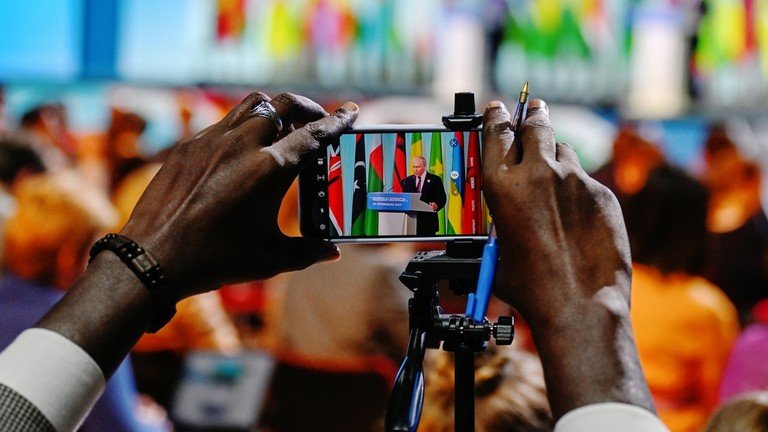
The Russia-Africa summit in St. Petersburg was a landmark event in Moscow’s foreign policy concept and practice. Not so much because it brought scores of African leaders and senior officials to the country. The first summit, four years ago in Sochi, featured even more African heads of state. Also, it is not solely because its agenda expanded beyond economics and included a humanitarian dimension: this is important, but this isn’t all.

Essentially, the meeting, with the bureaucratic preparation and the wide public coverage it has received within Russia, testifies to a sea change in Moscow’s worldview and international positioning toward the world’s rising non-Western majority, as laid down in the recently adopted Foreign Policy Concept.

St. Petersburg was founded by Peter the Great in the early 18th century as a ‘window to Europe,’ and last week, it served the same purpose for Africa.

Eurocentrism, of course, is still deeply embedded in the Russian elite’s thinking and aspirations. Nevertheless, the failure of Russia’s long travails of Western integration in the wake of the demise of the Soviet Union has now exploded into the proxy war against the United States and NATO in Ukraine. This has produced a historic shift in Moscow’s policies, comparable to the time of Peter the Great in its significance, though in a wholly different direction. For the foreseeable future, the universe of Russia’s foreign policy will remain divided in two large parts: the house of foes including Europe, North America, and the rest of the Anglosphere, and the house of friends elsewhere. The dividing line between the two is a country’s position in relation to the sanctions regime against Russia.

Africa, in this regard, is largely on the right side of that divide. 49 nations out of the continent’s 54 were represented in St. Petersburg. True, only 17 of them participated at the top level. No longer a curious and skeptical observer, as during the Sochi summit four years ago, the West this time made a determined effort, advising, cajoling or threatening African leaders against going to Russia and dealing directly with President Putin. As a matter of fact, Western pressure scored some points (the number of top leaders in St. Petersburg was about half of what it was in Sochi), but failed to undercut the event. What was lost in the status of representation was compensated in intensity of interaction. The amount of time Vladimir Putin personally invested in the event – that actually lasted three days rather than two – was impressive and noteable. 

The need to counter Western accusations of Russia’s responsibility for the spike in food prices following Moscow’s withdrawal from the Black Sea grain deal (while conveniently ignoring the fact that promises to Moscow to end the Western blockage of Russia’s agricultural exports were never kept) made the Kremlin go beyond the usual verbal rebuttal. At the summit, Putin not only promised to deliver grain free of charge to five of Africa’s poorest nations, but announced plans to expand commercial shipping and to build logistics by sea and air linking Russia to Africa, create a hub in Africa for Russian trade, and expand Russia’s share of African food imports. As for dealing with Western propaganda, Moscow envisages a major expansion of the Russian media presence on the continent. The idea is that Russians and Africans need to have the means of learning about each other directly, rather than through non-neutral intermediaries in London, Paris, or New York.  

Russia certainly has its work cut out for it. Having abandoned the Soviet Union’s rich legacy in Africa in the early 1990s, Moscow faces strong competition there. Compared to China’s Africa trade ($280 billion), or America’s ($60 billion), Russia’s is a puny $18 billion. However, Moscow can do much better. The summit in St. Petersburg focussed on a number of areas, from food security to healthcare and pharma to nuclear energy and security assistance. Of particular importance is education and IT. Since the early 1960s, Moscow’s Lumumba University has been a flagship for training African professionals in Russia. After the break-up of the Soviet Union, the school lost much of its luster. But this is now changing and the number of stipends for Africans to study in Russia is being tripled, and many Russian universities are encouraged to seek cooperation partners in Africa.

Recently, Russia has made enormous progress in terms of making the Internet available across its vast territory and turning Moscow into one of the of the world’s most advanced metropolitan areas in terms of public Wi-Fi access. This experience is certainly something to share.

Russia’s revived interest in Africa is strategic rather than tactical. It goes way beyond the important but mundane issues of economic, security and technological cooperation. It also reaches beyond the war in Ukraine – which inevitably also came under discussion in St. Petersburg, – allowing Putin to explain his rationale for acting the way he has and lay out his views on the modalities of peace. In more strategic terms, Russian policymakers increasingly see Africa – along with Asia and Latin America – as part of the rising wave that will help replace the current Western-dominated world order with a more diversified construct built around a number of civilizations.

Some Russians claim that they have a continent of friends in Africa. This is largely true as far as popular sentiments are concerned. Indeed, Russia – in contrast to Western countries – is unblemished by colonial and neo-colonial exploitation of the continent. In the 20th century, it actually provided military assistance to a number of national liberation movements, and economically supported many of Africa’s newly-independent states through infrastructure projects. It trained thousands of doctors, engineers, and teachers, yet the political reality is more complex than that. The US and the former colonial powers France, Britain and others – not to forget Germany – see the continent as essentially their market and resource base, and will seek to protect their economic dominance and political influence. They will make Russia’s progress in Africa as difficult as possible. 

Faced with that opposition, Moscow should avoid falling for the temptation of competing with outside powers for spheres of influence. It needs to be guided by its national interest, which lies in expanding all-around cooperation with African partners, as well as by its aspiration to a new, more equitable, non-Western-dominated world order. The second Russia-Africa summit, for all the complexities and complications it has encountered on the road to St. Petersburg, was a success. However, what is more important is the paradigm shift in Russian thinking and actions towards Africa, which is turning formerly “exotic” states into normal and valuable partners.
Related Posts

Johan Galtung 1930-2024October 2015 Published here on October 3, 2026 Let us focus on Civilization for conflict analysis and remedies. Major forms of disorder use violence; war is state organized violence. The most belligerent states are the United States of America and Israel, both with civilization roots. National Evangelism, the US Protestant Christian civilization– more national than evangelical–justifies US warfare as exceptionalism of a people chosen by God, with a manifest destiny to run the world. Orthodox Judaism justifies Israeli warfare to conquer and expand from Nile to Euphrates as a religious right and duty to the Eternal One. The third most belligerent country, the UK, no longer believes it is God-chosen but chosen by the USA; not quite the same but something. But the root cause of global disorder lies in the Occident–with Islam–seeing itself as the single, universal civilization valid for all at all times, all others being...
The agreement is catastrophic both because of what it says and what it doesn’t mention. It reduces further the major asset of security policies: Freedom of action. Jan Oberg TFF director September 25, 2026 A couple of hours before the agreement was signed on September 22, 2026, I published the following 13 hypotheses about what it would most likely contain on TFF Substack (in English). I was wrong on only the first point. Contrary to what Trump had written on his Truth Social platform, it does not appear to come into force immediately. In fact, it turned out to be worse than even I had anticipated. After these hypotheses now come a number of reflections in light of what the agreement actually contains, and does not contain, as well as the way in which it has generally been presented by major media outlets and by the public-service broadcaster DR. My...
Below are TFF-related media mentions, comments, videos and social media posts published elsewhere but not on this homepage. We happen to catch and list only a fraction. Regarding video comments and debates, we recommend that you go to the TFF Video Channel on Substack where many of them are reproduced. Jan Oberg is a contributor to China Daily – 52 million daily clicks – and Global Times, CGTN and CCTV (the national television), China Investment, Xinhua News Agency and several others. Articles and videos on these media very often multiply into countless Chinese (and Western media) that re-post them from these main media. Thanks to The China Academy, his analyses, interviews and comments are frequently posted on YouTube channels such as Thinkers Forum and Wave Media. These videos are often re-posted on Bilibili (China’s YouTube), the China Content Center on TikTok, and on the Chinese edition of TikTok, Douyin.com. This means reaching hundreds of millions of viewers worldwide over a year. While there are too many to catch on all these...

Recent Articles

Tony Robinson October 4, 2026 Violence is easy to recognise when someone is being beaten, shot or killed. It becomes more difficult when nobody is holding a weapon. Poverty, discrimination, exploitation and repression can restrict a human life just as effectively, although they do so in very different ways and with very different consequences. Simply adding more categories to an ever-growing list of forms of violence does not really solve the problem. The more interesting question is what all these different situations have in common and why it makes sense to describe them using the same word. Human beings do not simply react to what happens around them. They remember the past, imagine things that do not yet exist, make plans and undertake projects. Workers organise because they imagine different working conditions; people migrate because they imagine another life somewhere else; social movements emerge because people refuse to accept the...
It’s a matter of principles, courage, vision and pulling together – while the militarist world is falling apart… Peter Langille October 3, 2026 “Here, then, is the problem which we present to you, stark and dreadful and inescapable: Shall we put an end to the human race; or shall mankind renounce war?”The Bertrand Russell—Albert Einstein Manifesto, July 9, 1955 ⁕ The forecast for what’s ahead is worrisome. The sharp rise in armed conflicts over the past three years is adding to what was already the highest level in over seventy years. Genocides, which should be prevented are supported. A shared climate emergency that jeopardises survival is ignored. Diverse polls now suggest that people are war-weary, worried and interested in a more effective United Nations. And, there are viable policy options for a more secure world! Yet governments are doubling-down, betting on more war and investing heavily. If current trends persist,...
Johan Galtung 1930-2024October 2015 Published here on October 3, 2026 Let us focus on Civilization for conflict analysis and remedies. Major forms of disorder use violence; war is state organized violence. The most belligerent states are the United States of America and Israel, both with civilization roots. National Evangelism, the US Protestant Christian civilization– more national than evangelical–justifies US warfare as exceptionalism of a people chosen by God, with a manifest destiny to run the world. Orthodox Judaism justifies Israeli warfare to conquer and expand from Nile to Euphrates as a religious right and duty to the Eternal One. The third most belligerent country, the UK, no longer believes it is God-chosen but chosen by the USA; not quite the same but something. But the root cause of global disorder lies in the Occident–with Islam–seeing itself as the single, universal civilization valid for all at all times, all others being...

TFF on Substack

Discover and subscribe to more peace materials on TFF Substack

Most Popular

Tony Robinson October 4, 2026 Violence is easy to recognise when someone is being beaten, shot or killed. It becomes more difficult when nobody is holding a weapon. Poverty, discrimination, exploitation and repression can restrict a human life just as effectively, although they do so in very different ways and with very different consequences. Simply adding more categories to an ever-growing list of forms of violence does not really solve the problem. The more interesting question is what all these different situations have in common and why it makes sense to describe them using the same word. Human beings do not simply react to what happens around them. They remember the past, imagine things that do not yet exist, make plans and undertake projects. Workers organise because they imagine different working conditions; people migrate because they imagine another life somewhere else; social movements emerge because people refuse to accept the...
It’s a matter of principles, courage, vision and pulling together – while the militarist world is falling apart… Peter Langille October 3, 2026 “Here, then, is the problem which we present to you, stark and dreadful and inescapable: Shall we put an end to the human race; or shall mankind renounce war?”The Bertrand Russell—Albert Einstein Manifesto, July 9, 1955 ⁕ The forecast for what’s ahead is worrisome. The sharp rise in armed conflicts over the past three years is adding to what was already the highest level in over seventy years. Genocides, which should be prevented are supported. A shared climate emergency that jeopardises survival is ignored. Diverse polls now suggest that people are war-weary, worried and interested in a more effective United Nations. And, there are viable policy options for a more secure world! Yet governments are doubling-down, betting on more war and investing heavily. If current trends persist,...
Johan Galtung 1930-2024October 2015 Published here on October 3, 2026 Let us focus on Civilization for conflict analysis and remedies. Major forms of disorder use violence; war is state organized violence. The most belligerent states are the United States of America and Israel, both with civilization roots. National Evangelism, the US Protestant Christian civilization– more national than evangelical–justifies US warfare as exceptionalism of a people chosen by God, with a manifest destiny to run the world. Orthodox Judaism justifies Israeli warfare to conquer and expand from Nile to Euphrates as a religious right and duty to the Eternal One. The third most belligerent country, the UK, no longer believes it is God-chosen but chosen by the USA; not quite the same but something. But the root cause of global disorder lies in the Occident–with Islam–seeing itself as the single, universal civilization valid for all at all times, all others being...
Read More
Living-Peace-Sign-Budapest-copy
Tony Robinson October 4, 2026 Violence is easy to recognise when someone is being beaten, shot or killed. It becomes more difficult when nobody is holding a weapon. Poverty, discrimination, exploitation and repression can restrict a human life just as effectively, although they do so in very different ways and with very different consequences. Simply adding more categories to an ever-growing list of forms of violence does not really solve the problem. The more interesting question is what all these different situations have in common and why it makes sense to describe them using the same word. Human beings do not simply react to what happens around them. They remember the past, imagine things that do not yet exist, make plans and undertake projects. Workers organise because they imagine different working conditions; people migrate because they imagine another life somewhere else; social movements emerge because people refuse to accept the...
b54a1f10-8c65-4f0b-9dd5-4abc0a7d04cc_2659x2659
It’s a matter of principles, courage, vision and pulling together – while the militarist world is falling apart… Peter Langille October 3, 2026 “Here, then, is the problem which we present to you, stark and dreadful and inescapable: Shall we put an end to the human race; or shall mankind renounce war?”The Bertrand Russell—Albert Einstein Manifesto, July 9, 1955 ⁕ The forecast for what’s ahead is worrisome. The sharp rise in armed conflicts over the past three years is adding to what was already the highest level in over seventy years. Genocides, which should be prevented are supported. A shared climate emergency that jeopardises survival is ignored. Diverse polls now suggest that people are war-weary, worried and interested in a more effective United Nations. And, there are viable policy options for a more secure world! Yet governments are doubling-down, betting on more war and investing heavily. If current trends persist,...
010
Johan Galtung 1930-2024October 2015 Published here on October 3, 2026 Let us focus on Civilization for conflict analysis and remedies. Major forms of disorder use violence; war is state organized violence. The most belligerent states are the United States of America and Israel, both with civilization roots. National Evangelism, the US Protestant Christian civilization– more national than evangelical–justifies US warfare as exceptionalism of a people chosen by God, with a manifest destiny to run the world. Orthodox Judaism justifies Israeli warfare to conquer and expand from Nile to Euphrates as a religious right and duty to the Eternal One. The third most belligerent country, the UK, no longer believes it is God-chosen but chosen by the USA; not quite the same but something. But the root cause of global disorder lies in the Occident–with Islam–seeing itself as the single, universal civilization valid for all at all times, all others being...
Screenshot 2026-10-02 011738
Jan ObergPhD, director, The Transnational Foundation for Peace and Future Research, TFFLund, Sweden October 2, 2026 This is my full original manuscript. The Chinese Academy of Social Science, CASS, makes two publications out if it. 1. China’s Five-year plan emphasized the capabilities of basic research and original innovation. It is regarded as the goal of the future social development, which, as required, should be significantly enhanced. Can you comment on the importance of original innovation in research and academic study? I believe it is easier to define “original innovation” in the natural sciences than in social sciences. The breaking points of what constitutes something new, or innovative, are not quite as sharp in the latter. But in both fields it is about opening up something that was closed, unseen, unexplored before – making manifest what was earlier latent. Innovations come in many forms and shapes – naming something that was not...
arctic-circle-map
The agreement is catastrophic both because of what it says and what it doesn’t mention. It reduces further the major asset of security policies: Freedom of action. Jan Oberg TFF director September 25, 2026 A couple of hours before the agreement was signed on September 22, 2026, I published the following 13 hypotheses about what it would most likely contain on TFF Substack (in English). I was wrong on only the first point. Contrary to what Trump had written on his Truth Social platform, it does not appear to come into force immediately. In fact, it turned out to be worse than even I had anticipated. After these hypotheses now come a number of reflections in light of what the agreement actually contains, and does not contain, as well as the way in which it has generally been presented by major media outlets and by the public-service broadcaster DR. My...
girl-5894831_1280
Below are TFF-related media mentions, comments, videos and social media posts published elsewhere but not on this homepage. We happen to catch and list only a fraction. Regarding video comments and debates, we recommend that you go to the TFF Video Channel on Substack where many of them are reproduced. Jan Oberg is a contributor to China Daily – 52 million daily clicks – and Global Times, CGTN and CCTV (the national television), China Investment, Xinhua News Agency and several others. Articles and videos on these media very often multiply into countless Chinese (and Western media) that re-post them from these main media. Thanks to The China Academy, his analyses, interviews and comments are frequently posted on YouTube channels such as Thinkers Forum and Wave Media. These videos are often re-posted on Bilibili (China’s YouTube), the China Content Center on TikTok, and on the Chinese edition of TikTok, Douyin.com. This means reaching hundreds of millions of viewers worldwide over a year. While there are too many to catch on all these...