Reflections taking off from the Marathon murders

Written April 19, 2013 – before the manhunt ended

The dominant reactions to the horrific bombings on April 15th, the day of the running of the Boston Marathon, as well as the celebration of Patriots Day, have been so far: compassion for the victims, a maximal resolve to track down the perpetrators, a pundit’s notebook that generally agrees that Americans have been protected against terrorist violence since 9/11 and that the best way to prevail against such sinister adversaries is to restore normalcy as quickly as possible.

In this spirit, it is best to avoid dwelling on the gory details by darkly glamorizing the scene of mayhem with flowers and homage. It is better to move forward with calm resolve and a re-commitment to the revolutionary ideals that midwifed the birth of the American nation. Such responses are generally benevolent, especially when compared to the holy war fevers espoused by national leaders, the media, and a vengeful public after the 9/11 attacks that also embraced Islamophobic falsehoods.

Maybe America has become more poised in relation to such extremist incidents, but maybe not. It is soon to tell, and the somewhat hysterical Boston dragnet for the remaining at large and alive suspect does suggest that the wounds of 9/11 are far from healed

For one thing, the scale and drama of the Boston attack, while great, was not nearly as large or as symbolically resonant as the destruction of the World Trade Center and the shattering of the Pentagon. Also, although each life is sacred, the magnitude of tragedy is somewhat conveyed by numbers, and the Marathon incident has so far produced three deaths as compared to three thousand, that is, 1/1000th of 9/11.

Also important, the neocon presidency of George W. Bush, was in 2001 prior to the attacks openly seeking a pretext to launch a regime-changing war against Saddam Hussein’s Iraq, and the 9/11 events, as interpreted and spun, provided just the supportive domestic climate needed for launching an aggressive war against the Baghdad regime. The Iraq War was undertaken despite the UN Security Council failure to lend its authority to such an American deadly geopolitical venture and in the face of the largest anti-war global demonstrations in human history.

In 2001 the preferred American grand strategy, as blueprinted by the ideologues of the American Enterprise Institute and the Hoover Institution, was given a green light by the Bush/Cheney White House even in the face of the red lights posted both at the UN and in the streets of 600 or more cities around the world.

Although there are many distressing continuities that emerge if the Obama presidency is appraised by comparison with the counter-terrorist agenda of his predecessors, there are also some key differences of situation and approach. Obama came to Washington as outspoken opponent of torture and of the Iraq War. He also arrived after the failed wars of Afghanistan and Iraq, which had devastated two countries, seemingly beyond foreseeable recovery, while adding nothing to American security, however measured.

These unlawful wars wasted trillions expended over the several years during which many Americans were enduring the hardships and pain of the deepest economic recession since the 1930s. In other words, temporarily at least, the Beltway think tanks and the government are doing their best to manage global crises without embarking on further wars in a spirit of geopolitical intoxication that was hallmark of the unipolar moment that was invoked by Republicans to chide the Clinton presidency for its wimpish failure to pursue American strategic interests in the Middle East.

Remember, as well, that this was the period of quick victorious wars that were also cheap when measured by casualties or resources. The Gulf War of 1991 and the NATO Kosovo War of 1999 were the poster children of this supposed revolution in warfare that enabled the United States and its allies to fight ‘zero casualty wars.’ At least it seems that for the present irresponsible and unlawful warfare are no longer the centerpiece of America’s foreign policy as had become the case in the first decade of the 21st century, although this is far from a certainty. The war drums are beating at this moment in relation to both North Korea and Iran, and as long as Tel Aviv has the compliant ear of the American political establishment those who wish for peace and justice in the world should not rest easy.

Aside from the dangers and unacceptability of promiscuous wars, there are other serious deficiencies in how the United States sees itself in the world. We should be worried by the taboo at this moment of 24/7 self-congratulatory commentary imposed on any type of self-scrutiny by either the political leadership or the mainstream media. Unlike the aftermath of 9/11, there are a few hopeful signs of awakening to this one-eyed vision on the part of the citizenry.

Listening to a PBS program hours after the Boston event, I was struck by the critical attitudes of several callers to the radio station: “it is horrible, but we in this country should not be too surprised, given our drone attacks that have killed women and children attending weddings and funerals in Afghanistan and Pakistan. Another caller asked “is this not a kind of retribution for torture inflicted by American security forces acting under the authority of the government, and verified for the world by pictures of the humiliation of Iraqi prisoners at Abu Ghraib?” And another asked, “in light of the authoritative reports of officially sanctioned torture as detailed in the 577 page report of a task force chaired by two former senators, one a Republican, the other a Democrat, and containing senior military and security officials, has not the time come to apply the law to the wrongdoers during the Bush presidency”? Can we not expect one among our politicians, other than the Tea Party darling Rand Paul, to have the courage to connect some of these dots? Should we not all be meditating on W.H. Auden’s haunting line: “Those to whom evil is done/do evil in return”?

The American global domination project is bound to generate all kinds of resistance in the post-colonial world. In some respects the United States has been fortunate not to experience worse blowbacks, and these may yet happen, especially if there is no disposition to rethink US relations to others in the world, starting with the Middle East. Some of us naively hoped that Obama’s Cairo speech of 2009 was to be beginning of such a process of renewal, and although timid in many ways, it was yet possessed of a tonality candidly acknowledged that relations with the Islamic world needed a fundamental moves by the US Government for the sake of reconciliation, including the adoption of a far more balanced approach to the Palestine/Israel impasse. But as the months passed, what became evident, especially given the strong pushback by Israel and its belligerent leader, Bibi Netanyahu, were a series of disappointing reactions by Obama, which could be described as an accelerating back peddling in relation to opening political space in the Middle East.

Now at the start of his second presidential term, it seems that Obama has given up altogether, succumbing to the Beltway ethos of Israel First. Obama has acknowledged the constraints on his freedom of maneuver on these foreign policy issues, and seeks to confine his legacy ambitions to such domestic concerns as immigration, gun control, and health care. In so doing he is virtually abandoning the international agenda except to manage crisis diplomacy in ways that do not disturb the global status quo or weaken America’s global reach.

Obama’s March trip to Israel, highlighted by his March 21st speech in Jerusalem, which was delivered as a love letter to the Israeli public rather than qualifying as a good faith effort to demonstrate his belief in a just peace. Such obsequious diplomacy was a disappointment even to those of us with low expectations in what the White House is willing to overcome the prolonged ordeal of the Palestinian people.

Aside from the tensions of the moment, self-scrutiny and mid-course reflections on America’s global role is long overdue.

Such a process is crucial both for the sake of the country’s own future security and also in consideration of the wellbeing of others. Such adjustments will eventually come about either as a result of a voluntary process of self-reflection or through the force of unpleasant events. How and when this process of reassessment occurs remains a mystery. Until it does, America’s military prowess and the abiding confidence of its leaders in hard power diplomacy makes the United States a menace to the world and to itself.

Such an observation is as true if the more avowedly belligerent Mitt Romney rather than the seemingly dovish Barack Obama was in the White House. Such bipartisan support for maintaining the globe-girdling geopolitics runs deep in the body politic, and is accompanied by the refusal to admit the evidence of national decline.

The signature irony is that the more American decline is met by a politics of denial, the more rapid and steep will be the decline, and the more abrupt and risky will be the necessary shrinking of the global leadership role so long played by the United States. We should be asking ourselves at this moment, “how many canaries will have to die before we awaken from our geopolitical fantasy of global domination?”

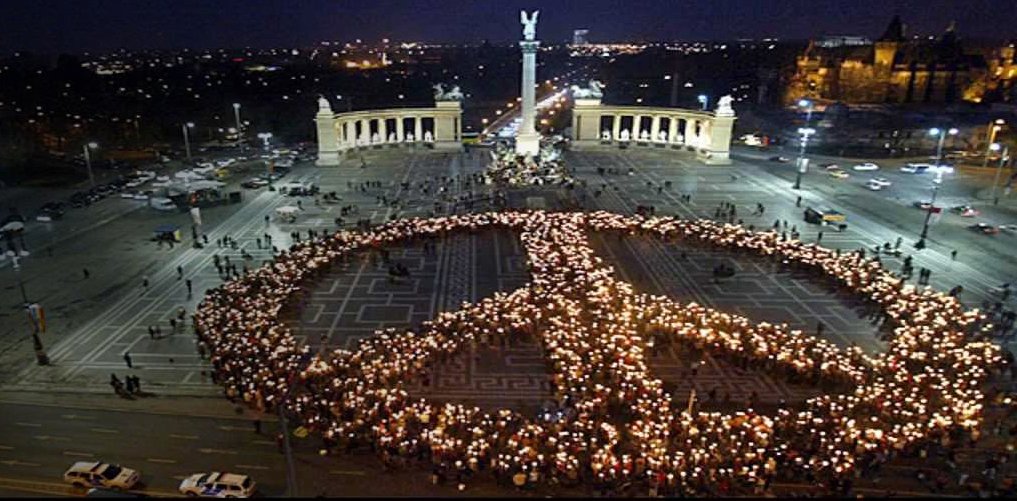
Professor Falk became an adviser to TFF when it was established in 1985.

Share

Leave a Reply

Your email address will not be published. Required fields are marked *

Related Posts

Peace is promoted by constructive proposals and dialogue Four preceding PressInfos have expressed concern over — and criticised — the ongoing, militarisation of the EU. Some will say: but there are no alternatives. We believe that there are always alternatives, that democracies are characterised by alternatives and choice, and that openly discussed alternatives will improve the quality and legitimacy of society’s decision–making. In addition, it is an intellectual and moral challenge to not only criticise but also be constructive. If we only tell people that we think they are wrong, they are not likely to listen. However, if we say: what are your views on this set of ideas and steps? — we may sometimes engage them in dialogue and sow a seed. Most people in power circles live their daily lives in in a time frame and a social space where certain ideas, viewpoints and concepts are just not...
Photos © TFF 2000 Read PressInfo 90 “Lift the Sanctions and Bring More Aid to Yugoslavia” See Pictures from Belgrade © TFF 2000 Please reprint, copy, archive, quote or re-post this item, but please retain the source.
By Jan ObergTFF co-founder and director February 11, 2026 PART 3 — ECONOMICS, TRADE & FINANCIAL SOVEREIGNTY A. Trade Measures & Market Signaling Economic pressure can be applied instantly and scaled without violence. Immediate Measures (within a week) Government boycott US goods and services  A very powerful signal which over time will be felt. Targeted tariffs on selected U.S. goods Symbolic but high-visibility sectors send a clear message. Suspend trade facilitation talks A peaceful pause that signals deep concern. Freeze U.S. participation in public procurement – military procurement in particular A nonviolent way to reduce influence. Competition law review of U.S. corporations A legal tool to scrutinise market dominance. Longer-Term Measures EU–Asia–Africa trade corridors Reducing reliance on U.S. markets. European supply chains for critical minerals Strategic autonomy in resource access. European Strategic Trade Authority Monitoring coercive practices globally. Euro-denominated commodity markets Weakening the dollar’s pricing monopoly. The EU must resume contacts and negotiations with Russia, focusing on energy cooperation To...

Recent Articles

Jan Oberg May 15, 2026 Go to this Fox News page and scroll the whole way down: President Donald Trump tells the world that his meeting with President Xi Jinping yielded a lot of very concrete political and economic results – of course, only where the Chinese side, according to him, agreed with him. He does not mention the Taiwan issue, but Secretary of State, Marco Rubio, says that it did not feature prominently in their talks and that the US policy on Taiwan has not changed. Then go to China Daily – or Global Times – and you will see that for the Chinese it is framework, principles, structure of cooperation etc. that matters – all embedded in the overall idea of “constructive bilateral relationship of strategic stability.” Nowhere is any concrete agreement or deal – all that Trump refers to – mentioned. At the general level, this gives you insights into the very different social...
Lena Petrova of “World Affairs In Context” with more than half a million subscribers on YouTube wanted to explore what a peace researcher like me has to say about, among other things, the First and the Second Cold War and why eethics has disappeared from politics. I am particularly happy about this conversation that also yielded an amazing number of very appreciative comments on YouTube. No doubt, people are longing for alternatives, including peace perspectives.
The MIMAC – Military-Industrial-Media-Academic Complex – drives the world’s rampant militarism and wars without end. Here is a short reflection of how it works against all interests of humanity. #5 deals with why there is no real enemy or threat images/analysis. It’s all ex-post constructions. And, btw, theTFF Peace Pulse is now on Rumble.

TFF on Substack

Discover more from TFF Transnational Foundation & Jan Oberg.

Most Popular

Jan Oberg May 15, 2026 Go to this Fox News page and scroll the whole way down: President Donald Trump tells the world that his meeting with President Xi Jinping yielded a lot of very concrete political and economic results – of course, only where the Chinese side, according to him, agreed with him. He does not mention the Taiwan issue, but Secretary of State, Marco Rubio, says that it did not feature prominently in their talks and that the US policy on Taiwan has not changed. Then go to China Daily – or Global Times – and you will see that for the Chinese it is framework, principles, structure of cooperation etc. that matters – all embedded in the overall idea of “constructive bilateral relationship of strategic stability.” Nowhere is any concrete agreement or deal – all that Trump refers to – mentioned. At the general level, this gives you insights into the very different social...
Lena Petrova of “World Affairs In Context” with more than half a million subscribers on YouTube wanted to explore what a peace researcher like me has to say about, among other things, the First and the Second Cold War and why eethics has disappeared from politics. I am particularly happy about this conversation that also yielded an amazing number of very appreciative comments on YouTube. No doubt, people are longing for alternatives, including peace perspectives.
The MIMAC – Military-Industrial-Media-Academic Complex – drives the world’s rampant militarism and wars without end. Here is a short reflection of how it works against all interests of humanity. #5 deals with why there is no real enemy or threat images/analysis. It’s all ex-post constructions. And, btw, theTFF Peace Pulse is now on Rumble.
Read More
Screenshot-2026-05-15-103534
Jan Oberg May 15, 2026 Go to this Fox News page and scroll the whole way down: President Donald Trump tells the world that his meeting with President Xi Jinping yielded a lot of very concrete political and economic results – of course, only where the Chinese side, according to him, agreed with him. He does not mention the Taiwan issue, but Secretary of State, Marco Rubio, says that it did not feature prominently in their talks and that the US policy on Taiwan has not changed. Then go to China Daily – or Global Times – and you will see that for the Chinese it is framework, principles, structure of cooperation etc. that matters – all embedded in the overall idea of “constructive bilateral relationship of strategic stability.” Nowhere is any concrete agreement or deal – all that Trump refers to – mentioned. At the general level, this gives you insights into the very different social...
Screenshot-2026-05-12-104023
Lena Petrova of “World Affairs In Context” with more than half a million subscribers on YouTube wanted to explore what a peace researcher like me has to say about, among other things, the First and the Second Cold War and why eethics has disappeared from politics. I am particularly happy about this conversation that also yielded an amazing number of very appreciative comments on YouTube. No doubt, people are longing for alternatives, including peace perspectives.
Screenshot-2026-04-13-154551 (2)
The MIMAC – Military-Industrial-Media-Academic Complex – drives the world’s rampant militarism and wars without end. Here is a short reflection of how it works against all interests of humanity. #5 deals with why there is no real enemy or threat images/analysis. It’s all ex-post constructions. And, btw, theTFF Peace Pulse is now on Rumble.
Screenshot-2026-04-13-154551 (1)
Jan Oberg, TFF director April 28, 2026 In this third TFF Peace Pulse, I make the important distinction between the violence and the conflict that violence is a symptom of. If you want peace, focus on the underlying conflict because that is the key to resolution, peacemaking, and a better future for the parties. The West is obsessed with violence, just look around you – and 90+ per cent of the public debate is about military issues and other violence – totally wasted for peace. These Peace Pulses will only be published here a few times. You will also not find them on YouTube and Vimeo because both platforms have blocked TFF and me; you know, peace is dangerous these days. Most TFF’s videos since 2007 are now on Rumble.
Screenshot-2026-04-13-154551
In contrast to most, we’ll bring alternatives, solutions, hope and strategies for a better future. Times are dangerous, yes, but that only intensifies the need for constructive thinking and action! Jan Oberg, TFF director April 13, 2026 The new TFF Peace Pulse uses video messages in a new way: Max 3-5-minute-long comments, ideas or perhaps mini-lectures, all about peace – positive peace. We launch them today on April 13, 2026 with a carefully crafted visual aesthetic fitting the content. We hope to publish them regularly from now on. We launch Peace Pulse (PP) – for a number of reasons. The world is in chaos, and there are countless reasons to feel concerned, frustrated, even angry. The atmosphere is saturated with doom and gloom, with negative energy and rear‑mirror thinking, while vision, imagination, alternatives, strategies and genuine future‑mindedness remain in short supply. And without them, we simply can’t save the world. Looking at problems from a hundred angles will...
IMG_5165 (1)
PART II — Publishing Peace in a System That Prioritises Militarism Jan Oberg, TFF director April 10, 2026 How TFF Maintains a Daily Voice in a Digital World Built for Noise This article is part of the series “TFF at 40″ and it invites you to learn about Four Decades of Publishing Peace. It takes a look at how a small, people‑financed peace foundation has communicated across four generations of technology — from wax stencils and fax machines to mass email and Substack — and why TFF continues to publish every single day in a system that rewards noise, conflict, and militarism. ◆ What it means to publish peace every single day in a digital system built for 24/7 news and other noise, confrontation, and militarism. How TFF’s independence, continuity, and global readership defy algorithms, donor cycles, and Western media censorhip — and why the Majority World keeps listening. When the...