
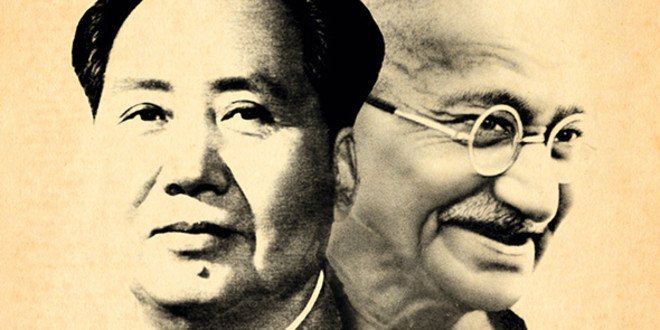
Mao and Gandhi: Comparing Two Giants

Published here on the birthday of Mao Zedong (26 December 1893 – 9 September 1976)

Last October, we had two important anniversary messages. One came through loud and clear in the Western media: the anniversary of the triumph of the Chinese Revolution, guided by Mao, restoring China to its own people, violently, on October 1.

The other message was considerably more subdued: the anniversary of the birth of Gandhi, the Father of the Indian nation, restoring India to its own people, nonviolently, on October 2.

Of course, the West focused on China, its military parades, its display of glittering affluence after decades of growth, true to its fascination with violence and economic growth.  Of course, India is also a BRIC country–Brazil-Russia-India-China–to be taken seriously because of its high growth and “muscle”.

But this obsession with military and economic power makes the West lose the essence of the two anniversaries, the underlying cultural power and the role it played politically for the two huge countries emerging from Western imperialism almost simultaneously, 1947 for India, 1949 for China. Like the birth of the countries, death came to Gandhi and Mao almost at the same age: 78 for Gandhi, 82 for Mao.

Like Chávez and Castro, Gandhi and Mao indeed had one thing in common: anti-imperialism, with anti-colonialism as one variety.  Just imagine that the West had used the past week to reflect on that, and on the disasters brought upon the two countries in the 19th century!

But Chávez and Castro have basic discrepancies: mixed economy, democracy with general voting and Christianity (Jesus lived among the poor!) as against state ownership, dictatorship and atheism.

So was Gandhi’s Hinduism very different from Mao’s Chinese atheism; India is formally a multi-party national election democracy, China is not; and the Indian economy is privatized, the Chinese economy is mixed.

And violence-nonviolence. But there are deep similarities.

They both rooted basic social change in the common person.  Change was meaningless unless as a positive change for people at the bottom, not just a circulation of elites, maybe with change of color, keeping everything else the same, like so often under decolonization.  China has been more successful in this than India, but then China implemented Maoism, and India did not implement Gandhism.

In practice, in both countries, that meant not only improving the lot of the peasant, but that peasants were key carriers of the struggle. Had they been Western Marxists, they would have waited for an industrial proletariat to be big enough; they did not.  Had they been Western liberals, they would have gambled on the elite, those with a university degree and/or capital. They did not do that either.

Struggle presupposes solid empirical groundwork. Idealists in their hearts, they were also realists in their brains; they wanted to know exactly in which empirical reality their peoples were living.

They both shared the conditions of the underprivileged, Gandhi more than Mao, but Mao also did for long periods. Both saw that as a condition for speaking and acting in the name of the people. No doubt they both knew very well what they were talking about, as opposed to leaders with only middle and upper-class experience.

They used gentle persuasion of peasants, not force.  And the best persuasion for very pragmatic peasants was by example, Gandhi’s Sarvodaya villages and Mao practising land reform in liberated areas; not waiting for 15 August 1947 and 1 October 1949.  Gandhi’s “Be the future you want to see” applied to them both.

They both wanted active participation by the people in the struggle, as subjects, not objects used as means or only as grateful recipients. So they organized mass movements, the Congress and the Communist parties, although the “iron law of oligarchy” applied to both of them. Yet that mass basis still exists, 60+ years later.

They had images of a decentralized society; for Gandhi, they were the oceanic circles of countless autonomous sarvodaya villages, and for Mao, they were cooperatives and People’s Communes.  India later adapted language-based federalism, whereas China is a federation in the name only, not even respecting local languages.  But in China the commune is still a key unit of development, and the Indian panchayat is also alive.

They were both strong believers in not waiting for “ripe time”, but in acting now, and here, not waiting for somebody else to do so. What is right is timeless, independent of opportunity. A society should be changed from within, through endogenous action. Social change cannot be served at the tip of liberation from the outside. Reliance on one’s own forces, only they can carry out the deep revolutionary changes needed; the liberation has to be theirs. Social change from bottom up, not from top or outside down.

And that revolution should be permanent, or intermittent.  There will always be new conflicts or contradictions; struggle is not a single-shot affair.  Swaraj, self-rule, is not only for India but also for oneself, for one’s own development and self-reliance.

So we find Gandhi in opposition against his own party after Indian independence, and Mao (The Gang of Four, And Mao Makes Five!) joining the Cultural Revolution against his own party hierarchy.  China goes through massive change about every 9 years, 1949-1956-1967-1976 Mao’s death to Deng’s Reform 1980-1989-1998-2007. India is less dramatic, there is much ultra-stability, but more will come.

What can we learn from what happened only a generation ago?

That the key problem was us, US, or we, West. We stood in the way and should be grateful they do not treat us like we treated them.

And, since the liberated Orient is now coming up quickly: learn from these ways of doing politics. In favour of the excluded masses in our elitist technocracies; they are our peasants, and they are the majority.

Share

Leave a Reply

Your email address will not be published. Required fields are marked *

Related Posts

Jan Oberg May 15, 2026 Go to this Fox News page and scroll the whole way down: President Donald Trump tells the world that his meeting with President Xi Jinping yielded a lot of very concrete political and economic results – of course, only where the Chinese side, according to him, agreed with him. He does not mention the Taiwan issue, but Secretary of State, Marco Rubio, says that it did not feature prominently in their talks and that the US policy on Taiwan has not changed. Then go to China Daily – or Global Times – and you will see that for the Chinese it is framework, principles, structure of cooperation etc. that matters – all embedded in the overall idea of “constructive bilateral relationship of strategic stability.” Nowhere is any concrete agreement or deal – all that Trump refers to – mentioned. At the general level, this gives you insights into the very different social...
The MIMAC – Military-Industrial-Media-Academic Complex – drives the world’s rampant militarism and wars without end. Here is a short reflection of how it works against all interests of humanity. #5 deals with why there is no real enemy or threat images/analysis. It’s all ex-post constructions. And, btw, theTFF Peace Pulse is now on Rumble.
Jan Oberg, TFF director April 28, 2026 In this third TFF Peace Pulse, I make the important distinction between the violence and the conflict that violence is a symptom of. If you want peace, focus on the underlying conflict because that is the key to resolution, peacemaking, and a better future for the parties. The West is obsessed with violence, just look around you – and 90+ per cent of the public debate is about military issues and other violence – totally wasted for peace. These Peace Pulses will only be published here a few times. You will also not find them on YouTube and Vimeo because both platforms have blocked TFF and me; you know, peace is dangerous these days. Most TFF’s videos since 2007 are now on Rumble.

Recent Articles

Jan Oberg May 15, 2026 Go to this Fox News page and scroll the whole way down: President Donald Trump tells the world that his meeting with President Xi Jinping yielded a lot of very concrete political and economic results – of course, only where the Chinese side, according to him, agreed with him. He does not mention the Taiwan issue, but Secretary of State, Marco Rubio, says that it did not feature prominently in their talks and that the US policy on Taiwan has not changed. Then go to China Daily – or Global Times – and you will see that for the Chinese it is framework, principles, structure of cooperation etc. that matters – all embedded in the overall idea of “constructive bilateral relationship of strategic stability.” Nowhere is any concrete agreement or deal – all that Trump refers to – mentioned. At the general level, this gives you insights into the very different social...
Lena Petrova of “World Affairs In Context” with more than half a million subscribers on YouTube wanted to explore what a peace researcher like me has to say about, among other things, the First and the Second Cold War and why eethics has disappeared from politics. I am particularly happy about this conversation that also yielded an amazing number of very appreciative comments on YouTube. No doubt, people are longing for alternatives, including peace perspectives.
The MIMAC – Military-Industrial-Media-Academic Complex – drives the world’s rampant militarism and wars without end. Here is a short reflection of how it works against all interests of humanity. #5 deals with why there is no real enemy or threat images/analysis. It’s all ex-post constructions. And, btw, theTFF Peace Pulse is now on Rumble.

TFF on Substack

Discover more from TFF Transnational Foundation & Jan Oberg.

Most Popular

Jan Oberg May 15, 2026 Go to this Fox News page and scroll the whole way down: President Donald Trump tells the world that his meeting with President Xi Jinping yielded a lot of very concrete political and economic results – of course, only where the Chinese side, according to him, agreed with him. He does not mention the Taiwan issue, but Secretary of State, Marco Rubio, says that it did not feature prominently in their talks and that the US policy on Taiwan has not changed. Then go to China Daily – or Global Times – and you will see that for the Chinese it is framework, principles, structure of cooperation etc. that matters – all embedded in the overall idea of “constructive bilateral relationship of strategic stability.” Nowhere is any concrete agreement or deal – all that Trump refers to – mentioned. At the general level, this gives you insights into the very different social...
Lena Petrova of “World Affairs In Context” with more than half a million subscribers on YouTube wanted to explore what a peace researcher like me has to say about, among other things, the First and the Second Cold War and why eethics has disappeared from politics. I am particularly happy about this conversation that also yielded an amazing number of very appreciative comments on YouTube. No doubt, people are longing for alternatives, including peace perspectives.
The MIMAC – Military-Industrial-Media-Academic Complex – drives the world’s rampant militarism and wars without end. Here is a short reflection of how it works against all interests of humanity. #5 deals with why there is no real enemy or threat images/analysis. It’s all ex-post constructions. And, btw, theTFF Peace Pulse is now on Rumble.
Read More
Screenshot-2026-05-15-103534
Jan Oberg May 15, 2026 Go to this Fox News page and scroll the whole way down: President Donald Trump tells the world that his meeting with President Xi Jinping yielded a lot of very concrete political and economic results – of course, only where the Chinese side, according to him, agreed with him. He does not mention the Taiwan issue, but Secretary of State, Marco Rubio, says that it did not feature prominently in their talks and that the US policy on Taiwan has not changed. Then go to China Daily – or Global Times – and you will see that for the Chinese it is framework, principles, structure of cooperation etc. that matters – all embedded in the overall idea of “constructive bilateral relationship of strategic stability.” Nowhere is any concrete agreement or deal – all that Trump refers to – mentioned. At the general level, this gives you insights into the very different social...
Screenshot-2026-05-12-104023
Lena Petrova of “World Affairs In Context” with more than half a million subscribers on YouTube wanted to explore what a peace researcher like me has to say about, among other things, the First and the Second Cold War and why eethics has disappeared from politics. I am particularly happy about this conversation that also yielded an amazing number of very appreciative comments on YouTube. No doubt, people are longing for alternatives, including peace perspectives.
Screenshot-2026-04-13-154551 (2)
The MIMAC – Military-Industrial-Media-Academic Complex – drives the world’s rampant militarism and wars without end. Here is a short reflection of how it works against all interests of humanity. #5 deals with why there is no real enemy or threat images/analysis. It’s all ex-post constructions. And, btw, theTFF Peace Pulse is now on Rumble.
Screenshot-2026-04-13-154551 (1)
Jan Oberg, TFF director April 28, 2026 In this third TFF Peace Pulse, I make the important distinction between the violence and the conflict that violence is a symptom of. If you want peace, focus on the underlying conflict because that is the key to resolution, peacemaking, and a better future for the parties. The West is obsessed with violence, just look around you – and 90+ per cent of the public debate is about military issues and other violence – totally wasted for peace. These Peace Pulses will only be published here a few times. You will also not find them on YouTube and Vimeo because both platforms have blocked TFF and me; you know, peace is dangerous these days. Most TFF’s videos since 2007 are now on Rumble.
Screenshot-2026-04-13-154551
In contrast to most, we’ll bring alternatives, solutions, hope and strategies for a better future. Times are dangerous, yes, but that only intensifies the need for constructive thinking and action! Jan Oberg, TFF director April 13, 2026 The new TFF Peace Pulse uses video messages in a new way: Max 3-5-minute-long comments, ideas or perhaps mini-lectures, all about peace – positive peace. We launch them today on April 13, 2026 with a carefully crafted visual aesthetic fitting the content. We hope to publish them regularly from now on. We launch Peace Pulse (PP) – for a number of reasons. The world is in chaos, and there are countless reasons to feel concerned, frustrated, even angry. The atmosphere is saturated with doom and gloom, with negative energy and rear‑mirror thinking, while vision, imagination, alternatives, strategies and genuine future‑mindedness remain in short supply. And without them, we simply can’t save the world. Looking at problems from a hundred angles will...
IMG_5165 (1)
PART II — Publishing Peace in a System That Prioritises Militarism Jan Oberg, TFF director April 10, 2026 How TFF Maintains a Daily Voice in a Digital World Built for Noise This article is part of the series “TFF at 40″ and it invites you to learn about Four Decades of Publishing Peace. It takes a look at how a small, people‑financed peace foundation has communicated across four generations of technology — from wax stencils and fax machines to mass email and Substack — and why TFF continues to publish every single day in a system that rewards noise, conflict, and militarism. ◆ What it means to publish peace every single day in a digital system built for 24/7 news and other noise, confrontation, and militarism. How TFF’s independence, continuity, and global readership defy algorithms, donor cycles, and Western media censorhip — and why the Majority World keeps listening. When the...

