

Environment a victim of war in Iraq and Syria

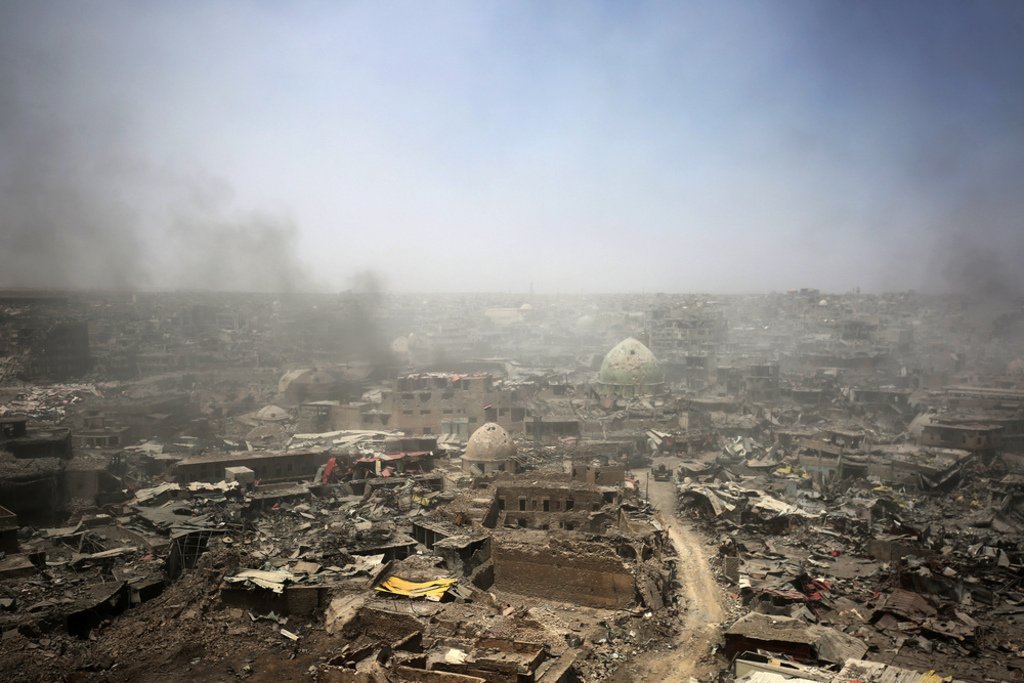
A picture taken on July 9, 2017, shows a general view of the destruction in Mosul’s Old City. Photo AFP ©AFP ⁃ AHMAD ALRUBAYE

June 16, 2020

The war in Syria, now in its sixth year, has been ferocious and deadly. In 2016, the death toll was estimated at 400,000. In Iraq, the fight against the Islamic State (IS) has destroyed cities and displaced around 3.3 million people. Yet beyond the immediate consequences of these conflicts, the environmental degradation in both countries could have a far-reaching impact.

Originally posted on Fanack.com on December 16, 2017

In a country at war, preserving the environment is not usually a high priority. However, it is a key issue that must be addressed before rebuilding begins. According to Living under a black sky, a report published by the Dutch peace organization PAX in November 2017, Iraq was severely affected even before the [IS] attacks in 2014 by the legacy of three wars and climate change, resulting in weak environmental governance and more frequent droughts. ‘Since then, you can also add illegal oil refineries, spills and fires, as well as debris, dust and decline of water infrastructure,’ the report said.

“We have been monitoring what’s happening in Iraq since IS took over,” Wim Zwijnenburg, PAX’s project leader in humanitarian disarmament, told Fanack Chronicle. “There was a lot of fighting around the oil refineries in the northern territories; we noticed severe pollution. When the Iraqi army pushed back IS, they started to set oil wells on fire, flood areas, damage wells and pipelines, and pollute water.”

According to the report, the most visibly affected areas are the Hamrin Mountains, where two oilfields were on fire for two years, Qayyarah, where the last fire was extinguished in March 2017, the contaminated River Tigris, Baiji, whose oil refinery is severely damaged, and Kirkuk, where almost all the oil infrastructure has been attacked. By pushing back IS, the coalition also contributed to oil spills and damaged infrastructure, adding to the pollution created by the jihadist group. Agricultural lands and water sources were compromised as a result.

IS also set the Mishraq sulphur plant on fire, releasing toxic smoke that resulted in the hospitalization of more than 1,000 people, 20 of whom later died. Other sites used to produce chemical weapons or mismanaged during the war have been hit by air strikes, which could result in long-lasting toxic air and ground pollution.

“In most populated areas like Mosul, Fallujah and Ramadi, there will be a mixture of all kinds of waste, which will affect the exposed population or workers removing rubble, as well as military remnants, destroyed tanks or vehicles containing chemicals,” Zwijnenburg said. “What’s obvious now is that we need to start monitoring health and the environment to see what the actual impact is in order for the government to find solutions. From a survey we conducted through our contacts on the ground, we discovered that people in heavily affected areas are very concerned about the impact of pollution on health.”

United Nations Environment Programme (UNEP) helps countries like Iraq address the consequences of conflicts. In September 2017, the organization published  a technical note about Mosul, in which it estimated that the quantity of conflict debris in the city is 11 million tons. “Environment can be used as a kind of weapon of war in that sort of strategy within a conflict to increase the damage to the local population,” Oli Brown, coordinator in UNEP’s disasters and conflicts subprogramme, told Fanack Chronicle. “It’s a tactic that has been used for thousands of years. The environment is always affected by war, and environmental damage, from our perspective, complicates recovery and worsens the humanitarian crisis. We see that very clearly in Iraq and Syria.”
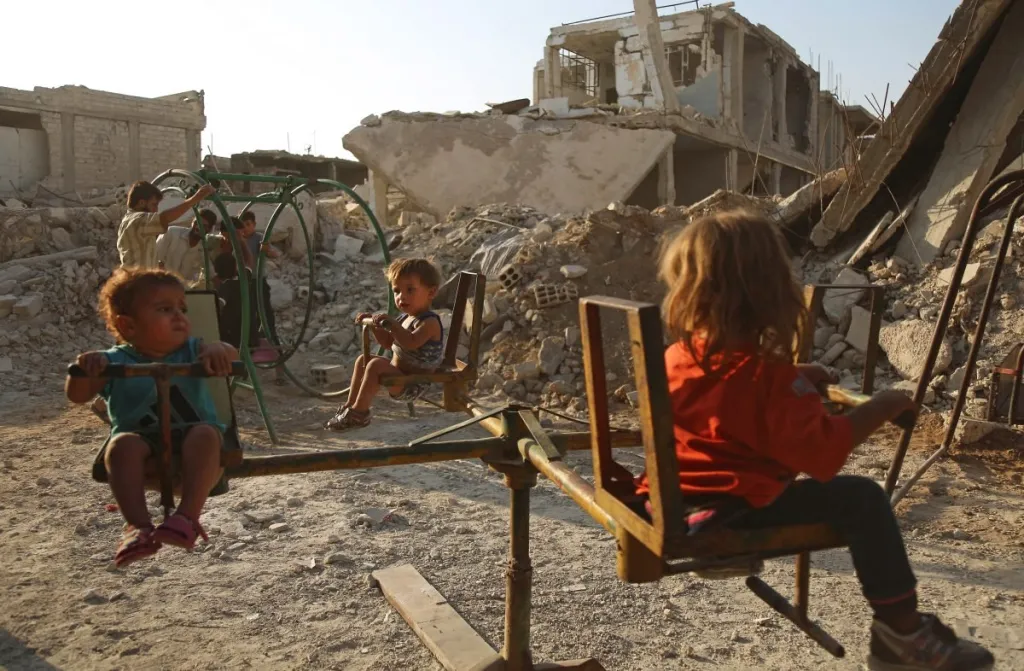
Syrian children play in a destroyed street in Douma, on the eastern outskirts of Damascus. Photo AFP ©AFP ⁃ AMER ALMOHIBANY

In Syria, one of the most critical aspects of the environmental crisis is the illegal refineries – more than 10,000 in 2016, according to PAX – that are being set up all over the country. “Due to bombardments and lack of staff who fled or left the country, professional refineries have drastically cut back their production,” Zwijnenburg explained in the report. “At the same time, the demand for fuel for daily life remains high. Armed groups including the Islamic State encourage the makeshift refining because the groups earn money by selling the raw oil to the amateur refineries, and then taxing the fuel they produce.”

Brown has observed this kind of behaviour in various conflicts, where the absence of governance and rule of law in a difficult situation pushes local populations to develop coping mechanisms at the expense of their environment.

“Now, in Iraq, the government has to think about how to clean the zones of conflict and where to put the rubble, in a way that doesn’t create more problems by polluting water sources,” he said. “In these kinds of post-conflict situations, you are keen to get people back to their homes, working again, getting the economy going, meeting humanitarian needs and rebuilding. But it’s worth also thinking about dealing with this toxic legacy.”

Unfortunately, the environment is frequently a secondary concern for people recovering from war. In Lebanon, for instance, garbage treatment remains an issue nearly three decades after the end of the civil war in 1990. “There is no obligation for a post-conflict state to actually follow the international recommendations for the environment,” Doug Weir, manager of the toxic remnants of War Project , told Fanack Chronicle. “All these environmental problems need money to be fixed; that can be quite expensive.”

At the third United Nations Environment Assembly on 4-6 December 2017 in Nairobi, Kenya, the Iraqi government tabled a draft conflict pollution resolution, titled ‘Pollution control in areas affected by terrorist operations and armed conflicts’, which reaffirms core environmental and rights principles, describes the nature of the problem, and proposes how UNEP and other actors could help address the generation and harm from toxic remnants of war. The resolution was passed on 5 December 2017, potentially sending a positive signal to other post-conflict countries that will almost certainly need help in the future, such as Syria.

Please help TFF remain truly independent here if you benefited from this article

[paypal-donation]

We recommend a visit to the online Fanack magazine in general which brings a lot of interesting stuff, in particular for younger readers.

Share

Leave a Reply

Your email address will not be published. Required fields are marked *

Related Posts

OK, Trump did not get it. But he got a full endorsement of a possible future US regime change in Venezuela. And that is what Ms Machado has advocated. On October 10, 2025, the Norwegian Nobel Committee awarded its Peace Prize to Venezuelan opposition figure María Corina Machado. The citation praised her “tireless work promoting democratic rights.” But Ms Machado has openly called for U.S. military intervention in Venezuela, stating on CBS: “The only way to stop the suppression is by force—U.S. force.” She or her party has received funding from the National Endowment for Democracy (NED), a U.S. government-backed body known as a CIA front organisation and for supporting regime-change operations worldwide. And in 2018, she sent a letter to Israeli Prime Minister Benjamin Netanyahu, asking him to use “force and influence” to help dismantle Venezuela’s government—citing alleged ties to terrorism, Iran and narcotrafficking. This year’s NATO Norwegian prize...
Officially, the drones were not identified. By simply thinking critically – which journalists and selected experts no longer do – there may be a good reason for that. And this article will never be mentioned in Denmark… Drones over Denmark. No damage. No trace. No answers. Yet the headlines scream “Russian threat,” and Prime Minister Mette Frederiksen speaks with a certainty that defies logic: “We don’t know they were Russian—but we know Russia is the biggest threat to Europe.” It could be nobody else – unless you make an interest analysis which I did two days ago. This is not security policy. It’s theatre. And the audience is being played. Let’s rewind. These drones—unphotographed, untracked, unclaimed—appear and vanish like ghosts. Airports shut down. Panic spreads. Military budgets swell. And the narrative hardens: Russia is behind it. But what if that’s not just wrong but deliberately misleading? Here’s a hypothesis for...
Drones over Nordic airports. No damage. No trace. No answers. Most assume Russia—but what if that’s not so? Why is there so much we are not told? This article explores the strategic ambiguity behind recent drone incursions and asks: Who else might benefit from sending drones into NATO airspace? From Ukraine’s surprising drone supremacy to Russia’s possible signalling, the silence itself may be the loudest message. These are the kinds of questions decent, intelligent investigative journalists and commentators could easily research. Why don’t they? Did you, dear reader, know or think of this? That the most powerful weapon in today’s conflicts might be the one that leaves no trace – and no answers. Just enough fear to justify the next move? Recently, drones have repeatedly appeared over Nordic airports and near some military facilities. They cause no damage – for which reason the designation “hybrid attack” is misleading but serves a purpose. These...

Recent Articles

Jan Oberg May 15, 2026 Go to this Fox News page and scroll the whole way down: President Donald Trump tells the world that his meeting with President Xi Jinping yielded a lot of very concrete political and economic results – of course, only where the Chinese side, according to him, agreed with him. He does not mention the Taiwan issue, but Secretary of State, Marco Rubio, says that it did not feature prominently in their talks and that the US policy on Taiwan has not changed. Then go to China Daily – or Global Times – and you will see that for the Chinese it is framework, principles, structure of cooperation etc. that matters – all embedded in the overall idea of “constructive bilateral relationship of strategic stability.” Nowhere is any concrete agreement or deal – all that Trump refers to – mentioned. At the general level, this gives you insights into the very different social...
Lena Petrova of “World Affairs In Context” with more than half a million subscribers on YouTube wanted to explore what a peace researcher like me has to say about, among other things, the First and the Second Cold War and why eethics has disappeared from politics. I am particularly happy about this conversation that also yielded an amazing number of very appreciative comments on YouTube. No doubt, people are longing for alternatives, including peace perspectives.
The MIMAC – Military-Industrial-Media-Academic Complex – drives the world’s rampant militarism and wars without end. Here is a short reflection of how it works against all interests of humanity. #5 deals with why there is no real enemy or threat images/analysis. It’s all ex-post constructions. And, btw, theTFF Peace Pulse is now on Rumble.

TFF on Substack

Discover more from TFF Transnational Foundation & Jan Oberg.

Most Popular

Jan Oberg May 15, 2026 Go to this Fox News page and scroll the whole way down: President Donald Trump tells the world that his meeting with President Xi Jinping yielded a lot of very concrete political and economic results – of course, only where the Chinese side, according to him, agreed with him. He does not mention the Taiwan issue, but Secretary of State, Marco Rubio, says that it did not feature prominently in their talks and that the US policy on Taiwan has not changed. Then go to China Daily – or Global Times – and you will see that for the Chinese it is framework, principles, structure of cooperation etc. that matters – all embedded in the overall idea of “constructive bilateral relationship of strategic stability.” Nowhere is any concrete agreement or deal – all that Trump refers to – mentioned. At the general level, this gives you insights into the very different social...
Lena Petrova of “World Affairs In Context” with more than half a million subscribers on YouTube wanted to explore what a peace researcher like me has to say about, among other things, the First and the Second Cold War and why eethics has disappeared from politics. I am particularly happy about this conversation that also yielded an amazing number of very appreciative comments on YouTube. No doubt, people are longing for alternatives, including peace perspectives.
The MIMAC – Military-Industrial-Media-Academic Complex – drives the world’s rampant militarism and wars without end. Here is a short reflection of how it works against all interests of humanity. #5 deals with why there is no real enemy or threat images/analysis. It’s all ex-post constructions. And, btw, theTFF Peace Pulse is now on Rumble.
Read More
Screenshot-2026-05-15-103534
Jan Oberg May 15, 2026 Go to this Fox News page and scroll the whole way down: President Donald Trump tells the world that his meeting with President Xi Jinping yielded a lot of very concrete political and economic results – of course, only where the Chinese side, according to him, agreed with him. He does not mention the Taiwan issue, but Secretary of State, Marco Rubio, says that it did not feature prominently in their talks and that the US policy on Taiwan has not changed. Then go to China Daily – or Global Times – and you will see that for the Chinese it is framework, principles, structure of cooperation etc. that matters – all embedded in the overall idea of “constructive bilateral relationship of strategic stability.” Nowhere is any concrete agreement or deal – all that Trump refers to – mentioned. At the general level, this gives you insights into the very different social...
Screenshot-2026-05-12-104023
Lena Petrova of “World Affairs In Context” with more than half a million subscribers on YouTube wanted to explore what a peace researcher like me has to say about, among other things, the First and the Second Cold War and why eethics has disappeared from politics. I am particularly happy about this conversation that also yielded an amazing number of very appreciative comments on YouTube. No doubt, people are longing for alternatives, including peace perspectives.
Screenshot-2026-04-13-154551 (2)
The MIMAC – Military-Industrial-Media-Academic Complex – drives the world’s rampant militarism and wars without end. Here is a short reflection of how it works against all interests of humanity. #5 deals with why there is no real enemy or threat images/analysis. It’s all ex-post constructions. And, btw, theTFF Peace Pulse is now on Rumble.
Screenshot-2026-04-13-154551 (1)
Jan Oberg, TFF director April 28, 2026 In this third TFF Peace Pulse, I make the important distinction between the violence and the conflict that violence is a symptom of. If you want peace, focus on the underlying conflict because that is the key to resolution, peacemaking, and a better future for the parties. The West is obsessed with violence, just look around you – and 90+ per cent of the public debate is about military issues and other violence – totally wasted for peace. These Peace Pulses will only be published here a few times. You will also not find them on YouTube and Vimeo because both platforms have blocked TFF and me; you know, peace is dangerous these days. Most TFF’s videos since 2007 are now on Rumble.
Screenshot-2026-04-13-154551
In contrast to most, we’ll bring alternatives, solutions, hope and strategies for a better future. Times are dangerous, yes, but that only intensifies the need for constructive thinking and action! Jan Oberg, TFF director April 13, 2026 The new TFF Peace Pulse uses video messages in a new way: Max 3-5-minute-long comments, ideas or perhaps mini-lectures, all about peace – positive peace. We launch them today on April 13, 2026 with a carefully crafted visual aesthetic fitting the content. We hope to publish them regularly from now on. We launch Peace Pulse (PP) – for a number of reasons. The world is in chaos, and there are countless reasons to feel concerned, frustrated, even angry. The atmosphere is saturated with doom and gloom, with negative energy and rear‑mirror thinking, while vision, imagination, alternatives, strategies and genuine future‑mindedness remain in short supply. And without them, we simply can’t save the world. Looking at problems from a hundred angles will...
IMG_5165 (1)
PART II — Publishing Peace in a System That Prioritises Militarism Jan Oberg, TFF director April 10, 2026 How TFF Maintains a Daily Voice in a Digital World Built for Noise This article is part of the series “TFF at 40″ and it invites you to learn about Four Decades of Publishing Peace. It takes a look at how a small, people‑financed peace foundation has communicated across four generations of technology — from wax stencils and fax machines to mass email and Substack — and why TFF continues to publish every single day in a system that rewards noise, conflict, and militarism. ◆ What it means to publish peace every single day in a digital system built for 24/7 news and other noise, confrontation, and militarism. How TFF’s independence, continuity, and global readership defy algorithms, donor cycles, and Western media censorhip — and why the Majority World keeps listening. When the...