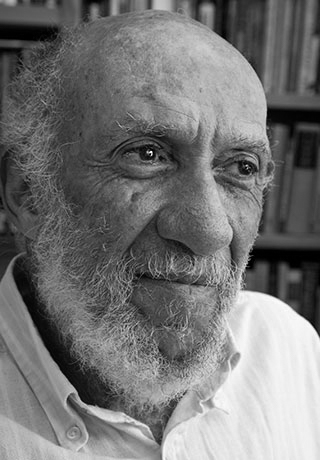
A few years ago, while giving talks in several Indonesian cities, I was struck by how often questions were raised during the discussion periods relating to the work and ideas of Edward Said. Indeed, anywhere that intellectuals with a progressive or internationist outlook gather on this planet, there is an awareness and appreciation of the indispensable contributions that Said has made to the life of free and independent inquiry, and beyond this, to a whole style and method of thought that takes ideas and culture seriously as crucially linked to structures of oppression and processes of emancipation.
Said’s work is also connected with the confusions of a Janus-faced identity of intellectuals that is so characteristic of this era, that of seeming to belong everywhere and nowhere simultaneously. There are at least two forms of connection that emerge from Said’s life and writings. First of all, being uprooted, Said’s embraces the identity of displacement, and yet addresses the audience of a borderless world. Beyond this, Said is convinced that the “hybridity” associated with displacement is the signature of the age, is at the core of globalization, and is the essence of the capitalist obsession, namely, money.
Such admiration and awareness is, of course, rare, but what makes it particularly remarkable, is that in Said’s case it is inseparable from his long and passionate engagement with the cause and tribulations of the Palestinian people, an embattled and frustrating particularity. Sadly, too many of its most committed partisans would have long ago had their moral, political, and intellectual energy sapped by such an involvement. Although for Said, his Palestinian origins and horizons are never truly absent, the depth and range of his concerns are such that their Palestinian grounding, rather than being a limiting factor, roots his thought and adds a dimension of authenticity and seriousness that partly explains its extraordinary range of influence.
The Palestinian ordeal, without being in any sense backgrounded, is itself partly transfigured from a struggle with the other to being a tragic encounter between two aggrieved and victimized peoples. Said’s distinctive capacity to exhibit genuine empathy for the ordeal of the historic opponent, Israel and the Jewish people, despite a lengthy period of oppressive Israeli dominance of the Palestinian peoples, deepens understanding, and creates the moral and psychological space for genuine reconciliation. By so doing, Said escapes the partisan pitfalls of one-eyed comprehension, thereby both humanizing and universalizing this bloody, anguishing, and still far from resolved encounter between these two peoples fated to continue shaping each other’s history to such a startling degree. What Said achieves by his approach is an orientation toward conflict that avoids enmity so convincingly as to make dialogue supersede polemics.
Said’s worldview is also an outcome of his lifelong work as a world class interpreter of literature, and more generally as a renowned and versatile cultural figure, whose publications include professional music criticism and whose activities include acclaimed public performances as a concert pianist. His field of scholarly specialization is comparative literature, which studies the manner by which the most adept cultural and imaginative sensibilities of various countries express the most profound human desires ambitions, and fears. Such studies presuppose an intimacy with foreign languages and modes of thought that blur distinctions between self and other, citizen and alien, native and foreigner. Such close encounters with literary classics, when undertaken with the intention of better illuminating their wider significance, tends toward an appreciation of complexity, and the incapacity of the human mind to comprehend reality in a totalizing manner. It is always beneficial to appreciate great literature from multiple perspectives, and as perpetually open to new readings. The inexhaustible mysteries of meaning is always a sign of a greatness beyond the now. Such interpretative mastery as is characteristic of Said’s literary studies exhibits the extent to which understanding is derived and enriched from a variety of perspectives. A student of comparative literature is self-consciously engaged in a continuing process of discovery that is historically and contextually conditioned even if such an interpreter does not have Said’s particular personal preoccupations about how the imaginations of the politically dominant and subordinate are intertwined, as well as dialectically related.
This passion for interpretation is reinforced by Said’s modernist skepticism about dogmatic claims, partly expressed by his own frequent reiteration of an unwavering commitment to secularism. He makes this commitment very clear in a wonderful passage toward the end of his 1993 Reith Lectures, Representations of the Intellectual (New York:Pantheon, 1994)120:
..the true intellectual is a secular being. However much intellectuals pretend
that their representations are of higher things or ultimate values, morality
begins with their activity in this secular world of ours- where it takes place,
whose interests it serves, how it jibes between power and justice, what it
reveals about of one’s choices and priorities. Those goals and that always
fail to demand from the intellectual in the end a kind of absolute certainty and a
total seamless view of reality that recognizes only disciples and enemies.
In so defining a secular stance, Said is distancing himself from the dogmatics of Marxist (and anti-Marxists) who see the reality of historical laws as the justification for killing fields. He is equally rejecting crusading devotees of religious faith who are prepared to embark on bloody crusades for the glory of their particular god or gods. My own humanism is less assured on these issues, feeling a kinship with William Connolly’s fine book, Why I Am Not a Secularist, which allows space for spirituality and religious devotion that is neither extremist nor oblivious to the justice claims of the oppressed and the marginal. Said’s secularism does not entertain such fence-straddling, beeing seemingly embattled against the repressive sides of religious truth claims (as exemplified by Said’s early and unconditional defense of Salman Rushdie’s The Satanic Verses) and content to operate within the broad confines of a compassionate and engaged rationalism (thereby making the best of the Enlightenment legacy).
As should be obvious, Said is never using complexity and the elusiveness of reality to validate a posture of non-action and ambivalence in the face of injustice and imperial domination. He seeks as much clarity as the integrity of observation allows, and some of his influence is attributable to an insistence that all cultural activity is inevitably bound up with the matricies of power. There is no place to hide behind the walls of ivy. Along with Foucault and others, Said goes further, suggesting that the vindication of serious reading and writing finally depends on illuminating the disguised, embedded structures of power and privilege. Gaining such knowledge teaches us how to live and act in the world. We are always confronted with the choice of acquiescence or of resistance to the injustices currently associated with the exercise of power.
Said views “the intellectual as exile and marginal, an amateur, and as the author of a language that tries to speak truth to power.”(Id., xvi) In effect, his stance embodies an alignment with those who are in some way, in any way, victimized by agencies of power (state, media, market): “It is a spirit of opposition, rather than accommodation, that grips me because the romance, the interest, the challenge of the intellectual life is to be found in dissent against the status quo at a time when the struggle on behalf of underrepresented and disadvantaged groups seems so fairly weighted against them.”(Id, xvii) It should be realized, of course, that these sentiments are not generally shared in universities or among most of those with the strongest academic credentials and honors. In such circles, the relentless search for influence and funds, generally leads “intellectuals” to condition their activity precisely by such a spirit of accommodation with the powers that be, which Said is decrying. His impact on cultural studies and the identity of the intellectual, in particular, is so significant because he is insisting upon commitment to the struggles of the day, and doing so with the authority of an eminent literary critic and the experience of a political militant. Said challenges all of us by arguing that the decisive test of the worth of intellectual activity is how it contributes to human wellbeing, and at the very least, as expressing the willingness to assume an honorable “role of a witness who testifies to a horror otherwise not recorded.” (Id, xvii)
It is tempting, yet mistaken, to discount Said’s affirmation of the orientations associated with exiles as self-serving, as an abstract endorsement of his own story so brilliantly depicted in Out of Place, a memoir of his formative years. This memoir end with the completion of Said’s graduate studies while he was still in his late twenties. As Said carefully notes, he was at all times a privileged exile if measured in purely class terms. Yet from the perspective of personal discomfort in his immediate family circumstances, the sense of being cast out from his place of origin, and his quintessential feeling of cultural hybridity the case is strongly made that Said possesses an authentic voice of marginality that enables him to enter into genuine solidarity with the oppressed. As a valiant and persistent public voice for justice to the Palestinian people, the strength of this voice has prompted death threats from those that have feared and resented his call for justice and true peace. Said has never retreated from his understanding of such controversies even when the pressure to do so mounted and his refusal is derided as stubbornness and arrogance.
Undoubtedly, Said’s most widely influential book was Orientalism in which he authoritatively depicted a whole way of not seeing the other, thereby facilitating domination and abuse. Although set in the pivotal relationship over the centuries between the West and the Islamic world, the impact of the book was far more general, suggesting the lethal power of constructing the subordinated other in a manner that vindicated the colonialist and hegemonic claims to civilizational superiority of the dominating self. The Orientalists were academic hired hands who made the work of imperial exploitation far easier to swallow at home, and even more damagingly, encouraged the ingestion of the stereotype by “Oriental peoples” themselves. Orientalism brilliantly demonstrates the reactionary political consequences of cultural studies supposedly performed according to canons of academic neutrality, but actually serving the cause of imperialism.
Said continues this line of inquiry in his very ambitious Culture and Imperialism, which generalizes the argument about the pernicious corruption of academic activity that is not aligned with the victims of injustice. Although concentrating on the literature of the colonial masters, Said extends his analysis in the latter chapters to the historical setting currently unfolding under the rubric of “globalization” and beneath the banner of the special brand of imperial leadership provided by the United States. In the end, Said is arguing with erudition and conviction against all forms of essentialist and reductive knowledge that defines the other, especially the vulnerable other, by culturally and media-coded images and ideas that validate the violent operations of the rich and powerful. In anti-imperial contrast, Said urges readers and writers alike to give their “..attention to detail, critical differentiation, discrimination, and distinction.” To the extent that this discipline of detail takes hold, Said believes it will produce “a somewhat elusive oppositional mood,” which can in due course emerge “as an internationalist counter-articulation.”(p.311)
Said has some strategic concerns about the current use and misuse of knowledge. He insists on the urgency of we in the West looking beyond the labels of “terrorism” and “fundamentalism” in dealing with the peoples and struggles of the East. And further, that both sides of this cultural divide need to acknowledge, and come to understand, the degree to which “all representations are constructed,” making it crucial to evaluate each undertaking by asking “for what purpose, by whom, and with what components.”(p.314).
In recent years, this self-imposed demand to remain on the battlefield of ideas, even if surrounded and isolated, has expressed itself particularly in relation to the Palestinian movement itself as it has turned from the clearcut logic of opposition to dispossession and occupation to the murky domain of diplomacy carried on behind closed doors. Said has opposed the Oslo “peace process” from its inception in 1993, contending that even before the Likud resumed its control of the Israeli government, the essential features being proposed, were tantamount to a Palestinian surrender, and, centrally, that the underlying disparity of power as manifested by unequal demands could never lead to a genuine and durable peace between the two peoples. It is an irony of monumental significance that Said’s books have been banned in recent years by the Palestinian Authority, which is a mode of suppression that even the Israelis have never relied upon
Toward the end of Out of Place, Said clearly subordinates political correctness to conscience even at the cost of community. While still an undergraduate at Princeton, Said had discussions with a family friend, the widely respected Lebanese diplomat, Charles Malik, in which he distanced himself from the unwavering identities of family, nation, and religious community that he found in this famous man. In a revealing passage Said expresses the sentiment that “would later become so central to my life and work”(p. 281):
It was in those Washington discussions that the inherent irreconcilability between intellectual belief and passionate loyalty to tribe, sect, and country first opened to me, and have remained open. I have never felt the need to close the gap but have kept them apart as opposites, and have always felt the priority of the intellectual, rather than national or tribal consciousness, no matter how solitary that made me. (p. 280)(emphasis added)(“no matter how solitary that made me”)
It is this extraordinary stance that Said has sustained in the most difficult of situations posed by the initial near universal enthusiasm surrounding the Oslo framework, and of utmost importance in his depiction of the role of public intellectual. As so often, with the unfolding of this geopolitically guided peace process, Said’s initial refusal to add his imprimatur of approval, has gathered increased support, even admiration, both from Palestinians who at first went along with Oslo and Arafat, hoping against hope, and from progressives, whether Palestinian or not, who generally thought that what was achieved at Oslo was the best that the Palestinians could expect to get, given the realities of Israeli/US power, and that if they accepted what was offered, it could in time lead to an acceptable Palestinian state.
Another closely related feature of Said’s worldview is his uncanny realization that the personal cannot be excluded from the field of knowledge, that subjectivity is the foundation of thought rather than its adversary. In this regard, Said embraces a view of reason that engages the emotions rather than confines itself to a realm of conceptual abstraction traced back to the formative influence of Descartes on the modern mind, and the rejection of modernist claims of certainty that feed tendencies toward “secular fundamentalism.” His affinity with the Romantic tradition enables Said to combine the passioonate with the rigorous to constitute a powerful type of academic scholarship that sustains a pervasive concern with struggles to overcome suffering and injustice in the lifeworld, whether these manifest themselves in relation to the health of the person or of the body politic. Said acts as both guide and exemplary figure in this troubling birth of a globalizing world, not only helping us to understand its contradictory currents that are flowing by us on all sides, but also illuminating paths of constructive action and attitude that provide firm ground for taking stands and steps forward, especially on behalf of those being most marginalized and victimized. As a citizen pilgrim, committed both to place and to the ennobling journey toward a desirable human future, the work and life of Edward Said serve us well as inspiration, while providing us with welcome comraderie.