A pandemic of fear

Let’s get death in proportion. True, Coronavirus is an appalling disease but the number of deaths it has caused this year is far lower than deaths caused by either common flue, car accidents, drug-taking, alcoholism or cigarette smoking. 

Governments don’t like these things and make an effort to combat them. But they don’t get themselves as worked up as they have with Coronavirus (For starters, why don’t they outlaw all smoking?). A Russian friend texted me from Moscow the other day saying the pandemic we should worry about is “the pandemic of fear”. Where is our sense of proportion?

Another issue to examine in order to clarify our thinking is how many people have US and NATO troops killed compared with the numbers killed by terrorism. Again it is a matter of getting things in proportion.

Terrorism puts the fear of God up to people and governments. But there’s less fuss made about what Western governments are doing with their never-ending killing wars.

Let’s first look at terrorism whose numbers of deaths have halved in the last four years, according to the respected Global Terrorism Index, published by the Institute for Economics and Peace. The numbers killed were 33,555 in 2014 but in 2018 were 15,952.

According to the 2019 report 98 countries have improved their situation with regard to terrorism when deaths are counted; 40 have worsened.

Seven out of the nine world regions in 2018 saw a reduction in terrorism. The largest improvement was in the Middle East and North Africa. In South America, Central America and the Caribbean it got worse. (But here we are talking about small numbers.)

Between 2002 and 2018, South Asia, the Middle East, sub-Saharan Africa and North Africa accounted for 93% of all deaths from terrorism. South Asia was the worst region, then sub-Saharan Africa (mainly because of Boko Haram in Nigeria), then the Middle East and North Africa.

The numbers killed in the West by terrorists are a small fraction of these. The number of deaths in Europe was over 200 in 2017 but was 62 in 2018. The total number of incidents fell by 40%.

Now, to compare, let’s look at the numbers killed by American and NATO-inflicted warfare.

A study by Nicolas Davies published in January concludes that 1.2 million Afghans and Pakistanis have been killed as a result of the US invasion of Afghanistan during 19 years of war.

That figure alone overwhelms the number of deaths caused by terrorism, even though it doesn’t include the war in Iraq, in Syria, in Somalia and in Yemen (where the US and UK have armed the Saudi invaders).

Neither the US government nor NATO governments keep a record of civilian casualties. Nevertheless, they admit, when questioned, that far more civilians have been killed in Afghanistan than were killed by the great act of terrorism, the attack on the World Trade Center on 9/11 in 2001.

The reason for the Western invasion of Afghanistan was to eliminate the small group of Al Qaeda followers who had conceived and implemented 9/11 and who were being sheltered by the Taliban in the Afghan mountains.

For that the Americans decided to invade and in effect punish the whole country, both insurgent and civilian.

Senior American officers admitted to Dana Priest and William Arkin of the Washington Post that more than half the raids conducted by US special operations forces target the wrong person or house.

Thus it has been inevitable that large numbers of innocent civilians have been killed, far more than official reporting suggests.

Let’s also take a look at Guatemala, a country I’ve extensively reported from for the International Herald Tribune, the New York Times and for two of my books.

The Guatemalan war lasted from 1960 to 1996. The deadliest part of the war was unleashed when President Ronald Reagan restored military aid to Guatemala in 1981.

One US government report defined the targets to include “the civilian support mechanism”, which in effect meant that a large part of the civilian population was a target for military action. 

A CIA report in 1982 described how “The commanding officers of the units involved have been instructed to destroy whole towns and villages which are cooperating with the guerrillas and eliminate all sources of resistance.

Since the operation have begun several villages have been burnt to the ground, and a large number of guerillas and collaborators have been killed”.

Later, when the war was over, the UN-sponsored Historical Clarification Commission (that received much of its funding from the US government of President Bill Clinton) documented 626 massacres and found that at least 200,000 people had been killed.

Clinton went to Guatemala to publically apologize for what the US had done. At least 93%, the report concluded, was killed by US-backed forces and death squads, and only 3% by the guerrillas.

Altogether it has been estimated that there were 735,000 civilian deaths up to the end of 2017. This war was supposedly to stop the march of communism across Central America and to resist those who wished to see a fairer land distribution and a greater share of social services for the poor Indian part of the population.

It’s obvious that over the last two decades the US and its European allies have inflicted far more killings of civilians than have the terrorists.

Yet one act of terrorism by a rudimentary armed group can generate ten times as much word-space in the newspaper or on the TV screen than an American bombing of civilian houses and hospitals. Proportion?

Proportion in both journalism and government actions went out of the window long ago. And now with the Coronavirus, because of that, we have a pandemic of fear.

Shakespeare wrote in Richard II, “How sour sweet music is/  When time is broke, and no proportion kept! /So it is in the music of men’s lives”.

If you think this article was useful, reward TFF with a dollar or two

[paypal-donation]

Foreign affairs columnist, film-maker and author

Share

Leave a Reply

Your email address will not be published. Required fields are marked *

Related Posts

The MIMAC – Military-Industrial-Media-Academic Complex – drives the world’s rampant militarism and wars without end. Here is a short reflection of how it works against all interests of humanity. #5 deals with why there is no real enemy or threat images/analysis. It’s all ex-post constructions. And, btw, theTFF Peace Pulse is now on Rumble.
Jan Oberg, TFF director April 28, 2026 In this third TFF Peace Pulse, I make the important distinction between the violence and the conflict that violence is a symptom of. If you want peace, focus on the underlying conflict because that is the key to resolution, peacemaking, and a better future for the parties. The West is obsessed with violence, just look around you – and 90+ per cent of the public debate is about military issues and other violence – totally wasted for peace. These Peace Pulses will only be published here a few times. You will also not find them on YouTube and Vimeo because both platforms have blocked TFF and me; you know, peace is dangerous these days. Most TFF’s videos since 2007 are now on Rumble.
In contrast to most, we’ll bring alternatives, solutions, hope and strategies for a better future. Times are dangerous, yes, but that only intensifies the need for constructive thinking and action! Jan Oberg, TFF director April 13, 2026 The new TFF Peace Pulse uses video messages in a new way: Max 3-5-minute-long comments, ideas or perhaps mini-lectures, all about peace – positive peace. We launch them today on April 13, 2026 with a carefully crafted visual aesthetic fitting the content. We hope to publish them regularly from now on. We launch Peace Pulse (PP) – for a number of reasons. The world is in chaos, and there are countless reasons to feel concerned, frustrated, even angry. The atmosphere is saturated with doom and gloom, with negative energy and rear‑mirror thinking, while vision, imagination, alternatives, strategies and genuine future‑mindedness remain in short supply. And without them, we simply can’t save the world. Looking at problems from a hundred angles will...

Recent Articles

Jan Oberg May 15, 2026 Go to this Fox News page and scroll the whole way down: President Donald Trump tells the world that his meeting with President Xi Jinping yielded a lot of very concrete political and economic results – of course, only where the Chinese side, according to him, agreed with him. He does not mention the Taiwan issue, but Secretary of State, Marco Rubio, says that it did not feature prominently in their talks and that the US policy on Taiwan has not changed. Then go to China Daily – or Global Times – and you will see that for the Chinese it is framework, principles, structure of cooperation etc. that matters – all embedded in the overall idea of “constructive bilateral relationship of strategic stability.” Nowhere is any concrete agreement or deal – all that Trump refers to – mentioned. At the general level, this gives you insights into the very different social...
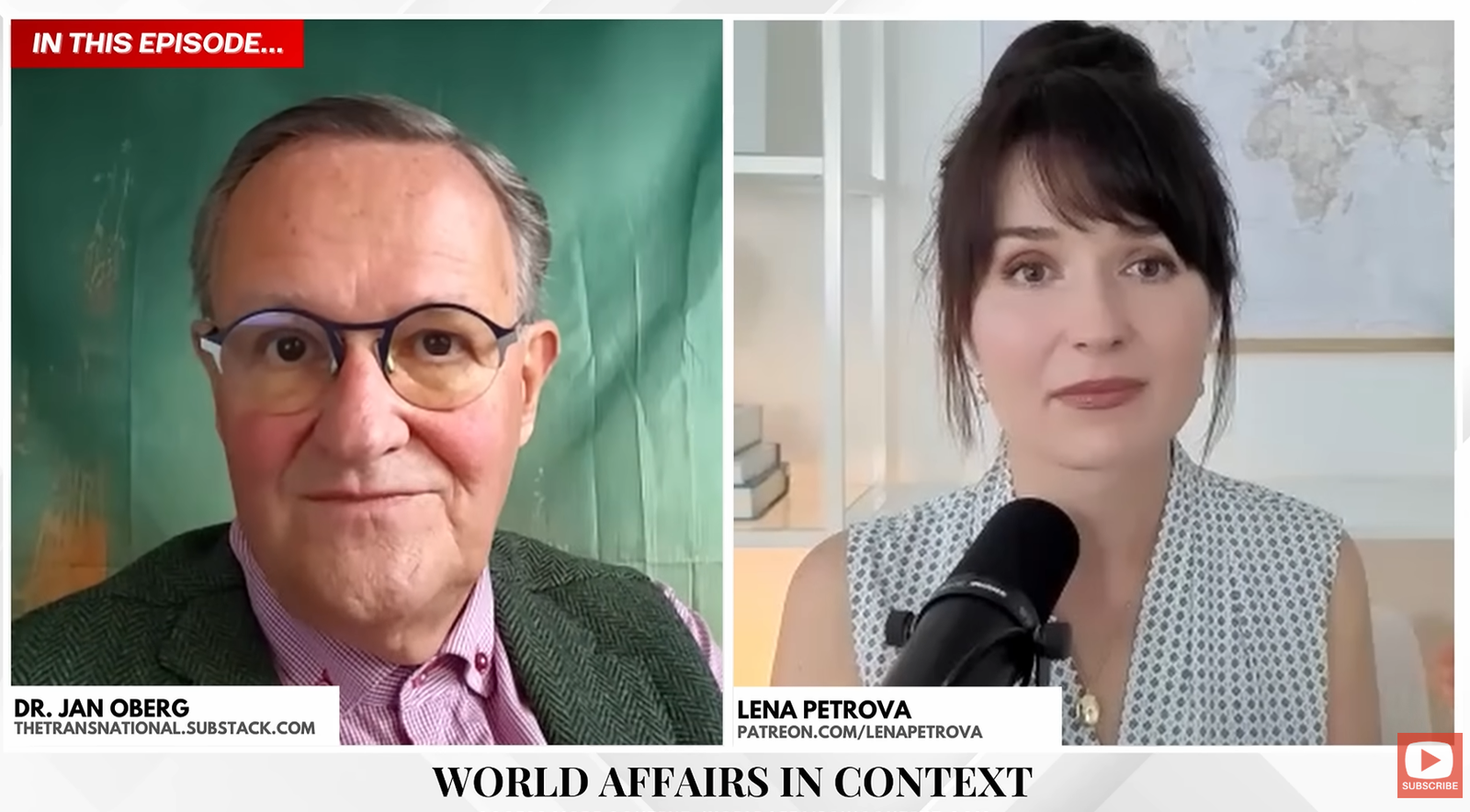
Lena Petrova of “World Affairs In Context” with more than half a million subscribers on YouTube wanted to explore what a peace researcher like me has to say about, among other things, the First and the Second Cold War and why eethics has disappeared from politics. I am particularly happy about this conversation that also yielded an amazing number of very appreciative comments on YouTube. No doubt, people are longing for alternatives, including peace perspectives.
The MIMAC – Military-Industrial-Media-Academic Complex – drives the world’s rampant militarism and wars without end. Here is a short reflection of how it works against all interests of humanity. #5 deals with why there is no real enemy or threat images/analysis. It’s all ex-post constructions. And, btw, theTFF Peace Pulse is now on Rumble.

TFF on Substack

Discover more from TFF Transnational Foundation & Jan Oberg.

Most Popular

Jan Oberg May 15, 2026 Go to this Fox News page and scroll the whole way down: President Donald Trump tells the world that his meeting with President Xi Jinping yielded a lot of very concrete political and economic results – of course, only where the Chinese side, according to him, agreed with him. He does not mention the Taiwan issue, but Secretary of State, Marco Rubio, says that it did not feature prominently in their talks and that the US policy on Taiwan has not changed. Then go to China Daily – or Global Times – and you will see that for the Chinese it is framework, principles, structure of cooperation etc. that matters – all embedded in the overall idea of “constructive bilateral relationship of strategic stability.” Nowhere is any concrete agreement or deal – all that Trump refers to – mentioned. At the general level, this gives you insights into the very different social...
Lena Petrova of “World Affairs In Context” with more than half a million subscribers on YouTube wanted to explore what a peace researcher like me has to say about, among other things, the First and the Second Cold War and why eethics has disappeared from politics. I am particularly happy about this conversation that also yielded an amazing number of very appreciative comments on YouTube. No doubt, people are longing for alternatives, including peace perspectives.
The MIMAC – Military-Industrial-Media-Academic Complex – drives the world’s rampant militarism and wars without end. Here is a short reflection of how it works against all interests of humanity. #5 deals with why there is no real enemy or threat images/analysis. It’s all ex-post constructions. And, btw, theTFF Peace Pulse is now on Rumble.
Read More
Screenshot-2026-05-15-103534
Jan Oberg May 15, 2026 Go to this Fox News page and scroll the whole way down: President Donald Trump tells the world that his meeting with President Xi Jinping yielded a lot of very concrete political and economic results – of course, only where the Chinese side, according to him, agreed with him. He does not mention the Taiwan issue, but Secretary of State, Marco Rubio, says that it did not feature prominently in their talks and that the US policy on Taiwan has not changed. Then go to China Daily – or Global Times – and you will see that for the Chinese it is framework, principles, structure of cooperation etc. that matters – all embedded in the overall idea of “constructive bilateral relationship of strategic stability.” Nowhere is any concrete agreement or deal – all that Trump refers to – mentioned. At the general level, this gives you insights into the very different social...
Screenshot-2026-05-12-104023
Lena Petrova of “World Affairs In Context” with more than half a million subscribers on YouTube wanted to explore what a peace researcher like me has to say about, among other things, the First and the Second Cold War and why eethics has disappeared from politics. I am particularly happy about this conversation that also yielded an amazing number of very appreciative comments on YouTube. No doubt, people are longing for alternatives, including peace perspectives.
Screenshot-2026-04-13-154551 (2)
The MIMAC – Military-Industrial-Media-Academic Complex – drives the world’s rampant militarism and wars without end. Here is a short reflection of how it works against all interests of humanity. #5 deals with why there is no real enemy or threat images/analysis. It’s all ex-post constructions. And, btw, theTFF Peace Pulse is now on Rumble.
Screenshot-2026-04-13-154551 (1)
Jan Oberg, TFF director April 28, 2026 In this third TFF Peace Pulse, I make the important distinction between the violence and the conflict that violence is a symptom of. If you want peace, focus on the underlying conflict because that is the key to resolution, peacemaking, and a better future for the parties. The West is obsessed with violence, just look around you – and 90+ per cent of the public debate is about military issues and other violence – totally wasted for peace. These Peace Pulses will only be published here a few times. You will also not find them on YouTube and Vimeo because both platforms have blocked TFF and me; you know, peace is dangerous these days. Most TFF’s videos since 2007 are now on Rumble.
Screenshot-2026-04-13-154551
In contrast to most, we’ll bring alternatives, solutions, hope and strategies for a better future. Times are dangerous, yes, but that only intensifies the need for constructive thinking and action! Jan Oberg, TFF director April 13, 2026 The new TFF Peace Pulse uses video messages in a new way: Max 3-5-minute-long comments, ideas or perhaps mini-lectures, all about peace – positive peace. We launch them today on April 13, 2026 with a carefully crafted visual aesthetic fitting the content. We hope to publish them regularly from now on. We launch Peace Pulse (PP) – for a number of reasons. The world is in chaos, and there are countless reasons to feel concerned, frustrated, even angry. The atmosphere is saturated with doom and gloom, with negative energy and rear‑mirror thinking, while vision, imagination, alternatives, strategies and genuine future‑mindedness remain in short supply. And without them, we simply can’t save the world. Looking at problems from a hundred angles will...
IMG_5165 (1)
PART II — Publishing Peace in a System That Prioritises Militarism Jan Oberg, TFF director April 10, 2026 How TFF Maintains a Daily Voice in a Digital World Built for Noise This article is part of the series “TFF at 40″ and it invites you to learn about Four Decades of Publishing Peace. It takes a look at how a small, people‑financed peace foundation has communicated across four generations of technology — from wax stencils and fax machines to mass email and Substack — and why TFF continues to publish every single day in a system that rewards noise, conflict, and militarism. ◆ What it means to publish peace every single day in a digital system built for 24/7 news and other noise, confrontation, and militarism. How TFF’s independence, continuity, and global readership defy algorithms, donor cycles, and Western media censorhip — and why the Majority World keeps listening. When the...