
PressInfo #225 - The Real Threat is Nuclear Terrorism

The four terrorist bombs that exploded in London on July 7, 2005, caused immense suffering and grief. This crime rightly received nearly universal condemnation. Violence does not solve any problems, it only aggravates them.

Yet this tragedy only foreshadows much worse future catastrophes if the world continues on its current course.
Tricycle and helmet found 1,500 m from hypocenter
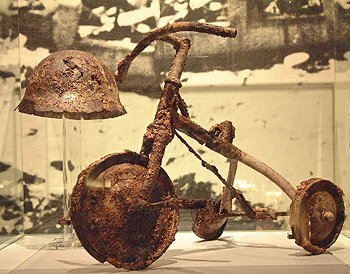
Tricycle and helmet found 1,500 m from hypocenter
Hiroshima Memorial Museum 
©
 Jan Oberg 2004

The trappings of nuclearism

As long as the big powers insist on maintaining nuclear weapons, claiming they need them to protect their security, they cannot expect to prevent other countries and terrorist organizations from acquiring such weapons–and some day using them.

The atomic bomb dropped on Hiroshima killed over 200,000 people.Today’s nuclear bombs are vastly more powerful. If even one nuclear device had been detonated in a parked car or a boat on the Thames, the Center of London would be strewn with smoking, radioactive rubble and over a million people might have been killed outright, and scores more would die slowly from radiation disease.

The double standard, “Nuclear weapons are good for us, but bad for you”, is stupid and unconvincing. Believing that nuclear weapons technology can be kept secret forever is naive.

Those who still believe in the fairy-tale of “deterrence theory” better wake up to the age of suicide bombers. Anyone convinced to go straight to paradise if blown up cannot be “deterred” by the threat of horrendous retaliation.

Governments that order tons of bombs to be rained on Iraq and Afghanistan should not be surprised if they plant ideas in the minds of eager imitators. Osama bin Laden once benefitted from support and training financed by the CIA.

Richard Falk, long a Professor of International Law at Princeton University, rightly pointed out: “The greatest utopians are those who call themselves ‘realists,’ because they falsely believe that we can survive the nuclear age with politics as usual. The true realists are those who recognize the need for change.”

Four changes we must make

What changes must we make if we want humanity to survive?

[1] We must stop believing that problems can be solved by applying offensive military force.

That only encourages others to pay back in kind. Policing to stop criminals, and defense against a foreign attack, are justified, but not military interventions abroad, except peacekeeping operations ordered by the UN security council to stop genocide or humanitarian disasters.

Hiroshima Memorial Dome © Jan Oberg 2004

[2] Thirty-seven years after signing the Nuclear Non-Proliferation Treaty, it is time for the nuclear powers to fulfill their commitment to nuclear disarmament.

We also need a vastly more open world, where all nuclear weapons are verifiably destroyed, and the manufacturing of new ones cannot be hidden.

The International Atomic Energy Agency (IAEA) can now inspect only sites that member countries voluntarily place under its supervision. If a suspected weapons smuggler could tell a border guard, “You may check under my seat, but don’t open the trunk,” such an “inspection” would be meaningless. The IAEA must have the power to inspect any suspected nuclear facilities, anywhere in the world, without advance warning, otherwise it is impossible to prevent the spread of nuclear weapons.

The governments that now possess nuclear weapons object to such intrusive inspections as a “violation of their sovereignty.” Yet many airline passengers also protested at first against having their luggage searched for guns or explosives, when such searches were introduced after a series of fatal hijackings. Today, passengers realize that such inspections protect their own security.

Those who have nothing to hide have nothing to fear. Sooner or later, governments will reach the same conclusion. The question is only whether this will happen before or after the first terrorist nuclear bomb explodes.

[3] We need to address the root causes of terrorism: long festering unresolved conflicts.

Particularly in situations of asymmetric power relations, the weaker side may be tempted to resort to random attacks against vulnerable targets of the more powerful antagonist, as in the 1970s the Red Brigades in Italy, the Red Army Faction in West Germany and the Irish Republican Army in Britain. More recently the Tamil Tigers have set off bombs in public places in their fight against the militarily superior Sri Lankan army and government. Today, car bombs explode almost daily in Iraq.

Of course, the killing of civilians with bombs dropped from the air, instead of being transported in cars and backpacks, also represents a form of “state terrorism” that stimulates violent popular resistance, which is then used as justification for an intensified hunt for terrorists, in a vicious cycle.

The meeting between President Franklin Delano Roosevelt and King Ibn Saud of Saudi Arabia aboard the cruiser USS Quincy in Egypt on 14 February 1945, in which Roosevelt committed the United States to support the Saudi Royal Family against internal opposition, in return for guaranteed access to oil, may partly explain why 15 of the 19 suicide bombers of 11 September 2001 in New York and Washington were Saudi citizens.

Arms exports to oppressive, dictatorial regimes produce dissatisfaction among those who suffer as a result.

The Middle East conflict, where Palestinians have lived for generations in refugee camps and suffer from high unemployment, is a breeding ground for suicide bombers.

At a broader level, a world economic system in which every day over 100,000 people, mostly children, die needlessly from hunger and preventable diseases, while there is enormous luxury and waste in wealthy countries, breeds discontent.

The fact that the United States has undertaken 67 foreign military interventions since World War II, in which an estimated 12 million people have been killed (3 million in vietnam alone) has not endeared it in many parts of the world.

Terrorism cannot be ended by killing terrorists. Doing so only enrages their admirers and provokes them to seek revenge. It is necessary to redress the sources of grievance and great injustice that drives people to sacrifice their own life in order to seek revenge.

The West must enter into dialogue with those who fight against it, to remove the motivation for resort to violence, including random violence against innocent citizens. The violence in the Northern Ireland conflict ended when the British government agreed to talks, instead of relying exclusively on the army to silence the grievances of the opposition.

[4] It is also important to transform conflicts peacefully before they erupt in violence.

This is a skill that can be taught and learned. For example, Johan Galtung, widely regarded as founder of the field of peace research, was able to help end a longstanding border conflict between Ecuador and Peru over which they had fought four wars by suggesting to make the disputed territory into a “binational zone with a natural park”, jointly administered. This peaceful intervention cost nearly nothing compared with a military peacekeeping operation.

We need a UN Organization for Mediation, with several hundred trained mediators who can help prevent conflicts from erupting into violence. This is a very inexpensive, worthwhile investment in human survival, compared with the trillion dollars the world spends each year to arm millions of troops, which only make the world collectively less secure.

If we cling to obsolete ways of thinking — that threatening others will make us safe –we face extinction as a human species, like other species that failed to adapt to new conditions.

It is realistic to get rid of nuclear weapons

Is it a realistic prospect to get rid of all nuclear weapons? Certainly more realistic than waiting until they are used, whether deliberately or by accident.

Some have argued that we cannot disinvent nuclear weapons and therefore will have to live with them as long as civilization exists. But nobody has disinvented cannibalism either, we have simply learned to abhor it.

Can’t we learn to abhor equally the incineration of entire cities with nuclear weapons?

Dietrich Fischer, a TFF Associate, is Academic Director of the European University Center for Peace Studies in Stadtschlaining, Austria, and Co-Director of TRANSCEND, a peace and development network.

© TFF and the author 2005

Share

Leave a Reply

Your email address will not be published. Required fields are marked *

Related Posts

PressInfo # 141, December 21, 2001It’s time to prepare reconciliation between Albanians and Serbs PressInfo # 140, December 14, 2001Ibrahim Rugova’s decade-long leadership in Kosovo/a PressInfo # 139, 11. december, 2001En god nyhet: Jugoslaviens Sannings- och försoningskommission PressInfo # 139, 11. december, 2001Gode nyheder: Jugoslaviens Sandheds- og Forsoningskommission PressInfo # 139, December 11, 2001Good news: Yugoslavia’s Truth and Reconciliation Commission PressInfo # 138, November 8, 2001TFF co-founder PhD with thesis about young people with roots in other cultures PressInfo # 138, November 8, 2001TFF:s medstiftare doktor på avhandling om unga med ursprung i andra kulturer PressInfo # 137, October 17, 2001A new Marshall Plan: Advancing human security and controlling terrorism PressInfo # 136, October 15, 2001The UN and Annan really deserve it PressInfo # 135, October 10, 2001Preventing a terrorist mushroom cloud PressInfo # 134, 17 oktober, 2001Sverige og 11. september PressInfo # 134, October 9, 2001Sweden and September 11...
Peace is promoted by constructive proposals and dialogue Four preceding PressInfos have expressed concern over — and criticised — the ongoing, militarisation of the EU. Some will say: but there are no alternatives. We believe that there are always alternatives, that democracies are characterised by alternatives and choice, and that openly discussed alternatives will improve the quality and legitimacy of society’s decision–making. In addition, it is an intellectual and moral challenge to not only criticise but also be constructive. If we only tell people that we think they are wrong, they are not likely to listen. However, if we say: what are your views on this set of ideas and steps? — we may sometimes engage them in dialogue and sow a seed. Most people in power circles live their daily lives in in a time frame and a social space where certain ideas, viewpoints and concepts are just not...
Photos © TFF 2000 Read PressInfo 90 “Lift the Sanctions and Bring More Aid to Yugoslavia” See Pictures from Belgrade © TFF 2000 Please reprint, copy, archive, quote or re-post this item, but please retain the source.

Recent Articles

PressInfo # 141, December 21, 2001It’s time to prepare reconciliation between Albanians and Serbs PressInfo # 140, December 14, 2001Ibrahim Rugova’s decade-long leadership in Kosovo/a PressInfo # 139, 11. december, 2001En god nyhet: Jugoslaviens Sannings- och försoningskommission PressInfo # 139, 11. december, 2001Gode nyheder: Jugoslaviens Sandheds- og Forsoningskommission PressInfo # 139, December 11, 2001Good news: Yugoslavia’s Truth and Reconciliation Commission PressInfo # 138, November 8, 2001TFF co-founder PhD with thesis about young people with roots in other cultures PressInfo # 138, November 8, 2001TFF:s medstiftare doktor på avhandling om unga med ursprung i andra kulturer PressInfo # 137, October 17, 2001A new Marshall Plan: Advancing human security and controlling terrorism PressInfo # 136, October 15, 2001The UN and Annan really deserve it PressInfo # 135, October 10, 2001Preventing a terrorist mushroom cloud PressInfo # 134, 17 oktober, 2001Sverige og 11. september PressInfo # 134, October 9, 2001Sweden and September 11...
Peace is promoted by constructive proposals and dialogue Four preceding PressInfos have expressed concern over — and criticised — the ongoing, militarisation of the EU. Some will say: but there are no alternatives. We believe that there are always alternatives, that democracies are characterised by alternatives and choice, and that openly discussed alternatives will improve the quality and legitimacy of society’s decision–making. In addition, it is an intellectual and moral challenge to not only criticise but also be constructive. If we only tell people that we think they are wrong, they are not likely to listen. However, if we say: what are your views on this set of ideas and steps? — we may sometimes engage them in dialogue and sow a seed. Most people in power circles live their daily lives in in a time frame and a social space where certain ideas, viewpoints and concepts are just not...
Photos © TFF 2000 Read PressInfo 90 “Lift the Sanctions and Bring More Aid to Yugoslavia” See Pictures from Belgrade © TFF 2000 Please reprint, copy, archive, quote or re-post this item, but please retain the source.

TFF on Substack

Discover more from TFF Transnational Foundation & Jan Oberg.

Most Popular

PressInfo # 141, December 21, 2001It’s time to prepare reconciliation between Albanians and Serbs PressInfo # 140, December 14, 2001Ibrahim Rugova’s decade-long leadership in Kosovo/a PressInfo # 139, 11. december, 2001En god nyhet: Jugoslaviens Sannings- och försoningskommission PressInfo # 139, 11. december, 2001Gode nyheder: Jugoslaviens Sandheds- og Forsoningskommission PressInfo # 139, December 11, 2001Good news: Yugoslavia’s Truth and Reconciliation Commission PressInfo # 138, November 8, 2001TFF co-founder PhD with thesis about young people with roots in other cultures PressInfo # 138, November 8, 2001TFF:s medstiftare doktor på avhandling om unga med ursprung i andra kulturer PressInfo # 137, October 17, 2001A new Marshall Plan: Advancing human security and controlling terrorism PressInfo # 136, October 15, 2001The UN and Annan really deserve it PressInfo # 135, October 10, 2001Preventing a terrorist mushroom cloud PressInfo # 134, 17 oktober, 2001Sverige og 11. september PressInfo # 134, October 9, 2001Sweden and September 11...
Peace is promoted by constructive proposals and dialogue Four preceding PressInfos have expressed concern over — and criticised — the ongoing, militarisation of the EU. Some will say: but there are no alternatives. We believe that there are always alternatives, that democracies are characterised by alternatives and choice, and that openly discussed alternatives will improve the quality and legitimacy of society’s decision–making. In addition, it is an intellectual and moral challenge to not only criticise but also be constructive. If we only tell people that we think they are wrong, they are not likely to listen. However, if we say: what are your views on this set of ideas and steps? — we may sometimes engage them in dialogue and sow a seed. Most people in power circles live their daily lives in in a time frame and a social space where certain ideas, viewpoints and concepts are just not...
Photos © TFF 2000 Read PressInfo 90 “Lift the Sanctions and Bring More Aid to Yugoslavia” See Pictures from Belgrade © TFF 2000 Please reprint, copy, archive, quote or re-post this item, but please retain the source.
Read More
Imagen-thumbnail-The-Transnational-1
PressInfo # 141, December 21, 2001It’s time to prepare reconciliation between Albanians and Serbs PressInfo # 140, December 14, 2001Ibrahim Rugova’s decade-long leadership in Kosovo/a PressInfo # 139, 11. december, 2001En god nyhet: Jugoslaviens Sannings- och försoningskommission PressInfo # 139, 11. december, 2001Gode nyheder: Jugoslaviens Sandheds- og Forsoningskommission PressInfo # 139, December 11, 2001Good news: Yugoslavia’s Truth and Reconciliation Commission PressInfo # 138, November 8, 2001TFF co-founder PhD with thesis about young people with roots in other cultures PressInfo # 138, November 8, 2001TFF:s medstiftare doktor på avhandling om unga med ursprung i andra kulturer PressInfo # 137, October 17, 2001A new Marshall Plan: Advancing human security and controlling terrorism PressInfo # 136, October 15, 2001The UN and Annan really deserve it PressInfo # 135, October 10, 2001Preventing a terrorist mushroom cloud PressInfo # 134, 17 oktober, 2001Sverige og 11. september PressInfo # 134, October 9, 2001Sweden and September 11...
Imagen-thumbnail-The-Transnational-1
Peace is promoted by constructive proposals and dialogue Four preceding PressInfos have expressed concern over — and criticised — the ongoing, militarisation of the EU. Some will say: but there are no alternatives. We believe that there are always alternatives, that democracies are characterised by alternatives and choice, and that openly discussed alternatives will improve the quality and legitimacy of society’s decision–making. In addition, it is an intellectual and moral challenge to not only criticise but also be constructive. If we only tell people that we think they are wrong, they are not likely to listen. However, if we say: what are your views on this set of ideas and steps? — we may sometimes engage them in dialogue and sow a seed. Most people in power circles live their daily lives in in a time frame and a social space where certain ideas, viewpoints and concepts are just not...
Imagen-thumbnail-The-Transnational-1
Photos © TFF 2000 Read PressInfo 90 “Lift the Sanctions and Bring More Aid to Yugoslavia” See Pictures from Belgrade © TFF 2000 Please reprint, copy, archive, quote or re-post this item, but please retain the source.
Imagen-thumbnail-The-Transnational-1
Av FRANK SØHOLM GREVIL 16 augusti 2004  Vi er nu nået til tredje akt i det absurde teaterstykke, der i analogi med de store skueprocesser i Moskva 1936-38 er blevet døbt ‘Grevil-sagen’. Første akt bestod i min anonyme fremlæggelse af egenhændigt nedklassificerede rapporter i Berlingske Tidende i februar og marts. Andet akt udgjordes af min fremtræden med navn og billede i Information i april samt den efterfølgende mediestorm, som uden min direkte medvirken kostede en forsvarsminister taburetten samt en sigtelse for brud på tavshedspligten. Tredje akt bliver en retssag, hvor jeg står tiltalt for at have overtrådt straffelovens bestemmelser om uberettiget videregivelse eller udnyttelse af fortrolige oplysninger. Statsanklageren har ovenikøbet valgt at påberåbe sig særligt skærpende omstændigheder. Da jeg aldrig har modtaget betaling for at stille rapporterne til rådighed eller lade mig interviewe, må det skærpende bestå i, at “videregivelsen eller udnyttelsen er sket under sådanne omstændigheder, at det påfører...
Imagen-thumbnail-The-Transnational-1
Af Svenska Irakkommittén mot de Ekonomiska Sanktionerna (SIES) 13 september 2002 FN:s ekonomiska sanktioner mot Irak har nu pågått i tolv år och drabbat det irakiska folket med svåra lidanden. Enligt FN:s egna siffror har mer än 1,5 miljoner människor, varav ca 600 000 barn, dött som en direkt följd av sanktionerna. Dessutom har ett lågintensivt bombkrig mot landet pågått under dessa år. Av all denna förödelse- orsakad huvudsakligen av amerikansk och brittisk politik- har Saddam Husseins brutala och diktatoriska regim snarast stärkts än försvagats. Nu förbereder USA under president Bushs ledning ett storskaligt bombkrig mot Irak som kommer att innebära ett ännu större lidande för civilbefolkningen. Ett sådant krig kommer dessutom att ytterligare undergräva freden och säkerheten i världen. Att upprätta en demokratisk regim i Irak är det irakiska folkets angelägenhet och får enligt folkrätten inte ske med krigshandlingar utifrån. Folkrätten och FN:s stadgar måste respekteras. Vi vädjar till...


