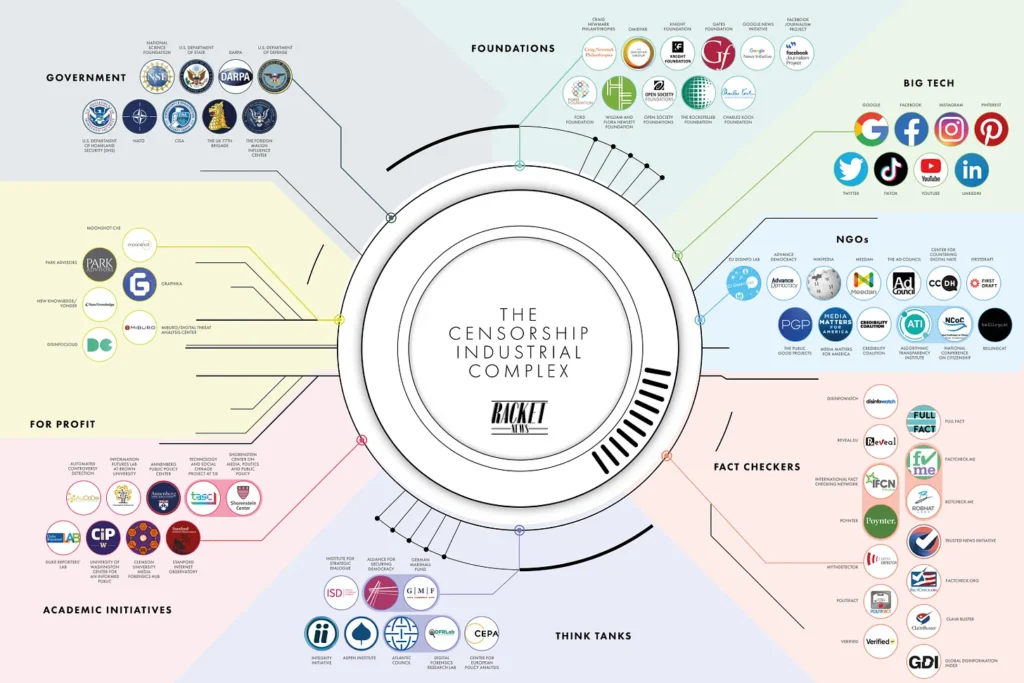
Report on the Censorship-Industrial Complex: The Top 50 Organizations to Know

The citizen’s starter kit to understanding the new global information cartel

Susan Schmidt,

Andrew Lowenthal,

Tom Wyatt,

Techno Fog, and 4 others

Originally published by Racket News on Substack on May 10, 2023

Introduction by Matt Taibbi

On January 17, 1961, outgoing President and former Supreme Allied Commander Dwight D. Eisenhower gave one of the most consequential speeches in American history. Eisenhower for eight years had been a popular president, whose appeal drew upon a reputation as a person of great personal fortitude, who’d guided the United States to victory in an existential fight for survival in World War II. Nonetheless, as he prepared to vacate the Oval Office for handsome young John F. Kennedy, he warned the country it was now at the mercy of a power even he could not overcome. 

Until World War II, America had no permanent arms manufacturing industry. Now it did, and this new sector, Eisenhower said, was building up around itself a cultural, financial, and political support system accruing enormous power. This “conjunction of an immense military establishment and a large arms industry is new in the American experience,” he said, adding:

In the councils of government, we must guard against the acquisition of unwarranted influence, whether sought or unsought, by the military-industrial complex. The potential for the disastrous rise of misplaced power exists and will persist. 

We must never let the weight of this combination endanger our liberties or democratic processes… Only an alert and knowledgeable citizenry can compel the proper meshing of the huge industrial and military machinery of defense with our peaceful methods and goals, so that security and liberty may prosper together. 

This was the direst of warnings, but the address has tended in the popular press to be ignored. After sixty-plus years, most of America – including most of the American left, which traditionally focused the most on this issue – has lost its fear that our arms industry might conquer democracy from within. 

Now, however, we’ve unfortunately found cause to reconsider Eisenhower’s warning.

While the civilian population only in recent years began haggling over “de-platforming” incidents involving figures like Alex Jones and Milo Yiannopoulos, government agencies had already long been advancing a new theory of international conflict, in which the informational landscape is more importantly understood as a battlefield than a forum for exchanging ideas. In this view, “spammy” ads, “junk” news, and the sharing of work from “disinformation agents” like Jones aren’t inevitable features of a free Internet, but sorties in a new form of conflict called “hybrid warfare.” 

In 1996, just as the Internet was becoming part of daily life in America, the U.S. Army published “Field Manual 100-6,” which spoke of “an expanding information domain termed the Global Information Environment” that contains “information processes and systems that are beyond the direct influence of the military.” Military commanders needed to understand that “information dominance” in the “GIE” would henceforth be a crucial element for “operating effectively.”

You’ll often see it implied that “information operations” are only practiced by America’s enemies, because only America’s enemies are low enough, and deprived enough of real firepower, to require the use of such tactics, needing as they do to “overcome military limitations.” We rarely hear about America’s own lengthy history with “active measures” and “information operations,” but popular media gives us space to read about the desperate tactics of the Asiatic enemy, perennially described as something like an incurable trans-continental golf cheat.

Indeed, part of the new mania surrounding “hybrid warfare” is the idea that while the American human being is accustomed to living in clear states of “war” or “peace,” the Russian, Chinese, or Iranian citizen is born into a state of constant conflict, where war is always ongoing, whether declared or not. In the face of such adversaries, America’s “open” information landscape is little more than military weakness.

In March of 2017, in a hearing of the House Armed Services Committee on hybrid war, chairman Mac Thornberry opened the session with ominous remarks, suggesting that in the wider context of history, an America built on constitutional principles of decentralized power might have been badly designed:

Americans are used to thinking of a binary state of either war or peace. That is the way our organizations, doctrine, and approaches are geared. Other countries, including Russia, China, and Iran, use a wider array of centrally controlled, or at least centrally directed, instruments of national power and influence to achieve their objectives…

Whether it is contributing to foreign political parties, targeted assassinations of opponents, infiltrating non-uniformed personnel such as the little green men, traditional media and social media, influence operations, or cyber-connected activity, all of these tactics and more are used to advance their national interests and most often to damage American national interests… 

The historical records suggest that hybrid warfare in one form or another may well be the norm for human conflict, rather than the exception.

Around that same time, i.e. shortly after the election of Donald Trump, it was becoming gospel among the future leaders of the “Censorship-Industrial Complex” that interference by “malign foreign threat actors” and the vicissitudes of Western domestic politics must be linked. Everything, from John Podesta’s emails to Trump’s Rust Belt primary victories to Brexit, were to be understood first and foremost as hybrid war events.

This is why the Trump-Russia scandal in the United States will likely be remembered as a crucial moment in 21st-century history, even though the investigation superficially ended a non-story, fake news in itself. What the Mueller investigation didn’t accomplish in ousting Trump from office, it did accomplish in birthing a vast new public-private bureaucracy devoted to stopping “mis-, dis-, and malinformation,” while smoothing public acquiescence to the emergence of a spate of new government agencies with “information warfare” missions. 

The “Censorship-Industrial Complex” is just the Military-Industrial Complex reborn for the “hybrid warfare” age.

Much like the war industry, pleased to call itself the “defense” sector, the “anti-disinformation” complex markets itself as merely defensive, designed to fend off the hostile attacks of foreign cyber-adversaries who unlike us have “military limitations.” The CIC, however, is neither wholly about defense, nor even mostly focused on foreign “disinformation.” It’s become instead a relentless, unified messaging system aimed primarily at domestic populations, who are told that political discord at home aids the enemy’s undeclared hybrid assault on democracy

They suggest we must rethink old conceptions about rights, and give ourselves over to new surveillance techniques like “toxicity monitoring,” replace the musty old free press with editors claiming a “nose for news” with an updated model that uses automated assignment tools like “newsworthy claim extraction,” and submit to frank thought-policing mechanisms like the “redirect method,” which sends ads at online browsers of dangerous content, pushing them toward “constructive alternative messages.”

Binding all this is a commitment to a new homogeneous politics, which the complex of public and private agencies listed below seeks to capture in something like a Unified Field Theory of neoliberal narrative, which can be perpetually tweaked and amplified online via algorithm and machine learning. This is what some of the organizations on this list mean when they talk about coming up with a “shared vocabulary” of information disorder, or “credibility,” or “media literacy.”

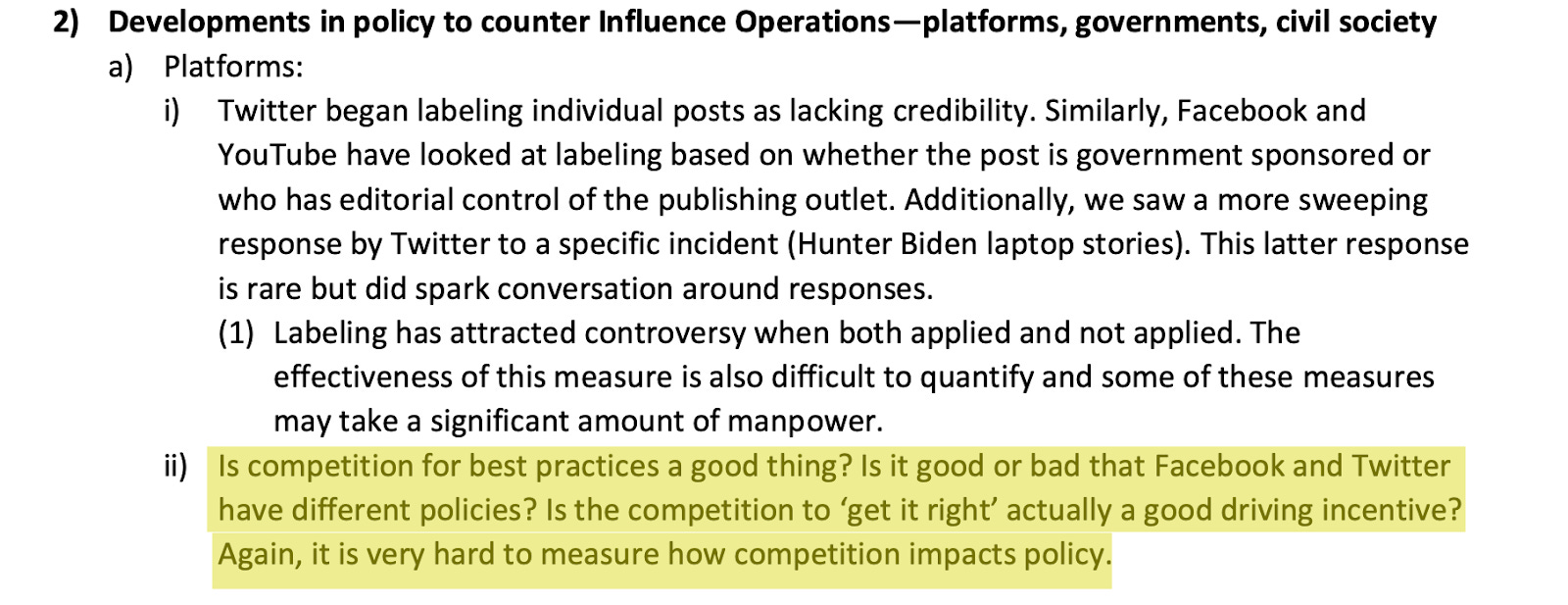
Anti-disinformation groups talk endlessly about building “resilience” to disinformation (which in practice means making sure the public hears approved narratives so often that anything else seems frightening or repellent), and audiences are trained to question not only the need for checks and balances, but competition. Competition is increasingly frowned upon not just in the “marketplace of ideas” (an idea itself more and more often described as outdated), but in the traditional capitalist sense. In the Twitter Files we repeatedly find documents like this unsigned “Sphere of Influence” review circulated by the Carnegie Endowment that wonders aloud if tech companies really need to be competing to “get it right”:
In place of competition, the groups we’ve been tracking favor the concept of the “shared endeavor” (one British group has even started a “Shared Endeavour” program), in which key “stakeholders” hash out their disagreements in private, but present a unified front.

Who are the leaders of these messaging campaigns? If you care to ask, the groups below are a good place to start. 

“The Top 50 List” is intended as a resource for reporters and researchers beginning their journey toward learning the scale and ambition of the “Censorship-Industrial Complex.” Written like a magazine feature, it tries to answer a few basic questions about funding, organization type, history, and especially, methodology. Many anti-disinformation groups adhere to the same formulaic approach to research, often using the same “hate-mapping,” guilt-by-association-type analysis to identify wrong-thinkers and suppressive persons. There is even a tendency to use what one Twitter Files source described as the same “hairball” graphs.

Where they compete, often, is in the area of gibberish verbiage describing their respective analytical methods. My favorite came from the Public Good Projects, which in a display of predictive skills reminiscent of the “unsinkable Titanic” described itself as the “Buzzfeed of public health.” 

Together, these groups are fast achieving what Eisenhower feared: the elimination of “balance” between the democratic need for liberalizing laws and institutions, and the vigilance required for military preparation. Democratic society requires the nourishment of free debate, disagreement, and intellectual tension, but the groups below seek instead that “shared vocabulary” to deploy on the hybrid battlefield. They propose to serve as the guardians of that “vocabulary,” which sounds very like the scenario Ike outlined in 1961, in which “public policy could itself become the captive of a scientific and technological elite.”

Without further ado, continue reading this introduction to the main – 50 – players in this “CIC”.
Share

Leave a Reply

Your email address will not be published. Required fields are marked *

Related Posts

PART 1 — Media, Culture and Information Sovereignty By Jan ObergTFF co-founder and director January 20, 2026 This is the first of four TFF-created idea portfolios designed to curb the global reach of the United States and, in both the short and long term, help catalyse a worldwide nonviolent resistance to what many observers describe as the Trump administration’s uniquely confrontational, destructive and world-threatening policies. These portfolios outline what governments and citizens across the world can do through dynamic diplomacy, creative initiatives, and strictly nonviolent means. They are typical TFF works in that we do not only tell what the problem is and how bad it will go – as 90+% of all commentators, experts and scholars do – we tell what we think can be done, inviting you to think of what you think you can do. It seems painfully clear to me that the current political dynamics in Washington increasingly resemble the most...
Officially, the drones were not identified. By simply thinking critically – which journalists and selected experts no longer do – there may be a good reason for that. And this article will never be mentioned in Denmark… Drones over Denmark. No damage. No trace. No answers. Yet the headlines scream “Russian threat,” and Prime Minister Mette Frederiksen speaks with a certainty that defies logic: “We don’t know they were Russian—but we know Russia is the biggest threat to Europe.” It could be nobody else – unless you make an interest analysis which I did two days ago. This is not security policy. It’s theatre. And the audience is being played. Let’s rewind. These drones—unphotographed, untracked, unclaimed—appear and vanish like ghosts. Airports shut down. Panic spreads. Military budgets swell. And the narrative hardens: Russia is behind it. But what if that’s not just wrong but deliberately misleading? Here’s a hypothesis for...
Drones over Nordic airports. No damage. No trace. No answers. Most assume Russia—but what if that’s not so? Why is there so much we are not told? This article explores the strategic ambiguity behind recent drone incursions and asks: Who else might benefit from sending drones into NATO airspace? From Ukraine’s surprising drone supremacy to Russia’s possible signalling, the silence itself may be the loudest message. These are the kinds of questions decent, intelligent investigative journalists and commentators could easily research. Why don’t they? Did you, dear reader, know or think of this? That the most powerful weapon in today’s conflicts might be the one that leaves no trace – and no answers. Just enough fear to justify the next move? Recently, drones have repeatedly appeared over Nordic airports and near some military facilities. They cause no damage – for which reason the designation “hybrid attack” is misleading but serves a purpose. These...

Recent Articles

Jan Oberg May 15, 2026 Go to this Fox News page and scroll the whole way down: President Donald Trump tells the world that his meeting with President Xi Jinping yielded a lot of very concrete political and economic results – of course, only where the Chinese side, according to him, agreed with him. He does not mention the Taiwan issue, but Secretary of State, Marco Rubio, says that it did not feature prominently in their talks and that the US policy on Taiwan has not changed. Then go to China Daily – or Global Times – and you will see that for the Chinese it is framework, principles, structure of cooperation etc. that matters – all embedded in the overall idea of “constructive bilateral relationship of strategic stability.” Nowhere is any concrete agreement or deal – all that Trump refers to – mentioned. At the general level, this gives you insights into the very different social...
Lena Petrova of “World Affairs In Context” with more than half a million subscribers on YouTube wanted to explore what a peace researcher like me has to say about, among other things, the First and the Second Cold War and why eethics has disappeared from politics. I am particularly happy about this conversation that also yielded an amazing number of very appreciative comments on YouTube. No doubt, people are longing for alternatives, including peace perspectives.
The MIMAC – Military-Industrial-Media-Academic Complex – drives the world’s rampant militarism and wars without end. Here is a short reflection of how it works against all interests of humanity. #5 deals with why there is no real enemy or threat images/analysis. It’s all ex-post constructions. And, btw, theTFF Peace Pulse is now on Rumble.

TFF on Substack

Discover more from TFF Transnational Foundation & Jan Oberg.

Most Popular

Jan Oberg May 15, 2026 Go to this Fox News page and scroll the whole way down: President Donald Trump tells the world that his meeting with President Xi Jinping yielded a lot of very concrete political and economic results – of course, only where the Chinese side, according to him, agreed with him. He does not mention the Taiwan issue, but Secretary of State, Marco Rubio, says that it did not feature prominently in their talks and that the US policy on Taiwan has not changed. Then go to China Daily – or Global Times – and you will see that for the Chinese it is framework, principles, structure of cooperation etc. that matters – all embedded in the overall idea of “constructive bilateral relationship of strategic stability.” Nowhere is any concrete agreement or deal – all that Trump refers to – mentioned. At the general level, this gives you insights into the very different social...
Lena Petrova of “World Affairs In Context” with more than half a million subscribers on YouTube wanted to explore what a peace researcher like me has to say about, among other things, the First and the Second Cold War and why eethics has disappeared from politics. I am particularly happy about this conversation that also yielded an amazing number of very appreciative comments on YouTube. No doubt, people are longing for alternatives, including peace perspectives.
The MIMAC – Military-Industrial-Media-Academic Complex – drives the world’s rampant militarism and wars without end. Here is a short reflection of how it works against all interests of humanity. #5 deals with why there is no real enemy or threat images/analysis. It’s all ex-post constructions. And, btw, theTFF Peace Pulse is now on Rumble.
Read More
Screenshot-2026-05-15-103534
Jan Oberg May 15, 2026 Go to this Fox News page and scroll the whole way down: President Donald Trump tells the world that his meeting with President Xi Jinping yielded a lot of very concrete political and economic results – of course, only where the Chinese side, according to him, agreed with him. He does not mention the Taiwan issue, but Secretary of State, Marco Rubio, says that it did not feature prominently in their talks and that the US policy on Taiwan has not changed. Then go to China Daily – or Global Times – and you will see that for the Chinese it is framework, principles, structure of cooperation etc. that matters – all embedded in the overall idea of “constructive bilateral relationship of strategic stability.” Nowhere is any concrete agreement or deal – all that Trump refers to – mentioned. At the general level, this gives you insights into the very different social...
Screenshot-2026-05-12-104023
Lena Petrova of “World Affairs In Context” with more than half a million subscribers on YouTube wanted to explore what a peace researcher like me has to say about, among other things, the First and the Second Cold War and why eethics has disappeared from politics. I am particularly happy about this conversation that also yielded an amazing number of very appreciative comments on YouTube. No doubt, people are longing for alternatives, including peace perspectives.
Screenshot-2026-04-13-154551 (2)
The MIMAC – Military-Industrial-Media-Academic Complex – drives the world’s rampant militarism and wars without end. Here is a short reflection of how it works against all interests of humanity. #5 deals with why there is no real enemy or threat images/analysis. It’s all ex-post constructions. And, btw, theTFF Peace Pulse is now on Rumble.
Screenshot-2026-04-13-154551 (1)
Jan Oberg, TFF director April 28, 2026 In this third TFF Peace Pulse, I make the important distinction between the violence and the conflict that violence is a symptom of. If you want peace, focus on the underlying conflict because that is the key to resolution, peacemaking, and a better future for the parties. The West is obsessed with violence, just look around you – and 90+ per cent of the public debate is about military issues and other violence – totally wasted for peace. These Peace Pulses will only be published here a few times. You will also not find them on YouTube and Vimeo because both platforms have blocked TFF and me; you know, peace is dangerous these days. Most TFF’s videos since 2007 are now on Rumble.
Screenshot-2026-04-13-154551
In contrast to most, we’ll bring alternatives, solutions, hope and strategies for a better future. Times are dangerous, yes, but that only intensifies the need for constructive thinking and action! Jan Oberg, TFF director April 13, 2026 The new TFF Peace Pulse uses video messages in a new way: Max 3-5-minute-long comments, ideas or perhaps mini-lectures, all about peace – positive peace. We launch them today on April 13, 2026 with a carefully crafted visual aesthetic fitting the content. We hope to publish them regularly from now on. We launch Peace Pulse (PP) – for a number of reasons. The world is in chaos, and there are countless reasons to feel concerned, frustrated, even angry. The atmosphere is saturated with doom and gloom, with negative energy and rear‑mirror thinking, while vision, imagination, alternatives, strategies and genuine future‑mindedness remain in short supply. And without them, we simply can’t save the world. Looking at problems from a hundred angles will...
IMG_5165 (1)
PART II — Publishing Peace in a System That Prioritises Militarism Jan Oberg, TFF director April 10, 2026 How TFF Maintains a Daily Voice in a Digital World Built for Noise This article is part of the series “TFF at 40″ and it invites you to learn about Four Decades of Publishing Peace. It takes a look at how a small, people‑financed peace foundation has communicated across four generations of technology — from wax stencils and fax machines to mass email and Substack — and why TFF continues to publish every single day in a system that rewards noise, conflict, and militarism. ◆ What it means to publish peace every single day in a digital system built for 24/7 news and other noise, confrontation, and militarism. How TFF’s independence, continuity, and global readership defy algorithms, donor cycles, and Western media censorhip — and why the Majority World keeps listening. When the...