
Kishore Mahbubani: The G-7, G-20 paradox

Image: Wikimedia Commons

By P&I Guest Writers

August 24, 2022

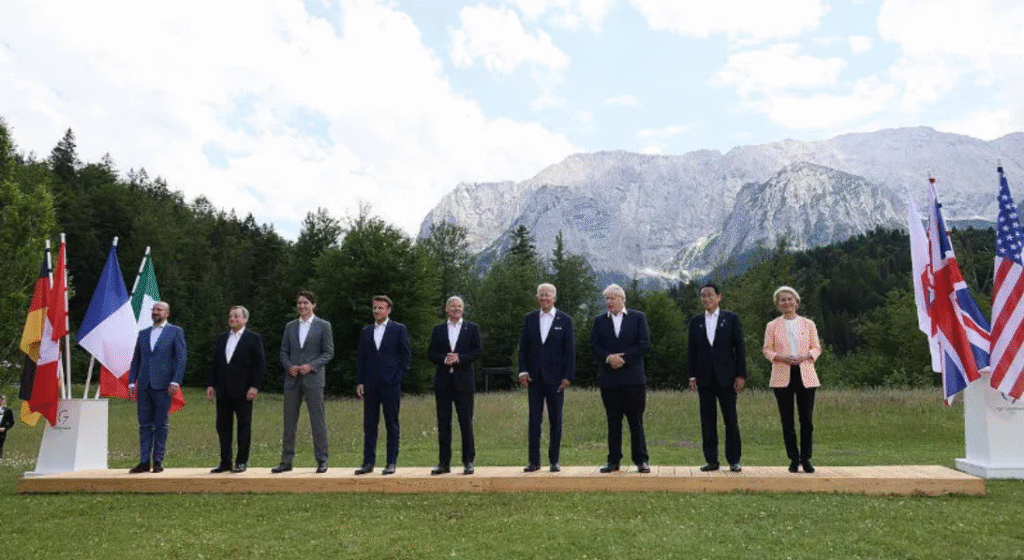
The G-7 countries are democratic domestically but are dictatorial globally. By contrast, the G-20 group, which has many autocratic regimes, represents a more democratic forum for governance.

The G-7 is dictatorial, while the G-20 is democratic.

This statement is obviously paradoxical. The G-7 countries are very proud of their liberal democratic societies. And they should be. However, while they are democratic domestically, they are dictatorial globally. By contrast, the G-20 group, which has many autocratic regimes, is more representative of the world’s population.

The spiritual essence of democracy is conveyed in the phrase: a government of the people, by the people, for the people. In short, it must represent a hundred per cent of the people. The G-7 represent just 10 per cent of the world’s population.

Yet, they make decisions and take actions that disrupt the lives of billions of people, including the world’s poor, without factoring in their interests and concerns. This is what dictators do.

Originally published at John Menadue’s “Pearls & Irritations” on August 4, 2022

The G-7 countries were right in imposing sanctions on Russia after its illegal invasion of Ukraine in February this year. But in designing the sanctions, the G-7 countries protected the interests of their own population, which makes up a minority of the world’s population. Indeed, the G-7 countries, especially the European countries, could have hastened the war’s end by boldly cutting off all the gas supplies from Russia immediately.

They didn’t do so because they didn’t want their own people to make any sacrifices. However, both the illegal Russian invasion and the subsequent sanctions led to massive increases in fuel and food prices, disrupting the lives of hundreds of millions, if not billions, of people, who had to make serious sacrifices.

Since the G-7 countries didn’t want to impose sacrifices on their own people, it was strange that they complained when China, India and other developing countries stepped up their purchases of Russian oil at a discount.

This led to two sharp responses from the Indian Foreign Minister S. Jaishankar. His two sharp responses resonated around the world. In response to criticisms about increased Indian oil purchases from Russia, he said: “India’s total purchases of oil from Russia in a month is probably less than what Europe does in an afternoon.” He also said, equally bitingly: “Europe has to grow out of the mindset that Europe’s problems are the world’s problems but the world’s problems are not Europe’s problems.”

Substitute G-7 for Europe and you get the essence of the problem with the G-7.

It takes care of the interests of the most privileged 10 per cent of the world’s population. It ignores the interests of the remaining 90 per cent. This is why the G-20 represents a more democratic forum governance. As Martin Wolf of the Financial Times wisely said: “The G-20 contains 63 per cent of the world’s people and 87 per cent of its output (at market prices). It contains the world’s most powerful countries and ones from every continent. It is our best chance for global economic governance.”

Even though the G-20 is a more democratic representation of the world’s population, some Western leaders are now suggesting that they should boycott the next G-20 leaders’ meeting, which will take place in Bali from Nov 15 to 16 2022, if Russian President Vladimir Putin is invited to attend. Any such Western boycott of the Bali Summit would be unwise. Indeed, it would damage the standing of the Western countries in the eyes of the majority of the world’s population in several ways.

Firstly, it will show the West acting in an “undemocratic” way by ignoring the wishes of the majority of the G-20 countries which want the meeting to continue, especially since the world is suffering from major global problems today. Secondly, if Mr Putin attends the G-20 meeting in Bali, he will hear the disapproving voices of both the West and the Rest on the invasion of Ukraine. He will also hear strong pleas to end the war as it is disrupting the lives of so many around the world.

Professor Barry R. Posen of MIT has argued persuasively in Foreign Affairs that the most likely result of the war in Ukraine is protracted conflict with painful losses on both sides. It’s thus in everyone’s best interests to “seek a diplomatic end to the war now”. His reasoning is sound. We’re more likely to get a diplomatic solution if Mr Putin hears clearly from his peers, both in the West and the Rest.

Finally, in ethical terms, the constituency we should care about the most is that of the very poor. On July 7, the United Nations Development Programme reported that an estimated 71 million people have fallen into poverty because of the skyrocketing food and fuel prices caused by the war in Ukraine, and that 750,000 people are at immediate risk of starvation. Given these dire challenges for the poor, it would be criminal to sabotage the November meeting of the G-20 leaders.

The West should also remember one important historical fact before taking action to undermine the Bali meeting. At the height of the Global Financial Crisis, when the Western countries were feeling threatened by an economic implosion, they convened the G-20 London Summit on April 2, 2009, to launch a global stimulus package to rescue the world economy.

All the G-20 countries – including the developing countries – participated in this US$1.1 trillion (S$1.53 trillion) rescue package, which was instrumental in turning things around for the embattled Western countries. The Rest didn’t hesitate to help the West in its hour of need. Perhaps the West should now consider repaying this debt by stepping up at the forthcoming Bali meeting to help the Rest.

Ultimately, to put it very simply, all eight billion people on Planet Earth are now on the same boat. We will sink or sail together. Let’s use the forthcoming G-20 meeting in Bali wisely to steer this common boat of ours.

Originally published at John Menadue’s “Pearls & Irritations” on August 4, 2022

About the author

Kishore Mahbubani is a veteran diplomat and a distinguished fellow at the Asia Research Institute at the National University of Singapore.

Source: The Straits Times © SPH Media Limited.

Please help TFF remain truly independent by contributing if you benefited from this article

[paypal-donation]

Share

Leave a Reply

Your email address will not be published. Required fields are marked *

Related Posts

Jan Oberg, TFF director April 9, 2026 I was recently invited to have a good, long talk about the world – and, of course, about peace too – with Boris Malagurski on his Weight of Chains Channel on YouTube. It was a real joy and seems to have been greatly appreciated by the viewers too. Mr Malagurski and I shall of course be grateful if you share this conversation in your circles – of course, only if you like what you see and hear  And remember that this one – like hundreds of others with TFF Associates – can be enjoyed at our TFF Video Collection.
This is not another geopolitical commentary on the Arctic. It is a visionary peace proposal that can save the region from militarised rivalry and ecological ruin. A blueprint for shared security, sustainable development, and human dignity — benefitting Greenland, the Arctic, and the rest of us. Jan Oberg TFF director Lund, Sweden, February 17, 2026 I. Four Principles for a New Arctic Vision The Arctic is often framed as a cold arena of rivalry — a place where great powers test each other’s resolve. But this worldview is outdated, unimaginative, and ultimately self‑defeating. The Arctic is not a vacuum waiting to be militarised; it is a living region, a climate stabiliser, and a cultural homeland whose future will shape the future of humanity. If we begin from that understanding, a far more rational Arctic order becomes possible — one that is peaceful, cooperative, and centred on the people who actually live there. This vision rests...
By Jan ObergTFF co-founder and director February 11, 2026 PART 3 — ECONOMICS, TRADE & FINANCIAL SOVEREIGNTY A. Trade Measures & Market Signaling Economic pressure can be applied instantly and scaled without violence. Immediate Measures (within a week) Government boycott US goods and services  A very powerful signal which over time will be felt. Targeted tariffs on selected U.S. goods Symbolic but high-visibility sectors send a clear message. Suspend trade facilitation talks A peaceful pause that signals deep concern. Freeze U.S. participation in public procurement – military procurement in particular A nonviolent way to reduce influence. Competition law review of U.S. corporations A legal tool to scrutinise market dominance. Longer-Term Measures EU–Asia–Africa trade corridors Reducing reliance on U.S. markets. European supply chains for critical minerals Strategic autonomy in resource access. European Strategic Trade Authority Monitoring coercive practices globally. Euro-denominated commodity markets Weakening the dollar’s pricing monopoly. The EU must resume contacts and negotiations with Russia, focusing on energy cooperation To...

Recent Articles

2003 The capital Bujumbura 2006 The capital Bujumbura 2006 Gitega, the second largest town& its surroundings 2007 Muramvia Back to Oberg’s Photography main page
By JONATHAN POWER August 16, 2000 LONDON – Remember the summer of ’98? In the sweltering, torpid heat of a Roman august, charged with exhaust fumes, the international community gave its overwhelming approval to the establishment of an International Criminal Court that will enable those accused of “crimes against humanity” to be tried and, if convicted, sentenced. Only seven nations opposed or abstained from the motion, including Israel, China, India and the U.S.A. where the Pentagon had successfully waged bureaucratic guerrilla war to undermine the initially sympathetic stance of President Bill Clinton. Two years on we can now see what an epochal event that was. In a the stroke of 120 pens it changed the climate on political thuggery. After numerous half-starts and false starts ever since the Nuremberg and Tokyo trials that convicted the war criminals of the Second World War, the world at last had agreed en masse a common...
By Jonathan Power April 8th 2004 LONDON – There is a widely held opinion abroad that Brazil never had the chance of profoundly changing for the better- shedding its widespread poverty and dire income distribution- until Lula (President Luiz Inácio da Silva) came along last year. This is not entirely false, but neither is it entirely true. Brazil has long made a kind of progress- in the last century it was second only to Taiwan as the fastest growing economy in the world- but it has been appallingly uneven. Part of the story of contemporary Brazil is clear to the eye in this small village of 7,000 people in the arid north east, along with the Amazon the poorest part of this vast country. Twenty five years or so ago I used to come to Pilõezinhos regularly when I had a close friend living here, Valéria Rezende, a radical, grass roots-stirring...

TFF on Substack

Discover more from TFF Transnational Foundation & Jan Oberg.

Most Popular

2003 The capital Bujumbura 2006 The capital Bujumbura 2006 Gitega, the second largest town& its surroundings 2007 Muramvia Back to Oberg’s Photography main page
By JONATHAN POWER August 16, 2000 LONDON – Remember the summer of ’98? In the sweltering, torpid heat of a Roman august, charged with exhaust fumes, the international community gave its overwhelming approval to the establishment of an International Criminal Court that will enable those accused of “crimes against humanity” to be tried and, if convicted, sentenced. Only seven nations opposed or abstained from the motion, including Israel, China, India and the U.S.A. where the Pentagon had successfully waged bureaucratic guerrilla war to undermine the initially sympathetic stance of President Bill Clinton. Two years on we can now see what an epochal event that was. In a the stroke of 120 pens it changed the climate on political thuggery. After numerous half-starts and false starts ever since the Nuremberg and Tokyo trials that convicted the war criminals of the Second World War, the world at last had agreed en masse a common...
By Jonathan Power April 8th 2004 LONDON – There is a widely held opinion abroad that Brazil never had the chance of profoundly changing for the better- shedding its widespread poverty and dire income distribution- until Lula (President Luiz Inácio da Silva) came along last year. This is not entirely false, but neither is it entirely true. Brazil has long made a kind of progress- in the last century it was second only to Taiwan as the fastest growing economy in the world- but it has been appallingly uneven. Part of the story of contemporary Brazil is clear to the eye in this small village of 7,000 people in the arid north east, along with the Amazon the poorest part of this vast country. Twenty five years or so ago I used to come to Pilõezinhos regularly when I had a close friend living here, Valéria Rezende, a radical, grass roots-stirring...
Read More
Generic thumbnail
2003 The capital Bujumbura 2006 The capital Bujumbura 2006 Gitega, the second largest town& its surroundings 2007 Muramvia Back to Oberg’s Photography main page
By JONATHAN POWER August 16, 2000 LONDON – Remember the summer of ’98? In the sweltering, torpid heat of a Roman august, charged with exhaust fumes, the international community gave its overwhelming approval to the establishment of an International Criminal Court that will enable those accused of “crimes against humanity” to be tried and, if convicted, sentenced. Only seven nations opposed or abstained from the motion, including Israel, China, India and the U.S.A. where the Pentagon had successfully waged bureaucratic guerrilla war to undermine the initially sympathetic stance of President Bill Clinton. Two years on we can now see what an epochal event that was. In a the stroke of 120 pens it changed the climate on political thuggery. After numerous half-starts and false starts ever since the Nuremberg and Tokyo trials that convicted the war criminals of the Second World War, the world at last had agreed en masse a common...
By Jonathan Power April 8th 2004 LONDON – There is a widely held opinion abroad that Brazil never had the chance of profoundly changing for the better- shedding its widespread poverty and dire income distribution- until Lula (President Luiz Inácio da Silva) came along last year. This is not entirely false, but neither is it entirely true. Brazil has long made a kind of progress- in the last century it was second only to Taiwan as the fastest growing economy in the world- but it has been appallingly uneven. Part of the story of contemporary Brazil is clear to the eye in this small village of 7,000 people in the arid north east, along with the Amazon the poorest part of this vast country. Twenty five years or so ago I used to come to Pilõezinhos regularly when I had a close friend living here, Valéria Rezende, a radical, grass roots-stirring...
Mearsheimer-800x418-1
A friendly quarrel while we agree that the US sanctions are a weapon of mass destruction and kill more people than wars do. And that we must talk much more about sanctions than we have so far. Jan Oberg, TFF director March 16, 2026 John Mearsheimer recently stated that U.S. sanctions murdered around 38 million people between 1971 and 2021 – see the video below. It is a dramatic figure, and it has spread quickly because it captures, in one sentence, the enormous human cost of modern sanctions. I share his concern about the destructive effects of economic coercion. But the specific number he cites — and the way he attributes it — deserves a friendly academic clarification. The figure comes from a 2023 Lancet Global Health article estimating the mortality effects of unilateral U.S. and EU sanctions over the past half‑century. This is the first point where Mearsheimer’s shorthand diverges from the text: the study...
Screenshot-2026-05-15-103534
Jan Oberg May 15, 2026 Go to this Fox News page and scroll the whole way down: President Donald Trump tells the world that his meeting with President Xi Jinping yielded a lot of very concrete political and economic results – of course, only where the Chinese side, according to him, agreed with him. He does not mention the Taiwan issue, but Secretary of State, Marco Rubio, says that it did not feature prominently in their talks and that the US policy on Taiwan has not changed. Then go to China Daily – or Global Times – and you will see that for the Chinese it is framework, principles, structure of cooperation etc. that matters – all embedded in the overall idea of “constructive bilateral relationship of strategic stability.” Nowhere is any concrete agreement or deal – all that Trump refers to – mentioned. At the general level, this gives you insights into the very different social...
Screenshot-2026-05-12-104023
Lena Petrova of “World Affairs In Context” with more than half a million subscribers on YouTube wanted to explore what a peace researcher like me has to say about, among other things, the First and the Second Cold War and why eethics has disappeared from politics. I am particularly happy about this conversation that also yielded an amazing number of very appreciative comments on YouTube. No doubt, people are longing for alternatives, including peace perspectives.