May 3, 2022
I recently participated in a commemoration of Martin Luther King’s address “Beyond Vietnam — A Time to Break Silence,” originally delivered on April 2, 1967, at New York City’s Riverside Church. King used the occasion to announce his opposition to the ongoing war in Vietnam. Although a long time coming in the eyes of some in the antiwar movement, his decision was one for which he was roundly criticized, even by supporters of the Civil Rights Movement. He was straying out of his prescribed lane, they charged, and needed to get back where he belonged.
This year’s 55th anniversary event, also held in Riverside Church’s magnificent sanctuary, featured inspiring Christian music and a thoughtful discussion of King’s remarks. Most powerful of all, however, was a public reading of the address itself. “Beyond Vietnam” contains many famously moving passages.
King, for example, cited “the cruel irony of watching Negro and white boys on TV screens as they kill and die together for a nation that has been unable to seat them together in the same schools” and would not allow them to live “on the same block in Chicago.” And he reflected on the incongruity of young Black men being sent “eight thousand miles away to guarantee liberties in Southeast Asia which they had not found in southwest Georgia and East Harlem.”
Originally published at Tomdispatch.com & Juancole.com
For me, at least, what that commemorative moment brought into sharp focus was his lacerating critique of American freedom. And there, to my mind, lies its lasting value.
Between theory and practice — between the aspirations expressed in the Declaration of Independence and the Constitution, on the one hand, and the pervasive presence of what King labeled the “giant triplets” of racism, materialism, and militarism on the other — there still looms, even in our own day, a massive gap. His address eloquently reflected on that gap, which, with the passage of time, has not appreciably narrowed.
King was neither the first nor the last observer to note the debased and shoddy nature of American-style freedom as actually practiced. Nor was he unique in pointing out the hypocrisy pervading our politics. Yet because of the moral heights to which he had ascended, his critique had a particular bite.
In 2022, we have arrived at a moment, however belatedly and reluctantly, when most (though by no means all) Americans at least acknowledge that racism forms an ugly thread that runs through our nation’s history, mocking our professed devotion to liberty and equality for all.
Of course, acknowledgement alone hardly entails remedy. At best, it makes remedies plausible. At worst, it offers an excuse for inaction, as if merely confessing to sin suffices to expunge it.
The attention given to racism of late has had exactly that unintended effect — relieving Americans of any obligation even to acknowledge the insidious implications of materialism and militarism. In that sense, even now, two of King’s giant triplets barely qualify for lip service. In the political sphere, they are either ignored or, at best, treated as afterthoughts.
Presidents typically have lots to say about lots of things and Joe Biden has very much adhered to that tradition. Rarely indeed — Jimmy Carter being the only exception I can think of — do they train their sights on the impact of materialism and militarism on American life. On those two subjects, the otherwise garrulous Biden has been silent.
Speaking in a prophetic register in his address, King had described the Vietnam War as “but a symptom of a far deeper malady within the American spirit.” And although that war ended half a century ago, the deeper malady still persists.
It can be seen in the widespread inequality and crippling poverty that pervade what is still the world’s richest nation, as well as in our country’s continuing appetite for war, whether waged directly or through proxies.
Above all, we see it in a stubborn refusal to recognize the kinship of lingering racism, ubiquitous materialism, and corrosive militarism, each drawing on and sustaining the others.
At Riverside Church, King charged that while the U.S. government might profess a principled commitment to peace, it had become “the greatest purveyor of violence in the world.” Given the crescendo of death and destruction still building in Vietnam, the truth of that statement in 1967 was — or ought to have been — indisputable.
Even taking into account the Russian invasion of Ukraine and the ensuing destruction and slaughter there, it still remains true today. Tally up the consequences of the various misbegotten post-9/11 campaigns undertaken pursuant to the “Global War on Terror” and the facts speak for themselves.
In 1967, King laid down this challenge: “We as a nation must undergo a radical revolution of values.” In the decades that followed, no such revolution occurred. Indeed, those who wield power, whether in Washington or Hollywood, on Wall Street or in Silicon Valley, generally exert themselves to suppress any such inclination, except perhaps when there is money to be made.
So today, materialism and militarism remain hidden in plain sight.
Reloading for the Next War
For those proponents of the status quo intent on sustaining an American proclivity for materialism and militarism, the Russo-Ukraine War could not have happened at a better time. Indeed, it comes as if a gift from the gods.
In terms of immediate impact, that war has affected the American polity in two ways. First, it is diverting attention from Washington’s manifest inability to deal effectively with an accumulation of problems to which our profligate conception of freedom has given rise, preeminently the climate crisis.
The horrifying news out of Kharkiv or Mariupol buried the latest report warning that ongoing climate mitigation efforts are almost certain to fall short, with catastrophic consequences.
Meanwhile, naked Russian aggression in Ukraine has also offered an excuse for Washington to treat as old news or no news the embarrassing debacle of the U.S. withdrawal from Kabul in August 2021. The Pentagon thereby effectively shrugs off a humiliating episode that capped 20 years of misguided and mismanaged military efforts in Afghanistan.
Among the proponents of American militarism, few things are more important than forgetting — no, obliterating — those two decades of dismal failure and disappointment. In essence, Russia’s invasion of Ukraine has enabled Washington to do just that. As if by magic, Putin has changed the subject.
As an illustration of how this works, consider a recent essay in Foreign Affairs, the flagship journal of the foreign-policy establishment. It carries the title “The Return of the Pax Americana?“
The question mark is misleading. An exclamation point would more accurately have captured the aims of its authors. Michael Beckley and Hal Brands teach at Tufts and Johns Hopkins, respectively. Both are also senior fellows at the hawkish American Enterprise Institute in Washington, D.C. And both welcome the Ukraine War as the medium that will reignite an American commitment to the sort of assertive and muscular approach to global policy favoured in militaristic quarters.
Russian President Vladimir Putin, they write, has handed the United States “a historic opportunity to regroup and reload for an era of intense competition” — with not only Russia but also China meant to be in our crosshairs. The call to reload is central to their message.
The authors blame a “prevailing public apathy” and “strategic lethargy” for reducing the U.S. to a position of weakness. Notably, their essay contains only a single passing reference to the wars in Afghanistan and Iraq, and no mention whatsoever of what two decades of post-9/11 U.S. war-making yielded and at what cost. At least implicitly, Beckley and Brands deem such conflicts irrelevant.
Considered from this perspective, the war in Ukraine could hardly have come at a better moment. According to Beckley and Brands, it opens “a window of strategic opportunity” to deal with “the coming wave of autocratic aggression” the authors see lurking just over the horizon.
Seizing that opportunity will require the United States — its military budget already far and away the world’s largest — to undertake “massive investments in military forces geared for high-intensity combat,” while displaying a “willingness to confront adversaries and even risk war” in the process. That prospect is one they welcome.
From any perspective, in my judgment, the Ukraine War is proving to be a disaster for all parties involved (weapons manufacturers excluded). Whenever and however that conflict finally ends, there will be no victors, just victims. Even so, Beckley and Brands celebrate the war as the occasion for a great awakening in Washington — the moment when policymakers rediscovered “the value of hard power.”
What Would Martin Say?
I cite the views of Beckley and Brands not because they are original or even particularly interesting, but because they capture the essence of the conventional wisdom in Washington. Unapologetic and unembarrassed by its string of recent failures, the war party — the sole surviving expression of Congressional bipartisanship — is once again climbing back into the saddle.
Just as the foreign-policy establishment once absolved itself of responsibility for Vietnam and labored to ignore its lessons, so, too, the current generation of that establishment is palpably eager to move on.
Its members welcome the prospect of a “New Cold War” that would enable the United States to relive the ostensible glory days of the last one, which included, of course, not only the Vietnam War but also Korea, a nuclear arms race, and a pattern of CIA “dirty tricks” among other abominations.
Beckley and Brands have functionally volunteered to serve as scribes for this diabolical project. Should Washington heed their call to action, they will leave to others the infamies that will inevitably ensue.
Although there’s no way to know with certainty what Martin Luther King would have made of this undertaking, it’s not hard to guess. In all likelihood, he would have condemned it without reservation. He would have rejected any propagandistic effort to disguise the imperial underpinnings of the latest emerging version of a Pax Americana.
He would have demanded an honest accounting of our just-concluded wars before embarking upon what Beckley and Brands misleadingly characterize as another “long twilight struggle.” He would have reiterated his call for a radical revolution in values, leading to a society in which people matter more than things.
He would almost certainly have cited the impending climate crisis (which Beckley and Brands ignore) to drive home the point that the United States of 2022 has more important priorities than embarking on a new great-power competition likely to yield nothing but tears.
“We are now faced with the fact,” King said, concluding his speech at Riverside Church in April 1967,
… “that tomorrow is today. We are confronted with the fierce urgency of now. In this unfolding conundrum of life and history, there is such a thing as being too late. Procrastination is still the thief of time. Life often leaves us standing bare, naked, and dejected with a lost opportunity. The tide in the affairs of men does not remain at flood — it ebbs. We may cry out desperately for time to pause in her passage, but time is adamant to every plea and rushes on. Over the bleached bones and jumbled residues of numerous civilizations are written the pathetic words, ‘Too late.’”
This has become the question of our time: Is it already too late? We must hope not.
But if sufficient time remains to save the planet and ourselves — not to mention our troubled democracy — it is likely to prove, at best, barely enough.
Certainly, we have no time to waste on further militarized fecklessness of the sort that has, in recent years, cost our country and others all too dearly. We can ill afford to defer King’s revolution in values further.
Copyright 2022 Andrew Bacevich
Originally published at Tomdispatch.com & Juancole.com
About the author
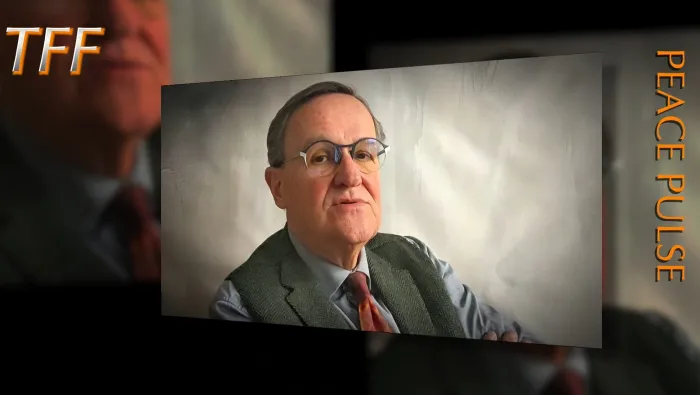
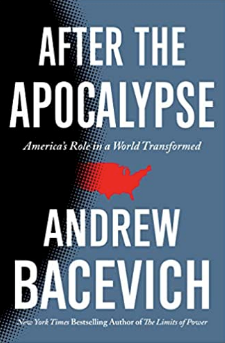
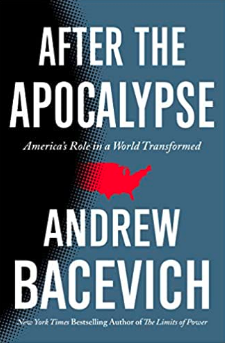
Andrew J. Bacevich is Professor Emeritus of International Relations and History at Boston University. A graduate of the U.S. Military Academy. He is the author of The Age of Illusions: How America Squandered Its Cold War Victory (Metropolitan Books, 2020) and of America’s War for the Greater Middle East: A Military History (Random House). He received his PhD in American Diplomatic History from Princeton University. His essays and reviews have appeared in The Wilson Quarterly, The National Interest, Foreign Affairs, Foreign Policy, The Nation, and The New Republic.
Please help TFF remain truly independent by contributing if you benefited from this article
[paypal-donation]