
Modern art was a CIA ’weapon’

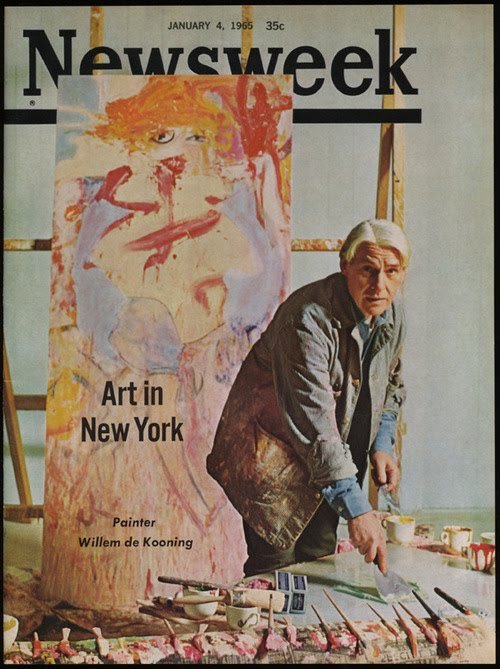
For decades in art circles it was either a rumour or a joke, but now it is confirmed as a fact. The Central Intelligence Agency used American modern art – including the works of such artists as Jackson Pollock, Robert Motherwell, Willem de Kooning and Mark Rothko – as a weapon in the Cold War.

In the manner of a Renaissance prince – except that it acted secretly – the CIA fostered and promoted American Abstract Expressionist painting around the world for more than 20 years.

Originally published in 1995 at The Independent and Voltairenet.org

The connection is improbable. This was a period, in the 1950s and 1960s, when the great majority of Americans disliked or even despised modern art – President Truman summed up the popular view when he said: “If that’s art, then I’m a Hottentot.”

As for the artists themselves, many were ex-communists barely acceptable in the America of the McCarthyite era, and certainly not the sort of people normally likely to receive US government backing.

Why did the CIA support them? Because in the propaganda war with the Soviet Union, this new artistic movement could be held up as proof of the creativity, the intellectual freedom, and the cultural power of the US. Russian art, strapped into the communist ideological straitjacket, could not compete.

The existence of this policy, rumoured and disputed for many years, has now been confirmed for the first time by former CIA officials. Unknown to the artists, the new American art was secretly promoted under a policy known as the “long leash” – arrangements similar in some ways to the indirect CIA backing of the journal Encounter, edited by Stephen Spender.

The decision to include culture and art in the US Cold War arsenal was taken as soon as the CIA was founded in 1947. Dismayed at the appeal communism still had for many intellectuals and artists in the West, the new agency set up a division, the Propaganda Assets Inventory, which at its peak could influence more than 800 newspapers, magazines and public information organisations.

They joked that it was like a Wurlitzer jukebox: when the CIA pushed a button it could hear whatever tune it wanted playing across the world.

The next key step came in 1950, when the International Organisations Division (IOD) was set up under Tom Braden. It was this office which subsidised the animated version of George Orwell’s Animal Farm, which sponsored American jazz artists, opera recitals, the Boston Symphony Orchestra’s international touring programme.

Its agents were placed in the film industry, in publishing houses, even as travel writers for the celebrated Fodor guides. And, we now know, it promoted America’s anarchic avant-garde movement, Abstract Expressionism.

Initially, more open attempts were made to support the new American art. In 1947 the State Department organised and paid for a touring international exhibition entitled “Advancing American Art“, with the aim of rebutting Soviet suggestions that America was a cultural desert.

But the show caused outrage at home, prompting Truman to make his Hottentot remark and one bitter congressman to declare: “I am just a dumb American who pays taxes for this kind of trash.” The tour had to be canceled.

The US government now faced a dilemma. This philistinism, combined with Joseph McCarthy’s hysterical denunciations of all that was avant-garde or unorthodox, was deeply embarrassing. It discredited the idea that America was a sophisticated, culturally rich democracy. It also prevented the US government from consolidating the shift in cultural supremacy from Paris to New York since the 1930s. To resolve this dilemma, the CIA was brought in.

The connection is not quite as odd as it might appear. At this time the new agency, staffed mainly by Yale and Harvard graduates, many of whom collected art and wrote novels in their spare time, was a haven of liberalism when compared with a political world dominated by McCarthy or with J. Edgar Hoover’s FBI.

If any official institution was in a position to celebrate the collection of Leninists, Trotskyites and heavy drinkers that made up the New York School, it was the CIA.

Until now there has been no first-hand evidence to prove that this connection was made, but for the first time a former case officer, Donald Jameson, has broken the silence. Yes, he says, the agency saw Abstract Expressionism as an opportunity, and yes, it ran with it.

“Regarding Abstract Expressionism, I’d love to be able to say that the CIA invented it just to see what happens in New York and downtown SoHo tomorrow!” he joked. “But I think that what we did really was to recognise the difference. It was recognised that Abstract Expression-ism was the kind of art that made Socialist Realism look even more stylised and more rigid and confined than it was. And that relationship was exploited in some of the exhibitions.

“In a way our understanding was helped because Moscow in those days was very vicious in its denunciation of any kind of non-conformity to its own very rigid patterns. And so one could quite adequately and accurately reason that anything they criticised that much and that heavy-handedly was worth support one way or another.”

To pursue its underground interest in America’s lefty avant-garde, the CIA had to be sure its patronage could not be discovered. “Matters of this sort could only have been done at two or three removes,” Mr. Jameson explained, “so that there wouldn’t be any question of having to clear Jackson Pollock, for example, or do anything that would involve these people in the organisation. And it couldn’t have been any closer, because most of them were people who had very little respect for the government, in particular, and certainly none for the CIA. If you had to use people who considered themselves one way or another to be closer to Moscow than to Washington, well, so much the better perhaps.”

This was the “long leash”. The centrepiece of the CIA campaign became the Congress for Cultural Freedom, a vast jamboree of intellectuals, writers, historians, poets, and artists which was set up with CIA funds in 1950 and run by a CIA agent.

It was the beach-head from which culture could be defended against the attacks of Moscow and its “fellow travellers” in the West. At its height, it had offices in 35 countries and published more than two dozen magazines, including Encounter.

The Congress for Cultural Freedom also gave the CIA the ideal front to promote its covert interest in Abstract Expressionism. It would be the official sponsor of touring exhibitions; its magazines would provide useful platforms for critics favourable to the new American painting; and no one, the artists included, would be any the wiser.

This organisation put together several exhibitions of Abstract Expressionism during the 1950s. One of the most significant, “The New American Painting”, visited every big European city in 1958-59. Other influential shows included “Modern Art in the United States” (1955) and “Masterpieces of the Twentieth Century” (1952).

Because Abstract Expressionism was expensive to move around and exhibit, millionaires and museums were called into play. Pre-eminent among these was Nelson Rockefeller, whose mother had co-founded the Museum of Modern Art in New York.

As president of what he called “Mummy’s museum”, Rockefeller was one of the biggest backers of Abstract Expressionism (which he called “free enterprise painting”). His museum was contracted to the Congress for Cultural Freedom to organise and curate most of its important art shows.

The museum was also linked to the CIA by several other bridges. William Paley, the president of CBS broadcasting and a founding father of the CIA, sat on the members’ board of the museum’s International Programme.

John Hay Whitney, who had served in the agency’s wartime predecessor, the OSS, was its chairman. And Tom Braden, first chief of the CIA’s International Organisations Division, was executive secretary of the museum in 1949.

Now in his eighties, Mr. Braden lives in Woodbridge, Virginia, in a house packed with Abstract Expressionist works and guarded by enormous Alsatians. He explained the purpose of the IOD.

“We wanted to unite all the people who were writers, who were musicians, who were artists, to demonstrate that the West and the United States was devoted to freedom of expression and to intellectual achievement, without any rigid barriers as to what you must write, and what you must say, and what you must do, and what you must paint, which was what was going on in the Soviet Union. I think it was the most important division that the agency had, and I think that it played an enormous role in the Cold War.”

He confirmed that his division had acted secretly because of the public hostility to the avant-garde: “It was very difficult to get Congress to go along with some of the things we wanted to do – send art abroad, send symphonies abroad, publish magazines abroad. That’s one of the reasons it had to be done covertly. It had to be a secret. In order to encourage openness we had to be secret.”

If this meant playing pope to this century’s Michelangelos, well, all the better: “It takes a pope or somebody with a lot of money to recognise art and to support it,” Mr. Braden said. “And after many centuries people say, ’Oh look! the Sistine Chapel, the most beautiful creation on Earth!’ It’s a problem that civilisation has faced ever since the first artist and the first millionaire or pope who supported him. And yet if it hadn’t been for the multi-millionaires or the popes, we wouldn’t have had the art.”

Would Abstract Expressionism have been the dominant art movement of the post-war years without this patronage? The answer is probably yes. Equally, it would be wrong to suggest that when you look at an Abstract Expressionist painting you are being duped by the CIA.

But look where this art ended up: in the marble halls of banks, in airports, in city halls, boardrooms and great galleries. For the Cold Warriors who promoted them, these paintings were a logo, a signature for their culture and system which they wanted to display everywhere that counted. They succeeded.

Covert Operation

In 1958 the touring exhibition “The New American Painting”, including works by Pollock, de Kooning, Motherwell and others, was on show in Paris. The Tate Gallery was keen to have it next, but could not afford to bring it over. Late in the day, an American millionaire and art lover, Julius Fleischmann, stepped in with the cash and the show was brought to London.

The money that Fleischmann provided, however, was not his but the CIA’s. It came through a body called the Farfield Foundation, of which Fleischmann was president, but far from being a millionaire’s charitable arm, the foundation was a secret conduit for CIA funds.

So, unknown to the Tate, the public or the artists, the exhibition was transferred to London at American taxpayers’ expense to serve subtle Cold War propaganda purposes.

A former CIA man, Tom Braden, described how such conduits as the Farfield Foundation were set up. “We would go to somebody in New York who was a well-known rich person and we would say, ’We want to set up a foundation.’ We would tell him what we were trying to do and pledge him to secrecy, and he would say, ’Of course I’ll do it,’ and then you would publish a letterhead and his name would be on it and there would be a foundation. It was really a pretty simple device.”

Julius Fleischmann was well placed for such a role. He sat on the board of the International Programme of the Museum of Modern Art in New York – as did several powerful figures close to the CIA.

Originally published at voltairenet.org

About the author

Frances Stonor Saunders is author of a masterful study on the CIA and the cultural Cold War, which provided a detailed account of the CIA’s covert role in sponsoring Abstract Expressionist painting in the United States – and many other CIA operations in various fields of culture.
The CIA exploited this artistic movement as a showcase of freedom and free enterprise, and to counteract the influence that communist ideology still had for many intellectuals and artists in the West.
In 2000, Saunders published it all in Who Pays The Piper? CIA and the Cultural Cold War, Granta, 509 pages.

Did you enjoy this article? You can show it here:

[paypal-donation]
Share

Leave a Reply

Your email address will not be published. Required fields are marked *

Related Posts

list=PLgfli1PY64h3bpPsycG1E1PquoujN9wIIu0026ab_channel=NeutralityStudies”,”type”:”video”,”providerNameSlug”:”youtube”,”responsive”:true,”className”:”wp-embed-aspect-16-9 wp-has-aspect-ratio”} –>
Launched on November 17, 2024Updated with new materials regularly TFF Board members Thore Vest. Everywhere, the delegation was met with a sincere wish to develop knowledge, dialogue, cooperative projects, and initiatives based on citizens’ diplomacy – in general, but with the West in particular. For more, see “Report from the Nordic delegation to China’s Xinjiang Province, September 7-15, 2024.” While the delegation was in Xinjiang, various ideas were already being discussed from the local to the top level, i.e., with the governor and party leaders of Xinjiang. The two TFF Associates suggested that TFF set up a special section – in addition to its “China and Silk” – where various quality materials about Xinjiang would regularly be published to promote public education about Xinjiang, particularly its contemporary development – worldwide but in the West in particular. This is now a reality – as can be seen below – but it...
On the invisible codes of culture that shape our worldviews long before memory or reason. This analysis was initially published on the author’s “China21 Journal” which contains several analyses of related issues, China-Western relations and how to increase knowledge and mutual understanding. Last week, we picked up our 5-year-old son from his public kindergarten in Beijing. On the way home, he proudly recited a Tang Dynasty poem by heart — 春望 (Chūnwàng, or Spring View, 757 AD), one of the most famous and widely recited works from that vibrant dynastic era over a thousand years ago, written by the renowned poet 杜甫 (Dù Fǔ, 712–770). The poem reflects on wartime and exile — hardly light or child-friendly themes. But that’s not the point. Children (and adults) recite ancient poems not just for their content, but for their rhythm, rhyme, tone, and the cultural feeling embedded in them. This is how cultural programming begins: not through rules or explanations,...

Recent Articles

Gandhi, Arun. Lord Richard Attenborough. Kasturba: a lifeNew Delhi: Penguin Books Ltd., 2000.315 pp, 295 Indian Rs, US $22.51 January 29, 2002 Arun Gandhi, grandson to Mohandas and Kasturba, has written a thorough account of Kasturba’s life. Arun begins with a description of Kasturba’s childhood in Porbandar in the late1800s, before she met Mohandas. By having chosen to embark on difficult research into his grandmother’s life, including her first years which are not well-documented, Arun ensures that the reader receives an intimate and life-long portrait of this amazing woman. Kasturba is presented as a lively woman &endash; obedient, yet with a mind of her own. As the relationship between Kasturba and Mohandas developed, Arun maintains that Kasturba’s influence over Mohandas in her own quiet way also grew, to which some of Mohandas’ writings also attest.  Arun paints a vivid picture of the beginnings of Mohandas’ non-violence movement in South Africa, a...
In response to an urgent Appeal from all the living Nobel Peace Prize Laureates, the General Assembly of the United Nations, on November 1998, unanimously declared the first decade of the twenty-first century to be The Decade for a Culture of Peace and Nonviolence. While people are naturally concerned about the amount of violence in our world and how it threatens our future, the Nobel Laureates are right to remind us of the potential of nonviolence and our calling to build a culture of peace and nonviolence.  The twentieth century is instructive in the way that the philosophy and practice of nonviolence have begun to flourish and in the way that nonviolent movements have had an exponential growth across the world. Mohandas Gandhi and Martin Luther King, Jr. are the most famous nonviolent leaders but many have built upon the paths they charted as in country after country, tyrannies and...
We know that medical personnel have failed to report to higher authorities wounds that were clearly caused by torture and that they have neglected to take steps to interrupt this torture. In addition, they have turned over prisoners’ medical records to interrogators who could use them to exploit the prisoners’ weaknesses or vulnerabilities. We have not yet learned the extent of medical involvement in delaying and possibly falsifying the death certificates of prisoners who have been killed by torturers. A May 22 article on Abu Ghraib in the New York Times states that “much of the evidence of abuse at the prison came from medical documents” and that records and statements “showed doctors and medics reporting to the area of the prison where the abuse occurred several times to stitch wounds, tend to collapsed prisoners or see patients with bruised or reddened genitals.” http://www.truthout.org/docs_04/080604J.shtml#16 According to the article, two doctors who...

TFF on Substack

Discover more from TFF Transnational Foundation & Jan Oberg.

Most Popular

Gandhi, Arun. Lord Richard Attenborough. Kasturba: a lifeNew Delhi: Penguin Books Ltd., 2000.315 pp, 295 Indian Rs, US $22.51 January 29, 2002 Arun Gandhi, grandson to Mohandas and Kasturba, has written a thorough account of Kasturba’s life. Arun begins with a description of Kasturba’s childhood in Porbandar in the late1800s, before she met Mohandas. By having chosen to embark on difficult research into his grandmother’s life, including her first years which are not well-documented, Arun ensures that the reader receives an intimate and life-long portrait of this amazing woman. Kasturba is presented as a lively woman &endash; obedient, yet with a mind of her own. As the relationship between Kasturba and Mohandas developed, Arun maintains that Kasturba’s influence over Mohandas in her own quiet way also grew, to which some of Mohandas’ writings also attest.  Arun paints a vivid picture of the beginnings of Mohandas’ non-violence movement in South Africa, a...
In response to an urgent Appeal from all the living Nobel Peace Prize Laureates, the General Assembly of the United Nations, on November 1998, unanimously declared the first decade of the twenty-first century to be The Decade for a Culture of Peace and Nonviolence. While people are naturally concerned about the amount of violence in our world and how it threatens our future, the Nobel Laureates are right to remind us of the potential of nonviolence and our calling to build a culture of peace and nonviolence.  The twentieth century is instructive in the way that the philosophy and practice of nonviolence have begun to flourish and in the way that nonviolent movements have had an exponential growth across the world. Mohandas Gandhi and Martin Luther King, Jr. are the most famous nonviolent leaders but many have built upon the paths they charted as in country after country, tyrannies and...
We know that medical personnel have failed to report to higher authorities wounds that were clearly caused by torture and that they have neglected to take steps to interrupt this torture. In addition, they have turned over prisoners’ medical records to interrogators who could use them to exploit the prisoners’ weaknesses or vulnerabilities. We have not yet learned the extent of medical involvement in delaying and possibly falsifying the death certificates of prisoners who have been killed by torturers. A May 22 article on Abu Ghraib in the New York Times states that “much of the evidence of abuse at the prison came from medical documents” and that records and statements “showed doctors and medics reporting to the area of the prison where the abuse occurred several times to stitch wounds, tend to collapsed prisoners or see patients with bruised or reddened genitals.” http://www.truthout.org/docs_04/080604J.shtml#16 According to the article, two doctors who...
Read More
Imagen-thumbnail-The-Transnational-1
Gandhi, Arun. Lord Richard Attenborough. Kasturba: a lifeNew Delhi: Penguin Books Ltd., 2000.315 pp, 295 Indian Rs, US $22.51 January 29, 2002 Arun Gandhi, grandson to Mohandas and Kasturba, has written a thorough account of Kasturba’s life. Arun begins with a description of Kasturba’s childhood in Porbandar in the late1800s, before she met Mohandas. By having chosen to embark on difficult research into his grandmother’s life, including her first years which are not well-documented, Arun ensures that the reader receives an intimate and life-long portrait of this amazing woman. Kasturba is presented as a lively woman &endash; obedient, yet with a mind of her own. As the relationship between Kasturba and Mohandas developed, Arun maintains that Kasturba’s influence over Mohandas in her own quiet way also grew, to which some of Mohandas’ writings also attest.  Arun paints a vivid picture of the beginnings of Mohandas’ non-violence movement in South Africa, a...
Imagen-thumbnail-The-Transnational-1
In response to an urgent Appeal from all the living Nobel Peace Prize Laureates, the General Assembly of the United Nations, on November 1998, unanimously declared the first decade of the twenty-first century to be The Decade for a Culture of Peace and Nonviolence. While people are naturally concerned about the amount of violence in our world and how it threatens our future, the Nobel Laureates are right to remind us of the potential of nonviolence and our calling to build a culture of peace and nonviolence.  The twentieth century is instructive in the way that the philosophy and practice of nonviolence have begun to flourish and in the way that nonviolent movements have had an exponential growth across the world. Mohandas Gandhi and Martin Luther King, Jr. are the most famous nonviolent leaders but many have built upon the paths they charted as in country after country, tyrannies and...
Imagen-thumbnail-The-Transnational-1
We know that medical personnel have failed to report to higher authorities wounds that were clearly caused by torture and that they have neglected to take steps to interrupt this torture. In addition, they have turned over prisoners’ medical records to interrogators who could use them to exploit the prisoners’ weaknesses or vulnerabilities. We have not yet learned the extent of medical involvement in delaying and possibly falsifying the death certificates of prisoners who have been killed by torturers. A May 22 article on Abu Ghraib in the New York Times states that “much of the evidence of abuse at the prison came from medical documents” and that records and statements “showed doctors and medics reporting to the area of the prison where the abuse occurred several times to stitch wounds, tend to collapsed prisoners or see patients with bruised or reddened genitals.” http://www.truthout.org/docs_04/080604J.shtml#16 According to the article, two doctors who...
Imagen-thumbnail-The-Transnational-1
Jan Øberg behandler i artiklen en lang række faktorer, som ligger til grund for den måde vores samfund er organiseret på – og derfor også for konflikter. Artiklen introducerer således sammenhængen mellem familien, foreninger, regeringer, NGO’ er, nation, stat, nationalstat og alliancer for på denne måde bedre at kunne forstå konflikter og i sidste ende blive klogere mht. at løse disse. Øberg, der er fortaler for global bevidsthed, hvilket skal ses i lyset af den øgede globalisering, skelner mellem kulturkamp og kulturdialog. Endelig behandles begrebet magt og magtesløshed: giver magt ret til at udøve magt – fordi man mener at have ret? Litteraturliste og arbejdsspørgsmål efter artiklen. Ordene vi bruger om verden I satellitperspektiv kan man godt tale om den menneskelige familie eller menneskeheden. Udtrykket understreger, at der eksisterer – eller burde eksistere – et fællesskab fordi vi alle er mennesker og sammen bebor denne klode og ingen anden. Og...
Imagen-thumbnail-The-Transnational-1
Kapitel 2: Forskellige sider af Europa og USA…fortsat 2.5 Militære relationer I forbifarten har vi allerede sagt nogle ting om USA’s militære situation. Kig lige en gang til på afsnit 2.3. Nu skal vi uddybe det militære forhold mellem USA og EU. Der er en række ligheder mellem visse europæiske landes og USA’s militær. Næsten alle er med på en eller anden måde i NATO, direkte som medlem – selv Island, der ikke har et forsvar – eller indirekte i Partnerskab for Fred. USA og Canada er med i OSCE (på dansk OSSE), Organisationen for Sikkerhed og Samarbejde i Europa, der tæller over 50 lande. USA samt England og Frankrig er kernevåbenstater og de har styrker til intervention langt borte fra hjemlandet, om end USA’s er tifold større. Alle har også en omfattende våbeneksport og bruger den som et middel til at tjene penge og få loyale venner på, det...
Imagen-thumbnail-The-Transnational-1
Background Christian Harleman and Jan Oberg conducted a fact-finding mission to Burundi between November 26 and December 6, 2003. (See websites about the country here). The first TFF mission took place in March 1999. Unfortunately, since then it has not been practically possible to implement the co-operation with Burundi’s Ministry of Education and Burundian NGOs that was planned at the time. The 2003 mission had three purposes. First, to do fact-finding in general about the situation and, in particular, the progress under the Arusha Peace Process. Second, to explore the possibilities for co-operation between the government and relevant NGOs on the one hand and TFF on the other, in order to develop and deepen the existing competence in fields such as conflict-understanding, reconciliation and peace-building. Finally, third, to find out whether it would be possible, in co-operation with the Swedish Rescue Services Agency (Statens Räddningsverk), to establish a health care unit that...