Americans are ready for a different approach to nuclear weapons

By Dr. Lawrence Wittner

January 17, 2020

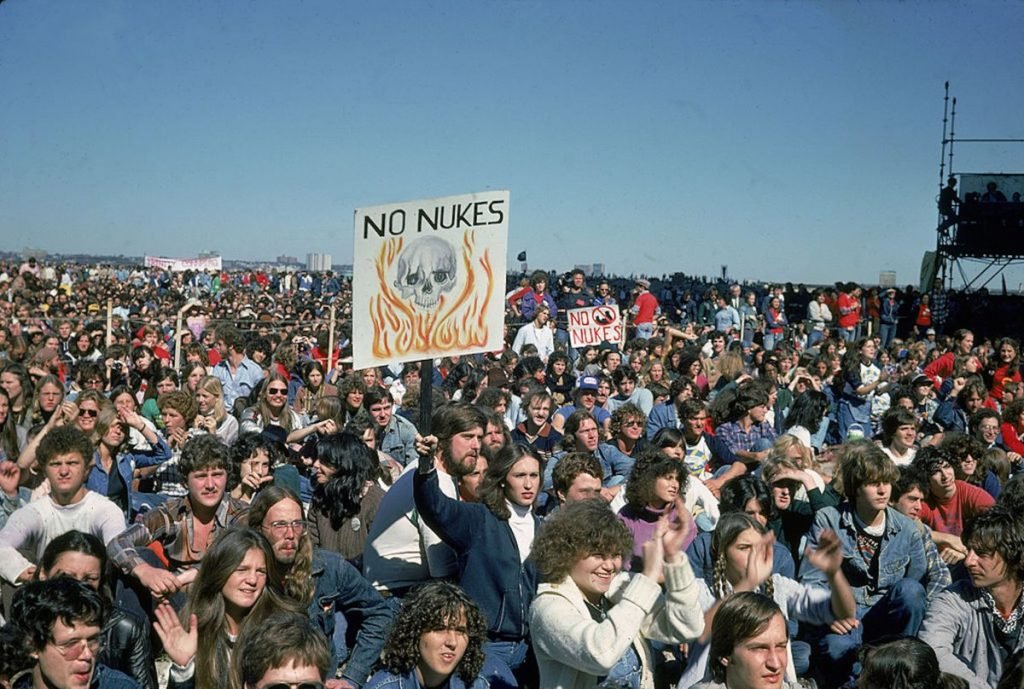
Although today’s public protests against nuclear weapons can’t compare to the major antinuclear upheavals of past decades, there are clear indications that most Americans reject the Trump administration’s nuclear weapons policies.

Originally posted on History News Network on December 22, 2019 here

Since entering office in 2017, the Trump administration has withdrawn the United States from the nuclear agreement with Iranscrapped the Intermediate-Range Nuclear Forces (INF) Treaty with Russia, and apparently abandoned plans to renew the New START Treaty with Russia. After an overwhelming majority of the world’s nations agreed on a landmark UN Treaty on the Prohibitions of Nuclear Weapons in July 2017, the Trump administration quickly announced that it would never sign the treaty.  The only nuclear arms control measure that the Trump administration has pursued―an agreement by North Korea to abandon its nuclear weapons program―appears to have collapsed, at least in part because the Trump administration badly mishandled the negotiations.

Moreover, the Trump administration has not only failed to follow the nuclear arms control and disarmament policies of its Democratic and Republican predecessors, but has plunged into a renewed nuclear arms race with other nations by championing a $1.7 trillion program to refurbish the entire U.S. nuclear weapons complex.  Perhaps most alarming, it has again and again publicly threatened to initiate a nuclear war.

These policies are quite out of line with U.S. public opinion.

Polling Americans in July 2018 about Trump’s withdrawal of the United States from the Iran nuclear agreement, the Chicago Council on Global Affairs found that 66 percent of respondents preferred remaining within it.  In February 2019, when the Chicago Council surveyed Americans about U.S. withdrawal from the INF Treaty, 54 percent opposed the action.  Moreover, when Americans were presented with arguments for and against withdrawal, opposition to withdrawal rose to 66 percent. 

The Center for International & Security Studies at the University of Maryland also reported overwhelming public support for nuclear arms control and disarmament agreements.  Polling Americans in early 2019, the Center found that two-thirds of respondents (including a majority of Republicans) favored remaining within the INF Treaty, while eight out of ten respondents wanted the U.S. government to extend the New START Treaty. Indeed, more than eight out of ten U.S. respondents backed new nuclear arms control treaties with Russia―findings similar to those of the Chicago Council, which reported that 87 percent of American respondents to a poll in early 2019 wanted the United States and Russia to secure a further nuclear arms limitation agreement.

But just how much arms control and disarmament do Americans want?  It might come as a shock to the many pundits in the mass media who have never mentioned the 2017 UN Treaty on the Prohibition of Nuclear Weapons, but roughly half the U.S. population supports nuclear abolition along the lines of the treaty.  According to a YouGov opinion survey done in late September 2019, 49 percent of American respondents thought the United States should work with other nations to eliminate all nuclear weapons in the world. Only 32 percent disagreed, while 19 percent said they didn’t know.

When it comes to actual use of nuclear weapons, Americans are even clearer in their preferences.  A YouGov/Huffington Post poll in August 2016 found that 67 percent of American respondents thought the U.S. government should never initiate a nuclear attack.  In mid-2019, Zogby Analytics surveys of American respondents in key primary states also discovered very high levels of opposition to first use of nuclear weapons.

Not surprisingly, Donald Trump’s angry, impulsive behavior, coupled with his threats to launch nuclear attacks upon other nations, has left many Americans uneasy.  This might help to explain why 68 percent of Americans surveyed in early 2019 by the Center for International & Security Studies backed congressional legislation requiring that a president, before ordering a nuclear attack upon another nation, consult with congress and secure a congressional declaration of war upon that nation.  As the U.S. congress has not passed a declaration of war since 1941, this opinion, too, provides a substantial challenge to current U.S. nuclear policy.

There are other indications, as well, that the American public wants a new approach.  In July 2019, the U.S. Conference of Mayors, at its 87th annual meeting, unanimously passed a resolution calling on all U.S. presidential candidates “to pledge U.S. global leadership in preventing nuclear war, returning to diplomacy, and negotiating the elimination of nuclear weapons.”  Calling for negotiations to replace the INF Treaty and to extend or replace the New START Treaty, the resolution demanded that candidates support the Treaty on the Prohibition of Nuclear Weapons and renounce the option of first use of nuclear weapons.

Yet another sign of public discontent is the emerging Back from the Brink campaign, supported by numerous peace, environmental, religious, health, and other organizations.  Endorsed by dozens of cities and towns across the country, it has also received the official backing of the state legislatures of California and Oregon, as well as of the New Jersey State Assembly and the Maine State Senate.  The campaign calls on the U.S. government to “lead a global effort to prevent nuclear war” by: “renouncing the option of using nuclear weapons first”; “ending the sole, unchecked authority of any U.S. president to launch a nuclear attack”; “taking U.S. nuclear weapons off hair-trigger alert”; “cancelling the plan to replace its entire nuclear arsenal with enhanced weapons”; and “actively pursuing a verifiable agreement among nuclear-armed states to eliminate their nuclear arsenals.”

Looked at from the standpoint of most Americans and, indeed, survival in the nuclear age, this departure from the dangerous direction of U.S. nuclear policy makes a lot of sense.  Looked at from the standpoint of candidates seeking election to national office, it would also make good politics.

If you appreciated this…

[paypal-donation]


Dr. Lawrence Wittner is a prominent American historian who has combined intellectual life with activism for peace and social justice. He is a professor of History Emeritus at SUNY/Albany and the author of Confronting the Bomb (Stanford University Press).
Share

Leave a Reply

Your email address will not be published. Required fields are marked *

Related Posts

PRESS RELEASE – 6 OCTOBER 2025 LAY DOWN YOUR ARMSPEACE PRIZE FOR 2025 is awarded Francesca Albanese The United Nations Special Rapporteur on the occupied Palestinian territories – as the person who, in accordance with Alfred Nobel’s will, has “done the most or the best work for fraternity between nations and for the abolition or reduction of standing armies as well as for the holding and promotion of peace congresses.” Francesca Albanese has forcefully and unwaveringly worked against Israel’s full-scale war on the occupied Palestinian territories, in particular Israel´s ongoing genocide against the Palestinian people. She has confronted Israel’s systematic war crimes and crimes against humanity in a truly global outreach. Further, she has brought governments, international organisations and people’s groups together to underline the responsibility of the world at large to act and to stop arming, enabling, and profiting from Israel’s ongoing criminal actions. But first of all, Albanese...
And why the world, especially the EU, must now declare itself independent of the United States. UN’s 80th anniversary This year, the United Nations celebrates the 80th anniversary of its founding. The UN was formed after the scourge of the Second World War, in which 70 to 85 million people were killed and many countries were destroyed. That war came on the heels of the First World War, which also killed between 15 and 22 million people. After the Second World War, especially after the use of nuclear weapons by the United States, which marked a turning point in the history of warfare that could result in the end of civilisation as we know it, humanity decided to move away from the era of empires and big power politics and usher in a new era of peace, freedom and cooperation. These were the principles enshrined in the UN Charter. The United States...
America’s Strategic Assault on Art, Academia, and the Imagination That Sustains Peace The United States once stood as a beacon of cultural audacity—a place where dissent could be beautiful, and beauty and innovation could challenge the present order of things. Its museums, universities, and artists helped inspire a worldwide imagination rooted in creative freedom and innovation. But today, under the Trump regime’s second term, those dynamic qualities are being systematically dismantled. Just read this. As Trump goes after the arts, many museums remain silent | CNN As CNN reports, the administration has launched an aggressive campaign to “eradicate improper ideology” from federally funded museums. Exhibitions involving race, gender, and identity are being censored or cancelled. Amy Sherald’s reimagining of the Statue of Liberty as a Black, trans woman was pulled from the Smithsonian after curators objected to its symbolism. Sherald warned that “history shows us what happens when governments demand loyalty...

Recent Articles

PressInfo # 141, December 21, 2001It’s time to prepare reconciliation between Albanians and Serbs PressInfo # 140, December 14, 2001Ibrahim Rugova’s decade-long leadership in Kosovo/a PressInfo # 139, 11. december, 2001En god nyhet: Jugoslaviens Sannings- och försoningskommission PressInfo # 139, 11. december, 2001Gode nyheder: Jugoslaviens Sandheds- og Forsoningskommission PressInfo # 139, December 11, 2001Good news: Yugoslavia’s Truth and Reconciliation Commission PressInfo # 138, November 8, 2001TFF co-founder PhD with thesis about young people with roots in other cultures PressInfo # 138, November 8, 2001TFF:s medstiftare doktor på avhandling om unga med ursprung i andra kulturer PressInfo # 137, October 17, 2001A new Marshall Plan: Advancing human security and controlling terrorism PressInfo # 136, October 15, 2001The UN and Annan really deserve it PressInfo # 135, October 10, 2001Preventing a terrorist mushroom cloud PressInfo # 134, 17 oktober, 2001Sverige og 11. september PressInfo # 134, October 9, 2001Sweden and September 11...
Peace is promoted by constructive proposals and dialogue Four preceding PressInfos have expressed concern over — and criticised — the ongoing, militarisation of the EU. Some will say: but there are no alternatives. We believe that there are always alternatives, that democracies are characterised by alternatives and choice, and that openly discussed alternatives will improve the quality and legitimacy of society’s decision–making. In addition, it is an intellectual and moral challenge to not only criticise but also be constructive. If we only tell people that we think they are wrong, they are not likely to listen. However, if we say: what are your views on this set of ideas and steps? — we may sometimes engage them in dialogue and sow a seed. Most people in power circles live their daily lives in in a time frame and a social space where certain ideas, viewpoints and concepts are just not...
Photos © TFF 2000 Read PressInfo 90 “Lift the Sanctions and Bring More Aid to Yugoslavia” See Pictures from Belgrade © TFF 2000 Please reprint, copy, archive, quote or re-post this item, but please retain the source.

TFF on Substack

Discover more from TFF Transnational Foundation & Jan Oberg.

Most Popular

PressInfo # 141, December 21, 2001It’s time to prepare reconciliation between Albanians and Serbs PressInfo # 140, December 14, 2001Ibrahim Rugova’s decade-long leadership in Kosovo/a PressInfo # 139, 11. december, 2001En god nyhet: Jugoslaviens Sannings- och försoningskommission PressInfo # 139, 11. december, 2001Gode nyheder: Jugoslaviens Sandheds- og Forsoningskommission PressInfo # 139, December 11, 2001Good news: Yugoslavia’s Truth and Reconciliation Commission PressInfo # 138, November 8, 2001TFF co-founder PhD with thesis about young people with roots in other cultures PressInfo # 138, November 8, 2001TFF:s medstiftare doktor på avhandling om unga med ursprung i andra kulturer PressInfo # 137, October 17, 2001A new Marshall Plan: Advancing human security and controlling terrorism PressInfo # 136, October 15, 2001The UN and Annan really deserve it PressInfo # 135, October 10, 2001Preventing a terrorist mushroom cloud PressInfo # 134, 17 oktober, 2001Sverige og 11. september PressInfo # 134, October 9, 2001Sweden and September 11...
Peace is promoted by constructive proposals and dialogue Four preceding PressInfos have expressed concern over — and criticised — the ongoing, militarisation of the EU. Some will say: but there are no alternatives. We believe that there are always alternatives, that democracies are characterised by alternatives and choice, and that openly discussed alternatives will improve the quality and legitimacy of society’s decision–making. In addition, it is an intellectual and moral challenge to not only criticise but also be constructive. If we only tell people that we think they are wrong, they are not likely to listen. However, if we say: what are your views on this set of ideas and steps? — we may sometimes engage them in dialogue and sow a seed. Most people in power circles live their daily lives in in a time frame and a social space where certain ideas, viewpoints and concepts are just not...
Photos © TFF 2000 Read PressInfo 90 “Lift the Sanctions and Bring More Aid to Yugoslavia” See Pictures from Belgrade © TFF 2000 Please reprint, copy, archive, quote or re-post this item, but please retain the source.
Read More
Imagen-thumbnail-The-Transnational-1
PressInfo # 141, December 21, 2001It’s time to prepare reconciliation between Albanians and Serbs PressInfo # 140, December 14, 2001Ibrahim Rugova’s decade-long leadership in Kosovo/a PressInfo # 139, 11. december, 2001En god nyhet: Jugoslaviens Sannings- och försoningskommission PressInfo # 139, 11. december, 2001Gode nyheder: Jugoslaviens Sandheds- og Forsoningskommission PressInfo # 139, December 11, 2001Good news: Yugoslavia’s Truth and Reconciliation Commission PressInfo # 138, November 8, 2001TFF co-founder PhD with thesis about young people with roots in other cultures PressInfo # 138, November 8, 2001TFF:s medstiftare doktor på avhandling om unga med ursprung i andra kulturer PressInfo # 137, October 17, 2001A new Marshall Plan: Advancing human security and controlling terrorism PressInfo # 136, October 15, 2001The UN and Annan really deserve it PressInfo # 135, October 10, 2001Preventing a terrorist mushroom cloud PressInfo # 134, 17 oktober, 2001Sverige og 11. september PressInfo # 134, October 9, 2001Sweden and September 11...
Imagen-thumbnail-The-Transnational-1
Peace is promoted by constructive proposals and dialogue Four preceding PressInfos have expressed concern over — and criticised — the ongoing, militarisation of the EU. Some will say: but there are no alternatives. We believe that there are always alternatives, that democracies are characterised by alternatives and choice, and that openly discussed alternatives will improve the quality and legitimacy of society’s decision–making. In addition, it is an intellectual and moral challenge to not only criticise but also be constructive. If we only tell people that we think they are wrong, they are not likely to listen. However, if we say: what are your views on this set of ideas and steps? — we may sometimes engage them in dialogue and sow a seed. Most people in power circles live their daily lives in in a time frame and a social space where certain ideas, viewpoints and concepts are just not...
Imagen-thumbnail-The-Transnational-1
Photos © TFF 2000 Read PressInfo 90 “Lift the Sanctions and Bring More Aid to Yugoslavia” See Pictures from Belgrade © TFF 2000 Please reprint, copy, archive, quote or re-post this item, but please retain the source.
Imagen-thumbnail-The-Transnational-1
Av FRANK SØHOLM GREVIL 16 augusti 2004  Vi er nu nået til tredje akt i det absurde teaterstykke, der i analogi med de store skueprocesser i Moskva 1936-38 er blevet døbt ‘Grevil-sagen’. Første akt bestod i min anonyme fremlæggelse af egenhændigt nedklassificerede rapporter i Berlingske Tidende i februar og marts. Andet akt udgjordes af min fremtræden med navn og billede i Information i april samt den efterfølgende mediestorm, som uden min direkte medvirken kostede en forsvarsminister taburetten samt en sigtelse for brud på tavshedspligten. Tredje akt bliver en retssag, hvor jeg står tiltalt for at have overtrådt straffelovens bestemmelser om uberettiget videregivelse eller udnyttelse af fortrolige oplysninger. Statsanklageren har ovenikøbet valgt at påberåbe sig særligt skærpende omstændigheder. Da jeg aldrig har modtaget betaling for at stille rapporterne til rådighed eller lade mig interviewe, må det skærpende bestå i, at “videregivelsen eller udnyttelsen er sket under sådanne omstændigheder, at det påfører...
Imagen-thumbnail-The-Transnational-1
Af Svenska Irakkommittén mot de Ekonomiska Sanktionerna (SIES) 13 september 2002 FN:s ekonomiska sanktioner mot Irak har nu pågått i tolv år och drabbat det irakiska folket med svåra lidanden. Enligt FN:s egna siffror har mer än 1,5 miljoner människor, varav ca 600 000 barn, dött som en direkt följd av sanktionerna. Dessutom har ett lågintensivt bombkrig mot landet pågått under dessa år. Av all denna förödelse- orsakad huvudsakligen av amerikansk och brittisk politik- har Saddam Husseins brutala och diktatoriska regim snarast stärkts än försvagats. Nu förbereder USA under president Bushs ledning ett storskaligt bombkrig mot Irak som kommer att innebära ett ännu större lidande för civilbefolkningen. Ett sådant krig kommer dessutom att ytterligare undergräva freden och säkerheten i världen. Att upprätta en demokratisk regim i Irak är det irakiska folkets angelägenhet och får enligt folkrätten inte ske med krigshandlingar utifrån. Folkrätten och FN:s stadgar måste respekteras. Vi vädjar till...