Jimmy Carter: US 'Most Warlike Nation in History of the World'

Former president says peaceful China ‘ahead of us in almost every way’.

By Brett Wilkins

May 13, 2019

The only US president to complete his term without war, military attack or occupation has called the United States “the most warlike nation in the history of the world.”

During his regular Sunday school lesson at Maranatha Baptist Church in his hometown of Plains, Georgia, Jimmy Carter revealed that he had recently spoken with President Donald Trump about China. Carter, 94, said Trump was worried about China’s growing economy and expressed concern that “China is getting ahead of us.”

Originally published at commondreams.org

Carter, who normalized diplomatic relations between Washington and Beijing in 1979, said he told Trump that much of China’s success was due to its peaceful foreign policy.

Carter then referred to the US as “the most warlike nation in the history of the world,” a result, he said, of the US forcing other countries to “adopt our American principles.”

“Since 1979, do you know how many times China has been at war with anybody?” Carter asked. “None, and we have stayed at war.”

While it is true that China’s last major war—an invasion of Vietnam—occurred in 1979, its People’s Liberation Army pounded border regions of Vietnam with artillery and its navy battled its Vietnamese counterpart in the 1980s. Since then, however, China has been at peace with its neighbors and the world.

Carter then said the US has been at peace for only 16 of its 242 years as a nation. Counting wars, military attacks and military occupations, there have actually only been five years of peace in US history—1976, the last year of the Gerald Ford administration and 1977-80, the entirety of Carter’s presidency.

Carter then referred to the US as “the most warlike nation in the history of the world,” a result, he said, of the US forcing other countries to “adopt our American principles.”

China’s peace dividend has allowed and enhanced its economic growth, Carter said. “How many miles of high-speed railroad do we have in this country?” he asked. China has around 18,000 miles (29,000 km) of high speed rail lines while the US has “wasted, I think, $3 trillion” on military spending.

According to a November 2018 study by Brown University’s Watson Institute of International and Public Affairs, the US has spent $5.9 trillion waging war in Iraq, Syria, Afghanistan, Pakistan and other nations since 2001.

“It’s more than you can imagine,” Carter said of US war spending. “China has not wasted a single penny on war, and that’s why they’re ahead of us. In almost every way.”
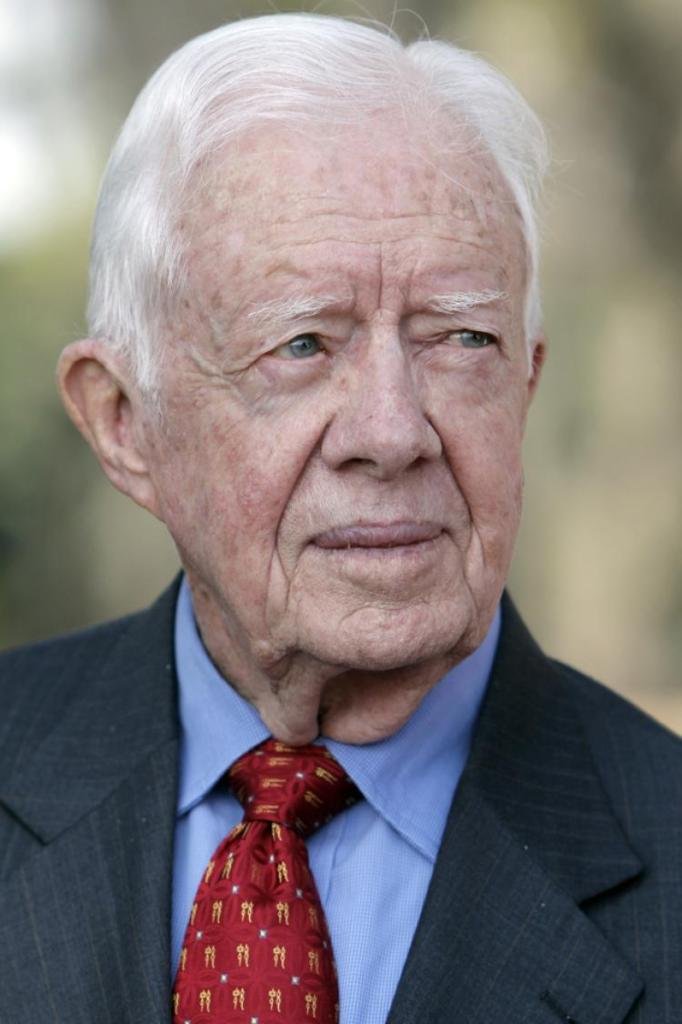
President Jimmy Carter

“And I think the difference is if you take $3 trillion and put it in American infrastructure you’d probably have $2 trillion leftover,” Carter told his congregation.

“We’d have high-speed railroad. We’d have bridges that aren’t collapsing, we’d have roads that are maintained properly. Our education system would be as good as that of say South Korea or Hong Kong.”

The US has also invaded or bombed dozens of countries and supported nearly every single right wing dictatorship in the world since the end of World War II.

While there is a prevalent belief in the United States that the country almost always wages war for noble purposes and in defense of freedom, global public opinion and facts paint a very different picture.

Most countries surveyed in a 2013 WIN/Gallup poll identified the United States as the greatest threat to world peace, and a 2017 Pew Research poll found that a record number of people in 30 surveyed nations viewed US power and influence as a “major threat.”

The US has also invaded or bombed dozens of countries and supported nearly every single right wing dictatorship in the world since the end of World War II.

It has overthrown or attempted to overthrow dozens of foreign governments since 1949 and has actively sought to crush nearly every single people’s liberation movement over that same period. It has also meddled in scores of elections, in countries that are allies and adversaries alike.

Originally published at commondreams.org

Brett Wilkins is a San Francisco-based freelance author and editor-at-large for US news at Digital Journal. His work, which focuses on issues of war and peace and human rights, is archived at www.brettwilkins.com.

(Header photo credit: CD/CC BY 2.0)
Share

Leave a Reply

Your email address will not be published. Required fields are marked *

Related Posts

Jan Oberg May 15, 2026 Go to this Fox News page and scroll the whole way down: President Donald Trump tells the world that his meeting with President Xi Jinping yielded a lot of very concrete political and economic results – of course, only where the Chinese side, according to him, agreed with him. He does not mention the Taiwan issue, but Secretary of State, Marco Rubio, says that it did not feature prominently in their talks and that the US policy on Taiwan has not changed. Then go to China Daily – or Global Times – and you will see that for the Chinese it is framework, principles, structure of cooperation etc. that matters – all embedded in the overall idea of “constructive bilateral relationship of strategic stability.” Nowhere is any concrete agreement or deal – all that Trump refers to – mentioned. At the general level, this gives you insights into the very different social...
Jan Oberg, TFF director April 9, 2026 I was recently invited to have a good, long talk about the world – and, of course, about peace too – with Boris Malagurski on his Weight of Chains Channel on YouTube. It was a real joy and seems to have been greatly appreciated by the viewers too. Mr Malagurski and I shall of course be grateful if you share this conversation in your circles – of course, only if you like what you see and hear  And remember that this one – like hundreds of others with TFF Associates – can be enjoyed at our TFF Video Collection.
Jan Oberg February 19, 2026 What a thrill to be interviewed by former British diplomat Ian Proud! Don’t waste a minute: acquaint yourself with him here on his homepage, which he elegantly calls “Proud Diplomat.” Notice also his book, A Misfit In Moscow. Ian is, of course, also on Substack, where he calls himself The Peace Monger, and recently he set up his own PeaceMonger Channel on YouTube. For once, I was not interviewed as if I were a military geopolitical expert, where I normally have to twist the whole thing in the direction of peace. No, we both had a focus on peace – why it has been disappeared by research, politics and the media, but also what can be done to shape a more peaceful future for us all. One idea we came up with was that of connecting people through citizens diplomacy – in an era where more or less authoritarian leaders meet frequently and confirm each other as members...

Recent Articles

Jan Oberg May 15, 2026 Go to this Fox News page and scroll the whole way down: President Donald Trump tells the world that his meeting with President Xi Jinping yielded a lot of very concrete political and economic results – of course, only where the Chinese side, according to him, agreed with him. He does not mention the Taiwan issue, but Secretary of State, Marco Rubio, says that it did not feature prominently in their talks and that the US policy on Taiwan has not changed. Then go to China Daily – or Global Times – and you will see that for the Chinese it is framework, principles, structure of cooperation etc. that matters – all embedded in the overall idea of “constructive bilateral relationship of strategic stability.” Nowhere is any concrete agreement or deal – all that Trump refers to – mentioned. At the general level, this gives you insights into the very different social...
Lena Petrova of “World Affairs In Context” with more than half a million subscribers on YouTube wanted to explore what a peace researcher like me has to say about, among other things, the First and the Second Cold War and why eethics has disappeared from politics. I am particularly happy about this conversation that also yielded an amazing number of very appreciative comments on YouTube. No doubt, people are longing for alternatives, including peace perspectives.
The MIMAC – Military-Industrial-Media-Academic Complex – drives the world’s rampant militarism and wars without end. Here is a short reflection of how it works against all interests of humanity. #5 deals with why there is no real enemy or threat images/analysis. It’s all ex-post constructions. And, btw, theTFF Peace Pulse is now on Rumble.

TFF on Substack

Discover more from TFF Transnational Foundation & Jan Oberg.

Most Popular

Jan Oberg May 15, 2026 Go to this Fox News page and scroll the whole way down: President Donald Trump tells the world that his meeting with President Xi Jinping yielded a lot of very concrete political and economic results – of course, only where the Chinese side, according to him, agreed with him. He does not mention the Taiwan issue, but Secretary of State, Marco Rubio, says that it did not feature prominently in their talks and that the US policy on Taiwan has not changed. Then go to China Daily – or Global Times – and you will see that for the Chinese it is framework, principles, structure of cooperation etc. that matters – all embedded in the overall idea of “constructive bilateral relationship of strategic stability.” Nowhere is any concrete agreement or deal – all that Trump refers to – mentioned. At the general level, this gives you insights into the very different social...
Lena Petrova of “World Affairs In Context” with more than half a million subscribers on YouTube wanted to explore what a peace researcher like me has to say about, among other things, the First and the Second Cold War and why eethics has disappeared from politics. I am particularly happy about this conversation that also yielded an amazing number of very appreciative comments on YouTube. No doubt, people are longing for alternatives, including peace perspectives.
The MIMAC – Military-Industrial-Media-Academic Complex – drives the world’s rampant militarism and wars without end. Here is a short reflection of how it works against all interests of humanity. #5 deals with why there is no real enemy or threat images/analysis. It’s all ex-post constructions. And, btw, theTFF Peace Pulse is now on Rumble.
Read More
Screenshot-2026-05-15-103534
Jan Oberg May 15, 2026 Go to this Fox News page and scroll the whole way down: President Donald Trump tells the world that his meeting with President Xi Jinping yielded a lot of very concrete political and economic results – of course, only where the Chinese side, according to him, agreed with him. He does not mention the Taiwan issue, but Secretary of State, Marco Rubio, says that it did not feature prominently in their talks and that the US policy on Taiwan has not changed. Then go to China Daily – or Global Times – and you will see that for the Chinese it is framework, principles, structure of cooperation etc. that matters – all embedded in the overall idea of “constructive bilateral relationship of strategic stability.” Nowhere is any concrete agreement or deal – all that Trump refers to – mentioned. At the general level, this gives you insights into the very different social...
Screenshot-2026-05-12-104023
Lena Petrova of “World Affairs In Context” with more than half a million subscribers on YouTube wanted to explore what a peace researcher like me has to say about, among other things, the First and the Second Cold War and why eethics has disappeared from politics. I am particularly happy about this conversation that also yielded an amazing number of very appreciative comments on YouTube. No doubt, people are longing for alternatives, including peace perspectives.
Screenshot-2026-04-13-154551 (2)
The MIMAC – Military-Industrial-Media-Academic Complex – drives the world’s rampant militarism and wars without end. Here is a short reflection of how it works against all interests of humanity. #5 deals with why there is no real enemy or threat images/analysis. It’s all ex-post constructions. And, btw, theTFF Peace Pulse is now on Rumble.
Screenshot-2026-04-13-154551 (1)
Jan Oberg, TFF director April 28, 2026 In this third TFF Peace Pulse, I make the important distinction between the violence and the conflict that violence is a symptom of. If you want peace, focus on the underlying conflict because that is the key to resolution, peacemaking, and a better future for the parties. The West is obsessed with violence, just look around you – and 90+ per cent of the public debate is about military issues and other violence – totally wasted for peace. These Peace Pulses will only be published here a few times. You will also not find them on YouTube and Vimeo because both platforms have blocked TFF and me; you know, peace is dangerous these days. Most TFF’s videos since 2007 are now on Rumble.
Screenshot-2026-04-13-154551
In contrast to most, we’ll bring alternatives, solutions, hope and strategies for a better future. Times are dangerous, yes, but that only intensifies the need for constructive thinking and action! Jan Oberg, TFF director April 13, 2026 The new TFF Peace Pulse uses video messages in a new way: Max 3-5-minute-long comments, ideas or perhaps mini-lectures, all about peace – positive peace. We launch them today on April 13, 2026 with a carefully crafted visual aesthetic fitting the content. We hope to publish them regularly from now on. We launch Peace Pulse (PP) – for a number of reasons. The world is in chaos, and there are countless reasons to feel concerned, frustrated, even angry. The atmosphere is saturated with doom and gloom, with negative energy and rear‑mirror thinking, while vision, imagination, alternatives, strategies and genuine future‑mindedness remain in short supply. And without them, we simply can’t save the world. Looking at problems from a hundred angles will...
IMG_5165 (1)
PART II — Publishing Peace in a System That Prioritises Militarism Jan Oberg, TFF director April 10, 2026 How TFF Maintains a Daily Voice in a Digital World Built for Noise This article is part of the series “TFF at 40″ and it invites you to learn about Four Decades of Publishing Peace. It takes a look at how a small, people‑financed peace foundation has communicated across four generations of technology — from wax stencils and fax machines to mass email and Substack — and why TFF continues to publish every single day in a system that rewards noise, conflict, and militarism. ◆ What it means to publish peace every single day in a digital system built for 24/7 news and other noise, confrontation, and militarism. How TFF’s independence, continuity, and global readership defy algorithms, donor cycles, and Western media censorhip — and why the Majority World keeps listening. When the...