History

Showing 1-10 of 154 stories

Sort by
Categories

Year

Author / Contributor

Region

freepik__primitive-violent-caveman__10528
AI generated imagine on Freepik A 2-minute “appetiser” for an extended interview by China’s CGTN. More to come!
Rapport-Top_small
I. Introduction The initiative for the “Nordic Delegation to China, September 7-15, 2024” was taken from the Norwegian side. Journalist and former editor Arild Vollan wanted to investigate claims in the media about an ongoing genocide against the Uyghurs in the autonomous region of Xinjiang in western China. Vollan selected an independent, cross-disciplinary and cross-political delegation group consisting of people who have worked with China and who wanted to get personal impressions of the conditions described in the previous section. The delegation consisted of: The delegation itself developed the project’s mandate. Following an excursion to Xinjiang province, the delegation’s mandate was to clarify whether observations made during the trip substantiated claims in the media that there is an ongoing genocide in Xinjiang today. Arild Vollan prepared the excursion program in dialogue with Thore Vestby, who has previously visited the province. The logistics were set up in dialogue with the Chinese Embassy in...
NotIranToo_FR_4_72dpi_ForNet
1. Israel: The policy’s background As a small country with a tiny population surrounded by large and hostile countries, Israel’s policy ever since its establishment has been to rely on some external forces, the British Empire at the beginning of its creation and later on the American superpower to protect herself. It has also involved the creation of a nuclear arsenal in contravention of the Non-Proliferation Treaty (the NPT) and by means of lies and deception, while being the most vociferous opponent of any other country in the Middle East to even have a peaceful nuclear programme for producing energy. Another aspect of this policy of self-preservation has been to divide and partition the neighbouring countries so that they would lose their advantage of larger size and greater population vis-à-vis Israel. As early as 1982, the Israeli scholar Oded Yinon authored an essay called “A Strategy for Israel in the...
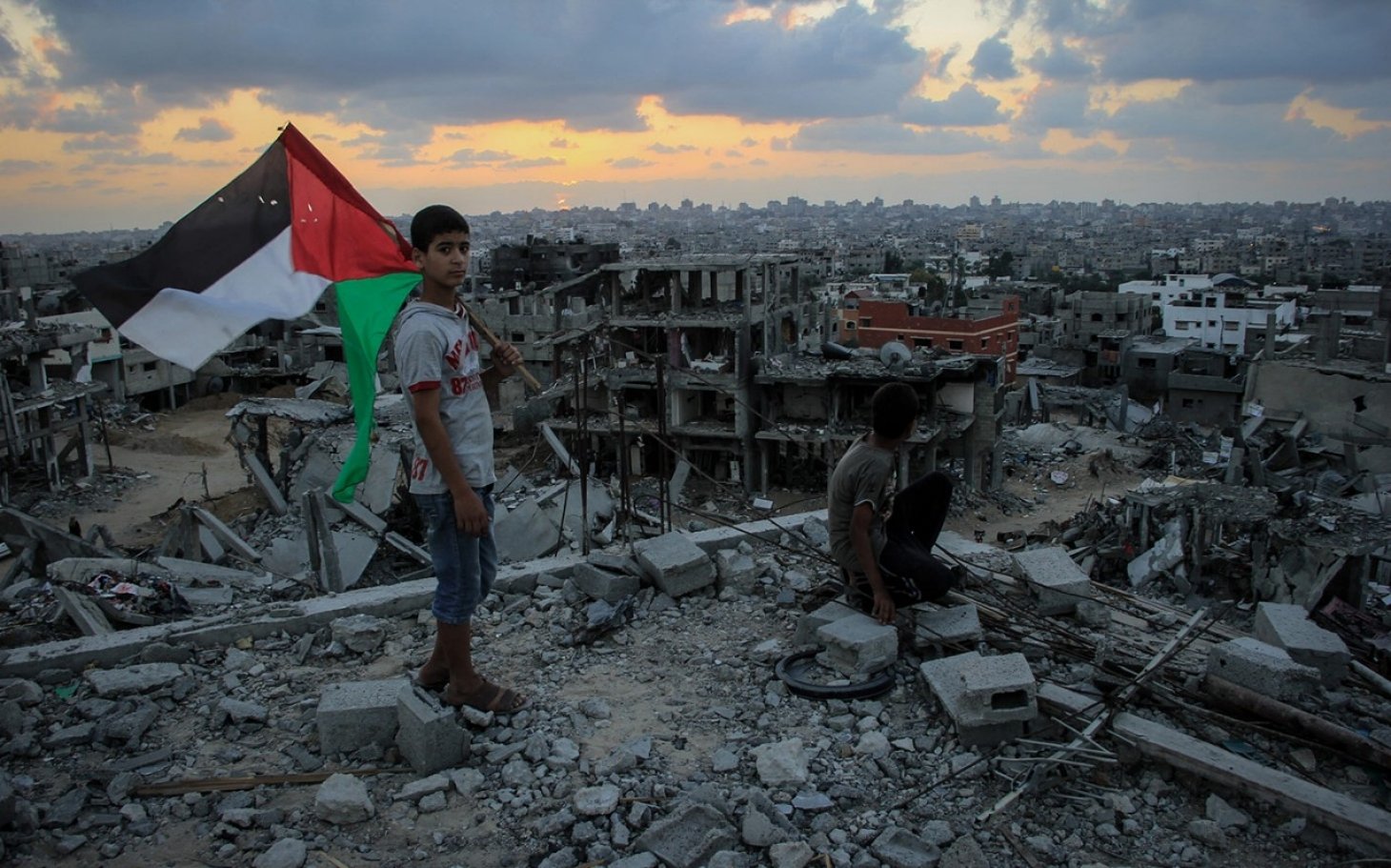
flagboy
Liberal democracies remain shamefully complicit with Israel, despite its ongoing genocide against the Palestinian people Students of world politics have long understood that when it comes to the strategic interests of leading states, international law is marginalised unless it is useful in waging a propaganda war against adversaries.  Indeed, the United Nations was designed in ways that recognised this feature of international political life. Otherwise, giving the winners of World War II a right of veto would make no sense.  Such an exemption from international law was also evident at the war crimes trials held in Nuremberg and Tokyo after World War II, at which only the crimes of the losers were scrutinised for legal accountability, and obvious crimes of the victors – such as the indiscriminate bombing of Dresden and the atomic bomb attacks on Hiroshima and Nagasaki – were not prosecuted.  To this day, for understandable reasons, many...
ModTemple
The India that goes to the polls this month is a markedly less democratic one: Narendra Modi has hollowed out institutions and targeted opponents, all the while sowing inter-ethnic tensions. Christophe Jaffrelot April 16, 2024 In 2001, I walked for 7 weeks in the footsteps of Gandhi, his most important places including parts of the Salt March. Already back then, the ruthless emergence of Hindutva and the growing animosity toward Gandhi was easy to sense. One man I struck up a conversation with on a longer bus drive told me that it was high time that Gandhi was murdered. Today, statutes of his murderer are put up, and Gandhi is being marginalised. That is no wonder in Modi’s India – although, of course, Modi has Gandhi in his office and likes to be seen as a Gandhian. Regrettably, TFF seldom published anything about India. But what seems to be a...
janne-leimola-SZf2CEG7PQk-unsplash
Photo by Janne Leimola on Unsplash This interview is one of the first outcomes of the January 27-28, 2024 “Emergency London Conference of Global Intellectuals of Conscience, arranged by Turkey’s former PM and former foreign minister, Ahmet Davutoğlu and Richard Falk, professor emeritus at Princeton University and TFF Associate since 1986. The conference was based on the prior statement that TFF participated in and published here. We are grateful for you sharing both the statement and this important interview. The genocide in Gaza requires our utmost attention, and we must build critical human mass to get it stopped. Your help is vital. Please support TFF, which continues to deliver truthful, pro-peace public education based on decades of research by some of the world’s most experienced professionals. Press this read peace button. Thanks!
MEEye
David Hearst October 26, 2023 TFF Associate professor Farhang Jahanpour in Oxford writes: “Anyone who wants to learn the truth about what is going on in Gaza and Israel should watch this short video which not only deals with the carnage in Gaza but also puts forward a solution to the conflict. David Hearst is not an “anti-Semite”. As he says in this video, half of his family were killed in the Holocaust. He is as an eminent author and journalist dealing with the Middle East with an honourable record of fairness and impartiality. He is the Editor in Chief of Middle East Eye. We must listen to him. The continuation of this long conflict will only cause more death and misery for Arabs and Israelis and more conflict in the Middle East and beyond.”
Original_Geneva_Conventions-1536x1254-1
A facsimile of the signature-and-seals page of the 1864 Geneva Convention. Photograph Source: Kevin Quinn, Ohio, US – CC BY 2.0 Alfred De Zayas September 26, 2023 Progress and retrogression characterize the reality of international law, international relations, and the concrete enjoyment of human rights by women and men throughout the planet. We hail the tides of opportunity, the times of liberation and expansion, but we should not be blind to recurrent abuses, crimes, and moments of disgrace. Today our world is experiencing chaos, but not more so than in the 18th, 19th and 20th centuries. At least we are not burning witches or massacring indigenous Hopi, Pequots, Sioux, Quechua and Taínos, the slave trade is abolished, colonialism is drastically reduced. We welcome the landmark resolution 48/7 adopted by the UN Human Rights Council on 8 October 2021 concerning the legacies of colonialism in Africa, Asia and Latin America, particularly...

responsiblestatecraft
Joint demonstration of the trade unions on May Day in Berlin under the slogan Unbroken Solidarity. Photography K.M.Krause via Reuters Anatol Lieven & George Beebe August 23, 2023 Demonizing Russian culture and people only makes peace in Ukraine harder to achieve and plays into Putin’s propaganda A deeply sinister and dangerous tendency has made its appearance in Western writing about the war in Ukraine. This is the extension of hatred for the Putin regime and its crimes to the entire Russian people, the Russian national tradition, and Russian culture. This tendency is of course bitterly familiar from the history of hostile propaganda, but precisely for that reason we should have learned to shun it. The banning of Russian cultural events and calls for the “decolonization” of Russian literature and Russian studies recall the propaganda of all sides during the First World War, which did so much to embitter that war and make its peaceful resolution...
Symmetry_of_Diplomacy-1125x630-1
Ger van Elk, Symmetry of Diplomacy, 1975, Groninger Museum   Alfred de Zayas   July 31, 2023   The blaming game has always been counter-productive. In the UN Human Rights Council, the practice is known as “naming and shaming”, as if the States engaging in “naming” would possess a higher moral authority over those “named”, and as if the assignment of blame could possibly contribute to an atmosphere conducive to dialogue and compromise.   Originally published at CounterPunch on July 25, 2023   Those who assign the blame would do better to look for root causes and, in any event, do some sweeping at their doorsteps, as China has told the US on repeated occasions[1]. I recall once the Chinese Ambassador saying in jest that he would send a couple hundred mirrors to the White House. This also reflects an idiom attributed to Confucius (551-479 BC) that “all will follow...
NYT-Iraq-Cemetery-600x312-1
Arie Pauil, Julie Hollar and Jim Naureckas May 4, 2023 On the 20th anniversary of the US- and British-led invasion of Iraq, the New York Times continued to dedicate itself to a waffling narrative, one that writes out most of history and opts for a message of “it’s complicated” to discuss the disaster it can’t admit that it helped create. On Saturday, the Times (3/18/23) published an article on its website headlined, “20 Years After US Invasion, Iraq Is a Freer Place, but Not a Hopeful One.” The next morning, the article (under the headline “Lost Hopes Haunt Iraqis, Two Decades After Invasion”) was featured at the top-right corner of its front page—making it one of the most prominent articles in the English-speaking world that day. Originally published at FAIR on March 22, 2023 The article, by Baghdad bureau chief Alissa Rubin, began and ended in a Fallujah cemetery, and it certainly painted a gloomy picture of both...
quote-civilizations-i-believe-come-to-birth-and-proceed-to-grow-by-successfully-responding-arnold-j-toynbee-75-80-98
Christopher Quigley April 28, 2023 Very few people today know that between 1934 and 1961 the British historian Arnold Toynbee wrote A Study of History describing the rise and fall of the 23 civilizations he had identified in human history. In contrast to Oswald Spengler, who thought that the rise and fall of civilizations was inevitable, Toynbee maintained that the fate of civilizations is determined by their response to the challenges facing them. In fact the unifying theme throughout the book is challenge and response. One of the ground-breaking discoveries by Toynbee is the fact that there have been so many highly developed civilizations. Understandably in the West, our history lessons focus on our own civilization with its roots in Greek and Roman cultures, but in addition, there have been Chinese, Indian, Mayan, Islamic, Sumerian and Orthodox civilizations, to name but a few. According to Toynbee, civilizations start to decay...
Categories

Year

Author / Contributor

Region