
Training the Kosovo Protection Corps in Kosovo. A Report

Photo © TFF

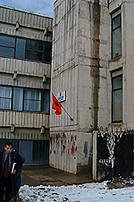
The Leadership Academy, Pristina University
where some of the training took place,
13 C inside in February

A huge task – on Women’s Day, in Mitrovica

The day after a violent clash with several people wounded, from the UN as well as Albanians and Serbs I arrived in Mitrovica, described in Western media as “the most dangerous European city”. The first people I met were some happy youngsters jumping on the road waving hello. Then I was addressed by a Kosovar with a friendly “Congratulations”. When I looked confused another man explained, “Don’t you know, today is March 8th, the International Women’s Day.”

I was in Mitrovica invited as a TFF associate by IOM, the International Organization for Migration, to give lectures as a part of a training program for members of KPC, the Kosovo Protection Corps, most of whom are former KLA soldiers, now transformed to a civil protection corps. This training program involved about 500 KPC leaders in middle positions.

30.700 applicants were registered and they have all gone through intelligence and attitude tests. From this group 5.000 have been selected, 2.000 as reservists and 3.000 as active KPC members, located in six different cities, Pristina, Skenderaj, Prizren, Pec/Gjakova, Mitrovica and Gjilan.IOM is tasked with training them to go through the transformation from being warriors to become civilians, live a civilian life and perform professionally as KPC members.I was seriously worried about the possibilities to talk about conflict management and reconciliation in this very tense situation. However it turned out very much the other way, with lots of positive emotions. I have seldom – perhaps never – experienced such deep feelings of the importance of these topics to be addressed directly to the involved parties in complicated post-war situations as that day in Mitrovica.

The themes of my training sessions

The lecture in Mitrovica was performed in a municipality building in bad condition, being reconstructed. Participators were about 60 men from KPC. They were all dressed as soldiers, in military uniforms, some with flak jackets and some even carrying short weapons. My lecture was about skills needed in leadership. The main subjects were: a) a short introduction about my own experiences visiting Kosovo several times since 1991 on my experiences from reconciliation work in different parts of the former Yugoslavia, e.g.. with people in Mostar and Vukovar, b) a short introduction on leadership and empowerment and skills needed. Small training in self-knowledge &endash; to reflect on your own behaviour; c) the basics of conflicts in general and the role of conflicts in our lives. Attitudes towards conflicts; d) conflict behaviour; e) when do conflicts produce violence? – and, finally, f) conflict-resolution: how to deal with conflicts in a productive manner?

So much for the first part of my lecture. After the break I focussed on forgiveness within the larger framework of reconciliation. I went on to the central issue of mourning and how to free one self from the burden of hatred and the need of/right to revenge. I started with a general approach and ended up with the actual situation in Kosovo and really just outside the door.

My approach was to talk directly to the participants, to get them involved and to touch their feelings in order to permit them to open up to insights they already have but have not been allowed, or able, to address.

In the first part of my lecture, I think, I succeeded in getting the participants to actively take part and reflect. In the second part about reconciliation I could feel and see the deep affection in the eyes of the participants, although it was such a large group. They were very active in the first part of the lecture, giving comments and asking questions. In the second part I could experience a silent, very active listening.

A rose – and other reactions

After the lecture I got several positive responses from the audience &endash; as well as from the interpreters. Some of them told me that they had really learned something, something new. They not only applauded, I also received a red rose from the participants. We were all very touched of the situation.

In Gjilan my lecture was performed in the same way in front of about 50 participants from KPC. They were very actively taking part and asked questions. We all agreed that we needed more time. In the second part about reconciliation there was a very concentrated and emotional atmosphere. Warm applause again, and several participants told me that they wanted more training like this. The interpreters were positive: “You really made a success! We have worked with them these days during the training course but we have never seen them listen so intensively.”

During both my lectures there were no threatening situations or tense reactions &endash; although the reactions were full of strong emotions. In order to create a sustainable peace process, I am convinced by years of work in the field, that there is a great need for reconciliation work. It takes time and it must be done with the parties on all sides.

For me as a woman, it was a very special feeling to visit Mitrovica on the International Women’s Day and interact with former KLA warriors on these deeply personal, indeed existential issue.

Photo © TFF

Dr. Kouchner, Chief of the UN mission,
UNMIK, opens the KPC seminar

What’s so wrong with the international community’s approach

I could really experience what the priorities of the international so-called community are. There was no lack of weapons, armoured personnel carriers, military jeeps or any military equipment, you name it. But no unit, not even a full-time staff member, works with the existing deep lack of trust, with the manifest hate, or with the need for forgiveness, tolerance and reconciliation. I couldn’t see any attempts in that direction.

My view is that everything with male association – such as as APCs, weapons of all kinds, barbed wires, mobile phones, cars and so on are plenty and have received enormous resources. In contrast, things with female associations and affecting the civil society and the elementary conditions of every day life is very neglected – if working at all.

As a privileged foreigner, I stayed in a private pension in Pristina, without heating and shortage of water and electricity only available for a few hours a day. I could not wash my hair or take a shower during my five days visit in Kosovo. But I learned quickly what “auto lasje” means – car wash. There are several “auto lasjes” in every single village but water supply for washing and the households doesn’t work.

I do remember from my visits to Kosovo in the early 90th that there were problems in taking care of the garbage due to the conflict between Serbs and Albanians. Today I can really see and smell how that garbage management is no longer a problem but a catastrophe. It doesn’t seem to be of any priority though garbage collecting and garbage management could give many meaningful and necessary work opportunities to many unemployed people who need an income. The same can be said for all the aluminium cans which can be found in drifts everywhere as a gift from all the internationals drinking coke everywhere, anytime. We have solved that problems long ago; if people in Kosovo would get money for every can, they would have been collected in no time.

Photo © TFF

Participants in the KPC training, men in uniforms,
many armed – although it is a civilian force

Dangerous traffic…culture of violence.

The traffic is most dangerous in Kosovo. The roads are in a terrible condition and the traffic is chaotic. Military convoys, APCs, lorries, new cars, 4-wheel cars, worn-out busses together with tractors and horse wagons. And people! Why has so little been done to repair the infrastructure? Several of the Kosovars told me that they thought the war was over but today they still wake up of the flapping sound of the helicopters and there are just soldiers, weapons and APCs all over the place. Oh, an quite a few drive stolen cars without plates and without driving licences.

I have seen in Mostar, Eastern Slavonia and elsewhere how ambitious peacebuilding work has failed due to lack in this respect. Lots of money has been used to rebuild destroyed houses and bridges &endash; but to little has been done to rebuild – social – bridges between people and individuals.

It is necessary to break the destructive spirals of revenge, hate and violence. If not, this culture of violence will be inherited and handed over to future generations. If we don’t even try to help “repair” the souls, what’s the point of all the economic aid, the soldiers and the managers. Can there be democracy with continued hate?

Identify the peace pioneers first.

However difficult it may seem, it is my experience that it IS possible to identify dialogue-oriented individuals from all sides involved in a conflict. It is with their help , we can assist in re-building confidence, tolerance and community. I would say that that is the first difficult step on the long road to a lasting peace.

Such training should, I believe, take place in Kosovo. In must happen on all sides and not just vis-a-vis the Albanians. We must work first with participants from each side on its own and in then bring small, mixed peace-pioneering groups together. It’s a soft approach, but over time even water shapes the hardest of stones.


Share

Leave a Reply

Your email address will not be published. Required fields are marked *

Related Posts

“En dag som berättigar till fest”, utropade den London-baserade al-Quds al-Arabi efter FN:s eldupphörresolution, “eftersom detta är första gången som Israel accepterar ett FN-beslut från en position som besegrad och inte som segrare”. Att ett arabisk-israeliskt krig för en gångs skull slutat med arabisk seger, är en helt dominerade åsikt i arabiska medier. Al-Quds al-Arabi tillåter sig att drömma om att det israeliska nederlaget skall leda till massflykt från Israel. Men i nästa andetag påminner tidningen om att Israel aldrig brukar genomföra sina internationella åtaganden och varnar för att förlorarna, liksom tidigare, kan hämnas genom att provocera fram inbördeskrig i Libanon. Med tanke på de otaliga massmediala vittnesmålen om det libanesiska folkets eniga motståndskraft förefaller risken för inre stridigheter i det sargade landet just nu liten. Men visst kan man urskilja nyansskillnader i libanesiska tidningar. Vänsterorganet al-Safir uppfattar FN-resolutionen som en komplott i syfte att rädda Israel från ännu större...
A donors’ conference, co-sponsered by the Burundian government, the Belgian government and UNDP will be held in Brussels January 12-13, 2004. This PressInfo offers a perspective on its urgency. See also TFF’s new Burundi Forum. Imagine for a moment that politics is about goodness and generosity. Where could a few million dollars of government aid and a few civil society organisations – guaranteed – win the hearts of extremely poor millions who want peace and already work hard to achieve it after 10 years of war and genocide? The answer is Burundi, the heart-shaped country in the heart of Africa. Burundi makes a good story from Africa. But what does the world know about Burundi, its problems and struggles? Burundi’s tough reality Here are the basic facts. Burundi’s population is about 7 million and it is number 171 out of the 175 countries on the UNDP’s human development index. Their life...
Peace is promoted by constructive proposals and dialogue Four preceding PressInfos have expressed concern over — and criticised — the ongoing, militarisation of the EU. Some will say: but there are no alternatives. We believe that there are always alternatives, that democracies are characterised by alternatives and choice, and that openly discussed alternatives will improve the quality and legitimacy of society’s decision–making. In addition, it is an intellectual and moral challenge to not only criticise but also be constructive. If we only tell people that we think they are wrong, they are not likely to listen. However, if we say: what are your views on this set of ideas and steps? — we may sometimes engage them in dialogue and sow a seed. Most people in power circles live their daily lives in in a time frame and a social space where certain ideas, viewpoints and concepts are just not...

Recent Articles

“En dag som berättigar till fest”, utropade den London-baserade al-Quds al-Arabi efter FN:s eldupphörresolution, “eftersom detta är första gången som Israel accepterar ett FN-beslut från en position som besegrad och inte som segrare”. Att ett arabisk-israeliskt krig för en gångs skull slutat med arabisk seger, är en helt dominerade åsikt i arabiska medier. Al-Quds al-Arabi tillåter sig att drömma om att det israeliska nederlaget skall leda till massflykt från Israel. Men i nästa andetag påminner tidningen om att Israel aldrig brukar genomföra sina internationella åtaganden och varnar för att förlorarna, liksom tidigare, kan hämnas genom att provocera fram inbördeskrig i Libanon. Med tanke på de otaliga massmediala vittnesmålen om det libanesiska folkets eniga motståndskraft förefaller risken för inre stridigheter i det sargade landet just nu liten. Men visst kan man urskilja nyansskillnader i libanesiska tidningar. Vänsterorganet al-Safir uppfattar FN-resolutionen som en komplott i syfte att rädda Israel från ännu större...
Greenland – the world’s largest island, a continent of its own with only 57.000 inhabitants. I visited it for the first time in May 2005. I flew across the inland ice to Nuuk, the tiny capital with some 14.000 inhabitants. I was overwhelmed by the pride and kindness of everyone I met as well as by the unique natural beauty. Unfortunately, due to weather conditions during my ten-day stay I could get nowhere else but Nuuk. Fortunately, however, among those I met was Gitte Arvegaard, a Danish lawyer and negotiator employed by the local government, Greenland Home Rule. She turned out to be an enthusiastic photographer with a lot of pictures taken during various trips around Greenland. So this Greeland series is the result of our cooperative effort. We both hope you enjoy it and are stimulated to visit Greenland – about which you may read more here. Finally, if you want to...
 Jan Oberg’s storyof how he met Sir Paul Liverpool – where else to meet Paul McCartney? Paul’s old class mate and TFF Associate, Jonathan Power introduced me to Paul McCartney in Liverpool at an informal reception. It was held at what used to be their school, now the Liverpool Institute for Performing Arts and we were there to celebrate that Jonathan had written Amnesty International’s 40th Anniversary book. This happy event for “righting wrongs and writing songs” gave me an opportunity to meet Paul and tell him about TFF and get straight to the matter: would he consider making a donation in support of our work for peace? While I was probably the only one with such a wish that day, I was certainly not the only one who wanted to shake hands and talk with him. In the last minutes before Paul was to leave, Jonathan brought us together and we got about three...

TFF on Substack

Discover more from TFF Transnational Foundation & Jan Oberg.

Most Popular

“En dag som berättigar till fest”, utropade den London-baserade al-Quds al-Arabi efter FN:s eldupphörresolution, “eftersom detta är första gången som Israel accepterar ett FN-beslut från en position som besegrad och inte som segrare”. Att ett arabisk-israeliskt krig för en gångs skull slutat med arabisk seger, är en helt dominerade åsikt i arabiska medier. Al-Quds al-Arabi tillåter sig att drömma om att det israeliska nederlaget skall leda till massflykt från Israel. Men i nästa andetag påminner tidningen om att Israel aldrig brukar genomföra sina internationella åtaganden och varnar för att förlorarna, liksom tidigare, kan hämnas genom att provocera fram inbördeskrig i Libanon. Med tanke på de otaliga massmediala vittnesmålen om det libanesiska folkets eniga motståndskraft förefaller risken för inre stridigheter i det sargade landet just nu liten. Men visst kan man urskilja nyansskillnader i libanesiska tidningar. Vänsterorganet al-Safir uppfattar FN-resolutionen som en komplott i syfte att rädda Israel från ännu större...
Greenland – the world’s largest island, a continent of its own with only 57.000 inhabitants. I visited it for the first time in May 2005. I flew across the inland ice to Nuuk, the tiny capital with some 14.000 inhabitants. I was overwhelmed by the pride and kindness of everyone I met as well as by the unique natural beauty. Unfortunately, due to weather conditions during my ten-day stay I could get nowhere else but Nuuk. Fortunately, however, among those I met was Gitte Arvegaard, a Danish lawyer and negotiator employed by the local government, Greenland Home Rule. She turned out to be an enthusiastic photographer with a lot of pictures taken during various trips around Greenland. So this Greeland series is the result of our cooperative effort. We both hope you enjoy it and are stimulated to visit Greenland – about which you may read more here. Finally, if you want to...
 Jan Oberg’s storyof how he met Sir Paul Liverpool – where else to meet Paul McCartney? Paul’s old class mate and TFF Associate, Jonathan Power introduced me to Paul McCartney in Liverpool at an informal reception. It was held at what used to be their school, now the Liverpool Institute for Performing Arts and we were there to celebrate that Jonathan had written Amnesty International’s 40th Anniversary book. This happy event for “righting wrongs and writing songs” gave me an opportunity to meet Paul and tell him about TFF and get straight to the matter: would he consider making a donation in support of our work for peace? While I was probably the only one with such a wish that day, I was certainly not the only one who wanted to shake hands and talk with him. In the last minutes before Paul was to leave, Jonathan brought us together and we got about three...
Read More
Imagen-thumbnail-The-Transnational-1
“En dag som berättigar till fest”, utropade den London-baserade al-Quds al-Arabi efter FN:s eldupphörresolution, “eftersom detta är första gången som Israel accepterar ett FN-beslut från en position som besegrad och inte som segrare”. Att ett arabisk-israeliskt krig för en gångs skull slutat med arabisk seger, är en helt dominerade åsikt i arabiska medier. Al-Quds al-Arabi tillåter sig att drömma om att det israeliska nederlaget skall leda till massflykt från Israel. Men i nästa andetag påminner tidningen om att Israel aldrig brukar genomföra sina internationella åtaganden och varnar för att förlorarna, liksom tidigare, kan hämnas genom att provocera fram inbördeskrig i Libanon. Med tanke på de otaliga massmediala vittnesmålen om det libanesiska folkets eniga motståndskraft förefaller risken för inre stridigheter i det sargade landet just nu liten. Men visst kan man urskilja nyansskillnader i libanesiska tidningar. Vänsterorganet al-Safir uppfattar FN-resolutionen som en komplott i syfte att rädda Israel från ännu större...
Greenland – the world’s largest island, a continent of its own with only 57.000 inhabitants. I visited it for the first time in May 2005. I flew across the inland ice to Nuuk, the tiny capital with some 14.000 inhabitants. I was overwhelmed by the pride and kindness of everyone I met as well as by the unique natural beauty. Unfortunately, due to weather conditions during my ten-day stay I could get nowhere else but Nuuk. Fortunately, however, among those I met was Gitte Arvegaard, a Danish lawyer and negotiator employed by the local government, Greenland Home Rule. She turned out to be an enthusiastic photographer with a lot of pictures taken during various trips around Greenland. So this Greeland series is the result of our cooperative effort. We both hope you enjoy it and are stimulated to visit Greenland – about which you may read more here. Finally, if you want to...
p_mccartney_poem
 Jan Oberg’s storyof how he met Sir Paul Liverpool – where else to meet Paul McCartney? Paul’s old class mate and TFF Associate, Jonathan Power introduced me to Paul McCartney in Liverpool at an informal reception. It was held at what used to be their school, now the Liverpool Institute for Performing Arts and we were there to celebrate that Jonathan had written Amnesty International’s 40th Anniversary book. This happy event for “righting wrongs and writing songs” gave me an opportunity to meet Paul and tell him about TFF and get straight to the matter: would he consider making a donation in support of our work for peace? While I was probably the only one with such a wish that day, I was certainly not the only one who wanted to shake hands and talk with him. In the last minutes before Paul was to leave, Jonathan brought us together and we got about three...
Logo-Transnational
1942James Paul McCartney is born in Liverpool on June 18th. 1956Paul writes his first song, I Lost My Little Girl. 1957Paul meets John Lennon at St. Peter’s Church Fete, Woolton, Liverpool. He joins his first group, The Quarrymen and performs in his first gig at The New Clubmoor Hall, Liverpool, on October 18th. 1960Formation of The Beatles, who play residencies in Hamburg and at The Cavern in Liverpool. 1961First Beatles recordings issued in Germany, as the backing group for Tony Sheridan. 1962The first Beatles Parlophone recording, Love Me Do, reaches number 17 in the British charts. 1963The birth of Beatlemania. Please Please Me gives the group their first British Number 1. She Loves You cements their success. Please Please Me and With The Beatles albums released. 1964First triumphant American tour. The Beatles perform at the Royal Command Performance and release their first film, A Hard Day’s Night. Their single I...
Logo-Transnational
  Back to the series “Bujumbura, Burundi”
By JONATHAN POWER August 16, 2000 LONDON – Remember the summer of ’98? In the sweltering, torpid heat of a Roman august, charged with exhaust fumes, the international community gave its overwhelming approval to the establishment of an International Criminal Court that will enable those accused of “crimes against humanity” to be tried and, if convicted, sentenced. Only seven nations opposed or abstained from the motion, including Israel, China, India and the U.S.A. where the Pentagon had successfully waged bureaucratic guerrilla war to undermine the initially sympathetic stance of President Bill Clinton. Two years on we can now see what an epochal event that was. In a the stroke of 120 pens it changed the climate on political thuggery. After numerous half-starts and false starts ever since the Nuremberg and Tokyo trials that convicted the war criminals of the Second World War, the world at last had agreed en masse a common...

