TFF PressInfo #355: The deeper reason Syria negotiations are doomed

Negotiations were supposed to start in Geneva today, January 25. The media is full of analyses of why it won’t happen and how virtually everybody disagrees with everybody else about who should be there and who should not. That’s all surface, however.

Objectively speaking is it of course hugely difficult. No one would envy chief UN envoy, Italian-Swedish diplomat Staffan de Mistura. That said, a totally different perspective may be helpful:

It has to do with a simple distinction that few still in the international community are able to make – that between the conflict and the violence in the conflict zone. Almost all conflicts can be mitigated or solved – but the more violence infused into the conflict (and the longer it lasts), the more difficult it will be to find a solution – because on top of the original conflict you build anger, sorrow, wish for revenge, traumas and justifications for counter-violence.

It’s a simple as that.

Everybody confuses the two – the underlying conflict that should have been addressed from Day One and the violent means that should not have been delivered from outside in the shape of arms, ammunition and bombings.

However, the world’s decision-makers continue – seemingly unable to learn – to put weapons before peace.

The Syrian conflict had to do with peaceful demonstrations, an authoritarian human rights violating national leadership, an environmental crisis that had made people migrate into cities; it had to do with an immensely complex history, society with many groups and fractions – and with the interests of neighbouring countries. And it came in the wake of failed wars and weaponization/wars of Afghanistan, Iraq and Libya.

And all conflicts have to do with grievances, incomptaible goals and wishes, fears, trauma, economic and other structures as shaped through history – and they have to do with the West’s historical influence – most violent and detrimental – in the region.

All of it is left aside. The focus is on nine other amateurish, superficial matters – see below.

So, yes, turmoil all over the place – but also something somebody somewhere should have learned something from. They did not. They put the outdated military “security and stability” before peace – and lost it all.

The Western world – read US/NATO, Russia joining later – un/anti-intellectually brought it all on the old hopelessly false and counterproductive formula’s 9 elements:

1. The conflict is about two parties, in this case al-Assad against the rest – however, no conflict in the real world is has only two parties.


2. All the good guys are on one side, all the bad ones on the other – however, it’s never that black/white anywhere.


3. Conflict-resolution is about siding with one against the other – however, no textbook in conflict-resolution would tell you that. 


4. Siding means giving the good guys weapons – however, we know from everywhere else that among the good guys are some not-so-good guys.


5. Conflicts are about individuals (in this case al-Assad) and if only such top trouble-makers are marginalised or killed, things will be fine – however, we have seen what that meant in Iraq and Libya, etc.


6. When we have poured in weapons (and arms producers, govenments and dealers have profitted) and other support such as money to all sides (proxy war), they will be more willing to go and sit at a negotiation table and make peace – however, we know it works the opposite way: weapons attract bad people, harden their minds and make some ‘heroes’ and all of them less prone to peace. Hoping to ‘win’ on the battle field is one reason for not coming to negotiations.


7. Since we have given them weapons and money, they will accept us (foreigners) as ‘mediators’ and we happen to know what is best for them – however, a number of conflict parties will shape their own agenda and take no orders. And only the people in the conflict knows what is best for them and only when they are true stakeholders will a peace agreement be sustainable.


8. Since people with arms have power they must be at the negotiation table – however, we know that the most important (and suffering) people in any conflict are those who are ordinary citizens, never touched a weapons and hate, about equally much, the regime and the armed opposition – i.e. 98-99% of the people in any conflict region (i.e. if they have not already run away from the hell we have helped to create).


9. After all this we can invite a UN envoy to pick up the pieces – however, we know that the major countries have done their utmost the last 25 years to undermine the authority, mandate, budget and quality of the UN and its leadership and there is no mention of what would have been the most relevant to do in a mature non-nationalist global society: to have used UN peace-keeper and -makers in large numbers from Day One to work with the conflict, not to work against the violence.

The introduction of weapons into conflicts is the single most important factor in making peace impossible. However, we know from SIPRI that the arms trade is booming.

Behind every refugee stands an arms trader and war-maker.

Don’t believe government leaders and ministers when – later – they appoint themselves as peacemakers/mediators and lament the fact that local parties don’t want to come to their peace talks in Geneva. (And by the way, even the shape of the table there is counterproductive as any conflict-professional (and psychologist) would tell you).
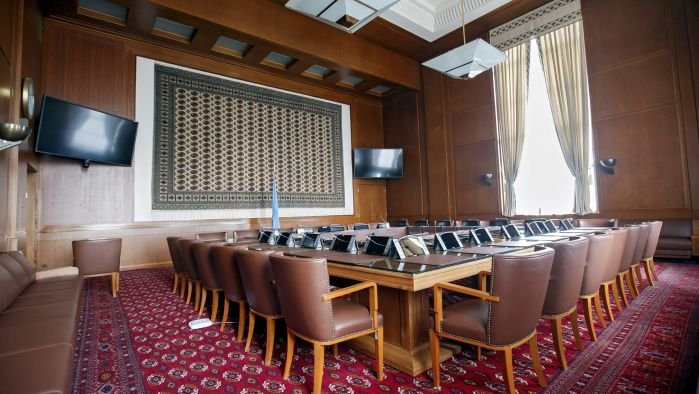
The table in Geneva – Photo Salvatore Di Nolfi, Scanpix

The 9 points explains why today’s Geneva negotiations are doomed to fail. NATO/EU countries and Russia are the main reasons they will. Like two years ago.

Governments are still so much more professional and resourceful when it comes to wars and militarism than they are when it comes to conflict-resolution and peace. The main reason everywhere is the vested elite interests in MIMAC, the Military-Industrial-Media-Academic Complex – a cancer that kills hundreds of thousands of people, create refugees and work against both democracy and peace. As well as negotiated solutions.
Peace & future researcher + ‌Art Photographer

Share

Leave a Reply

Your email address will not be published. Required fields are marked *

Related Posts

Peace is promoted by constructive proposals and dialogue Four preceding PressInfos have expressed concern over — and criticised — the ongoing, militarisation of the EU. Some will say: but there are no alternatives. We believe that there are always alternatives, that democracies are characterised by alternatives and choice, and that openly discussed alternatives will improve the quality and legitimacy of society’s decision–making. In addition, it is an intellectual and moral challenge to not only criticise but also be constructive. If we only tell people that we think they are wrong, they are not likely to listen. However, if we say: what are your views on this set of ideas and steps? — we may sometimes engage them in dialogue and sow a seed. Most people in power circles live their daily lives in in a time frame and a social space where certain ideas, viewpoints and concepts are just not...
Photos © TFF 2000 Read PressInfo 90 “Lift the Sanctions and Bring More Aid to Yugoslavia” See Pictures from Belgrade © TFF 2000 Please reprint, copy, archive, quote or re-post this item, but please retain the source.
Av FRANK SØHOLM GREVIL 16 augusti 2004  Vi er nu nået til tredje akt i det absurde teaterstykke, der i analogi med de store skueprocesser i Moskva 1936-38 er blevet døbt ‘Grevil-sagen’. Første akt bestod i min anonyme fremlæggelse af egenhændigt nedklassificerede rapporter i Berlingske Tidende i februar og marts. Andet akt udgjordes af min fremtræden med navn og billede i Information i april samt den efterfølgende mediestorm, som uden min direkte medvirken kostede en forsvarsminister taburetten samt en sigtelse for brud på tavshedspligten. Tredje akt bliver en retssag, hvor jeg står tiltalt for at have overtrådt straffelovens bestemmelser om uberettiget videregivelse eller udnyttelse af fortrolige oplysninger. Statsanklageren har ovenikøbet valgt at påberåbe sig særligt skærpende omstændigheder. Da jeg aldrig har modtaget betaling for at stille rapporterne til rådighed eller lade mig interviewe, må det skærpende bestå i, at “videregivelsen eller udnyttelsen er sket under sådanne omstændigheder, at det påfører...

Recent Articles

PressInfo # 141, December 21, 2001It’s time to prepare reconciliation between Albanians and Serbs PressInfo # 140, December 14, 2001Ibrahim Rugova’s decade-long leadership in Kosovo/a PressInfo # 139, 11. december, 2001En god nyhet: Jugoslaviens Sannings- och försoningskommission PressInfo # 139, 11. december, 2001Gode nyheder: Jugoslaviens Sandheds- og Forsoningskommission PressInfo # 139, December 11, 2001Good news: Yugoslavia’s Truth and Reconciliation Commission PressInfo # 138, November 8, 2001TFF co-founder PhD with thesis about young people with roots in other cultures PressInfo # 138, November 8, 2001TFF:s medstiftare doktor på avhandling om unga med ursprung i andra kulturer PressInfo # 137, October 17, 2001A new Marshall Plan: Advancing human security and controlling terrorism PressInfo # 136, October 15, 2001The UN and Annan really deserve it PressInfo # 135, October 10, 2001Preventing a terrorist mushroom cloud PressInfo # 134, 17 oktober, 2001Sverige og 11. september PressInfo # 134, October 9, 2001Sweden and September 11...
Peace is promoted by constructive proposals and dialogue Four preceding PressInfos have expressed concern over — and criticised — the ongoing, militarisation of the EU. Some will say: but there are no alternatives. We believe that there are always alternatives, that democracies are characterised by alternatives and choice, and that openly discussed alternatives will improve the quality and legitimacy of society’s decision–making. In addition, it is an intellectual and moral challenge to not only criticise but also be constructive. If we only tell people that we think they are wrong, they are not likely to listen. However, if we say: what are your views on this set of ideas and steps? — we may sometimes engage them in dialogue and sow a seed. Most people in power circles live their daily lives in in a time frame and a social space where certain ideas, viewpoints and concepts are just not...
Photos © TFF 2000 Read PressInfo 90 “Lift the Sanctions and Bring More Aid to Yugoslavia” See Pictures from Belgrade © TFF 2000 Please reprint, copy, archive, quote or re-post this item, but please retain the source.

TFF on Substack

Discover more from TFF Transnational Foundation & Jan Oberg.

Most Popular

PressInfo # 141, December 21, 2001It’s time to prepare reconciliation between Albanians and Serbs PressInfo # 140, December 14, 2001Ibrahim Rugova’s decade-long leadership in Kosovo/a PressInfo # 139, 11. december, 2001En god nyhet: Jugoslaviens Sannings- och försoningskommission PressInfo # 139, 11. december, 2001Gode nyheder: Jugoslaviens Sandheds- og Forsoningskommission PressInfo # 139, December 11, 2001Good news: Yugoslavia’s Truth and Reconciliation Commission PressInfo # 138, November 8, 2001TFF co-founder PhD with thesis about young people with roots in other cultures PressInfo # 138, November 8, 2001TFF:s medstiftare doktor på avhandling om unga med ursprung i andra kulturer PressInfo # 137, October 17, 2001A new Marshall Plan: Advancing human security and controlling terrorism PressInfo # 136, October 15, 2001The UN and Annan really deserve it PressInfo # 135, October 10, 2001Preventing a terrorist mushroom cloud PressInfo # 134, 17 oktober, 2001Sverige og 11. september PressInfo # 134, October 9, 2001Sweden and September 11...
Peace is promoted by constructive proposals and dialogue Four preceding PressInfos have expressed concern over — and criticised — the ongoing, militarisation of the EU. Some will say: but there are no alternatives. We believe that there are always alternatives, that democracies are characterised by alternatives and choice, and that openly discussed alternatives will improve the quality and legitimacy of society’s decision–making. In addition, it is an intellectual and moral challenge to not only criticise but also be constructive. If we only tell people that we think they are wrong, they are not likely to listen. However, if we say: what are your views on this set of ideas and steps? — we may sometimes engage them in dialogue and sow a seed. Most people in power circles live their daily lives in in a time frame and a social space where certain ideas, viewpoints and concepts are just not...
Photos © TFF 2000 Read PressInfo 90 “Lift the Sanctions and Bring More Aid to Yugoslavia” See Pictures from Belgrade © TFF 2000 Please reprint, copy, archive, quote or re-post this item, but please retain the source.
Read More
Imagen-thumbnail-The-Transnational-1
PressInfo # 141, December 21, 2001It’s time to prepare reconciliation between Albanians and Serbs PressInfo # 140, December 14, 2001Ibrahim Rugova’s decade-long leadership in Kosovo/a PressInfo # 139, 11. december, 2001En god nyhet: Jugoslaviens Sannings- och försoningskommission PressInfo # 139, 11. december, 2001Gode nyheder: Jugoslaviens Sandheds- og Forsoningskommission PressInfo # 139, December 11, 2001Good news: Yugoslavia’s Truth and Reconciliation Commission PressInfo # 138, November 8, 2001TFF co-founder PhD with thesis about young people with roots in other cultures PressInfo # 138, November 8, 2001TFF:s medstiftare doktor på avhandling om unga med ursprung i andra kulturer PressInfo # 137, October 17, 2001A new Marshall Plan: Advancing human security and controlling terrorism PressInfo # 136, October 15, 2001The UN and Annan really deserve it PressInfo # 135, October 10, 2001Preventing a terrorist mushroom cloud PressInfo # 134, 17 oktober, 2001Sverige og 11. september PressInfo # 134, October 9, 2001Sweden and September 11...
Imagen-thumbnail-The-Transnational-1
Peace is promoted by constructive proposals and dialogue Four preceding PressInfos have expressed concern over — and criticised — the ongoing, militarisation of the EU. Some will say: but there are no alternatives. We believe that there are always alternatives, that democracies are characterised by alternatives and choice, and that openly discussed alternatives will improve the quality and legitimacy of society’s decision–making. In addition, it is an intellectual and moral challenge to not only criticise but also be constructive. If we only tell people that we think they are wrong, they are not likely to listen. However, if we say: what are your views on this set of ideas and steps? — we may sometimes engage them in dialogue and sow a seed. Most people in power circles live their daily lives in in a time frame and a social space where certain ideas, viewpoints and concepts are just not...
Imagen-thumbnail-The-Transnational-1
Photos © TFF 2000 Read PressInfo 90 “Lift the Sanctions and Bring More Aid to Yugoslavia” See Pictures from Belgrade © TFF 2000 Please reprint, copy, archive, quote or re-post this item, but please retain the source.
Imagen-thumbnail-The-Transnational-1
Av FRANK SØHOLM GREVIL 16 augusti 2004  Vi er nu nået til tredje akt i det absurde teaterstykke, der i analogi med de store skueprocesser i Moskva 1936-38 er blevet døbt ‘Grevil-sagen’. Første akt bestod i min anonyme fremlæggelse af egenhændigt nedklassificerede rapporter i Berlingske Tidende i februar og marts. Andet akt udgjordes af min fremtræden med navn og billede i Information i april samt den efterfølgende mediestorm, som uden min direkte medvirken kostede en forsvarsminister taburetten samt en sigtelse for brud på tavshedspligten. Tredje akt bliver en retssag, hvor jeg står tiltalt for at have overtrådt straffelovens bestemmelser om uberettiget videregivelse eller udnyttelse af fortrolige oplysninger. Statsanklageren har ovenikøbet valgt at påberåbe sig særligt skærpende omstændigheder. Da jeg aldrig har modtaget betaling for at stille rapporterne til rådighed eller lade mig interviewe, må det skærpende bestå i, at “videregivelsen eller udnyttelsen er sket under sådanne omstændigheder, at det påfører...
Imagen-thumbnail-The-Transnational-1
Af Svenska Irakkommittén mot de Ekonomiska Sanktionerna (SIES) 13 september 2002 FN:s ekonomiska sanktioner mot Irak har nu pågått i tolv år och drabbat det irakiska folket med svåra lidanden. Enligt FN:s egna siffror har mer än 1,5 miljoner människor, varav ca 600 000 barn, dött som en direkt följd av sanktionerna. Dessutom har ett lågintensivt bombkrig mot landet pågått under dessa år. Av all denna förödelse- orsakad huvudsakligen av amerikansk och brittisk politik- har Saddam Husseins brutala och diktatoriska regim snarast stärkts än försvagats. Nu förbereder USA under president Bushs ledning ett storskaligt bombkrig mot Irak som kommer att innebära ett ännu större lidande för civilbefolkningen. Ett sådant krig kommer dessutom att ytterligare undergräva freden och säkerheten i världen. Att upprätta en demokratisk regim i Irak är det irakiska folkets angelägenhet och får enligt folkrätten inte ske med krigshandlingar utifrån. Folkrätten och FN:s stadgar måste respekteras. Vi vädjar till...