
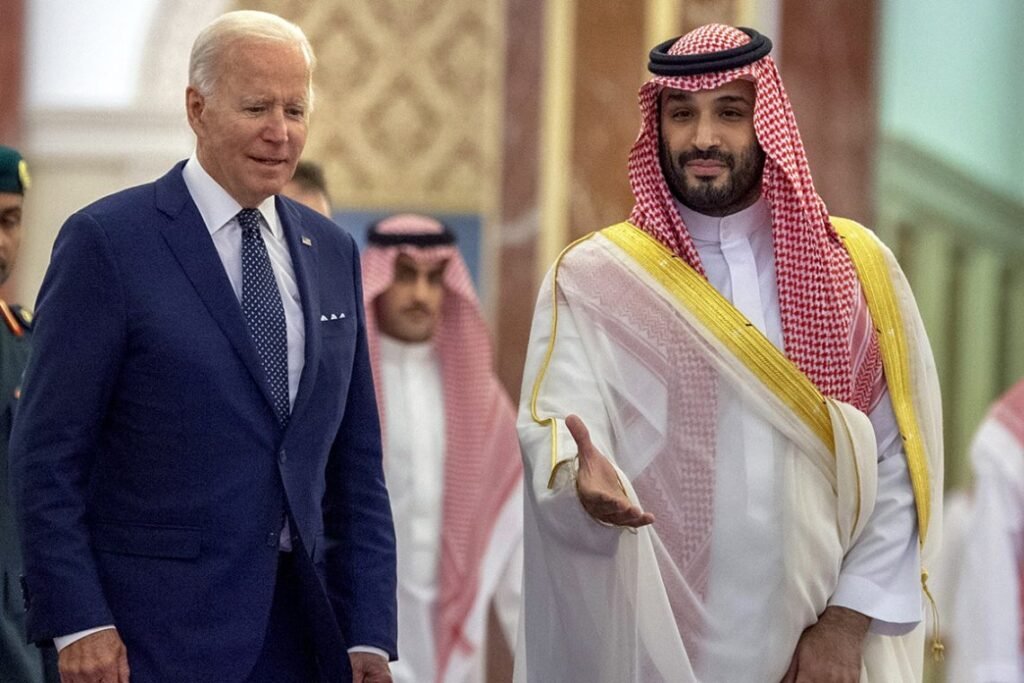
Juan Cole: In Saudi Arabia, Biden Plays Defence Against Russia, China and Iran

Juan Cole

July 21, 2022

Although President Joe Biden’s trip to Saudi Arabia was ostensibly about petroleum and attempting to lower gasoline prices in the US, it doesn’t seem to me that that rationale entirely explains Biden’s about-face on Saudi Arabia. For one thing, Biden must have been told that Saudi Arabia does not have much extra capacity to put more petroleum on the market and so cannot itself lower prices. Whether OPEC will be willing to loosen the quotas for member states is unclear, and whether there is much extra capacity in the organization as a whole is a question mark.

So if it isn’t all about oil, what is driving the president’s Middle East trip? On the one hand, I think he is trying to pressure Iran into coming back to the Joint Comprehensive Plan of Action or JCPOA, the 2015 nuclear deal. If Biden could close that deal, Iran would put 2 million barrels a day on the market immediately, which would likely begin bringing down prices at the pump in short order.

On the other hand, I wonder if Biden is playing defense, trying to keep long-time US partners from switching to China and Russia.

Published initially on Juan Cole’s “Informed Comment” on July 16, 2022

Biden’s central foreign policy initiative as of last February is to defeat Russia in Ukraine or at least to make it pay an enormous price for its invasion of Ukraine. Biden has orchestrated a widespread boycott of the Russian economy by America’s European allies, and the provision of military and other aid to Ukraine.

While Biden has had some success in overcoming German skittishness about getting involved in that effort and has gotten all of the EU except for Hungary on board with ending imports of petroleum from Russia, his efforts have fallen on fallow ground in the Middle East.

No diplomatic partner of the US in the latter region has shown any interest in joining Biden’s crusade against the Russian Federation.

Even the one actual U.S. ally in the region, Turkey, despite being part of NATO, is declining to boycott Russia, though it does sell drones to Ukraine. The most Turkey is willing to do is to negotiate with Russia to allow Ukrainian grain exports, from which Turkey would benefit.

Neither Saudi Arabia nor Israel has pledged to defend the US, and so they are not allies, unlike Turkey, which fought alongside US troops as part of NATO in Korea and again in Afghanistan

Israel has been careful not to offend Russia, only yielding to US pressure on a few minor votes at the U.N. Egypt is cosying up to Russia and China, and desperately needs Russian wheat if it is to avoid another revolution.

Saudi Arabia is actually importing discounted Russian oil at a third off for its own citizens’ use and then exporting more of its own petroleum at world market prices, making a pretty penny on the transaction. The Russian oil is so deeply discounted because of US sanctions on both petroleum and on Russian bank transactions, making it difficult to move.

Not only are US partners not stepping up to boycott Russia, but some are also actively swinging to Russia and China for security and trade relations because they have developed doubts about the US commitment to them. President Barack Obama’s 2015 Iran deal shook the Arab Gulf states to their core. They liked Trump better but were aware that he could not exactly be depended on in a crunch, seeing how he threw Qatar under the bus in 2017 and was willing to break up NATO.

Russia is part of OPEC+, the extended Organization of Petroleum Exporting Countries, and coordinates on pricing efforts. What if Russia could prevail upon OPEC to tighten oil exports, bringing higher prices and more revenues both to Moscow and to the central OPEC states?

By meeting with the Saudi royal family and, on Saturday, with the Gulf Cooperation Council, Biden is attempting to forestall a stampede of these countries to China, with which most of them already do a great deal of business, and which never bothers them about not having free and fair elections. How security-linked the trip was is obvious from the agreements the White House signed in Saudi Arabia.

Article continues after bonus IC video
CBC News: “Biden fist bumps Saudi crown prince ahead of controversial meeting”

Reuters quotes Jake Sullivan, the National Security Adviser, as saying of Biden, “He’s intent on ensuring that there is not a vacuum in the Middle East for China and Russia to fill.”

Of course, Biden is also striving for further Israeli integration into the Middle East. Saudi Arabia announced Thursday evening that it was granting all countries overflight rights, which benefits Israel’s El Al, which can now save fuel by not having to skirt the kingdom.

He also wants to cement the ceasefire in Yemen, and finally end the Saudi/ UAE war on Yemen, about which Congress has been upset.

Finally, Biden is trying to establish security ties between Israel and the Gulf oil monarchies so as to make a united front against Iran. Some Washington hawks dream of a Middle Eastern NATO against Iran.

This hope is forlorn. The United Arab Emirates just announced an upgrade in diplomatic relations with Iran and said it is not interested in making a common front against Iran. Dubai is said to be a major money launderer of Iranian funds. Qatar has and will keep correct relations with Iran. The Arab states can’t coordinate too closely with Israel without giving away their own military secrets, and they are too suspicious to do that, even with each other. Being too close to Israel is also a security risk for the Arab states, whose peoples are deeply interested in the fate of the Palestinians, unlike Biden and many of the royal families.

If Biden wants to get a deal with Iran, he should take off some of Trump’s maximum sanctions, which have nothing to do with the country’s civilian nuclear enrichment program, especially the sanctions on the central bank, which hurt civilians. Tehran is not afraid of the Gulf postage stamp countries, even if they do have better relations than before with Israel.

As for defending US interests in the Middle East against Russia and China, it is too soon to say whether Biden’s personal diplomacy has done much to stop these countries from diversifying their security bets.

Please support TFF’s work for peace through research and public education. We are all-volunteer, people-financed and do not accept money from governments or corporations. In other words, one of the very last free research think tanks in this world – and for a noble purpose: Peace by peaceful – intelligent – means. It is fast, easy and secure. Click here. Thanks!

Juan Cole is the founder and chief editor of Informed Comment. He is Richard P. Mitchell Professor of History at the University of Michigan. He is the author of, among many other books, Muhammad: Prophet of Peace amid the Clash of Empires and The Rubaiyat of Omar Khayyam. Follow him on Twitter at @jricole or the Informed Comment Facebook Page.

Share

Leave a Reply

Your email address will not be published. Required fields are marked *

Related Posts

TFF Associate and former Board member On 28 August 2025, France, Germany, and the United Kingdom (the EU Troika) decided to trigger the so-called “snapback mechanism” and reimpose stringent sanctions on Iran after 30 days for its alleged violation of the terms of the Iran nuclear deal, known as the Joint Comprehensive Plan of Action (JCPOA), if Iran did not give in to their demands within 30 days. In the lawless world in which we are living at the moment, discussing the principles of international law is futile and irrelevant. We have reverted to the age of imperial dictatorship and big power dominance. This state of affairs is dangerous for the whole world, especially the Global South, which is at the mercy of the dictates of the superpowers. However, a return to the rivalry between powerful empires outside the scope of international law, which led to the two world wars,...
A slightly modified version of a text published on Sept. 1, 2025 in TMS. On August 25 Thomas Friedman, always a weathervane for political and economic establishment thinking in the West, wrote a notable column in the NY Times that was pragmatic in tone, misleading in substance, and regressive in intention. Yet it reflects a growing ambivalence toward Israel’s prolonged genocide even among longtime supporters of Israel that now highlights starvation, famine, and a gross distortion of the delivery of humanitarian aid under emergency conditions. But expressed dangerously without hiding the hope that Israel could even now restore its legitimacy without being held accountable for crimes in Gaza and despite all, still expecting to be rewarded by excluding Hamas from any further governance role in Gaza and continuing to move toward the annexation of the West Bank by formal action or through further settlement expansion. It is notable that the headline of...
Professor emeritus, TFF Associate Oxford (Special to Informed Comment; Feature) The dam has burst. Netanyahu and his far-right regime have gone too far. Public pressure on politicians in Europe and many other countries has become irresistible, forcing them to change course. Most countries, 147 of the UN’s 193 members, have formally recognized a Palestinian state, and last week, France pledged to do so at the UN meeting in September. Fourteen nations, including Canada, New Zealand and Australia, join France in a push to recognize a Palestinian state. The British Prime Minister Keir Starmer, one of Israel’s staunchest allies who even refused to condemn the Israeli blockade of food, water, medicine and fuel to the Palestinians after the terrible events of 7th October, has buckled under the pressure of public opinion. More than 255 MPs of all parties signed a letter addressed to the prime minister in which they urged him to...

Recent Articles

Jan Oberg May 15, 2026 Go to this Fox News page and scroll the whole way down: President Donald Trump tells the world that his meeting with President Xi Jinping yielded a lot of very concrete political and economic results – of course, only where the Chinese side, according to him, agreed with him. He does not mention the Taiwan issue, but Secretary of State, Marco Rubio, says that it did not feature prominently in their talks and that the US policy on Taiwan has not changed. Then go to China Daily – or Global Times – and you will see that for the Chinese it is framework, principles, structure of cooperation etc. that matters – all embedded in the overall idea of “constructive bilateral relationship of strategic stability.” Nowhere is any concrete agreement or deal – all that Trump refers to – mentioned. At the general level, this gives you insights into the very different social...
Lena Petrova of “World Affairs In Context” with more than half a million subscribers on YouTube wanted to explore what a peace researcher like me has to say about, among other things, the First and the Second Cold War and why eethics has disappeared from politics. I am particularly happy about this conversation that also yielded an amazing number of very appreciative comments on YouTube. No doubt, people are longing for alternatives, including peace perspectives.
The MIMAC – Military-Industrial-Media-Academic Complex – drives the world’s rampant militarism and wars without end. Here is a short reflection of how it works against all interests of humanity. #5 deals with why there is no real enemy or threat images/analysis. It’s all ex-post constructions. And, btw, theTFF Peace Pulse is now on Rumble.

TFF on Substack

Discover more from TFF Transnational Foundation & Jan Oberg.

Most Popular

Jan Oberg May 15, 2026 Go to this Fox News page and scroll the whole way down: President Donald Trump tells the world that his meeting with President Xi Jinping yielded a lot of very concrete political and economic results – of course, only where the Chinese side, according to him, agreed with him. He does not mention the Taiwan issue, but Secretary of State, Marco Rubio, says that it did not feature prominently in their talks and that the US policy on Taiwan has not changed. Then go to China Daily – or Global Times – and you will see that for the Chinese it is framework, principles, structure of cooperation etc. that matters – all embedded in the overall idea of “constructive bilateral relationship of strategic stability.” Nowhere is any concrete agreement or deal – all that Trump refers to – mentioned. At the general level, this gives you insights into the very different social...
Lena Petrova of “World Affairs In Context” with more than half a million subscribers on YouTube wanted to explore what a peace researcher like me has to say about, among other things, the First and the Second Cold War and why eethics has disappeared from politics. I am particularly happy about this conversation that also yielded an amazing number of very appreciative comments on YouTube. No doubt, people are longing for alternatives, including peace perspectives.
The MIMAC – Military-Industrial-Media-Academic Complex – drives the world’s rampant militarism and wars without end. Here is a short reflection of how it works against all interests of humanity. #5 deals with why there is no real enemy or threat images/analysis. It’s all ex-post constructions. And, btw, theTFF Peace Pulse is now on Rumble.
Read More
Screenshot-2026-05-15-103534
Jan Oberg May 15, 2026 Go to this Fox News page and scroll the whole way down: President Donald Trump tells the world that his meeting with President Xi Jinping yielded a lot of very concrete political and economic results – of course, only where the Chinese side, according to him, agreed with him. He does not mention the Taiwan issue, but Secretary of State, Marco Rubio, says that it did not feature prominently in their talks and that the US policy on Taiwan has not changed. Then go to China Daily – or Global Times – and you will see that for the Chinese it is framework, principles, structure of cooperation etc. that matters – all embedded in the overall idea of “constructive bilateral relationship of strategic stability.” Nowhere is any concrete agreement or deal – all that Trump refers to – mentioned. At the general level, this gives you insights into the very different social...
Screenshot-2026-05-12-104023
Lena Petrova of “World Affairs In Context” with more than half a million subscribers on YouTube wanted to explore what a peace researcher like me has to say about, among other things, the First and the Second Cold War and why eethics has disappeared from politics. I am particularly happy about this conversation that also yielded an amazing number of very appreciative comments on YouTube. No doubt, people are longing for alternatives, including peace perspectives.
Screenshot-2026-04-13-154551 (2)
The MIMAC – Military-Industrial-Media-Academic Complex – drives the world’s rampant militarism and wars without end. Here is a short reflection of how it works against all interests of humanity. #5 deals with why there is no real enemy or threat images/analysis. It’s all ex-post constructions. And, btw, theTFF Peace Pulse is now on Rumble.
Screenshot-2026-04-13-154551 (1)
Jan Oberg, TFF director April 28, 2026 In this third TFF Peace Pulse, I make the important distinction between the violence and the conflict that violence is a symptom of. If you want peace, focus on the underlying conflict because that is the key to resolution, peacemaking, and a better future for the parties. The West is obsessed with violence, just look around you – and 90+ per cent of the public debate is about military issues and other violence – totally wasted for peace. These Peace Pulses will only be published here a few times. You will also not find them on YouTube and Vimeo because both platforms have blocked TFF and me; you know, peace is dangerous these days. Most TFF’s videos since 2007 are now on Rumble.
Screenshot-2026-04-13-154551
In contrast to most, we’ll bring alternatives, solutions, hope and strategies for a better future. Times are dangerous, yes, but that only intensifies the need for constructive thinking and action! Jan Oberg, TFF director April 13, 2026 The new TFF Peace Pulse uses video messages in a new way: Max 3-5-minute-long comments, ideas or perhaps mini-lectures, all about peace – positive peace. We launch them today on April 13, 2026 with a carefully crafted visual aesthetic fitting the content. We hope to publish them regularly from now on. We launch Peace Pulse (PP) – for a number of reasons. The world is in chaos, and there are countless reasons to feel concerned, frustrated, even angry. The atmosphere is saturated with doom and gloom, with negative energy and rear‑mirror thinking, while vision, imagination, alternatives, strategies and genuine future‑mindedness remain in short supply. And without them, we simply can’t save the world. Looking at problems from a hundred angles will...
IMG_5165 (1)
PART II — Publishing Peace in a System That Prioritises Militarism Jan Oberg, TFF director April 10, 2026 How TFF Maintains a Daily Voice in a Digital World Built for Noise This article is part of the series “TFF at 40″ and it invites you to learn about Four Decades of Publishing Peace. It takes a look at how a small, people‑financed peace foundation has communicated across four generations of technology — from wax stencils and fax machines to mass email and Substack — and why TFF continues to publish every single day in a system that rewards noise, conflict, and militarism. ◆ What it means to publish peace every single day in a digital system built for 24/7 news and other noise, confrontation, and militarism. How TFF’s independence, continuity, and global readership defy algorithms, donor cycles, and Western media censorhip — and why the Majority World keeps listening. When the...