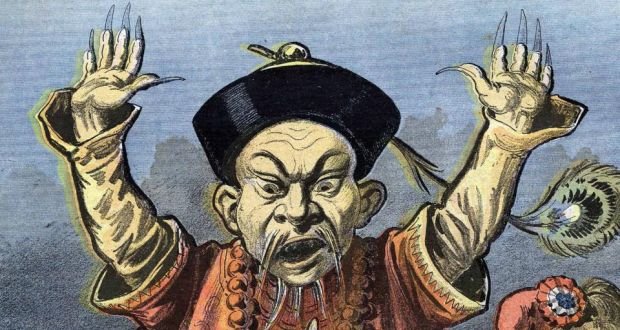
Leung Wing-Fai: Perceptions of the East – "Yellow Peril: An Archive of Anti-Asian Fear"

By Leung Wing-Fai

November 16, 2021

Review: Fascination mixed with fear is how many in the West culturally construct the East

Apocalyptic pollution, “Asian” flu, unfettered economic growth, boot camps for internet addiction, hacker attacks on western businesses and governments:– there is no shortage of fascination mixed with fear directed towards the culturally constructed East. Yellow Peril! An Archive of Anti-Asian Fear distils and presents a collection of accounts, images and essays related to this fear.

The phrase yellow peril (sometimes yellow terror or yellow spectre), coined by Kaiser Wilhelm II of Germany, in the 1880s, after a dream in which he saw the Buddha riding a dragon threatening to invade Europe, blends western anxieties about sex, racist fears of the alien other, and the Spenglerian belief that the West will become outnumbered and enslaved by the East.

These fears became increasingly reinscribed as ideology through popular cultural products. In the late 19th century in Europe, the threat to imperialism drove the yellow-peril narrative, while in the United States it emerged predominantly as a response to social factors such as cheap “coolie” labour and increased immigration.

“Yellow peril”, which refers to the skin colour of east Asians, developed into a vague form of xenophobia that taps into the racist notion that “they all look the same” and extends beyond individual countries to encompass a whole continent and “colour” of peoples.

But in a far-reaching and often enlightening analysis that reveals the very blurred lines of designation in this field, John Kuo Wei Tchen, one of the editors of this book, points out that the colour yellow was originally attributed to natives of India rather than to east Asians.

Tchen is associate professor at New York University, a historian by training, author of New York Before Chinatown: Orientalism and the Shaping of American Culture, 1776-1882 (2001) and cofounder of the New York-based Museum of Chinese in America.

Along with his coeditor, Dylan Yeats, he presents a cornucopia of snippets, illustrations and essays aptly collected as an archive demonstrating what they define as yellow perilism, a “practice rooted within a European Enlightenment and European colonialist worldview”.

Archival ordering

The book is divided into three main systematic and logical sections. “The Imagined West” traces a prehistory of yellow perilism through an outline of how the westerncentric worldview came to be, beginning with early maps that place Europe at the centre.

“Manifest Destinies” centres on the constructions of otherness that western nations perpetuated through social Darwinism, manifest destiny, white supremacy and projected fears. “Indispensable Enemies” focuses on the manifestations of yellow perilism in the American context up to the present day.

Some of the extracts are especially illuminating, such as Teddy Roosevelt’s endorsement of Jeremiah Curtain’s historical account The Mongols (1904), comparing “Mongols” to North American Comanches and Apaches, written while he was president of the United States.

By pointing to the relevance of The Mongols in terms of an ongoing struggle between East and West, the excerpt exposes an apparent American predisposition regarding the necessity of the West to defeat the imagined Asian enemy and to create a narrative history that rationalises state violence by accentuating the apparent brutality of the perceived other.

Yellow Peril! An Archive of Anti-Asian Fear is unique in presenting a carefully selected repository of anti-Asian images and writing, pop culture artefacts and political polemic, from a diverse and well-researched range of sources that includes excerpts spanning from Hegel and Marx to Jack London and WEB Du Bois.

Stressing that yellow peril is one of the longest-standing and most pervasive racist ideas in western culture, the book traces its history to medieval Europe.

Modern incarnations include Sax Rohmer’s enduring Edwardian literary yellow-peril villain, Dr Fu Manchu, an archetype now embedded in characterisations of villains from the emperor Ming the Merciless of the 1930s Flash Gordon comic strip through to the Mandarin in the 2013 film Iron Man 3.

Despite its reputation as a fading historical memory, a yellow-peril ideology persists, ranging from storylines in the 2004 reboot of the TV serial Battlestar Gallactica to campaign commercials from the 2012 US presidential election.

The collection nonetheless misses several related theoretical frameworks, such as Michel Foucault’s notion of biopolitics, which he discussed in his lectures Society Must Be Defended (1975-76), in that biopower is invoked to establish a continuum of regime, especially in the elimination of the biological threat to and the improvement of the racial species.

Yellow peril, with its focus on biological differences to explain developing civilisations, was part of the rise of eugenics, Darwinism and Nazism in Europe between the two World Wars.

Other theories, such as postcolonialism and linguistic profiling, are only tacitly referred to. These theoretical frames could have added more complexity to the understanding of the development and constitution of yellow perilism.

Michel Foucault

The book appears to be aimed at an interested general audience while attempting to be academically vigorous, although there seems to be uncertainty about the level at which the content is presented. Further explication and more detailed introduction to the excerpts would have been useful; for instance, are the definition and location of the Eurasian steppe common knowledge?

Specific elements are not fully or further developed, such as the physiological distinction of single eye flaps; neither does the book examine examples of yellow perilism that have occurred in countries such as Mexico, which may create problems for the phenomena mostly characterised as West-East relationships.

The collection offers considerable investment in visual references and analysis of political cartoons and advertising imagery, although at times the writing could be expanded, such as the discussion of processes of scapegoating and stereotyping. Some background to the definitions of terminology connected to such processes, and their alliance to psychology and sociology, would have been helpful to the readers.

An intellectually stimulating and ambitious book, Yellow Peril! An Archive of Anti-Asian Fear both benefits and suffers from its broad range. It excels as a fresh and light read with a wide variety of sources and topics, but its breadth prevents the analysis from delving deeper and from including more contrasting viewpoints.

With such a broad topic it is inevitably difficult to delimit the central writers and texts, but the editors have done an admirable job of compiling this wide range of materials into an attractive and accessible collection.

Originally published by Irish Times, August 14, 2014

Please help TFF remain truly independent and deliver more quality articles and themes like this. We are people-financed – and that means… by you! Thanks

[paypal-donation]
Share

Leave a Reply

Your email address will not be published. Required fields are marked *

Related Posts

Jan Oberg May 15, 2026 Go to this Fox News page and scroll the whole way down: President Donald Trump tells the world that his meeting with President Xi Jinping yielded a lot of very concrete political and economic results – of course, only where the Chinese side, according to him, agreed with him. He does not mention the Taiwan issue, but Secretary of State, Marco Rubio, says that it did not feature prominently in their talks and that the US policy on Taiwan has not changed. Then go to China Daily – or Global Times – and you will see that for the Chinese it is framework, principles, structure of cooperation etc. that matters – all embedded in the overall idea of “constructive bilateral relationship of strategic stability.” Nowhere is any concrete agreement or deal – all that Trump refers to – mentioned. At the general level, this gives you insights into the very different social...
Jan Oberg, TFF director April 9, 2026 I was recently invited to have a good, long talk about the world – and, of course, about peace too – with Boris Malagurski on his Weight of Chains Channel on YouTube. It was a real joy and seems to have been greatly appreciated by the viewers too. Mr Malagurski and I shall of course be grateful if you share this conversation in your circles – of course, only if you like what you see and hear  And remember that this one – like hundreds of others with TFF Associates – can be enjoyed at our TFF Video Collection.
By Jan ObergTFF co-founder and director February 11, 2026 PART 3 — ECONOMICS, TRADE & FINANCIAL SOVEREIGNTY A. Trade Measures & Market Signaling Economic pressure can be applied instantly and scaled without violence. Immediate Measures (within a week) Government boycott US goods and services  A very powerful signal which over time will be felt. Targeted tariffs on selected U.S. goods Symbolic but high-visibility sectors send a clear message. Suspend trade facilitation talks A peaceful pause that signals deep concern. Freeze U.S. participation in public procurement – military procurement in particular A nonviolent way to reduce influence. Competition law review of U.S. corporations A legal tool to scrutinise market dominance. Longer-Term Measures EU–Asia–Africa trade corridors Reducing reliance on U.S. markets. European supply chains for critical minerals Strategic autonomy in resource access. European Strategic Trade Authority Monitoring coercive practices globally. Euro-denominated commodity markets Weakening the dollar’s pricing monopoly. The EU must resume contacts and negotiations with Russia, focusing on energy cooperation To...

Recent Articles

Jan Oberg May 15, 2026 Go to this Fox News page and scroll the whole way down: President Donald Trump tells the world that his meeting with President Xi Jinping yielded a lot of very concrete political and economic results – of course, only where the Chinese side, according to him, agreed with him. He does not mention the Taiwan issue, but Secretary of State, Marco Rubio, says that it did not feature prominently in their talks and that the US policy on Taiwan has not changed. Then go to China Daily – or Global Times – and you will see that for the Chinese it is framework, principles, structure of cooperation etc. that matters – all embedded in the overall idea of “constructive bilateral relationship of strategic stability.” Nowhere is any concrete agreement or deal – all that Trump refers to – mentioned. At the general level, this gives you insights into the very different social...
Lena Petrova of “World Affairs In Context” with more than half a million subscribers on YouTube wanted to explore what a peace researcher like me has to say about, among other things, the First and the Second Cold War and why eethics has disappeared from politics. I am particularly happy about this conversation that also yielded an amazing number of very appreciative comments on YouTube. No doubt, people are longing for alternatives, including peace perspectives.
The MIMAC – Military-Industrial-Media-Academic Complex – drives the world’s rampant militarism and wars without end. Here is a short reflection of how it works against all interests of humanity. #5 deals with why there is no real enemy or threat images/analysis. It’s all ex-post constructions. And, btw, theTFF Peace Pulse is now on Rumble.

TFF on Substack

Discover more from TFF Transnational Foundation & Jan Oberg.

Most Popular

Jan Oberg May 15, 2026 Go to this Fox News page and scroll the whole way down: President Donald Trump tells the world that his meeting with President Xi Jinping yielded a lot of very concrete political and economic results – of course, only where the Chinese side, according to him, agreed with him. He does not mention the Taiwan issue, but Secretary of State, Marco Rubio, says that it did not feature prominently in their talks and that the US policy on Taiwan has not changed. Then go to China Daily – or Global Times – and you will see that for the Chinese it is framework, principles, structure of cooperation etc. that matters – all embedded in the overall idea of “constructive bilateral relationship of strategic stability.” Nowhere is any concrete agreement or deal – all that Trump refers to – mentioned. At the general level, this gives you insights into the very different social...
Lena Petrova of “World Affairs In Context” with more than half a million subscribers on YouTube wanted to explore what a peace researcher like me has to say about, among other things, the First and the Second Cold War and why eethics has disappeared from politics. I am particularly happy about this conversation that also yielded an amazing number of very appreciative comments on YouTube. No doubt, people are longing for alternatives, including peace perspectives.
The MIMAC – Military-Industrial-Media-Academic Complex – drives the world’s rampant militarism and wars without end. Here is a short reflection of how it works against all interests of humanity. #5 deals with why there is no real enemy or threat images/analysis. It’s all ex-post constructions. And, btw, theTFF Peace Pulse is now on Rumble.
Read More
Screenshot-2026-05-15-103534
Jan Oberg May 15, 2026 Go to this Fox News page and scroll the whole way down: President Donald Trump tells the world that his meeting with President Xi Jinping yielded a lot of very concrete political and economic results – of course, only where the Chinese side, according to him, agreed with him. He does not mention the Taiwan issue, but Secretary of State, Marco Rubio, says that it did not feature prominently in their talks and that the US policy on Taiwan has not changed. Then go to China Daily – or Global Times – and you will see that for the Chinese it is framework, principles, structure of cooperation etc. that matters – all embedded in the overall idea of “constructive bilateral relationship of strategic stability.” Nowhere is any concrete agreement or deal – all that Trump refers to – mentioned. At the general level, this gives you insights into the very different social...
Screenshot-2026-05-12-104023
Lena Petrova of “World Affairs In Context” with more than half a million subscribers on YouTube wanted to explore what a peace researcher like me has to say about, among other things, the First and the Second Cold War and why eethics has disappeared from politics. I am particularly happy about this conversation that also yielded an amazing number of very appreciative comments on YouTube. No doubt, people are longing for alternatives, including peace perspectives.
Screenshot-2026-04-13-154551 (2)
The MIMAC – Military-Industrial-Media-Academic Complex – drives the world’s rampant militarism and wars without end. Here is a short reflection of how it works against all interests of humanity. #5 deals with why there is no real enemy or threat images/analysis. It’s all ex-post constructions. And, btw, theTFF Peace Pulse is now on Rumble.
Screenshot-2026-04-13-154551 (1)
Jan Oberg, TFF director April 28, 2026 In this third TFF Peace Pulse, I make the important distinction between the violence and the conflict that violence is a symptom of. If you want peace, focus on the underlying conflict because that is the key to resolution, peacemaking, and a better future for the parties. The West is obsessed with violence, just look around you – and 90+ per cent of the public debate is about military issues and other violence – totally wasted for peace. These Peace Pulses will only be published here a few times. You will also not find them on YouTube and Vimeo because both platforms have blocked TFF and me; you know, peace is dangerous these days. Most TFF’s videos since 2007 are now on Rumble.
Screenshot-2026-04-13-154551
In contrast to most, we’ll bring alternatives, solutions, hope and strategies for a better future. Times are dangerous, yes, but that only intensifies the need for constructive thinking and action! Jan Oberg, TFF director April 13, 2026 The new TFF Peace Pulse uses video messages in a new way: Max 3-5-minute-long comments, ideas or perhaps mini-lectures, all about peace – positive peace. We launch them today on April 13, 2026 with a carefully crafted visual aesthetic fitting the content. We hope to publish them regularly from now on. We launch Peace Pulse (PP) – for a number of reasons. The world is in chaos, and there are countless reasons to feel concerned, frustrated, even angry. The atmosphere is saturated with doom and gloom, with negative energy and rear‑mirror thinking, while vision, imagination, alternatives, strategies and genuine future‑mindedness remain in short supply. And without them, we simply can’t save the world. Looking at problems from a hundred angles will...
IMG_5165 (1)
PART II — Publishing Peace in a System That Prioritises Militarism Jan Oberg, TFF director April 10, 2026 How TFF Maintains a Daily Voice in a Digital World Built for Noise This article is part of the series “TFF at 40″ and it invites you to learn about Four Decades of Publishing Peace. It takes a look at how a small, people‑financed peace foundation has communicated across four generations of technology — from wax stencils and fax machines to mass email and Substack — and why TFF continues to publish every single day in a system that rewards noise, conflict, and militarism. ◆ What it means to publish peace every single day in a digital system built for 24/7 news and other noise, confrontation, and militarism. How TFF’s independence, continuity, and global readership defy algorithms, donor cycles, and Western media censorhip — and why the Majority World keeps listening. When the...