
Afghanistan and the CIA heroin ratline

Pepe Escobar

August 25, 2021

The Persian Gulf harbors an array of extremely compromising secrets. Near the top is the Afghan heroin ratline – with the United Arab Emirates (UAE) positioned as the golden node of a transnational, trillion dollar heroin money laundering operation.

Originally posted on LewRockwell homepage on January 18, 2021

In this 21st century Opium War, crops harvested in Afghanistan are essentially feeding the heroin market not only in Russia and Iran but especially in the US. Up to 93% of the world’s opium comes from Afghanistan.

Contrary to predominant Western perception, this is not an Afghan Taliban operation. The key questions — never asked by Atlanticist circles — are who buys the opium harvests; refines them into heroin; controls the export routes; and then sell them for humongous profit compared to what the Taliban have locally imposed in taxes.

The hegemonic narrative rules that Washington bombed Afghanistan in 2001 in “self-defense” after 9/11; installed a “democratic” government; and after 16 years never de facto left because this is a key node in the Global War on Terror (GWOT), against al-Qaeda and the Taliban alike.

Washington spent over $100 billion in Afghan reconstruction. And, allegedly, $8.4 billion in “counternarcotics programs”. Operation Enduring Freedom — along with the “liberation” of Iraq — have cost an astonishing several trillion dollars. And still the heroin ratline, out of occupied Afghanistan, thrives. Cui bono?

Have a SIGAR

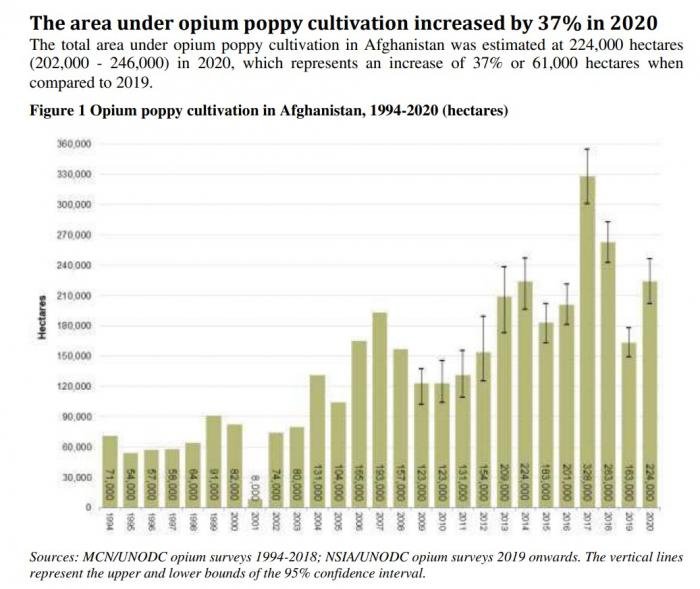
An exhaustive Afghanistan Opium Survey details the steady rise of Afghan opium production as well as the sprawl in production areas; “In 2016, opium production had increased by approximately 25 times in relation to its 2001 levels, from 185 tons in 2001 to 4800 tons in 2016.”

Another exhaustive report issued by the delightful acronym SIGAR (Special Inspector General for Afghanistan Reconstruction) even hints — discreetly — at the crucial connection; Operation Enduring Freedom feeding America’s heroin epidemic.

Afghanistan is infested by contractors; numbers vary from 10,000 to tens of thousands. Military and ex-military alike can be reasonably pinpointed as players in the heroin ratline — in many cases for personal profit. But the clincher concerns the financing of US intel black ops that should not by any means come under scrutiny by the US Congress. 

A Gulf-based intel source with vast experience across the Pentagon-designated “arc of instability” tells the story of his interaction with an Australian intel operative who served in Afghanistan; “This was about 2011. He said he gave US Army Intelligence and the CIA reports on the Afghan heroin trade — that US military convoys from the ports of Pakistan were being used to ship the heroin out of Afghanistan — much of it was raw opium — for distribution as their backhaul.

No one answered.

He then cornered the key army intelligence operations and CIA at a meeting and asked why no action was taken. The answer was that the goal of the US was winning the hearts and minds of the population and giving them the poppies to grow won their hearts. He was then warned that if he brought this issue up again he would be returned to Australia in a body bag.”

The source is adamant, “CIA external operations are financed from these profits. The charge that the Taliban was using the heroin trade to finance their operations was a fabrication and a form of misdirection.”

And that brings us to a key motive behind President Trump‘s going against his instincts and accepting a new Afghan surge; “In the tradition of the opium wars of perfidious Albion in the 19th century, in which opium paid for tea and silk from India, and the taxes on these silk and tea imports financed the construction of the mighty British Navy which ruled the seas, the CIA has built itself up into a most powerful agent based on the trillion dollar heroin trade. It is impossible for Trump to overcome it as he has no allies to tap. The military are working together with the CIA, and therefore the officers that surround Trump are worthless.”

None of this deviates from the CIA’s modus operandi.

Past examples abound. The most notorious concerns the Golden Triangle during the Vietnam war, when the CIA imposed a food-for-opium scheme on Hmong tribesmen from Laos — complete with a heroin refinery at the CIA headquarters in northern Laos and the set up of nefarious Air America to export the opium.

The whole story was exposed on Prof. Alfred McCoy’s seminal The Politics of Heroin in Southeast Asia — which drove Langley nuts.

A contemporary counterpart would be a recent book by Italian journalist Enrico Piovesana detailing the New Opium War in Afghanistan.

The return of Air America

A Pakistani intel source with vast Pashtun/ tribal area contacts delves into even more incendiary territory; “According to our best information the CIA has brought in their al-Qaeda-Daesh proxies into Afghanistan to justify the additional American troops”. That would neatly tie in with Trump being cornered by his generals.

And then, there’s Moscow. Last week, the Russian Foreign Ministry was adamantly denouncing “foreign fighters” transferred by “unknown helicopters” as the perpetrators of a massacre of Hazara Shi’ites in a northern Afghanistan province; “It seems that the command of the NATO forces controlling the Afghan sky stubbornly refuses to notice these incidents.”

It does not get more serious than that; Moscow denouncing sectors of the US-trained Afghan Armed Forces side by side with NATO engaged in covert ops supporting jihadis.  Russian intel has hinted — discreetly — for quite some time that US intel is covertly sponsoring Daesh — a.k.a. “ISIS Khorasan” — in Afghanistan.

Russian intel is very much aware of the Afghan chapter in the New Great Game. Russian citizens are “collateral damage” of the Afghan heroin ratline as much as Americans. The Russian Foreign Ministry is tracking how tons of chemicals are being illegally imported into Afghanistan from, among others, “Italy, France and the Netherlands”, and how the US and NATO are doing absolutely nothing to contain the heroin ratline.

Well, Air America, after all, never died. It just relocated from the jungles of Southeast Asia to the arid crossroads of Central and South Asia.

If you appreciate this kind of enlightened public education material, relevant to peace-making – please help TFF to publish more like this. We are entirely people-financed and therefore truly independent and trustworthy
Pepe Escobar

Pepe Escobar is the roving correspondent for Asia Times and an analyst for the Real News. This article draws from his new book, Obama does Globalistan. He may be reached at pepeasia@yahoo.com.
No data was found

Share

Leave a Reply

Your email address will not be published. Required fields are marked *

Related Posts

Contrary to what we stated when publishing this Call, the UN General Assembly (GA) opened on September 9, 2025, in New York, not in Geneva, as we initially wrote. However, due to the host role-violating US ban on visas to Palestinians, the Special GA Segment on Palestine will be held in the UN Geneva from September 22. And it builds up to something historic. Anyhow, here is what we believe you must advocate or do to help stop the Israeli genocide. It’s called people’s power or citizens’ diplomacy. SHARE! The first of three appeals from TFF. The second is here, and the third here. Across the world, people are witnessing the systematic destruction of Palestinian lives, homes, and communities. The scale and intensity of Israel’s military operations — especially in Gaza — have led leading legal bodies, including the International Court of Justice, to warn of a plausible genocide. The...
Professor Zhang Weiwei is a highly respected Chinese intellectual and professor at Fudan University in Shanghai. He is the director of its China Institute and also runs a series of conversations with many different people around the world. Here is what came out of their meetings there and in Skopje, Macedonia in October 2024: & ◪ As you can see, also at the end of the second one, we both enjoy win-win exchanges like these about world order issues. Zhang Weiwei is known for using videos and social media to reach a large audience in China and worldwide. We suggest you see many more of Zhang Weiwei’s conversations – like recently with Professor Jeffrey Sachs – on the Thinkers’ Forum on YouTube. PS TFF posts hundreds of videos, its own and those of others, in our Video Collections on TFF Substack – including those that appear on YouTube. However, TFF...
Launched on November 17, 2024Updated with new materials regularly TFF Board members Thore Vest. Everywhere, the delegation was met with a sincere wish to develop knowledge, dialogue, cooperative projects, and initiatives based on citizens’ diplomacy – in general, but with the West in particular. For more, see “Report from the Nordic delegation to China’s Xinjiang Province, September 7-15, 2024.” While the delegation was in Xinjiang, various ideas were already being discussed from the local to the top level, i.e., with the governor and party leaders of Xinjiang. The two TFF Associates suggested that TFF set up a special section – in addition to its “China and Silk” – where various quality materials about Xinjiang would regularly be published to promote public education about Xinjiang, particularly its contemporary development – worldwide but in the West in particular. This is now a reality – as can be seen below – but it...

Recent Articles

Jan Øberg behandler i artiklen en lang række faktorer, som ligger til grund for den måde vores samfund er organiseret på – og derfor også for konflikter. Artiklen introducerer således sammenhængen mellem familien, foreninger, regeringer, NGO’ er, nation, stat, nationalstat og alliancer for på denne måde bedre at kunne forstå konflikter og i sidste ende blive klogere mht. at løse disse. Øberg, der er fortaler for global bevidsthed, hvilket skal ses i lyset af den øgede globalisering, skelner mellem kulturkamp og kulturdialog. Endelig behandles begrebet magt og magtesløshed: giver magt ret til at udøve magt – fordi man mener at have ret? Litteraturliste og arbejdsspørgsmål efter artiklen. Ordene vi bruger om verden I satellitperspektiv kan man godt tale om den menneskelige familie eller menneskeheden. Udtrykket understreger, at der eksisterer – eller burde eksistere – et fællesskab fordi vi alle er mennesker og sammen bebor denne klode og ingen anden. Og...
Kapitel 2: Forskellige sider af Europa og USA…fortsat 2.5 Militære relationer I forbifarten har vi allerede sagt nogle ting om USA’s militære situation. Kig lige en gang til på afsnit 2.3. Nu skal vi uddybe det militære forhold mellem USA og EU. Der er en række ligheder mellem visse europæiske landes og USA’s militær. Næsten alle er med på en eller anden måde i NATO, direkte som medlem – selv Island, der ikke har et forsvar – eller indirekte i Partnerskab for Fred. USA og Canada er med i OSCE (på dansk OSSE), Organisationen for Sikkerhed og Samarbejde i Europa, der tæller over 50 lande. USA samt England og Frankrig er kernevåbenstater og de har styrker til intervention langt borte fra hjemlandet, om end USA’s er tifold større. Alle har også en omfattende våbeneksport og bruger den som et middel til at tjene penge og få loyale venner på, det...
Background Christian Harleman and Jan Oberg conducted a fact-finding mission to Burundi between November 26 and December 6, 2003. (See websites about the country here). The first TFF mission took place in March 1999. Unfortunately, since then it has not been practically possible to implement the co-operation with Burundi’s Ministry of Education and Burundian NGOs that was planned at the time. The 2003 mission had three purposes. First, to do fact-finding in general about the situation and, in particular, the progress under the Arusha Peace Process. Second, to explore the possibilities for co-operation between the government and relevant NGOs on the one hand and TFF on the other, in order to develop and deepen the existing competence in fields such as conflict-understanding, reconciliation and peace-building. Finally, third, to find out whether it would be possible, in co-operation with the Swedish Rescue Services Agency (Statens Räddningsverk), to establish a health care unit that...

TFF on Substack

Discover more from TFF Transnational Foundation & Jan Oberg.

Most Popular

Jan Øberg behandler i artiklen en lang række faktorer, som ligger til grund for den måde vores samfund er organiseret på – og derfor også for konflikter. Artiklen introducerer således sammenhængen mellem familien, foreninger, regeringer, NGO’ er, nation, stat, nationalstat og alliancer for på denne måde bedre at kunne forstå konflikter og i sidste ende blive klogere mht. at løse disse. Øberg, der er fortaler for global bevidsthed, hvilket skal ses i lyset af den øgede globalisering, skelner mellem kulturkamp og kulturdialog. Endelig behandles begrebet magt og magtesløshed: giver magt ret til at udøve magt – fordi man mener at have ret? Litteraturliste og arbejdsspørgsmål efter artiklen. Ordene vi bruger om verden I satellitperspektiv kan man godt tale om den menneskelige familie eller menneskeheden. Udtrykket understreger, at der eksisterer – eller burde eksistere – et fællesskab fordi vi alle er mennesker og sammen bebor denne klode og ingen anden. Og...
Kapitel 2: Forskellige sider af Europa og USA…fortsat 2.5 Militære relationer I forbifarten har vi allerede sagt nogle ting om USA’s militære situation. Kig lige en gang til på afsnit 2.3. Nu skal vi uddybe det militære forhold mellem USA og EU. Der er en række ligheder mellem visse europæiske landes og USA’s militær. Næsten alle er med på en eller anden måde i NATO, direkte som medlem – selv Island, der ikke har et forsvar – eller indirekte i Partnerskab for Fred. USA og Canada er med i OSCE (på dansk OSSE), Organisationen for Sikkerhed og Samarbejde i Europa, der tæller over 50 lande. USA samt England og Frankrig er kernevåbenstater og de har styrker til intervention langt borte fra hjemlandet, om end USA’s er tifold større. Alle har også en omfattende våbeneksport og bruger den som et middel til at tjene penge og få loyale venner på, det...
Background Christian Harleman and Jan Oberg conducted a fact-finding mission to Burundi between November 26 and December 6, 2003. (See websites about the country here). The first TFF mission took place in March 1999. Unfortunately, since then it has not been practically possible to implement the co-operation with Burundi’s Ministry of Education and Burundian NGOs that was planned at the time. The 2003 mission had three purposes. First, to do fact-finding in general about the situation and, in particular, the progress under the Arusha Peace Process. Second, to explore the possibilities for co-operation between the government and relevant NGOs on the one hand and TFF on the other, in order to develop and deepen the existing competence in fields such as conflict-understanding, reconciliation and peace-building. Finally, third, to find out whether it would be possible, in co-operation with the Swedish Rescue Services Agency (Statens Räddningsverk), to establish a health care unit that...
Read More
Imagen-thumbnail-The-Transnational-1
Jan Øberg behandler i artiklen en lang række faktorer, som ligger til grund for den måde vores samfund er organiseret på – og derfor også for konflikter. Artiklen introducerer således sammenhængen mellem familien, foreninger, regeringer, NGO’ er, nation, stat, nationalstat og alliancer for på denne måde bedre at kunne forstå konflikter og i sidste ende blive klogere mht. at løse disse. Øberg, der er fortaler for global bevidsthed, hvilket skal ses i lyset af den øgede globalisering, skelner mellem kulturkamp og kulturdialog. Endelig behandles begrebet magt og magtesløshed: giver magt ret til at udøve magt – fordi man mener at have ret? Litteraturliste og arbejdsspørgsmål efter artiklen. Ordene vi bruger om verden I satellitperspektiv kan man godt tale om den menneskelige familie eller menneskeheden. Udtrykket understreger, at der eksisterer – eller burde eksistere – et fællesskab fordi vi alle er mennesker og sammen bebor denne klode og ingen anden. Og...
Imagen-thumbnail-The-Transnational-1
Kapitel 2: Forskellige sider af Europa og USA…fortsat 2.5 Militære relationer I forbifarten har vi allerede sagt nogle ting om USA’s militære situation. Kig lige en gang til på afsnit 2.3. Nu skal vi uddybe det militære forhold mellem USA og EU. Der er en række ligheder mellem visse europæiske landes og USA’s militær. Næsten alle er med på en eller anden måde i NATO, direkte som medlem – selv Island, der ikke har et forsvar – eller indirekte i Partnerskab for Fred. USA og Canada er med i OSCE (på dansk OSSE), Organisationen for Sikkerhed og Samarbejde i Europa, der tæller over 50 lande. USA samt England og Frankrig er kernevåbenstater og de har styrker til intervention langt borte fra hjemlandet, om end USA’s er tifold større. Alle har også en omfattende våbeneksport og bruger den som et middel til at tjene penge og få loyale venner på, det...
Imagen-thumbnail-The-Transnational-1
Background Christian Harleman and Jan Oberg conducted a fact-finding mission to Burundi between November 26 and December 6, 2003. (See websites about the country here). The first TFF mission took place in March 1999. Unfortunately, since then it has not been practically possible to implement the co-operation with Burundi’s Ministry of Education and Burundian NGOs that was planned at the time. The 2003 mission had three purposes. First, to do fact-finding in general about the situation and, in particular, the progress under the Arusha Peace Process. Second, to explore the possibilities for co-operation between the government and relevant NGOs on the one hand and TFF on the other, in order to develop and deepen the existing competence in fields such as conflict-understanding, reconciliation and peace-building. Finally, third, to find out whether it would be possible, in co-operation with the Swedish Rescue Services Agency (Statens Räddningsverk), to establish a health care unit that...
Imagen-thumbnail-The-Transnational-1
Former UN Under-Secretary-General with special responsibility for peacekeeping operations TFF associate August 20, 2003 YRINGHAM, Mass.- Ralph Bunche was born in Detroit 100 years ago today (August 7, 2003). His passionate determination to get results did not extend to seeking credit for them, so his work is better remembered than he is. Of all his many accomplishments – civil rights pioneer, Nobel Peace Prize laureate, chief drafter of two chapters of the United Nations charter, negotiator of the armistices that ended the first Arab-Israeli war – Bunche said he was proudest of developing what came to be known as peacekeeping. Setting up the United Nations Truce Supervision Organization in Palestine in 1948, Bunche formulated the principles that have governed peacekeeping operations ever since. In the 1956 Suez crisis, working with Secretary General Dag Hammarskjold and Lester Pearson of Canada, he organized the first peacekeeping force, the United Nations Emergency Force...
– nästan 11 månader Till Sofia nästan 11 månader # 1  Till Sofias huvudsida Till alla Privata Foto-Serier
Till Sofias huvudsida