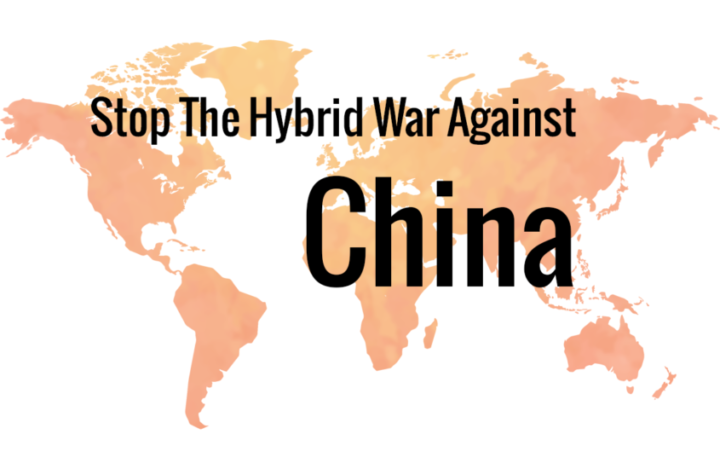

Why We Must Prevent the U.S. From Launching a Hybrid War Against China

Image by Stock File

Madison Tang and Jodie Evans

May 23, 2021

U.S. President Joe Biden’s budget proposal for the next fiscal year was recently announced, and it requests $715 billion for his first Pentagon budget, 1.6 percent more than the $704 billion enacted under Trump’s administration. The outline states that the primary justification for this increase in military spending is to counter the threat of China, and identifies China as the U.S.’s “top challenge.”

Within the proposal is an endorsement of U.S. Indo-Pacific Command head Admiral Philip Davidson’s request for $4.7 billion for the “Pacific Deterrence Initiative,” which will increase U.S. military capabilities in Guam and the surrounding region. The Indo-Pacific Command is also requesting $27 billion in additional spending between 2022 and 2027 to build a network of precision-strike missiles along the islands surrounding Beijing.

This article was originally published at Pressenza

The U.S.’s unilateral aggression toward China—in the hybrid form of economic, legal, information, and military warfare—is particularly dangerous today because there is bipartisan consensus in Washington on these policies. And while the anti-China stance may seem like a recent phenomenon to some, the consolidation of a U.S. national security policy that singles out a rising China as a target for “containment” in order to maintain U.S. dominance abroad has been long in the making.

After the fall of the Soviet Union in 1989, the U.S. had no further political need to cooperate or engage with China to counterbalance the Soviet Union. Led by Andrew Marshall, a member of RAND and the top adviser to 12 secretaries of defense, the Pentagon’s military supremacy policy (or “full-spectrum dominance,” as the Department of Defense calls it) since then has gradually shifted focus from deterring the Soviet Union to containing an emerging China.

In 1992, neoconservatives drafted the Defense Planning Guidance (DPG) document, or the “Wolfowitz Doctrine,” which announced the U.S. as the world’s only remaining superpower following the collapse of the Soviet Union and proclaimed the prevention of “the re-emergence of a new rival” as its main objective.

While this document was dismissed for its hubris upon leaking, scholar and journalist K.J. Noh explains that its ideas were not discarded and were later converted into the 2000 “Rebuilding America’s Defenses” document by the Project for the New American Century (PNAC).

Along with its focus on stated enemy nations like Russia, North Korea, Iran, and Iraq, “Rebuilding America’s Defenses” explicitly stated that, “with Europe now generally at peace, the new strategic center of concern appears to be shifting to East Asia. The missions for America’s armed forces have not diminished so much as shifted,” and that “raising U.S. military strength in East Asia is the key to coping with the rise of China to great-power status.”

So when Hillary Clinton announced the U.S.’s “Pivot to Asia” in Foreign Policy magazine in 2011, although she emphasized the positive rebalance and opportunity the Asia-Pacific region presented for the U.S. economy, behind the scenes she was adhering to PNAC’s defense strategy as the intellectual justification for the transference of 60 percent of U.S. naval capacity to the Asia-Pacific region, including the encircling of China with 400 U.S. military bases with invasive radar and missile systems.

The U.S.’s New Cold War on China Today: Defensive or Pre-Emptive?

Today the U.S. is launching a full-scale multi-pronged new Cold War on China and is relying on the same threat inflation strategies that foreign policy architect Andrew Marshall and his hawkish neoconservative protégés began nearly three decades ago.

From this progression, it is clear that the Biden administration’s stated reasons for escalating war and hostility with China—that the Chinese government is a dangerous aggressor and that the U.S. must maintain a robust defensive posture in response—belie the U.S.’s historical and ongoing imperialist motivations in its involvement in the Asia-Pacific region.

Just as the 1992 “Wolfowitz Doctrine” explicitly defined itself as a “blueprint for maintaining global U.S. pre-eminence,” President Biden vowed in his first formal press conference on March 25 that he would not let China surpass the U.S. as a global leader. “China has an overall goal… to become the leading country in the world, the wealthiest country in the world, and the most powerful country in the world,” he told reporters at the White House. “That’s not going to happen on my watch because the United States is going to continue to grow.”

Upon closer examination, the notion that China is the aggressor and the U.S. is maintaining a purely defensive military posture does not align with the facts.

For example, the U.S. spends about three times more on its military than China does. The U.S. has more than 800 overseas bases compared with China’s three; 400 of these 800 U.S. military bases are encircling China’s borders.

The U.S. Indo-Pacific Command has been conducting extensive military exercises, including missile test flights, with regularity. As Fareed Zakaria recently described for the Washington Post, the U.S. has nearly 20 times the number of nuclear warheads as China, has twice the tonnage of warships at sea, and has over 130,000 troops stationed in the Indo-Pacific.

The People’s Liberation Army of China has also not waged a full-scale war outside its borders in more than 40 years since the Vietnam War, while the U.S. has engaged in combat in over 66 other nations since 1979.

Importantly, China maintains a no-first-use policy on the use of nuclear weapons, and has even publicly called on nuclear weapon states to create and join a multilateral Treaty on Mutual No-First-Use of Nuclear Weapons; the U.S. does not maintain a no-first-use policy.

In fact, since the 2002 Nuclear Posture Review, the U.S. has explicitly prepared for nuclear war with Chinathreatening “intolerable damage” in response to “non-nuclear or nuclear aggression.”

The U.S. is continuing its attempts to maintain its status as a global power at all costs, rather than accepting the development of other nations as a positive form of progress for the international community.

Instead of provoking a new Cold War, the U.S. should be cooperating with China, whose administration has reiterated its willingness to maintain bilateral respect and non-confrontational relations, on pressing crises and humanitarian concerns like climate change mitigation, global poverty, and equitable worldwide vaccine distribution.

Please help TFF remain truly independent by contributing if you benefited from this article

[paypal-donation]

This article was produced by Local Peace Economy, a project of the Independent Media Institute.

This article was originally published at Pressenza

About the authors

Madison Tang is the campaign manager of China Is Not Our Enemy at CODEPINK.
Jodie Evans is the co-founder of CODEPINK and 826LA.
Share

Leave a Reply

Your email address will not be published. Required fields are marked *

Related Posts

Jan Oberg May 15, 2026 Go to this Fox News page and scroll the whole way down: President Donald Trump tells the world that his meeting with President Xi Jinping yielded a lot of very concrete political and economic results – of course, only where the Chinese side, according to him, agreed with him. He does not mention the Taiwan issue, but Secretary of State, Marco Rubio, says that it did not feature prominently in their talks and that the US policy on Taiwan has not changed. Then go to China Daily – or Global Times – and you will see that for the Chinese it is framework, principles, structure of cooperation etc. that matters – all embedded in the overall idea of “constructive bilateral relationship of strategic stability.” Nowhere is any concrete agreement or deal – all that Trump refers to – mentioned. At the general level, this gives you insights into the very different social...
In contrast to most, we’ll bring alternatives, solutions, hope and strategies for a better future. Times are dangerous, yes, but that only intensifies the need for constructive thinking and action! Jan Oberg, TFF director April 13, 2026 The new TFF Peace Pulse uses video messages in a new way: Max 3-5-minute-long comments, ideas or perhaps mini-lectures, all about peace – positive peace. We launch them today on April 13, 2026 with a carefully crafted visual aesthetic fitting the content. We hope to publish them regularly from now on. We launch Peace Pulse (PP) – for a number of reasons. The world is in chaos, and there are countless reasons to feel concerned, frustrated, even angry. The atmosphere is saturated with doom and gloom, with negative energy and rear‑mirror thinking, while vision, imagination, alternatives, strategies and genuine future‑mindedness remain in short supply. And without them, we simply can’t save the world. Looking at problems from a hundred angles will...
Jan Oberg, TFF director April 9, 2026 I was recently invited to have a good, long talk about the world – and, of course, about peace too – with Boris Malagurski on his Weight of Chains Channel on YouTube. It was a real joy and seems to have been greatly appreciated by the viewers too. Mr Malagurski and I shall of course be grateful if you share this conversation in your circles – of course, only if you like what you see and hear  And remember that this one – like hundreds of others with TFF Associates – can be enjoyed at our TFF Video Collection.

Recent Articles

Jan Oberg May 15, 2026 Go to this Fox News page and scroll the whole way down: President Donald Trump tells the world that his meeting with President Xi Jinping yielded a lot of very concrete political and economic results – of course, only where the Chinese side, according to him, agreed with him. He does not mention the Taiwan issue, but Secretary of State, Marco Rubio, says that it did not feature prominently in their talks and that the US policy on Taiwan has not changed. Then go to China Daily – or Global Times – and you will see that for the Chinese it is framework, principles, structure of cooperation etc. that matters – all embedded in the overall idea of “constructive bilateral relationship of strategic stability.” Nowhere is any concrete agreement or deal – all that Trump refers to – mentioned. At the general level, this gives you insights into the very different social...
Lena Petrova of “World Affairs In Context” with more than half a million subscribers on YouTube wanted to explore what a peace researcher like me has to say about, among other things, the First and the Second Cold War and why eethics has disappeared from politics. I am particularly happy about this conversation that also yielded an amazing number of very appreciative comments on YouTube. No doubt, people are longing for alternatives, including peace perspectives.
The MIMAC – Military-Industrial-Media-Academic Complex – drives the world’s rampant militarism and wars without end. Here is a short reflection of how it works against all interests of humanity. #5 deals with why there is no real enemy or threat images/analysis. It’s all ex-post constructions. And, btw, theTFF Peace Pulse is now on Rumble.

TFF on Substack

Discover more from TFF Transnational Foundation & Jan Oberg.

Most Popular

Jan Oberg May 15, 2026 Go to this Fox News page and scroll the whole way down: President Donald Trump tells the world that his meeting with President Xi Jinping yielded a lot of very concrete political and economic results – of course, only where the Chinese side, according to him, agreed with him. He does not mention the Taiwan issue, but Secretary of State, Marco Rubio, says that it did not feature prominently in their talks and that the US policy on Taiwan has not changed. Then go to China Daily – or Global Times – and you will see that for the Chinese it is framework, principles, structure of cooperation etc. that matters – all embedded in the overall idea of “constructive bilateral relationship of strategic stability.” Nowhere is any concrete agreement or deal – all that Trump refers to – mentioned. At the general level, this gives you insights into the very different social...
Lena Petrova of “World Affairs In Context” with more than half a million subscribers on YouTube wanted to explore what a peace researcher like me has to say about, among other things, the First and the Second Cold War and why eethics has disappeared from politics. I am particularly happy about this conversation that also yielded an amazing number of very appreciative comments on YouTube. No doubt, people are longing for alternatives, including peace perspectives.
The MIMAC – Military-Industrial-Media-Academic Complex – drives the world’s rampant militarism and wars without end. Here is a short reflection of how it works against all interests of humanity. #5 deals with why there is no real enemy or threat images/analysis. It’s all ex-post constructions. And, btw, theTFF Peace Pulse is now on Rumble.
Read More
Screenshot-2026-05-15-103534
Jan Oberg May 15, 2026 Go to this Fox News page and scroll the whole way down: President Donald Trump tells the world that his meeting with President Xi Jinping yielded a lot of very concrete political and economic results – of course, only where the Chinese side, according to him, agreed with him. He does not mention the Taiwan issue, but Secretary of State, Marco Rubio, says that it did not feature prominently in their talks and that the US policy on Taiwan has not changed. Then go to China Daily – or Global Times – and you will see that for the Chinese it is framework, principles, structure of cooperation etc. that matters – all embedded in the overall idea of “constructive bilateral relationship of strategic stability.” Nowhere is any concrete agreement or deal – all that Trump refers to – mentioned. At the general level, this gives you insights into the very different social...
Screenshot-2026-05-12-104023
Lena Petrova of “World Affairs In Context” with more than half a million subscribers on YouTube wanted to explore what a peace researcher like me has to say about, among other things, the First and the Second Cold War and why eethics has disappeared from politics. I am particularly happy about this conversation that also yielded an amazing number of very appreciative comments on YouTube. No doubt, people are longing for alternatives, including peace perspectives.
Screenshot-2026-04-13-154551 (2)
The MIMAC – Military-Industrial-Media-Academic Complex – drives the world’s rampant militarism and wars without end. Here is a short reflection of how it works against all interests of humanity. #5 deals with why there is no real enemy or threat images/analysis. It’s all ex-post constructions. And, btw, theTFF Peace Pulse is now on Rumble.
Screenshot-2026-04-13-154551 (1)
Jan Oberg, TFF director April 28, 2026 In this third TFF Peace Pulse, I make the important distinction between the violence and the conflict that violence is a symptom of. If you want peace, focus on the underlying conflict because that is the key to resolution, peacemaking, and a better future for the parties. The West is obsessed with violence, just look around you – and 90+ per cent of the public debate is about military issues and other violence – totally wasted for peace. These Peace Pulses will only be published here a few times. You will also not find them on YouTube and Vimeo because both platforms have blocked TFF and me; you know, peace is dangerous these days. Most TFF’s videos since 2007 are now on Rumble.
Screenshot-2026-04-13-154551
In contrast to most, we’ll bring alternatives, solutions, hope and strategies for a better future. Times are dangerous, yes, but that only intensifies the need for constructive thinking and action! Jan Oberg, TFF director April 13, 2026 The new TFF Peace Pulse uses video messages in a new way: Max 3-5-minute-long comments, ideas or perhaps mini-lectures, all about peace – positive peace. We launch them today on April 13, 2026 with a carefully crafted visual aesthetic fitting the content. We hope to publish them regularly from now on. We launch Peace Pulse (PP) – for a number of reasons. The world is in chaos, and there are countless reasons to feel concerned, frustrated, even angry. The atmosphere is saturated with doom and gloom, with negative energy and rear‑mirror thinking, while vision, imagination, alternatives, strategies and genuine future‑mindedness remain in short supply. And without them, we simply can’t save the world. Looking at problems from a hundred angles will...
IMG_5165 (1)
PART II — Publishing Peace in a System That Prioritises Militarism Jan Oberg, TFF director April 10, 2026 How TFF Maintains a Daily Voice in a Digital World Built for Noise This article is part of the series “TFF at 40″ and it invites you to learn about Four Decades of Publishing Peace. It takes a look at how a small, people‑financed peace foundation has communicated across four generations of technology — from wax stencils and fax machines to mass email and Substack — and why TFF continues to publish every single day in a system that rewards noise, conflict, and militarism. ◆ What it means to publish peace every single day in a digital system built for 24/7 news and other noise, confrontation, and militarism. How TFF’s independence, continuity, and global readership defy algorithms, donor cycles, and Western media censorhip — and why the Majority World keeps listening. When the...