
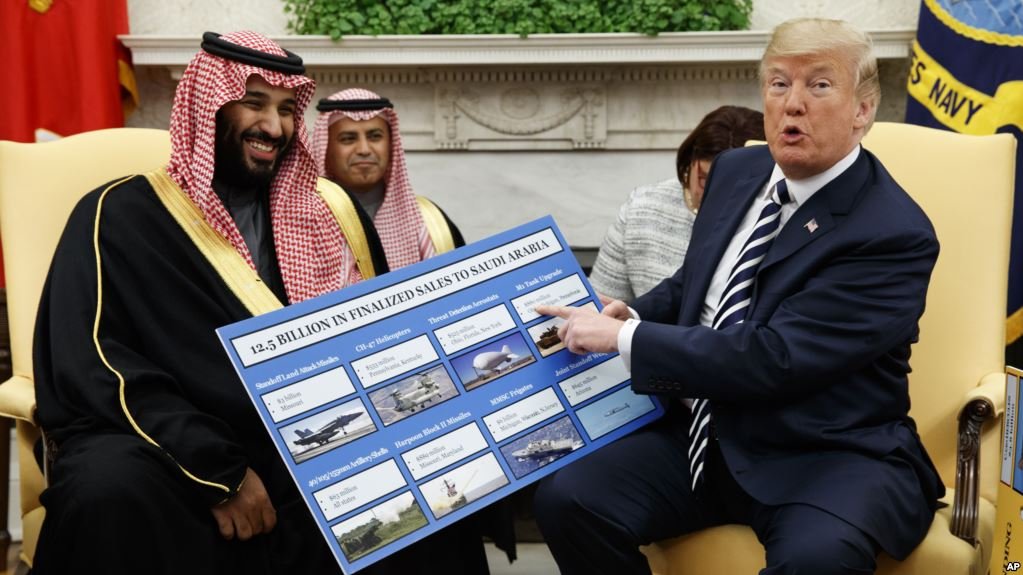
Photo: March 20, 2018. President Donald Trump and Saudi Crown Prince Mohammed bin Salman in the White House in Washington. (Photo credit: voanews.com).
By Emile Nakhleh*
November 30, 2018
The Middle East, like the rest of the world, is a “very dangerous place!” according to President Trump. The Saudis, with America’s tacit help, made it so.
President Trump’s bizarre and strange recent statement giving Saudi Crown Prince Mohammed bin Salman (MbS) a pass on his involvement in journalist Jamal Khashoggi’s murder raises a number of serious issues that Trump cavalierly dismisses or doesn’t know about in the first place.
Beyond the half-truths and the lame rationale he has offered in defense of MbS, the president is in fact undermining America’s long-term interests in the region and putting the lives of American citizens – civilians, diplomats, and military – in that part of the world at risk.
Originally published at lobelog.com
To ascribe theories of political realism, international trade, or regional power competition to Trump’s apologia of Saudi Arabia is to give unwarranted credit to the rambling statement that Trump reportedly dictated.
By attributing such lofty “transactional” doctrines as the realpolitik and liberal order paradigm to the statement is to presume that the president had studied the realities of the Middle East, the history and dynamics of American-Saudi relations over the years, the Saudi role in preaching a radical version of Sunni Islam in the past half century, or the emergence of the international order since World War II.
The piece failed to show any such analytic depth or informed expertise.
Instead, it was no more than a disjointed, truth-challenged, strategy-devoid, and Iran-bashing ode to Arab dictators, tribal Sunni potentates, and MbS in particular.
It takes the president’s dystopian view of the world to another level.
What president Trump has done is to reduce the American-Saudi strategic partnership, which for decades has been based on states regardless of who is in power in either country, to specific persons – Trump on the American side and MbS on the Saudi side.
Saudi kings, whether full brothers of the so-called Sudairi Seven, like the current King Salman, or half-brothers, like the late King Abdullah, have guarded the relationship because it served the strategic interests of Saudi Arabia, not any one leader.
In Trump’s world, the partnership has devolved into a series of pronouncements driven by the whims and predilections of two people, Trump and MbS.
Since the beginning of Robert Mueller’s Russia investigation and the president’s refusal to criticize Russia for attacking the 2016 American elections, people have asked, “What does Putin have on Trump?” With the recent pro-Saudi statement, a legitimate question might be, “What does MbS have on Trump?”
The U.S. president seems to have caved in to Putin.
In this instance, he seems to act as supplicant to MbS, not as the leader of the free world.
Undercutting the Intelligence Community
Two other dangers loom over the horizon because of Trump’s pro-MbS posture.
He has undercut the veracity and effectiveness of the U.S. intelligence community and has given a green light to dictators to persecute their opponents at will without culpability or accountability.
Like the military, American intelligence has been at the front lines in the defense of this country and its citizens.
Intelligence officers and their families have endured untold hardships in the service of the country, and many intelligence collectors and analysts have lost their lives in war-torn countries.
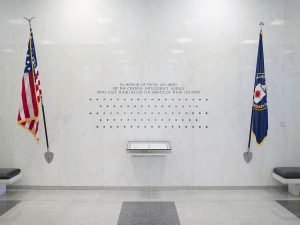
The stars engraved on the main lobby wall at CIA headquarters testify to the ultimate sacrifice that CIA officers have made over the years.
The intelligence community does not make a “high confidence” judgment lightly. Such a judgment must be based on first-hand information, including intercepts of phone calls, messages, and personal conversations.
Since the “Curveball” debacle during the Iraq War, intelligence analysts are now required to state the level of confidence they have in their judgments.
Such determination is based on the facts in question, the source of such facts, and the access and knowledge of the source.
If the recent media leak about MbS’s culpability is accurate, then the CIA judgment that MbS approved the murder in advance and was aware of the operation before and after the murder is correct.
If U.S. intelligence did not have first-hand information to make a “high confidence” judgment, a label of “low confidence” or “moderate confidence” would have been attached to the report.
It’s sad that the president of the United States, the primary “consumer” of U.S. intelligence, has rejected the CIA’s judgement and thrown all facts to the wind.
CIA analysts do not deal with “feelings,” as the president has claimed, but with corroborated evidence.
Equally disturbing is Trump’s message to the world that he doesn’t trust his own intelligence community and doesn’t put much stock in its evidence-based judgments.
How can intelligence collectors and analysts function under such a cloud of high-level suspicion?
Isn’t this the best Thanksgiving gift that Trump is giving to America’s adversaries, including the Saudi autocrat?
A few examples illustrate how the Saudis, with America’s help, have made the region a very dangerous place.
Regional Radicalism
The radical interpretation of Islam, based on the Hanbali-Wahhabi-Salafi Sunni School of jurisprudence, which Saudi Arabia began to export a half century ago, has produced Osama bin Laden, al-Qaeda, al-Shabab, the Islamic State, and other regional Sunni terrorist groups.
Many of the so-called jihadists in these groups have come from Saudi Arabia and other Gulf emirates and have been financed by individuals and organizations from those countries.
Saudi-funded Islamic NGOs—for example, the International Islamic Relief Organization, the World Assembly of Muslim Youth, al-Haramayn, and others – actively preached the radical vision of Islam across Asia, Africa, Central Asia, the Balkans, and elsewhere.
They preached a narrow-minded doctrine that was intolerant of other Muslims, Christians, and Jews. They also preached a dystopian view of the outside world that does not adhere to their ideology.
Many Saudis supported the Wahhabi doctrine, and in fact young Saudis – together with others from Bahrain, Kuwait, and the United Arab Emirates – flocked to al-Qaeda and its successor terror organization, the Islamic State.
Fifteen of the hijackers on September 11, 2001 were Saudi nationals. American officials held numerous meetings with their Saudi counterparts in the aftermath of 9/11 on the need to combat terrorism.
For years, the United States has been aware of the Saudi export of this extremist religious narrative, but U.S. policymakers before and since 9/11 have not held Saudi Arabia accountable for the growth of Sunni radicalism.
Despite the many briefings my analysts and I provided American senior policymakers in the late 1990s and early 2000s about how Saudi schools and textbooks continue to preach radical Islam, they were reluctant to confront the Saudis on this issue.
Only when terrorist attacks hit Riyadh in 2003-2004, which the Saudis dubbed as their “9/11,” did the Saudi government begin to focus on the threat of terrorism.
Yemen, Qatar, and Iran
The Saudi-led war in Yemen has created a humanitarian disaster of epic proportions. Many millions of Yemenis, mostly women and children, are currently at risk of dying from famine and related diseases.
Contrary to what the president said in his statement exonerating MbS, Saudi Arabia is the country most responsible for the human tragedy in Yemen.
Saudi jets have been bombing Yemeni civilian targets, including schools and hospitals, with American tactical and intelligence support and mid-air fueling.
Saudi Arabia and its close ally, the UAE, have kept the war going without consideration for the humanitarian calamity.
Because the president has been reluctant to push the Saudis to end the war, a bipartisan effort in Congress is being waged to force the Saudis to end the war.
Saudi Arabia and its allies have also declared a siege on their fellow GCC member and sister emirate, Qatar.
MbS and his counterpart in Abu Dhabi, Crown Prince Muhammad bin Zayed, have resented the Qatari emir’s independent streak and reform-oriented policies.
They have accused him of supporting terrorism, a bogus claim at best.
President Trump foolishly continues to side with MbS against Qatar even though it hosts one of the largest American military bases in the region.
American diplomats have issued perfunctory statements calling on the Saudis to end the Qatar siege, which MbS has ignored.
This Saudi-manufactured and American-supported conflict with Qatar has heightened tensions in the Gulf region and has increased the danger of war across the Middle East.
It has pushed Qatar toward Iran and Turkey, two non-Arab states, which MbS will be unable to defeat.
Meanwhile, Trump, MbS, and Israel’s right-wing prime minister, Benjamin Netanyahu, opposed the Iran nuclear deal from its inception, which finally led Trump to decertify the agreement.
Under the deal, Iran was required to halt its high enrichment of uranium and reduce the number of centrifuges.
Through a very intrusive inspections regime, the international community was making sure Iran would not cheat on the deal.
The Obama administration had hoped that once the nuclear agreement was in place, it would negotiate with Iran on the other thorny issues that threatened American interests in the region.
Trump scuttled the deal before any such negotiations commenced. Although MbS has fought against the Iran nuclear deal, he has concurrently sought to expand the Saudi nuclear program.
If he is allowed to pursue his nuclear dream, a dangerous era of nuclear proliferation will engulf the region, making future conflicts even deadlier.
Egypt and the Levant
American policy toward Iraq and Syria in the past decade and a half have also contributed significantly to making the Middle East a very dangerous place.
The U.S. invasion of Iraq without regard to the long-term ramifications of such a war and President Obama’s refusal to hold Syrian leader Bashar al-Assad accountable for using chemical weapons against his people created a chaotic vacuum in both countries, which the Islamic State quickly filled.
Obama’s inaction against Assad for gassing his people empowered the “Butcher of Damascus” to continue the barbaric destruction of Syria.
Both countries are in a dangerous place and remain at risk.
Saudi and U.S. support for the Egyptian strongman Abdel Fattah al-Sisi in his counter-revolution against the Arab Spring has empowered dictatorship in the region and removed human rights as a serious consideration in Washington’s relations with the region’s dictators.
To argue that because the world is a dangerous place, the United States should disengage from it, hunker down, and appease dictators that presumably serve U.S. interests is a warped view of the world and the U.S. role in it.
It is also an abandonment of what this country stands for. The world respects the United States not because of its military might but because of its belief in democratic values.
When dictators are given carte blanche to do as they wish, the world indeed becomes a very dangerous place.
The sooner that the United States realizes that its “spectacular ally” MbS has contributed to making the Middle East world more dangerous—with U.S. support—the sooner wiser heads in Washington will begin to look for solutions and right the ship of state.
Trump’s statement giving MbS a pass on murdering Khashoggi is a step in the wrong direction.
Originally published at lobelog.com
About the author
Dr. Emile Nakhleh was a Senior Intelligence Service officer and Director of the Political Islam Strategic Analysis Program at the Central Intelligence Agency. He is a member of the Council on Foreign Relations, a Research Professor and Director of the Global and National Security Policy Institute at the University of New Mexico, and the author of A Necessary Engagement: Reinventing America’s Relations with the Muslim World and Bahrain: Political Development in a Modernizing State. He has written extensively on Middle East politics, political Islam, radical Sunni ideologies, and terrorism.
His recent writings on terrorism and contemporary regional politics are posted on LobeLog.com. Dr. Nakhleh received his BA from St. John’s University (MN), the MA from Georgetown University, and the Ph.D. from the American University. He and his wife live in Albuquerque, New Mexico.
* As the editor of The Transnational, I appreciate a long series of points and arguments made in this article as well as its overall thrust. Which is why it is published here. However, when it comes to the description of Obama’s policies vis-a-vis Syria and the mention of “The Butcher’s” gassing of his own people and destruction of Syria, the author obviously is not able, or willing, to distance himself from the rampant war propaganda, fake and omission. Syria is quite a lot more complicated than this banal, journalistic and one-sided, demonising description. In addition, in Syria the US sided directly with the terrorists as did Saudi Arabia and it now operates lots of bases on Syrian territory. Why not mention that? – Jan Oberg.


