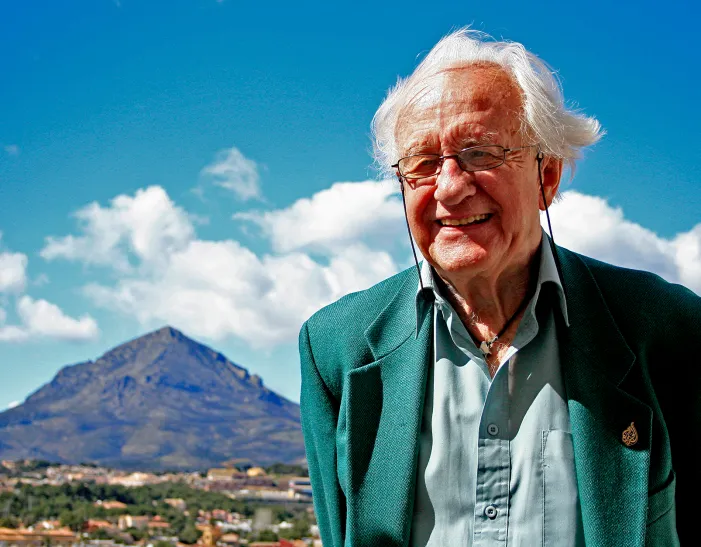
Johan Vincent Galtung (24 October 1930 – 17 February 2024) was a distinguished Norwegian sociologist, mathematician, and the principal founder of the academic discipline of peace and conflict studies. Widely regarded as the "father of peace studies," his pioneering work has left a lasting impact on how we understand and approach conflict and peacebuilding. ️
Early Life and Education
Born in Oslo, Norway, Galtung's academic journey began with a degree in mathematics from the University of Oslo. He later earned a degree in sociology from the same institution. This multidisciplinary foundation became a hallmark of his career, allowing him to blend quantitative and qualitative methods to explore the complex dynamics of social issues.
Career and Key Achievements
Galtung's career was marked by groundbreaking institutional and theoretical contributions.
- Founding of Key Institutions: In 1959, he founded the Peace Research Institute Oslo (PRIO), the world's first academic research center focused on peace studies, and served as its director until 1970. In 1964, he launched the influential Journal of Peace Research. He also co-founded TRANSCEND International in 1993, a global network dedicated to peace, development, and the environment.
- Academic Prolificacy: Galtung was an exceptionally prolific author, publishing over 1,600 articles and more than 160 books. His work has been translated into dozens of languages, making his theories accessible worldwide.
- Global Peacemaker: Beyond academia, Galtung was actively involved in practical peace work, mediating in over 100 international conflicts and frequently consulting for various United Nations agencies.
Throughout his career, he held professorships at numerous universities globally, including in Chile, Germany, the United States, and Malaysia.
Major Theories and Contributions
Galtung introduced several seminal concepts that have become central to peace and conflict studies.
- Positive and Negative Peace: He made a crucial distinction between negative peace, which is simply the absence of direct violence (like war), and positive peace, a more profound state characterized by the presence of social justice, equality, and the absence of indirect forms of violence.
- The Violence Triangle: He conceptualized violence in three interconnected forms:
- Direct Violence: The most visible form, involving physical harm.
- Structural Violence: Social and political structures that cause harm by preventing people from meeting their basic needs (e.g., poverty, inequality).
- Cultural Violence: Aspects of culture (like religion, ideology, or art) that are used to justify and legitimize direct or structural violence.
- Conflict Transformation: He developed the Transcend Method, a methodology for peacefully and creatively transforming conflicts through dialogue and empathy, aiming for a resolution that satisfies all parties.
Legacy and Recognition
For his immense contributions, Galtung received numerous awards and honors, including the Right Livelihood Award in 1987, often referred to as the "Alternative Nobel Prize." He passed away at the age of 93, leaving behind an extraordinary legacy that continues to inspire scholars, activists, and peacemakers around the world to work towards a more just and non-violent future.