Georgia

Showing 1-10 of 18 stories

Sort by
Categories

Year

Author / Contributor

Region

russ-georg
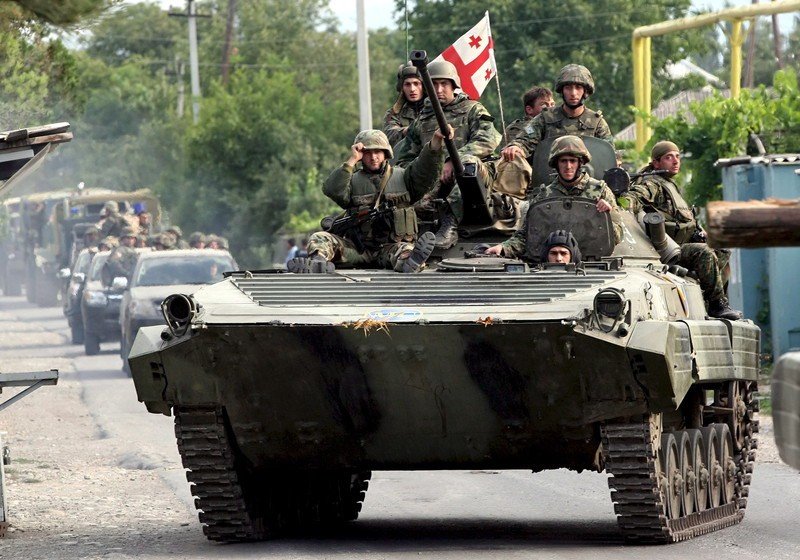
Thomas De Waal February 3, 2022 Many people are trying to rewrite the history of the 2008 Georgia-Russia War in the light of the Ukraine crisis. The EU’s report on the war is still a useful baseline and a reminder of how different the two conflicts are. Originally published at Carnegiemoscow Six years ago, on September 30, 2009, the European Union made a bold and mostly successful attempt to deal with recent history. The report on the Georgia-Russia war of 2008—known informally as the “Tagliavini Report” after its team-leader, Swiss diplomat Heidi Tagliavini—came out little more than a year after the events themselves. The idea of the “Report of the Independent International Fact-Finding Mission on the Conflict in Georgia,” was to separate truth from fiction in the information war which both sides had waged and in particular to explain how the conflict started. It would be wrong to simplify the...
photo-tell-a-lie-once-and-all-your-truths-become-questionable-quote-1
  By Gordon M. Hahn August 31, 2018 As the West has turned more and more to Soviet/Russian methods of the ‘big lie’ in order to advance democracy and its interests, the Russia-West propaganda war had produced a post-fact world in which disinformation comes to be believed by its purveyors. Both sides, forgetting the previous disinformation and lies from the most recent crisis of the day, reiterate their previous claims as part of the reason for believing the next series of disinformation and lies surrounding the current crisis of the day. This process of propaganda plague has filled the fake news on both sides of the Atlantic since Georgia through Syria, Ukraine, Syria, Skripal, Syria again. Russia has its RT and state television; the US has RFERL and state-tied mass media across the West. To be sure, the West has a problem with promoting a united message with messy changes...
Imagen-thumbnail-The-Transnational-1
A lecture at the XI Congress of Ukrainian European Studies Association, Kharkiv National University, October 20, 2017 Introduction: Sweden-Ukraine ties A couple of days ago Swedish media reported that a wild boar, shot some 200 kilometres north of Stockholm, had been found to contain ten times more radioactivity than permitted by the health authorities. As you may guess, this radioactivity emanated from the Tjernobyl nuclear disaster in 1986. This shows that we live in one globalized world and that my Sweden and your Ukraine are linked together. Another example of Swedish-Ukrainian common experience might be the battle of Poltava in June 1709, which according to Wikipedia resulted in the “beginning of Sweden’s decline as a Great Power”. As belligerents, Wikipedia lists on one side Sweden and Ukraine, on the other Russia. However, this military defeat against the Tsar may have been a blessing for the Swedes, because afterwards the Swedish...
jonathanpower2
I have a fantasy. Donald Trump wins. He goes to Moscow on his first trip as president and gives President Vladimir Putin a bear hug and they go hunting in the forest, Soviet style. When they emerge they have shot a couple of bears and have had a good lunch laid out for them by acolytes at which they have discussed the matters of the world. They give a press conference. They have decided to re-start negotiations on major nuclear arms reductions and both say they unilaterally are immediately ridding themselves of a 1000 missiles each. They have found a way to implement autonomy for eastern Ukraine, as done in Scotland, which Trump with his Scottish golf courses knows well. Ukraine can work towards both a trade agreement with the EU and the Russian-backed Eurasian Economic Union. Russia was always happy about such an arrangement, but many Ukrainians weren’t and...
jonathanpower2
The French ambassador to the US from 1902 to 1924, Jean-Jules Jusserand, observed that distant powers could not easily threaten the US because “On the north, she has a weak neighbour; on the south, another weak neighbour; on the east fish and on the west, fish”. The coming of the submarine-based nuclear missile has not changed that. Apart from the fact that no enemy would dare use them for fear of retaliation, and that there is no country in the world that feels that hostile to America (accept North Korea), the fact is America is too big and too far away to be invaded and dominated. There could not be a blitzkrieg by a foreign army across the mid-west or a Vichy America. The real tragedy of 9/11 is just as a majority of the US electorate had settled into a post-Cold War comfort zone with the new president, George...
Imagen-thumbnail-The-Transnational-1
Commenting on NATO S-G Jens Stoltenberg’s wish for dialogue with Russia – a bit odd after all the other provocative initiatives he has spearheaded the last good year or so. I felt like saying something more general about this outdated paradigm – and why it is dangerous for us all – referring also to the Russell-Einstein Manifesto of 1955. You may also see it as my statement countering the NATO Annual 2015 Report which lacks every intellectualism, theoretical/conceptual clarity, empathy, peace thinking and – naively – equates military build-up with ‘security’.
CJ_1
. We think that it’s 30th Anniversary is a fitting occasion to reflect on what has happened in the big world and in our lives with the foundation. It is also a piece of Lund’s research history in general and of peace research and education in particular. Part 2 Weak aspects of TFF • Being outside many networks and institutions – it has become more and more difficult to influence the world if you are small, independent and don’t accept governmental and corporate funds. • A perception that the interest/commitment of TFF is out of sync with the sentiments of times, of the Zeitgeist. In spite of that we maintain the fundamental belief that peace is essential and that we can forget about the rest if major wars or nuclear exchanges take place. • Too ‘academic’/theoretical to forge deeper, permanent links with public opinion and movements. • Too ‘radical’ or...
CJ_1
. We think that it’s 30th Anniversary is a fitting occasion to reflect on what has happened in the big world and in our lives with the foundation. It is also a piece of Lund’s research history in general and of peace research and education in particular. Motivation The 1980s was a decade of gross changes in Europe, the struggle against nuclear weapons in particular. Lund University was predominantly about education and single research projects – while TFF could be more of an experimental playground. We wanted to do truly free research and not negotiate with higher levels at, say, the university what to do where, in which countries to work and what to say to the media. Peace has always been controversial and there were – and remain – enough examples of places that become ‘mainstream’ and routine – rather than experimental and radically ’alternative.’ What we did not...
jonathanpower2
By Jonathan Power Even today in many different ways the US and Russia remain close. There is cooperation in space, not least the International Space Station. The US regularly hires Russian rockets to launch its crews to the Station and to launch satellites. Russia sells advanced rocket engines to the US. Russia allows war material en route to Afghanistan to pass through its territory on Russian trains. Russia worked hand in glove with the US to successfully remove the large stocks of chemical weapons possessed by Syria. It shares intelligence on Muslim extremists including ISIS. Conceivably it could enter the battle against ISIS. It has encouraged Western investment including joint oil exploration of the Artic. Recently it stood side by side with the US and the EU as they forged an agreement with Iran on its nuclear industry. At the UN Security Council Russia and the US voted together for...
jonathanpower2
By Jonathan Power The Russian European dreamers have included Pushkin, Lenin, Gorbachev and, until relatively recently, President Vladimir Putin. They have all seen their country’s future as part of the “European house”. But history and events have not been kind to Russia. Napoleon’s invasion, revolution, two world wars, Stalin’s communism and, most recently, the expansion of NATO, have shattered the dream again and again. At the end of the Cold War and with agreement on the NATO-Russia Founding Act it seemed that big steps towards that goal were being taken. First, Russia would have a seat at NATO’s table. Later it would join NATO. Later still, the European Union. Some said this would happen over ten years, others 20. Then, smash, the dream came to an end as President Bill Clinton, bucking America’s academic foreign policy elite, decided to expand NATO’s membership to former members of the Soviet Union’s Warsaw...

jonathanpower2
/10/jonathanpower2.jpg”> What would the conservative president, Ronald Reagan, have done if the Ukraine debacle had happened on his watch? I suspect he would have made sure it didn’t devalue relations between the US and Russia. It wasn’t him nor his vice-president, George W.H Bush, who inflamed relations with a post-Cold War Russia, it was his successor the liberal, Bill Clinton, who, together with a supine EU membership, decided to expand NATO right up to Russia’s doorstep, despite a solemn US promise given personally to the Soviet president, Mikhail Gorbachev, by George H. W. Bush’s secretary of state, James Baker, that it wouldn’t. And today President Barack Obama won’t say clearly and out loud that the US doesn’t expect that Ukraine will ever join NATO, a move that could de-escalate the crisis faster than you could say: “At last Obama understands where President Vladimir Putin is coming from”.
janoberg
Av Jan Öberg Dr.hc., direktör för TFF 4 maj 2014 Eliten i Sverige är mer lojal mot Nato, USA och EU än mot sitt folk • Under de senaste 25-30 åren har Sveriges militära, säkerhets- och utrikespolitiska elit vridit Sveriges politik 180 grader. • Dessa grundläggande förändringar inleddes av den socialdemokratiska regeringen under Göran Persson och utrikesminister Anna Lindh och har genomförts praktiskt taget utan offentlig debatt. • Omsvängningen till interventionism, militarism och USA/Nato på alla områden har planerats gradvis, i smyg och ohederligt – kort sagt på ett sätt som är ovärdigt en demokrati. • Denna elit är mer lojal mot Bryssel och Washington än mot svenskarna. • Om din bild av Sverige är att det är ett progressivt, förnyande och fredsfrämjande land med global inställning som försvarar folkrätten så är den – tråkigt nog – föråldrad. Hur Sverige har förändrats Sverige är inte längre neutralt och det är...