India: Democracy in name only?

Christophe Jaffrelot

April 16, 2024

Modi’s first day in office

In 2001, I walked for 7 weeks in the footsteps of Gandhi, his most important places including parts of the Salt March. Already back then, the ruthless emergence of Hindutva and the growing animosity toward Gandhi was easy to sense. One man I struck up a conversation with on a longer bus drive told me that it was high time that Gandhi was murdered. Today, statutes of his murderer are put up, and Gandhi is being marginalised. That is no wonder in Modi’s India – although, of course, Modi has Gandhi in his office and likes to be seen as a Gandhian.
Regrettably, TFF seldom published anything about India. But what seems to be a clear decades-long trend towards authoritarianism, personality cult, an ever-growing marginalisation of Muslims and making Hindutva the nationalist (para-military) ideology in what has often been called ‘the world’s largest democracy’ bodes ill for the wider world and for democracy in whatever form it may have had in India. This is all explained brilliantly in this article which was first published by Le Monde Diplomatique in April 2024.
Jan Oberg

Narendra Modi’s electoral success in Gujarat between 2001 and 2014 and on the Indian scene since then stems from his novel blend of populism and Hindu nationalism (Hindutva). Hindutva grew out of the Rashtriya Swayamsevak Sangh (National Volunteer Organisation, RSS), a paramilitary-style nationalist group founded in 1925 to bulk up young Hindus both physically and morally so they could stand up to Muslims, who were depicted as a danger to the majority.

Modi joined the RSS as a child and devoted his life to it, pursuing no other careers and even living apart from his wife. He rose through the ranks, eventually becoming the chief minister of Gujarat (his home state) in 2001. The following year, he oversaw an anti-Muslim pogrom that left some 2,000 dead ‒ a strategy of religious polarisation that won him the December 2002 regional elections. Similar successes in 2007 and 2012 made Modi the obvious prime ministerial candidate for his Bharatiya Janata Party (Indian People’s Party, BJP) in 2014.

But he left behind the RSS tradition of collective decision-making, putting himself front and centre and striving to connect directly with ‘his’ people. Rather than relying on the activist network, Modi held rally after rally where he showcased his flair for speechmaking. He also founded his own television channel, worked on social media and employed a revolutionary strategy: using holograms to simultaneously lead one rally in hundreds of places. Modi even distributed masks printed with his likeness to deepen supporters’ identification with him. In short, he saturated the public arena so as to embody the masses ‒ a task made easier by his low-caste origins, on which he has built a complete narrative (he worked as a teaboy in his father’s shop).

However, the ‘masses’ meant only the Hindu majority, which he was busy stirring up against one target in particular: Muslims. As in the 2014 elections, in 2019 ‘Moditva’ – Modi’s idiosyncratic hybridisation of rightwing nationalist ideology, Hindutva and a personality cult – triumphed on the strength of BJP landslides in the north and west. This success allowed him to bend to his will both the RSS and the BJP – whose MPs had ridden to victory on his coattails – fashioning a government of faithfuls and a parliament of yes-men.

The other institutions soon succumbed too – even the Supreme Court, once a beacon of independence. In the summer of 2014 Modi advanced a constitutional reform that would have changed the appointment process for judges, until then picked by a collegium of peers. His co-optation, opposed by the entire political class, would have replaced the collegium with a five-member commission. The Supreme Court eventually declared the amendment unconstitutional, but Modi still got his way: of the nominees submitted by the collegium, his government finalised appointments only for those he liked. The court thus resigned itself to proposing candidates who were apt to please him.

Society, meanwhile, was undergoing a similar process of enforced conformity, especially in higher education, despite India’s reputation for creativity and intellectual vitality. Public universities were under the thumb of vice-chancellors invariably chosen from among members or supporters of the Hindu nationalist current. Funders (mostly from the business world) of private institutions were pressured, and they in turn pressured the faculty: industrialists cannot afford to antagonise those in power.

Dozens of subtle manoeuvres brought the opposition to its knees. Most often, members of the Indian National Congress or regional parties would be intimidated via tax adjustments or police investigations based on shaky pretexts. The objective? To draw rivals away from their political affiliations and toward the BJP. A valuable catch would sometimes be rewarded with a ministerial position or an easy job. Those who resisted the carrot felt the sting of the stick, typically in the form of charges that could mean prison (the chief minister of Delhi, Arvind Kejriwal, was imprisoned last month) or a freeze on their party’s funds (the case for several Congress party bank accounts since February).

Despite the prime minister’s autocratic tendencies, his government has continued to hold elections. Other similarly disposed countries – think Recep Tayyip Erdoğan’s Turkey or Viktor Orbán’s Hungary – have done likewise. Elections have two major upsides. First, a country can claim to be a democracy (India is the ‘world’s largest’ according to Western leaders). Second, elections offer a cover of legitimacy to Modi: the people’s mandate justifies weakening all other power centres, especially those that uphold the rule of law. How could the judiciary system defy a leader who embodies the people? Legitimacy wins out over legality.

Elections offer a cover of legitimacy to Modi: the people’s mandate justifies weakening all other power centres, especially those that uphold the rule of law. How could the judiciary system defy a leader who embodies the people?

For Modi, running for reelection is a calculated risk. Regulatory institutions are shadows of their former selves: the electoral commission, which caused many a headache for prime ministers past, has become compliant as its civil servant leaders face the same pressures as political opponents. For example, although it is illegal to campaign on religious arguments, it would now be unthinkable to punish a BJP leader for doing so.

What’s more, Modi knows he can outspend any rival. BJP expenditures reportedly reached around $3bn in 2019, equivalent to those of all other parties combined. This financial heft was made possible by a law his government passed in 2017 that keeps donors anonymous through ‘electoral bonds’, a system declared unconstitutional by the Supreme Court this year in its most significant challenge to the government since 2015. Even if this system were eliminated, the BJP would still benefit from other private funding channels ‒ not to mention the vast sums that the government collects from the public sector to finance its campaigns.

Private sector money comes primarily from a handful of oligarchs. In exchange for significant advantages, these tycoons they help fund the government and back it in the press they are slowly taking over. New Delhi Television (NDTV), the last mainstream TV channel still brave enough to criticise Modi, was acquired in 2022 by Gautam Adani, and some highly popular journalists resigned as it morphed into his mouthpiece. Overall, TV channels and media companies have self-censored so as to avoid the tax officials and police.

At grassroots level, the Hindu nationalist movement relies on a network of disciplined activists trained by the RSS. As ‘vigilantes’ they primarily act as a sort of local cultural police, and Muslims are their favourite targets. Muslim men are barred from fraternising with young Hindu women in public or on campus, in the name of combatting ‘love jihad’ (a supposed strategy to seduce them, persuade them to convert to Islam and then marry them). Muslims are sometimes pressured to (re)convert to Hinduism, banned from mixed neighbourhoods ‒ causing increased ghettoisation ‒ or pursued on highways in the north when they are suspected of transporting a cow (sacred in Hinduism) to the slaughterhouse. This form of vigilantism sometimes leads to violent lynchings that are filmed and posted on social media.

Guided by the Hindu nationalist movement, these activists work hand in hand with the party-state that the BJP is becoming, to create a deeper state that penetrates society. Vigilantism indeed offers the state unprecedented societal reach: (cultural) order is enforced not just by the administration, but by activists who serve as proxies for those in uniform. The only difference is their attire.

Given this transformation of the public sphere, how different would things really be for minorities if the political pendulum were to swing? If elected, the opposition could reverse BJP laws, but what power would it have to keep self-proclaimed defenders of Hinduism from policing the streets? Legitimacy may continue to sideline legality for as long as the Hindu majority remains swayed by the dogmas that the BJP has effectively made mandatory.

Christophe Jaffrelot

Christophe Jaffrelot is the research director at CERI-Sciences Po/CNRS. His publications include Modi’s India: Hindu Nationalism and the Rise of Ethnic Democracy, Princeton University Press, 2021, and Gujarat under Modi: Laboratory of today’s India, Hurst, 2024.

Translated by Jeremy Sorkin

We also warmly recommend this analysis, India elections: ‘Our rule of law is under attack from our own government, but the world does not see this’ published by The Conversation.

Share

Leave a Reply

Your email address will not be published. Required fields are marked *

Related Posts

This is not another geopolitical commentary on the Arctic. It is a visionary peace proposal that can save the region from militarised rivalry and ecological ruin. A blueprint for shared security, sustainable development, and human dignity — benefitting Greenland, the Arctic, and the rest of us. Jan Oberg TFF director Lund, Sweden, February 17, 2026 I. Four Principles for a New Arctic Vision The Arctic is often framed as a cold arena of rivalry — a place where great powers test each other’s resolve. But this worldview is outdated, unimaginative, and ultimately self‑defeating. The Arctic is not a vacuum waiting to be militarised; it is a living region, a climate stabiliser, and a cultural homeland whose future will shape the future of humanity. If we begin from that understanding, a far more rational Arctic order becomes possible — one that is peaceful, cooperative, and centred on the people who actually live there. This vision rests...
The MSC’s closed groupthink militarism offers only one prescription — more weapons — even as record military expenditures, squeezed from taxpayers in economic crisis, destroy diplomacy and drive escalation to the highest war risks in decades. Jan Oberg TFF director February 13, 2026 From Dialogue Forum to Militarised Ritual For decades, the Munich Security Conference (MSC) – which opened today and runs till Sunday – was one of the few places where adversaries could meet without theatrics. Founded in 1963 as the Wehrkundetagung, it served as a discreet Cold War dialogue forum between NATO and the Warsaw Pact. Even at moments of high tension, Soviet and later Russian representatives were present, and Munich allowed uncomfortable messages to be delivered directly rather than through press releases or military manoeuvres. That era has vanished. The MSC has become something entirely different: a €13–20 million annual gathering of a closed Western security elite, a polished meeting...
By Jan ObergTFF co-founder and director February 11, 2026 PART 3 — ECONOMICS, TRADE & FINANCIAL SOVEREIGNTY A. Trade Measures & Market Signaling Economic pressure can be applied instantly and scaled without violence. Immediate Measures (within a week) Government boycott US goods and services  A very powerful signal which over time will be felt. Targeted tariffs on selected U.S. goods Symbolic but high-visibility sectors send a clear message. Suspend trade facilitation talks A peaceful pause that signals deep concern. Freeze U.S. participation in public procurement – military procurement in particular A nonviolent way to reduce influence. Competition law review of U.S. corporations A legal tool to scrutinise market dominance. Longer-Term Measures EU–Asia–Africa trade corridors Reducing reliance on U.S. markets. European supply chains for critical minerals Strategic autonomy in resource access. European Strategic Trade Authority Monitoring coercive practices globally. Euro-denominated commodity markets Weakening the dollar’s pricing monopoly. The EU must resume contacts and negotiations with Russia, focusing on energy cooperation To...

Recent Articles

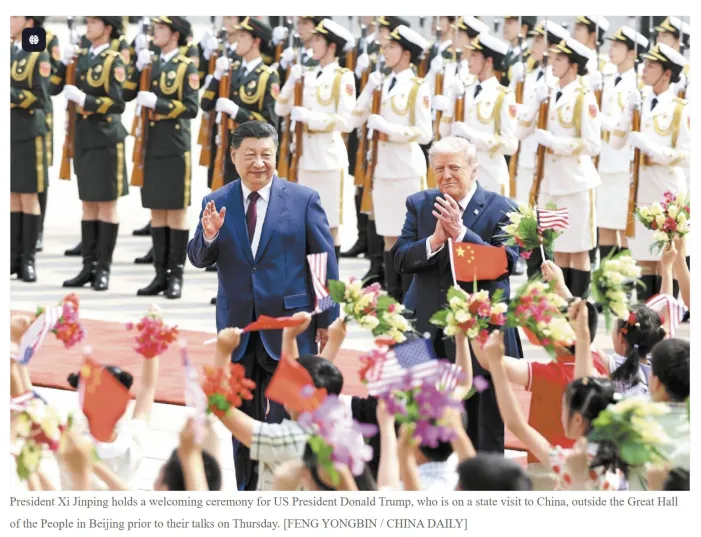
Jan Oberg May 15, 2026 Go to this Fox News page and scroll the whole way down: President Donald Trump tells the world that his meeting with President Xi Jinping yielded a lot of very concrete political and economic results – of course, only where the Chinese side, according to him, agreed with him. He does not mention the Taiwan issue, but Secretary of State, Marco Rubio, says that it did not feature prominently in their talks and that the US policy on Taiwan has not changed. Then go to China Daily – or Global Times – and you will see that for the Chinese it is framework, principles, structure of cooperation etc. that matters – all embedded in the overall idea of “constructive bilateral relationship of strategic stability.” Nowhere is any concrete agreement or deal – all that Trump refers to – mentioned. At the general level, this gives you insights into the very different social...
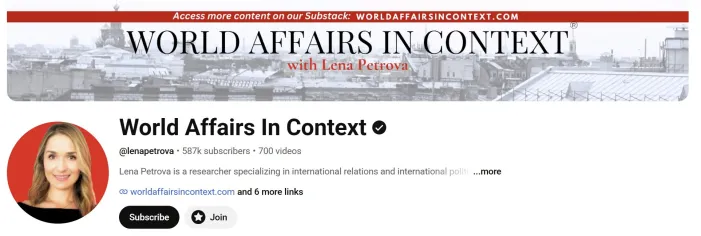
Lena Petrova of “World Affairs In Context” with more than half a million subscribers on YouTube wanted to explore what a peace researcher like me has to say about, among other things, the First and the Second Cold War and why eethics has disappeared from politics. I am particularly happy about this conversation that also yielded an amazing number of very appreciative comments on YouTube. No doubt, people are longing for alternatives, including peace perspectives.
The MIMAC – Military-Industrial-Media-Academic Complex – drives the world’s rampant militarism and wars without end. Here is a short reflection of how it works against all interests of humanity. #5 deals with why there is no real enemy or threat images/analysis. It’s all ex-post constructions. And, btw, theTFF Peace Pulse is now on Rumble.

TFF on Substack

Discover more from TFF Transnational Foundation & Jan Oberg.

Most Popular

Jan Oberg May 15, 2026 Go to this Fox News page and scroll the whole way down: President Donald Trump tells the world that his meeting with President Xi Jinping yielded a lot of very concrete political and economic results – of course, only where the Chinese side, according to him, agreed with him. He does not mention the Taiwan issue, but Secretary of State, Marco Rubio, says that it did not feature prominently in their talks and that the US policy on Taiwan has not changed. Then go to China Daily – or Global Times – and you will see that for the Chinese it is framework, principles, structure of cooperation etc. that matters – all embedded in the overall idea of “constructive bilateral relationship of strategic stability.” Nowhere is any concrete agreement or deal – all that Trump refers to – mentioned. At the general level, this gives you insights into the very different social...
Lena Petrova of “World Affairs In Context” with more than half a million subscribers on YouTube wanted to explore what a peace researcher like me has to say about, among other things, the First and the Second Cold War and why eethics has disappeared from politics. I am particularly happy about this conversation that also yielded an amazing number of very appreciative comments on YouTube. No doubt, people are longing for alternatives, including peace perspectives.
The MIMAC – Military-Industrial-Media-Academic Complex – drives the world’s rampant militarism and wars without end. Here is a short reflection of how it works against all interests of humanity. #5 deals with why there is no real enemy or threat images/analysis. It’s all ex-post constructions. And, btw, theTFF Peace Pulse is now on Rumble.
Read More
Screenshot-2026-05-15-103534
Jan Oberg May 15, 2026 Go to this Fox News page and scroll the whole way down: President Donald Trump tells the world that his meeting with President Xi Jinping yielded a lot of very concrete political and economic results – of course, only where the Chinese side, according to him, agreed with him. He does not mention the Taiwan issue, but Secretary of State, Marco Rubio, says that it did not feature prominently in their talks and that the US policy on Taiwan has not changed. Then go to China Daily – or Global Times – and you will see that for the Chinese it is framework, principles, structure of cooperation etc. that matters – all embedded in the overall idea of “constructive bilateral relationship of strategic stability.” Nowhere is any concrete agreement or deal – all that Trump refers to – mentioned. At the general level, this gives you insights into the very different social...
Screenshot-2026-05-12-104023
Lena Petrova of “World Affairs In Context” with more than half a million subscribers on YouTube wanted to explore what a peace researcher like me has to say about, among other things, the First and the Second Cold War and why eethics has disappeared from politics. I am particularly happy about this conversation that also yielded an amazing number of very appreciative comments on YouTube. No doubt, people are longing for alternatives, including peace perspectives.
Screenshot-2026-04-13-154551 (2)
The MIMAC – Military-Industrial-Media-Academic Complex – drives the world’s rampant militarism and wars without end. Here is a short reflection of how it works against all interests of humanity. #5 deals with why there is no real enemy or threat images/analysis. It’s all ex-post constructions. And, btw, theTFF Peace Pulse is now on Rumble.
Screenshot-2026-04-13-154551 (1)
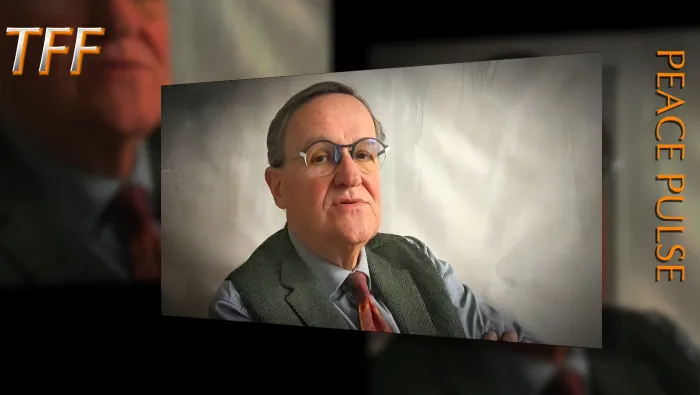
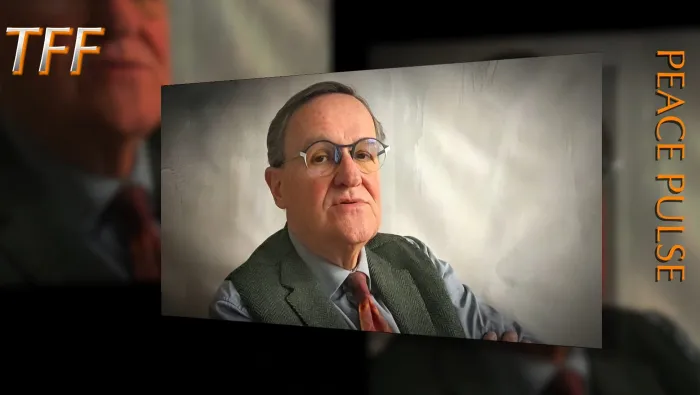
Jan Oberg, TFF director April 28, 2026 In this third TFF Peace Pulse, I make the important distinction between the violence and the conflict that violence is a symptom of. If you want peace, focus on the underlying conflict because that is the key to resolution, peacemaking, and a better future for the parties. The West is obsessed with violence, just look around you – and 90+ per cent of the public debate is about military issues and other violence – totally wasted for peace. These Peace Pulses will only be published here a few times. You will also not find them on YouTube and Vimeo because both platforms have blocked TFF and me; you know, peace is dangerous these days. Most TFF’s videos since 2007 are now on Rumble.
Screenshot-2026-04-13-154551
In contrast to most, we’ll bring alternatives, solutions, hope and strategies for a better future. Times are dangerous, yes, but that only intensifies the need for constructive thinking and action! Jan Oberg, TFF director April 13, 2026 The new TFF Peace Pulse uses video messages in a new way: Max 3-5-minute-long comments, ideas or perhaps mini-lectures, all about peace – positive peace. We launch them today on April 13, 2026 with a carefully crafted visual aesthetic fitting the content. We hope to publish them regularly from now on. We launch Peace Pulse (PP) – for a number of reasons. The world is in chaos, and there are countless reasons to feel concerned, frustrated, even angry. The atmosphere is saturated with doom and gloom, with negative energy and rear‑mirror thinking, while vision, imagination, alternatives, strategies and genuine future‑mindedness remain in short supply. And without them, we simply can’t save the world. Looking at problems from a hundred angles will...
IMG_5165 (1)
PART II — Publishing Peace in a System That Prioritises Militarism Jan Oberg, TFF director April 10, 2026 How TFF Maintains a Daily Voice in a Digital World Built for Noise This article is part of the series “TFF at 40″ and it invites you to learn about Four Decades of Publishing Peace. It takes a look at how a small, people‑financed peace foundation has communicated across four generations of technology — from wax stencils and fax machines to mass email and Substack — and why TFF continues to publish every single day in a system that rewards noise, conflict, and militarism. ◆ What it means to publish peace every single day in a digital system built for 24/7 news and other noise, confrontation, and militarism. How TFF’s independence, continuity, and global readership defy algorithms, donor cycles, and Western media censorhip — and why the Majority World keeps listening. When the...