May 2020

Showing 1-10 of 4016 stories

Sort by
Categories

Year

Author / Contributor

Region

3d iillustration of globe with China corona virus Spreads in Asia
Part 4 Part 1 and 2 were introductory and then made the diagnosis. Part 3 analysed the fraudulent threat analysis that fuels militarism.This 4th part focus on some theories and concepts about human security and how that concept differs fundamentally from the state-anchored, military policies that have dominated so far. Part 1 of this series • Part 2 of this series • Part 3 As pointed out in earlier parts of this series, the obsolete security concept was about national security – national military-first security. A new concept must take its departure elsewhere, namely in individual security, humanity’s security and – thereby, implicitly – the security of the environment. That is, individual and global human security and the security of the environment. It’s a much-needed holistic way of looking at it – also in the sense that human life cannot be secured if the environment decays into global climate breakdown....
Buddha-3
By David Loy Maybe every modern generation feels confronted by some crisis that will affect the fate of the world, but unless your head is buried in the sand (or some Buddhist equivalent) it’s impossible to be ignorant of the extraordinary planetary emergency that confronts us today. The recent IPCC report states clearly that ecological collapse no longer merely threatens — we are well into it. It’s become apparent that civilization as we know it is about to be transformed in some very uncomfortable ways by climate breakdown, mass extinction of species, resource depletion and various types of pollution — perhaps including some kinds we don’t even know about yet. Originally published at Huffington Post Although our globalizing economic system is a wholly-owned subsidiary of the biosphere, most of the CEOs who supervise it (as much as anyone controls it) can’t seem to plan much further than the next quarterly...
jonathanpower
Africa is suffering a double whammy after many years of success. The Coronavirus, while not taking down great numbers of people like in Europe, Asia and the Americas, has had a severe impact by curbing its exports in the face of the formers’ severe economic depression. For example, flowers grown in Kenya and Ethiopia have been particularly hit. Kenya’s flower industry employs up to 70,000 people. Ethiopia’s horticulture provides 180,000 jobs. Kenya’s overnight exports of cut flowers to Europe have been worth almost 770,000 US dollars a year, up from 134 million in 2000. Now sales are on their way to rock-bottom. At the same time parts of East Africa have been hit by plagues of locusts, the likes of which have not been seen for over 70 years. They eat everything that comes their way. For the first time in a decade in Africa, many people are going hungry...
96f258eb81837d6ccb7088f100f6aebd
May 25, 2020 Dr. Lawrence Wittner Decades ago, when I began teaching international history, I used to ask students if they thought it was possible for nations to end their fighting of wars against one another. Their responses varied. But the more pessimistic conclusions were sometimes tempered by the contention that, if the world’s nations faced a common foe, such as an invasion from another planet, this would finally pull them together. Originally published on Counterpunch on April 14, 2020 here I was reminded of this on March 23, when the UN Secretary-General, António Guterres, called for “an immediate global ceasefire.” The time had come, he said, to “end the sickness of war and fight the disease that is ravaging our world.” A UN summary noted that the Secretary-General had “urged warring parties across the world to lay down their weapons in support of the bigger battle against COVID-19: the...
gandhi-writing-letter
May 18, 2020 Steven Youngblood When asked to describe Mahatma Gandhi, most would say he was an Indian independence leader, human rights defender, and spiritual guide. However, “People don’t think of him as a journalist” even though “he was a journalist from an early age, and died as a journalist.” Originally posted on The Peace Journalist magazine, published by the Center for Global Peace Journalism on February 6, 2020, here This is according to professor, historian, and author Rajmohan Gandhi, the grandson of Mahatma Gandhi. Professor Gandhi was the featured speaker at a program titled “Gandhi: The First Peace Journalist,” held at Park University on Aug. 26. The evening began with a presentation by Gandhi documentarian, Cynthia Lukas, about Gandhi’s background as a journalist. Gandhi was a prolific journalist and editor who was well-known in India for his articles stressing social justice in such publications as Indian Opinion, Young India,...

Xi-Jinping
China has learned from its own rich history and is applying those lessons to re-emerge as a major 21st century power May 20, 2020 Pepe Escobar With hybrid warfare 2.0 against China reaching fever pitch, the New Silk Roads, or Belt and Road Initiative, will continue to be demonized 24/7 as the proverbial evil communist plot for economic and geopolitical domination of the “free” world, boosted by a sinister disinformation campaign.  It’s idle to discuss with simpletons. In the interest of an informed debate, what matters is to find the deeper roots of Beijing’s strategy – what the Chinese learned from their own rich history and how they are applying these lessons as a re-emerging major power in the young 21st century.  Originally published by Asia Times on May 11, 2020, here Let’s start with how East and West used to position themselves at the center of the world.  The first...
o-LAWRENCE-WILKERSON-facebook
May 19, 2020 Lawrence Wilkerson, US Army Colonel This is a stunning piece of documentary and a clear and sharp analysis of the moral and intellectual decay of the foreign interventionist policy of the United States. By a man who obviously knows. Retired U.S. Army Colonel Lawrence Wilkerson, who served as Secretary of State Colin Powell’s chief of staff from 2002 to 2005, says the escalation of tensions between the U.S. and Iran today is a continuation of two decades of U.S. policy disasters in the Middle East, starting with the 2003 run-up to war with Iraq under the Bush administration. “America exists today to make war. How else do we interpret 19 straight years of war and no end in sight? It’s part of who we are. It’s part of what the American Empire is,” says Wilkerson. “We are going to cheat and steal to do whatever it is...
jonathanpower
The world is supposed to be pulling together to defeat the Coronavirus and to some extent it is. Earlier on Russia sent special equipment to the US and recently the US has sent some to Russia. China has aided Italy and Africa with doctors and equipment. Tiny Cuba, with its deep pool of doctors, has also helped Africa. Around the world there is a sense of “we are all in this together” and that this is a bigger problem than the ones the world has faced since World War 2. The last two days the World Health Organization has brought all the world’s countries together to discuss how to go forward. Both the US and China, to a degree, have messed things up. President Donald Trump has been vicious in his attacks, suggesting Chinese culpability for spreading the virus. (He’s forgotten how the US incubated AIDS, an even greater killer....
PepeEscobar-1
Photo: Pepe Escobar The coming decade could see the US take on Russia, China and Iran over the New Silk Road connection May 18, 2020 Pepe Escobar The Raging Twenties started with a bang with the targeted assassination of Iran’s General Qasem Soleimani. Yet a bigger bang awaits us throughout the decade: the myriad declinations of the New Great Game in Eurasia, which pits the US against Russia, China and Iran, the three major nodes of Eurasia integration. Every game-changing act in geopolitics and geoeconomics in the coming decade will have to be analyzed in connection to this epic clash. The Deep State and crucial sectors of the US ruling class are absolutely terrified that China is already outpacing the “indispensable nation” economically and that Russia has outpaced it militarily. The Pentagon officially designates the three Eurasian nodes as “threats.” Originally published by AsiaTimes on January 16, 2020 Hybrid War techniques...
ObergComment_OnSite
On March 21 this year, Bulletin of the Atomic Scientists (BAS) published an article headlined Coronavirus in Russia: How Putin’s disinformation efforts could backfire at home and written by Judy Twigg, professor of political science at Virginia Commonwealth University. Take a look and get a sense of its quality, balance and bias. Having read it, I submitted the following comment underneath: I’m dismayed by this article. While there is no doubt that Russia is (mis)using information, this sort of thing must be seen as a tool, or weapon, in a conflict – a conflict Russia has with the 29-member NATO alliance. It is normal praxis for such high-ranking, respected and reliable media as yours to not talk about “the other” side’s weapons but looking at armament dynamics on both (or all) sides of a conflict formation. Just pointing fingers at one and keep quiet about the other side risks to...
JOAtInstallation_1000_72dpi
The author in front of a part of his photo-based, multi-media installation, “Silk Peace Art Road – SPAR” which was exhibited at the Venice Biennale 2019 and will be shown in China 2020. Yesterday, The Necessary Teacher Training College, DNS, in Denmark held its annual conference on peace and justice. As a couple of times before, I had the honour of being invited to be the keynote speaker. Because of the Coronavirus, it was online and not onsite – and I had produced the lecture in advance and then there was a Q&A session in the afternoon via Zoom. The two-part lecture is now on TFF’s Vimeo Channel here: Part 1 Part 2 The discussion that followed after group work If you found this lecture interesting or useful, please help us do more in the future. Remember, TFF is 100% people-financed and therefore completely independent of the government and corporate...
urmedium
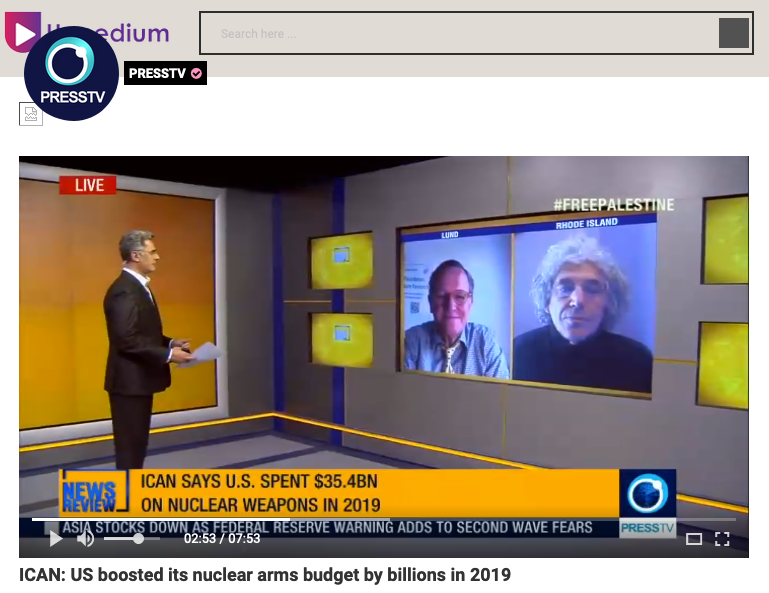
ICAN: The US boosted its nuclear arms budget A record $73 billion spent on nukes in 2019 – says ICAN. Nuclear-armed states spent a record $73 billion on nuclear weapons in 2019, a nearly 10% increase from 2018, and the US accounted for almost half of the spending, a new report states. Please find a short conversation about that at PressTV’s Channel at Urmedium.