
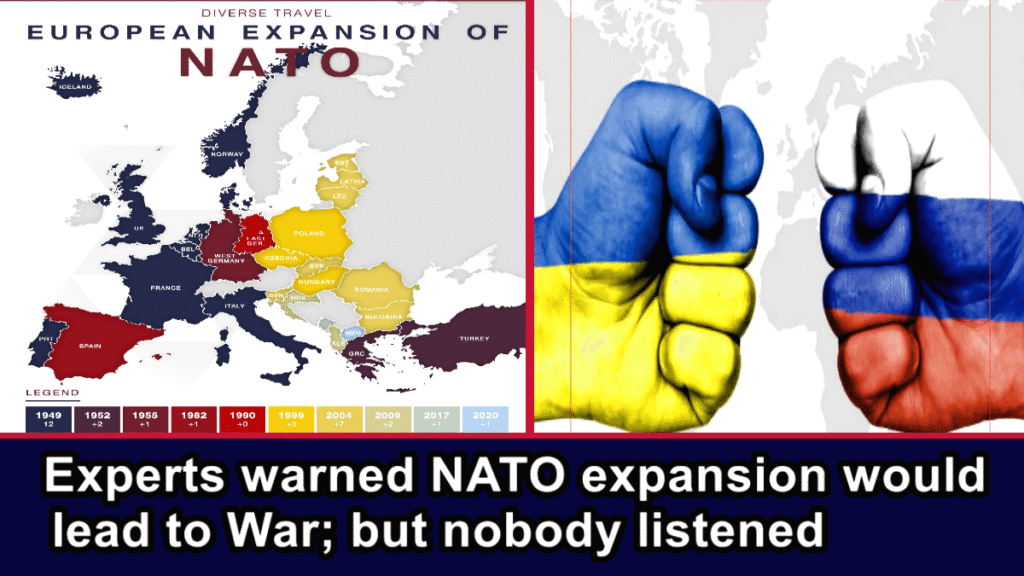
We Always Knew the Dangers of NATO Expansion

Ted Snider

April 5, 2023

In 2008, William Burns, who is now Biden’s director of the CIA but was then ambassador to Russia, warned that “Ukrainian entry into NATO is the brightest of all redlines for the Russian elite (not just Putin).” He warned Secretary of State Condoleezza Rice that “I have yet to find anyone who views Ukraine in NATO as anything other than a direct challenge to Russian interests.” Short even of expansion into Ukraine, Burns called NATO expansion into Eastern Europe “premature at best, and needlessly provocative at worst.” If it came to Ukraine, Burns warned, “There could be no doubt that Putin would fight back hard.”

But Burns was not the first Russia expert to flash that warning sign to the White House. In 1990, as the Soviet Union broke apart like a jigsaw puzzle into separate countries, the US and NATO were at a crucial crossroads confronted with two future changing choices. They could put the pieces of the puzzle back together in one inclusive picture of an integrated world that draws no new lines across Europe, welcomes Russia in, transcended blocs and creates a comprehensive European security structure, or they could attach the newly loosed pieces to NATO, exclude and isolate Russia and push a swollen NATO right up against Russia’s borders.

The US and NATO passed up a historic opportunity for cooperation and chose the latter. A pantheon of Russia experts bemoaned the lost chance and warned urgently against it. President Clinton’s secretary of defense, Bill Perry, called it “tragic” because “we had the opportunity in the 1990s to build a long-lasting cooperative relationship with Russia.”

A legion of the most knowledgeable and experienced US officials warned against that lost opportunity because, even then, they knew two things: that leaving Russia out of the EU and out of the new security arrangement and advancing on its borders would existentially threaten Russia’s security interests and that Russia’s red line was Ukraine.

Originally published at Antiwar.com on August 16, 2022

NATO Expansion East

As early as 1997, prior to any NATO expansion east, Jack Matlock, a former US ambassador to Russia, testified before the Senate Foreign Relations Committee that “I consider the Administration’s recommendation to take new members into NATO at this time misguided. If it should be approved by the United States Senate, it may well go down in history as the most profound strategic blunder made since the end of the Cold War.”

The same year, George Kennan, another former US ambassador to Russia and the architect of the US policy of containment and rollback of the Soviet Union, said that NATO expansion east “would be the most fateful error of American policy in the entire post-cold-war era.” He added that it would “restore the atmosphere of the cold war.” Kennan wrote that this view is “shared by a number of others with extensive and in most instances more recent experience in Russian matters.”

These warnings were neither subtle nor hedged: “most profound strategic blunder,” “most fateful error.” And they were coming from the people who best knew. US Ambassadors other than ambassadors to Russia seconded the warnings. In a 1995 article in New York Review of Books, former US ambassador to Poland Richard T. Davies warned that US policymakers were ignoring the best advice of their best advisors. But even these were not the earliest warnings. Warnings had been coming from within the Bush administration since the conversation about expansion started.

In October 1990, in perhaps the first warning, the State Department produced an analysis on “Eastern Europe and NATO. It concluded that “it is not in the best interest of NATO or the US that these states be granted full NATO membership.” It warned against “an anti-Soviet coalition whose frontier is the Soviet border.” That same month, the administrations’ European Strategy Steering Group reported that “all agencies agree that East European governments should not be invited to join NATO anytime in the immediate future.” All agencies included State, Defense, NSA, and the Joint Chiefs of Staff.

In 1992, the State Department, again considering NATO expansion, was advised by Assistant Secretary of State Thomas Niles that expanding east “would in effect tell Moscow that the end result of internal revolution and forsaking its Soviet/Warsaw Pact empire is the expansion of NATO to its border.” In Not One Inch, M.E. Sarotte says that “Niles advised ‘holding the line on NATO membership’.” The same year, according to Sarotte, Colin Powell, then chairman of the Joint Chiefs of Staff, cautioned that “he was personally reluctant to cross the bridge of Eastern European membership in NATO.”

In October 1995, scandal forced NATO Secretary General Willy Claes to resign. Ruud Lubbers was poised to replace him. But, in a less told story of US ignoring warnings and maneuvering to shape its goals, when it became clear that Lubbers opposed US plans to expand NATO east, the State Department’s director of policy planning, James Steinberg, says that the US decided to derail Lubber’s rise to the top of NATO. According to Sarotte, Steinberg reported that the US “‘decided afterward that we weren’t going to let’ Lubbers have the job.” Instead, the US escorted Javier Solana to the top of NATO. Solana made it clear that when it came to the issue of NATO expansion east, he “would track with the American view.”

The US knew that NATO expansion east would anger and threaten Moscow. They also knew that expansion to Ukraine was especially sensitive and threatening and constituted a special red line. Knowing the sensitivity of that red line, expansion to Ukraine had been especially debated.

In a moving 1991 appeal cited by Sarotte, US ambassador to Moscow Robert Strauss – another of those experts who, in Kennan’s words, had the most extensive and most recent experience – warned that “the most revolutionary event of 1991 for Russia may not be the collapse of Communism, but the loss of something Russians of all political stripes think of as part of their own body politic, and near to the heart at that: Ukraine.”

In his memoir, Duty, Robert Gates said, “trying to bring Georgia and Ukraine into NATO was truly overreaching.” He added that it was “recklessly ignoring what the Russians considered their own vital national interests.”

For these reasons, an internal 1991 draft paper recommended leaving “the possibility of Ukraine joining the NATO liaison program” for “a later time.”

Ukraine was also a sensitive case because they had former Soviet nuclear weapons on their territory that they were, at times, reluctant to surrender. But, even with NATO membership as the carrot for sending the nuclear weapons to Russia, experts were reluctant to offer NATO membership to Ukraine and cross Russia’s red line. In 1993, Clinton’s national security advisor, Anthony Lake, an aggressive proponent of NATO enlargement, told the British that if they admitted Ukraine into NATO, that would solve the nuclear problem. The record shows, according to Sarotte, that the British responded in disbelief. They reminded Lake that “expanding NATO to include Ukraine would cross the very reddest of Russian red lines.” That was known three decades ago.

Even Richard Holbrooke, who aggressively pushed expansion, knew that “Ukraine is the most delicate issue” and that it had to be treated differently. He knew that Ukraine was a red line that probably could not be crossed, calling NATO “an alliance it can probably never enter. . .” NATO Secretary General Javier Solana, who promised that his view on NATO expansion “would track with the American view,” knew that expansion into the Baltic States and Ukraine was “the most difficult part of enlargement.”

In December 1994, in a meeting attended by Clinton and Gore in the White House, the President and Vice-President secretly clarified that the time had come to expand NATO east. Sarotte reports that the decision was made, though, to focus on Central and Eastern Europe and not Ukraine.

Fourteen years later, Burns would send his warning to Washington that “Ukrainian entry into NATO is the brightest of all redlines” and that if NATO expanded into Ukraine, “There could be no doubt that Putin would fight back hard.”

Originally published at Antiwar.com on August 16, 2022

About the author
Ted Snider has a graduate degree in philosophy and writes on analyzing patterns in US foreign policy and history. Here are his many columns on AntiWar.com and on The American Conservative.

Please help TFF remain truly independent by contributing if you benefited from this article

[paypal-donation]

No data was found

Share

Leave a Reply

Your email address will not be published. Required fields are marked *

Related Posts

Drones over Nordic airports. No damage. No trace. No answers. Most assume Russia—but what if that’s not so? Why is there so much we are not told? This article explores the strategic ambiguity behind recent drone incursions and asks: Who else might benefit from sending drones into NATO airspace? From Ukraine’s surprising drone supremacy to Russia’s possible signalling, the silence itself may be the loudest message. These are the kinds of questions decent, intelligent investigative journalists and commentators could easily research. Why don’t they? Did you, dear reader, know or think of this? That the most powerful weapon in today’s conflicts might be the one that leaves no trace – and no answers. Just enough fear to justify the next move? Recently, drones have repeatedly appeared over Nordic airports and near some military facilities. They cause no damage – for which reason the designation “hybrid attack” is misleading but serves a purpose. These...
America’s Strategic Assault on Art, Academia, and the Imagination That Sustains Peace The United States once stood as a beacon of cultural audacity—a place where dissent could be beautiful, and beauty and innovation could challenge the present order of things. Its museums, universities, and artists helped inspire a worldwide imagination rooted in creative freedom and innovation. But today, under the Trump regime’s second term, those dynamic qualities are being systematically dismantled. Just read this. As Trump goes after the arts, many museums remain silent | CNN As CNN reports, the administration has launched an aggressive campaign to “eradicate improper ideology” from federally funded museums. Exhibitions involving race, gender, and identity are being censored or cancelled. Amy Sherald’s reimagining of the Statue of Liberty as a Black, trans woman was pulled from the Smithsonian after curators objected to its symbolism. Sherald warned that “history shows us what happens when governments demand loyalty...
Contrary to what we stated when publishing this Call, the UN General Assembly (GA) opened on September 9, 2025, in New York, not in Geneva, as we initially wrote. However, due to the host role-violating US ban on visas to Palestinians, the Special GA Segment on Palestine will be held in the UN Geneva from September 22. And it builds up to something historic. Anyhow, here is what we believe you must advocate or do to help stop the Israeli genocide. It’s called people’s power or citizens’ diplomacy. SHARE! The first of three appeals from TFF. The second is here, and the third here. Across the world, people are witnessing the systematic destruction of Palestinian lives, homes, and communities. The scale and intensity of Israel’s military operations — especially in Gaza — have led leading legal bodies, including the International Court of Justice, to warn of a plausible genocide. The...

Recent Articles

– nästan 11 månader Till Sofia nästan 11 månader # 1  Till Sofias huvudsida Till alla Privata Foto-Serier
Till Sofias huvudsida
OK, Trump did not get it. But he got a full endorsement of a possible future US regime change in Venezuela. And that is what Ms Machado has advocated. On October 10, 2025, the Norwegian Nobel Committee awarded its Peace Prize to Venezuelan opposition figure María Corina Machado. The citation praised her “tireless work promoting democratic rights.” But Ms Machado has openly called for U.S. military intervention in Venezuela, stating on CBS: “The only way to stop the suppression is by force—U.S. force.” She or her party has received funding from the National Endowment for Democracy (NED), a U.S. government-backed body known as a CIA front organisation and for supporting regime-change operations worldwide. And in 2018, she sent a letter to Israeli Prime Minister Benjamin Netanyahu, asking him to use “force and influence” to help dismantle Venezuela’s government—citing alleged ties to terrorism, Iran and narcotrafficking. This year’s NATO Norwegian prize...

TFF on Substack

Discover more from TFF Transnational Foundation & Jan Oberg.

Most Popular

– nästan 11 månader Till Sofia nästan 11 månader # 1  Till Sofias huvudsida Till alla Privata Foto-Serier
Till Sofias huvudsida
OK, Trump did not get it. But he got a full endorsement of a possible future US regime change in Venezuela. And that is what Ms Machado has advocated. On October 10, 2025, the Norwegian Nobel Committee awarded its Peace Prize to Venezuelan opposition figure María Corina Machado. The citation praised her “tireless work promoting democratic rights.” But Ms Machado has openly called for U.S. military intervention in Venezuela, stating on CBS: “The only way to stop the suppression is by force—U.S. force.” She or her party has received funding from the National Endowment for Democracy (NED), a U.S. government-backed body known as a CIA front organisation and for supporting regime-change operations worldwide. And in 2018, she sent a letter to Israeli Prime Minister Benjamin Netanyahu, asking him to use “force and influence” to help dismantle Venezuela’s government—citing alleged ties to terrorism, Iran and narcotrafficking. This year’s NATO Norwegian prize...
Read More
– nästan 11 månader Till Sofia nästan 11 månader # 1  Till Sofias huvudsida Till alla Privata Foto-Serier
Till Sofias huvudsida
BlackNobel
OK, Trump did not get it. But he got a full endorsement of a possible future US regime change in Venezuela. And that is what Ms Machado has advocated. On October 10, 2025, the Norwegian Nobel Committee awarded its Peace Prize to Venezuelan opposition figure María Corina Machado. The citation praised her “tireless work promoting democratic rights.” But Ms Machado has openly called for U.S. military intervention in Venezuela, stating on CBS: “The only way to stop the suppression is by force—U.S. force.” She or her party has received funding from the National Endowment for Democracy (NED), a U.S. government-backed body known as a CIA front organisation and for supporting regime-change operations worldwide. And in 2018, she sent a letter to Israeli Prime Minister Benjamin Netanyahu, asking him to use “force and influence” to help dismantle Venezuela’s government—citing alleged ties to terrorism, Iran and narcotrafficking. This year’s NATO Norwegian prize...
Screenshot-2025-10-08-163458
PRESS RELEASE – 6 OCTOBER 2025 LAY DOWN YOUR ARMSPEACE PRIZE FOR 2025 is awarded Francesca Albanese The United Nations Special Rapporteur on the occupied Palestinian territories – as the person who, in accordance with Alfred Nobel’s will, has “done the most or the best work for fraternity between nations and for the abolition or reduction of standing armies as well as for the holding and promotion of peace congresses.” Francesca Albanese has forcefully and unwaveringly worked against Israel’s full-scale war on the occupied Palestinian territories, in particular Israel´s ongoing genocide against the Palestinian people. She has confronted Israel’s systematic war crimes and crimes against humanity in a truly global outreach. Further, she has brought governments, international organisations and people’s groups together to underline the responsibility of the world at large to act and to stop arming, enabling, and profiting from Israel’s ongoing criminal actions. But first of all, Albanese...
Copilot_20251003_003414
Officially, the drones were not identified. By simply thinking critically – which journalists and selected experts no longer do – there may be a good reason for that. And this article will never be mentioned in Denmark… Drones over Denmark. No damage. No trace. No answers. Yet the headlines scream “Russian threat,” and Prime Minister Mette Frederiksen speaks with a certainty that defies logic: “We don’t know they were Russian—but we know Russia is the biggest threat to Europe.” It could be nobody else – unless you make an interest analysis which I did two days ago. This is not security policy. It’s theatre. And the audience is being played. Let’s rewind. These drones—unphotographed, untracked, unclaimed—appear and vanish like ghosts. Airports shut down. Panic spreads. Military budgets swell. And the narrative hardens: Russia is behind it. But what if that’s not just wrong but deliberately misleading? Here’s a hypothesis for...
Screenshot-2025-09-30-231913-1
And why the world, especially the EU, must now declare itself independent of the United States. UN’s 80th anniversary This year, the United Nations celebrates the 80th anniversary of its founding. The UN was formed after the scourge of the Second World War, in which 70 to 85 million people were killed and many countries were destroyed. That war came on the heels of the First World War, which also killed between 15 and 22 million people. After the Second World War, especially after the use of nuclear weapons by the United States, which marked a turning point in the history of warfare that could result in the end of civilisation as we know it, humanity decided to move away from the era of empires and big power politics and usher in a new era of peace, freedom and cooperation. These were the principles enshrined in the UN Charter. The United States...