US society and politics: Some linkages between the domestic and the global

Graffiti of swastika on a softball field dugout in Wellsville, N.Y., Nov. 9, 2016. Brian Quinn, Wellsville Daily Reporter

One of the constant features of US society is, to put it crudely, that it is an enigmatic mixture of the worst and the best.

Few who have followed this country from abroad over decades would dispute that the US has spearheaded a lot of essentially good developments, ideas and products that have benefited itself and the world. The other side of the US is that, over time, it has decayed into innumerable dimensions and types of domestic and global violence and become more destructive to the rest of the world and itself than it has ever been – and than any other country.

The main historical catchwords are genocide on its native people, the slave trade, racism, socioeconomic inequality, discrimination in terms of justice, employment, incarceration, health care, housing, work and business, voting rights, military service, extreme poverty, class divisions, and many more. Today, the idea that the US society was a melting pot and a place for everyone to try their hand and get to the top is, at least today, much more of a public relations stunt than a sociological fact.

Towering people who fought for the betterment of these fundamental points were killed – the Kennedys and Martin Luther King, Jr. A future president who would embark on a deep-rooted change on these dimensions would likely suffer the same fate.

The fact that these inter-related domestic problems have not been solved decades ago must be explained by there being elites and classes who do not want them to be solved, benefit from them and have the power to prevent deep change. Stagnation, in other words.

Thus, the Americans and the rest of the world are stuck with the tragedy of two extremely unattractive presidential candidates – Biden and Trump, who have no sense or ability to embark on deep change policies – and Robert F Kennedy, Jr., who has already been barred from certain media or demonised although he is the only candidate with a vision – a vision constructive also for the larger world. US democracy is, therefore, coming to an end.

The US insists on being Second To None, the only world leader, and the only real empire. However, its main contributions to the contemporary world is warfare, threats, Cold War policies, cancellation, armament, arms sales, sanctions, demonisation of countries that could be friends but must be seen as enemies, arrogance, lack of a global vision – which a global power must have – and a fundamental incapacity to adapt to the ongoing, rapid world order change towards cooperation, multipolarity and non-intervention in domestic affairs of other countries and culture, i.e. a world without missionaries with their Bibles and, if not yielding the desired results, the Sword.

Add to these, violation of some of its fundamental historical values like freedom of the press, promotion of double and triple standards and the pervasive belief that the US remains both exceptional(ist) and indispensable and, therefore, can do what it tells others is unacceptable or evil.

Macro-historian such as Arnold Toynbee have documented that empires emerge and rise, they have a peak and mature point and then – just as everything looks so promising and monotonous group think confirms that ”We’re second to none” across several power scales – the decline begins and leads to fall. But like the passengers aboard Titanic, they deny or pretend not to see what is happening.

Because of the wish to dominate, not cooperate, the us US manifest destiny seems now to be down and out.

If sociological laws exist, one is that empires go down, sooner or later. Why? Most often because of over-militarisation and over-extension, lack of legitimacy in the eyes of others, lack of vision and innovation, humility and the ability to listen and adapt. Fatigue because of too much success. They are all internal factors, not external conquerors.

Let’s now address two connected questions: Why is violence such a fundamental dimension of the North American society? How is it connected to the global role of the US Empire?

I would venture to say that a central factor is that violence comes from having eradicated, or exterminated, its native people. The history of the US is extremely violent, its military budget perverse – according to some measures about 60% of the government budget. This creates a sense of omnipotence and concomitant hubris: We can still get away with everything and accept no challengers.

Like with every other kind of violence, it flows from something deeply unhappy, undefined unresolved, dilemmas, inner pain – something like ”if we can’t fix our own problems at home, we can at least divert the world’s attention to our still being the global Second-To-None power.”

This requires more investment in the military that – like the drug addict – will be increasingly self-destructive, taking human and other resources away from urgently needed domestic reforms.

A third factor that deserves mention and ties, say, racism at home with global dominance is what has been called the contempt for weakness – a concept that resembles Edward Said’s (1935-2003) concept of ”Orientalism” which he applied to Western policies vis-a-vis the Middle East. Cyma Hibri summarises it well – ”Said shows how Orientalist writings and ideologies actively shape the world they describe, and how they perpetuate views of Middle Eastern people as inferior, subservient, and in need of saving. As a result, these often racist or romanticised stereotypes create a worldview that justifies Western colonialism and imperialism.”

The contempt for weakness theory was developed by the Norwegian moral philosopher, Harald Ofstad (1920-1994), in his now classical book from 1971 ”Our Contempt for Weakness: Nazi Norms and Values—and Our Own.”

An absolutely fundamental element in all violence is contempt: You are not worth being respected, not worthy of living – because you are not as civilised/strong/right/intelligent/etc as we are. Therefore, it is OK for us to use violence on you – you being humans, cultures, gender, the global environment, or whatever. You do not exterminate someone you look up to and respect deeply. Most violence thrives out of contempt, from regarding the object worthless, below, evil, despised, disgraced. Humiliation is related to the word ”humus” – soil.

While it is absolutely true that one cannot always or easily apply concepts of individual psychology to collectivities such as a nation, one can now and then sense that it is relevant. It’s an interesting hypothesis that the US – and it is not the only one but the major one – constantly projects it own dark sides onto others. Example: It condemns the Russian invasion of Ukraine as if it had never done something similar (or much worse) itself. The psychological, perhaps perverse, idea is that such psycho-political projections help oneself legitimise one’s often much larger crime.

Finally, one must wonder how the US with its good and bad sides – like everyone else but now more bad than others – has been able to promote itself worldwide as a force for good – good only.

The only answer seems to be: Because of its super power over the Western mainstream media. If you influence or even control the media, you control people’s way of thinking and worldviews since the media is the conveyor of the world to most people who cannot travel and see for themselves. When combining that power with telling your citizens that they are constantly threatened – your power, your violence and your lies expand and delusion follows. ’Realpolitik’ becomes irrational and self-destructive.

That’s the bad news. The good news is that no state can operate on these mechanisms forever. Truth will out. It will end and more and more will listen to the little boy who points out that the Emperor wears no clothes.

Humanity and the United States would benefit tremendously if the US began to fix its own problems, left behind the illusion of the Eternal Empire and, instead, contributed to the common peace and good.

If you think this article gave you something new and useful, please think of the time, energy and costs it takes to write it and post and help you in your struggle.
Go here and do today’s good deed – it is safe and simple to support TFF. Thanks!

Peace & future researcher + ‌Art Photographer

Share

Leave a Reply

Your email address will not be published. Required fields are marked *

Related Posts

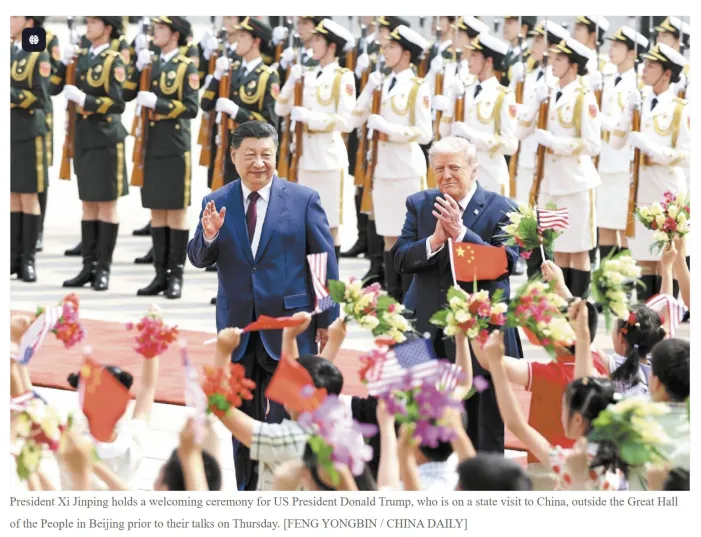
Jan Oberg May 15, 2026 Go to this Fox News page and scroll the whole way down: President Donald Trump tells the world that his meeting with President Xi Jinping yielded a lot of very concrete political and economic results – of course, only where the Chinese side, according to him, agreed with him. He does not mention the Taiwan issue, but Secretary of State, Marco Rubio, says that it did not feature prominently in their talks and that the US policy on Taiwan has not changed. Then go to China Daily – or Global Times – and you will see that for the Chinese it is framework, principles, structure of cooperation etc. that matters – all embedded in the overall idea of “constructive bilateral relationship of strategic stability.” Nowhere is any concrete agreement or deal – all that Trump refers to – mentioned. At the general level, this gives you insights into the very different social...
The MIMAC – Military-Industrial-Media-Academic Complex – drives the world’s rampant militarism and wars without end. Here is a short reflection of how it works against all interests of humanity. #5 deals with why there is no real enemy or threat images/analysis. It’s all ex-post constructions. And, btw, theTFF Peace Pulse is now on Rumble.
Jan Oberg, TFF director April 28, 2026 In this third TFF Peace Pulse, I make the important distinction between the violence and the conflict that violence is a symptom of. If you want peace, focus on the underlying conflict because that is the key to resolution, peacemaking, and a better future for the parties. The West is obsessed with violence, just look around you – and 90+ per cent of the public debate is about military issues and other violence – totally wasted for peace. These Peace Pulses will only be published here a few times. You will also not find them on YouTube and Vimeo because both platforms have blocked TFF and me; you know, peace is dangerous these days. Most TFF’s videos since 2007 are now on Rumble.

Recent Articles

Jan Oberg May 15, 2026 Go to this Fox News page and scroll the whole way down: President Donald Trump tells the world that his meeting with President Xi Jinping yielded a lot of very concrete political and economic results – of course, only where the Chinese side, according to him, agreed with him. He does not mention the Taiwan issue, but Secretary of State, Marco Rubio, says that it did not feature prominently in their talks and that the US policy on Taiwan has not changed. Then go to China Daily – or Global Times – and you will see that for the Chinese it is framework, principles, structure of cooperation etc. that matters – all embedded in the overall idea of “constructive bilateral relationship of strategic stability.” Nowhere is any concrete agreement or deal – all that Trump refers to – mentioned. At the general level, this gives you insights into the very different social...
Lena Petrova of “World Affairs In Context” with more than half a million subscribers on YouTube wanted to explore what a peace researcher like me has to say about, among other things, the First and the Second Cold War and why eethics has disappeared from politics. I am particularly happy about this conversation that also yielded an amazing number of very appreciative comments on YouTube. No doubt, people are longing for alternatives, including peace perspectives.
The MIMAC – Military-Industrial-Media-Academic Complex – drives the world’s rampant militarism and wars without end. Here is a short reflection of how it works against all interests of humanity. #5 deals with why there is no real enemy or threat images/analysis. It’s all ex-post constructions. And, btw, theTFF Peace Pulse is now on Rumble.

TFF on Substack

Discover more from TFF Transnational Foundation & Jan Oberg.

Most Popular

Jan Oberg May 15, 2026 Go to this Fox News page and scroll the whole way down: President Donald Trump tells the world that his meeting with President Xi Jinping yielded a lot of very concrete political and economic results – of course, only where the Chinese side, according to him, agreed with him. He does not mention the Taiwan issue, but Secretary of State, Marco Rubio, says that it did not feature prominently in their talks and that the US policy on Taiwan has not changed. Then go to China Daily – or Global Times – and you will see that for the Chinese it is framework, principles, structure of cooperation etc. that matters – all embedded in the overall idea of “constructive bilateral relationship of strategic stability.” Nowhere is any concrete agreement or deal – all that Trump refers to – mentioned. At the general level, this gives you insights into the very different social...
Lena Petrova of “World Affairs In Context” with more than half a million subscribers on YouTube wanted to explore what a peace researcher like me has to say about, among other things, the First and the Second Cold War and why eethics has disappeared from politics. I am particularly happy about this conversation that also yielded an amazing number of very appreciative comments on YouTube. No doubt, people are longing for alternatives, including peace perspectives.
The MIMAC – Military-Industrial-Media-Academic Complex – drives the world’s rampant militarism and wars without end. Here is a short reflection of how it works against all interests of humanity. #5 deals with why there is no real enemy or threat images/analysis. It’s all ex-post constructions. And, btw, theTFF Peace Pulse is now on Rumble.
Read More
Screenshot-2026-05-15-103534
Jan Oberg May 15, 2026 Go to this Fox News page and scroll the whole way down: President Donald Trump tells the world that his meeting with President Xi Jinping yielded a lot of very concrete political and economic results – of course, only where the Chinese side, according to him, agreed with him. He does not mention the Taiwan issue, but Secretary of State, Marco Rubio, says that it did not feature prominently in their talks and that the US policy on Taiwan has not changed. Then go to China Daily – or Global Times – and you will see that for the Chinese it is framework, principles, structure of cooperation etc. that matters – all embedded in the overall idea of “constructive bilateral relationship of strategic stability.” Nowhere is any concrete agreement or deal – all that Trump refers to – mentioned. At the general level, this gives you insights into the very different social...
Screenshot-2026-05-12-104023
Lena Petrova of “World Affairs In Context” with more than half a million subscribers on YouTube wanted to explore what a peace researcher like me has to say about, among other things, the First and the Second Cold War and why eethics has disappeared from politics. I am particularly happy about this conversation that also yielded an amazing number of very appreciative comments on YouTube. No doubt, people are longing for alternatives, including peace perspectives.
Screenshot-2026-04-13-154551 (2)
The MIMAC – Military-Industrial-Media-Academic Complex – drives the world’s rampant militarism and wars without end. Here is a short reflection of how it works against all interests of humanity. #5 deals with why there is no real enemy or threat images/analysis. It’s all ex-post constructions. And, btw, theTFF Peace Pulse is now on Rumble.
Screenshot-2026-04-13-154551 (1)
Jan Oberg, TFF director April 28, 2026 In this third TFF Peace Pulse, I make the important distinction between the violence and the conflict that violence is a symptom of. If you want peace, focus on the underlying conflict because that is the key to resolution, peacemaking, and a better future for the parties. The West is obsessed with violence, just look around you – and 90+ per cent of the public debate is about military issues and other violence – totally wasted for peace. These Peace Pulses will only be published here a few times. You will also not find them on YouTube and Vimeo because both platforms have blocked TFF and me; you know, peace is dangerous these days. Most TFF’s videos since 2007 are now on Rumble.
Screenshot-2026-04-13-154551
In contrast to most, we’ll bring alternatives, solutions, hope and strategies for a better future. Times are dangerous, yes, but that only intensifies the need for constructive thinking and action! Jan Oberg, TFF director April 13, 2026 The new TFF Peace Pulse uses video messages in a new way: Max 3-5-minute-long comments, ideas or perhaps mini-lectures, all about peace – positive peace. We launch them today on April 13, 2026 with a carefully crafted visual aesthetic fitting the content. We hope to publish them regularly from now on. We launch Peace Pulse (PP) – for a number of reasons. The world is in chaos, and there are countless reasons to feel concerned, frustrated, even angry. The atmosphere is saturated with doom and gloom, with negative energy and rear‑mirror thinking, while vision, imagination, alternatives, strategies and genuine future‑mindedness remain in short supply. And without them, we simply can’t save the world. Looking at problems from a hundred angles will...
IMG_5165 (1)
PART II — Publishing Peace in a System That Prioritises Militarism Jan Oberg, TFF director April 10, 2026 How TFF Maintains a Daily Voice in a Digital World Built for Noise This article is part of the series “TFF at 40″ and it invites you to learn about Four Decades of Publishing Peace. It takes a look at how a small, people‑financed peace foundation has communicated across four generations of technology — from wax stencils and fax machines to mass email and Substack — and why TFF continues to publish every single day in a system that rewards noise, conflict, and militarism. ◆ What it means to publish peace every single day in a digital system built for 24/7 news and other noise, confrontation, and militarism. How TFF’s independence, continuity, and global readership defy algorithms, donor cycles, and Western media censorhip — and why the Majority World keeps listening. When the...