
The EU bows to ‘systemic rival’ China

Slowly but surely, the EU is shifting its priorities to the East

By Pepe Escobar

April 18, 2019

Let’s start with the essential background for the meeting in Paris on Tuesday between Chinese President Xi Jinping and three EU heavyweights – French President Emmanuel Macron, German Chancellor Angela Merkel and President of the European Commission (EC) Jean-Claude Juncker.

As imperfect as these figures may be, economic growth for the past 10 years after the 2008 financial crisis – which was a made in the West phenomenon – do tell an enlightening story.

China’s growth: 139%. India’s growth: 96%. The US’ growth: 34%. EU growth: negative2%.

Originally posted in Asia Times on March 27, 2019 here

French mainstream media, controlled by a rarified group of oligarchs, spun a risible narrative that Macron “imposed” this four-way meeting on Xi to press on him the new EC strategy aiming to “clarify” Chinese ambiguity in relation to the New Silk Roads, or Belt and Road Initiative (BRI).

As I previously reported, the EC now brands China a “systemic rival,” and seems to have realized that Beijing is an “economic competitor in search of technological leadership.” And that may translate as a threat to European values and norms.

Xi had just come from Rome – where the populist, eurosceptic Lega, Five Stars coalition government became the first G7 nation to sign a partnership with the BRI, igniting massive sparks of Atlanticist fear.

So in the end, what did we get from Chancellor Angela Merkel as the EU faced a process French elites describe as Sino-globalization?

We had realpolitik. Merkel stressed the BRI was an “important” project: “We, as Europeans, want to play an active part and that must lead to certain reciprocity and we are still wrangling over that a bit.” She added: “We are seeing the project as a good visualization of interaction, interrelation and interdependence.”

Merkel was essentially relaying the position of German business elites – as a trade powerhouse, the future of Germany lies in turbo-charging business with Asia, especially China.

So, instead of demonizing Rome, in practice Berlin will eventually embark on the same path. After all, Duisburg, in the Ruhr valley, is already the de facto top BRI terminal in northern Europe.

Xi and his EU partners did not fail to emphasize multilateralism. There could not be a more glaring contrast to the Trump administration’s narrative that China is a threat and the BRI is all about Chinese “vanity.” Juncker even tried to defuse the “systemic” tension: “We understand that China does not like the expression ‘rivals,’ but it is a compliment describing our shared ambitions.”

Add to it that Xi also felt the need to remind the EU leadership of the obvious. China will continue to “open up,” as it managed in only 40 years to accomplish what Europe did over the course of the entire industrial revolution.

New Silk Air, anyone?

On the – embattled – Macron front, more than New Silk Roads a de facto New Silk Air seems to be in effect.

No one – apart from Boeing – argues about a 30 billion Euro-plus Chinese order to buy 300 Airbuses. And that’s only the beginning. The fact that Beijing will use Airbus technology to enhance its aviation prowess under the framework of Made in China 2025 is another matter entirely.

So Paris may not have turned, like Rome, into an official partner to the New Silk Roads – at least not yet. But the promises are quite telling – on three fronts.

1) The emphasis on multilateralism – “strong and efficient.” That’s not exactly Trumpian rhetoric.

2) Common action with Beijing on climate change and biodiversity.

3) An economic-trade partnership that respects mutual interests. That is, in fact, New Silk Roads-BRI official policy since the beginning, in 2013.

So when we compare the different strategies by Rome and Paris, Xi has, in fact, come out with a win-win.
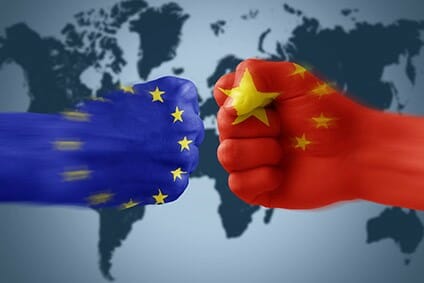
Merkel, predictably, was careful to hedge to the hilt: “The triangle between EU, China and US is very important. Without the US, we will not be able to have multilateralism.”

At the same time, she stressed, the US-China trade war was “hitting our German economy.”

As for Team Macron, with the leader obsessed with posing as the savior of the EU ahead of the European Parliament elections in May, they could not help but go after the administration in Rome.

According to a Macron acolyte: “There is this bad European habit to have 28 different policies, with countries competing against each other to attract investment. We need to speak with a common voice if we want to exist. We have the same approach on the 5G issue: avoiding 28 different decisions.”

The 5G Monaco Grand Prix

Which brings us to the case of Monaco, not exactly a shabby prize – and duly visited by Xi, who was received, literally, as royalty.

The principality is absolutely avid to gobble up the fast-growing Chinese luxury tourism market. And that explains why Monaco has already signed a deal with Huawei to be the first country to be entirely covered by 5G before the end of 2019.

Paris, by the way, has not ruled out using Huawei equipment. And as a cherry on the cake, guess which city Huawei chose to globally unveil its spectacular new P30 series of smartphones? Paris.

Make no mistake, for Beijing, in terms of trade and economic relations, Berlin is way more relevant than Paris. But these big three – Berlin, Paris and Rome – all have major roles to play.

The New Silk Roads being re-connected to Italy after half a millennium will accelerate Euro-Asia integration, and even, in the long run, more influence for both the Eurasia Economic Union (EAEU) and the Shanghai Cooperation Organization (SCO).

EU businesses, if not political Eurocrats, are starting to realize that Europe cannot afford to become a battlefield in Cold War 2.0 between the US and Russia, cannot afford to become a hostage of Washington tearing up international law – see, for instance, the destruction of the Iran nuclear deal and recognizing the occupied Golan Heights as part of Israel – and cannot afford to become a victim of Washington’s trade whims.

It’s no wonder that slowly but surely, the EU is shifting its priorities to the East – including to its “systemic rival.”

Pepe Escobar is a Brazilian journalist who has written for Asia Times for many years, covering events throughout Asia and the Middle East. He has also been an analyst for RT and Sputnik News, and previously worked for Al Jazeera.

Share

Leave a Reply

Your email address will not be published. Required fields are marked *

Related Posts

TFF Associate and former Board member On 28 August 2025, France, Germany, and the United Kingdom (the EU Troika) decided to trigger the so-called “snapback mechanism” and reimpose stringent sanctions on Iran after 30 days for its alleged violation of the terms of the Iran nuclear deal, known as the Joint Comprehensive Plan of Action (JCPOA), if Iran did not give in to their demands within 30 days. In the lawless world in which we are living at the moment, discussing the principles of international law is futile and irrelevant. We have reverted to the age of imperial dictatorship and big power dominance. This state of affairs is dangerous for the whole world, especially the Global South, which is at the mercy of the dictates of the superpowers. However, a return to the rivalry between powerful empires outside the scope of international law, which led to the two world wars,...
Professor Zhang Weiwei is a highly respected Chinese intellectual and professor at Fudan University in Shanghai. He is the director of its China Institute and also runs a series of conversations with many different people around the world. Here is what came out of their meetings there and in Skopje, Macedonia in October 2024: & As you can see, also at the end of the second one, we both enjoy win-win exchanges like these about world order issues. Zhang Weiwei is known for using videos and social media to reach a large audience in China and worldwide. We suggest you see many more of Zhang Weiwei’s conversations – like recently with Professor Jeffrey Sachs – on the Thinkers’ Forum on YouTube. PSTFF posts hundreds of videos, its own and those of others, in our Video Collections on TFF Substack – including those that appear on YouTube. However, TFF has been cancelled by Google-owned...
Launched on November 17, 2024Updated with new materials regularly TFF Board members Thore Vest. Everywhere, the delegation was met with a sincere wish to develop knowledge, dialogue, cooperative projects, and initiatives based on citizens’ diplomacy – in general, but with the West in particular. For more, see “Report from the Nordic delegation to China’s Xinjiang Province, September 7-15, 2024.” While the delegation was in Xinjiang, various ideas were already being discussed from the local to the top level, i.e., with the governor and party leaders of Xinjiang. The two TFF Associates suggested that TFF set up a special section – in addition to its “China and Silk” – where various quality materials about Xinjiang would regularly be published to promote public education about Xinjiang, particularly its contemporary development – worldwide but in the West in particular. This is now a reality – as can be seen below – but it...

Recent Articles

PressInfo # 141, December 21, 2001It’s time to prepare reconciliation between Albanians and Serbs PressInfo # 140, December 14, 2001Ibrahim Rugova’s decade-long leadership in Kosovo/a PressInfo # 139, 11. december, 2001En god nyhet: Jugoslaviens Sannings- och försoningskommission PressInfo # 139, 11. december, 2001Gode nyheder: Jugoslaviens Sandheds- og Forsoningskommission PressInfo # 139, December 11, 2001Good news: Yugoslavia’s Truth and Reconciliation Commission PressInfo # 138, November 8, 2001TFF co-founder PhD with thesis about young people with roots in other cultures PressInfo # 138, November 8, 2001TFF:s medstiftare doktor på avhandling om unga med ursprung i andra kulturer PressInfo # 137, October 17, 2001A new Marshall Plan: Advancing human security and controlling terrorism PressInfo # 136, October 15, 2001The UN and Annan really deserve it PressInfo # 135, October 10, 2001Preventing a terrorist mushroom cloud PressInfo # 134, 17 oktober, 2001Sverige og 11. september PressInfo # 134, October 9, 2001Sweden and September 11...
Peace is promoted by constructive proposals and dialogue Four preceding PressInfos have expressed concern over — and criticised — the ongoing, militarisation of the EU. Some will say: but there are no alternatives. We believe that there are always alternatives, that democracies are characterised by alternatives and choice, and that openly discussed alternatives will improve the quality and legitimacy of society’s decision–making. In addition, it is an intellectual and moral challenge to not only criticise but also be constructive. If we only tell people that we think they are wrong, they are not likely to listen. However, if we say: what are your views on this set of ideas and steps? — we may sometimes engage them in dialogue and sow a seed. Most people in power circles live their daily lives in in a time frame and a social space where certain ideas, viewpoints and concepts are just not...
Photos © TFF 2000 Read PressInfo 90 “Lift the Sanctions and Bring More Aid to Yugoslavia” See Pictures from Belgrade © TFF 2000 Please reprint, copy, archive, quote or re-post this item, but please retain the source.

TFF on Substack

Discover more from TFF Transnational Foundation & Jan Oberg.

Most Popular

PressInfo # 141, December 21, 2001It’s time to prepare reconciliation between Albanians and Serbs PressInfo # 140, December 14, 2001Ibrahim Rugova’s decade-long leadership in Kosovo/a PressInfo # 139, 11. december, 2001En god nyhet: Jugoslaviens Sannings- och försoningskommission PressInfo # 139, 11. december, 2001Gode nyheder: Jugoslaviens Sandheds- og Forsoningskommission PressInfo # 139, December 11, 2001Good news: Yugoslavia’s Truth and Reconciliation Commission PressInfo # 138, November 8, 2001TFF co-founder PhD with thesis about young people with roots in other cultures PressInfo # 138, November 8, 2001TFF:s medstiftare doktor på avhandling om unga med ursprung i andra kulturer PressInfo # 137, October 17, 2001A new Marshall Plan: Advancing human security and controlling terrorism PressInfo # 136, October 15, 2001The UN and Annan really deserve it PressInfo # 135, October 10, 2001Preventing a terrorist mushroom cloud PressInfo # 134, 17 oktober, 2001Sverige og 11. september PressInfo # 134, October 9, 2001Sweden and September 11...
Peace is promoted by constructive proposals and dialogue Four preceding PressInfos have expressed concern over — and criticised — the ongoing, militarisation of the EU. Some will say: but there are no alternatives. We believe that there are always alternatives, that democracies are characterised by alternatives and choice, and that openly discussed alternatives will improve the quality and legitimacy of society’s decision–making. In addition, it is an intellectual and moral challenge to not only criticise but also be constructive. If we only tell people that we think they are wrong, they are not likely to listen. However, if we say: what are your views on this set of ideas and steps? — we may sometimes engage them in dialogue and sow a seed. Most people in power circles live their daily lives in in a time frame and a social space where certain ideas, viewpoints and concepts are just not...
Photos © TFF 2000 Read PressInfo 90 “Lift the Sanctions and Bring More Aid to Yugoslavia” See Pictures from Belgrade © TFF 2000 Please reprint, copy, archive, quote or re-post this item, but please retain the source.
Read More
Imagen-thumbnail-The-Transnational-1
PressInfo # 141, December 21, 2001It’s time to prepare reconciliation between Albanians and Serbs PressInfo # 140, December 14, 2001Ibrahim Rugova’s decade-long leadership in Kosovo/a PressInfo # 139, 11. december, 2001En god nyhet: Jugoslaviens Sannings- och försoningskommission PressInfo # 139, 11. december, 2001Gode nyheder: Jugoslaviens Sandheds- og Forsoningskommission PressInfo # 139, December 11, 2001Good news: Yugoslavia’s Truth and Reconciliation Commission PressInfo # 138, November 8, 2001TFF co-founder PhD with thesis about young people with roots in other cultures PressInfo # 138, November 8, 2001TFF:s medstiftare doktor på avhandling om unga med ursprung i andra kulturer PressInfo # 137, October 17, 2001A new Marshall Plan: Advancing human security and controlling terrorism PressInfo # 136, October 15, 2001The UN and Annan really deserve it PressInfo # 135, October 10, 2001Preventing a terrorist mushroom cloud PressInfo # 134, 17 oktober, 2001Sverige og 11. september PressInfo # 134, October 9, 2001Sweden and September 11...
Imagen-thumbnail-The-Transnational-1
Peace is promoted by constructive proposals and dialogue Four preceding PressInfos have expressed concern over — and criticised — the ongoing, militarisation of the EU. Some will say: but there are no alternatives. We believe that there are always alternatives, that democracies are characterised by alternatives and choice, and that openly discussed alternatives will improve the quality and legitimacy of society’s decision–making. In addition, it is an intellectual and moral challenge to not only criticise but also be constructive. If we only tell people that we think they are wrong, they are not likely to listen. However, if we say: what are your views on this set of ideas and steps? — we may sometimes engage them in dialogue and sow a seed. Most people in power circles live their daily lives in in a time frame and a social space where certain ideas, viewpoints and concepts are just not...
Imagen-thumbnail-The-Transnational-1
Photos © TFF 2000 Read PressInfo 90 “Lift the Sanctions and Bring More Aid to Yugoslavia” See Pictures from Belgrade © TFF 2000 Please reprint, copy, archive, quote or re-post this item, but please retain the source.
Imagen-thumbnail-The-Transnational-1
Av FRANK SØHOLM GREVIL 16 augusti 2004  Vi er nu nået til tredje akt i det absurde teaterstykke, der i analogi med de store skueprocesser i Moskva 1936-38 er blevet døbt ‘Grevil-sagen’. Første akt bestod i min anonyme fremlæggelse af egenhændigt nedklassificerede rapporter i Berlingske Tidende i februar og marts. Andet akt udgjordes af min fremtræden med navn og billede i Information i april samt den efterfølgende mediestorm, som uden min direkte medvirken kostede en forsvarsminister taburetten samt en sigtelse for brud på tavshedspligten. Tredje akt bliver en retssag, hvor jeg står tiltalt for at have overtrådt straffelovens bestemmelser om uberettiget videregivelse eller udnyttelse af fortrolige oplysninger. Statsanklageren har ovenikøbet valgt at påberåbe sig særligt skærpende omstændigheder. Da jeg aldrig har modtaget betaling for at stille rapporterne til rådighed eller lade mig interviewe, må det skærpende bestå i, at “videregivelsen eller udnyttelsen er sket under sådanne omstændigheder, at det påfører...
Imagen-thumbnail-The-Transnational-1
Af Svenska Irakkommittén mot de Ekonomiska Sanktionerna (SIES) 13 september 2002 FN:s ekonomiska sanktioner mot Irak har nu pågått i tolv år och drabbat det irakiska folket med svåra lidanden. Enligt FN:s egna siffror har mer än 1,5 miljoner människor, varav ca 600 000 barn, dött som en direkt följd av sanktionerna. Dessutom har ett lågintensivt bombkrig mot landet pågått under dessa år. Av all denna förödelse- orsakad huvudsakligen av amerikansk och brittisk politik- har Saddam Husseins brutala och diktatoriska regim snarast stärkts än försvagats. Nu förbereder USA under president Bushs ledning ett storskaligt bombkrig mot Irak som kommer att innebära ett ännu större lidande för civilbefolkningen. Ett sådant krig kommer dessutom att ytterligare undergräva freden och säkerheten i världen. Att upprätta en demokratisk regim i Irak är det irakiska folkets angelägenhet och får enligt folkrätten inte ske med krigshandlingar utifrån. Folkrätten och FN:s stadgar måste respekteras. Vi vädjar till...