TFF 1986-1996

and later associate professor in peace studies (“docent” in Swedish) – was also head of the Lund University Peace Research Institute, LUPRI – succeeding the legendary peace researcher and Lund public figure, Haakan Wiberg (1942-2010).

Regrettably, the university’s social science faculty got the – even at the time bizarre – idea to close down all inter-disciplinary units and departments such as environment, human anthropology, gender studies, human rights and peace and conflict research.

Neither academic quality nor productivity in terms of courses given, students passing exams, research carried out etc. played any role.

The overarching idea was that Lund University should remain a traditional ”discipline university” as it was argued. The decision to close down peace research was also taken because the similar peace research institutions in Gothenburg and Uppsala seem to have had closer connections with the Ministry of Education than the researchers in Lund and had received full chairs in the field earlier.

The decision was taken without any consultation with Jan Oberg who therefore was the last head of the department. Some resources from the closed down department went to the department of sociology and the department of political science, the latter of which has offered courses under the heading of peace and conflict studies.

In the case of LUPRI, an additional argument for closing it down was that, since the Cold War would soon be history – this was November 1989 – there would be no need for such studies anymore.

It was only 10 months later that Iraq invaded Kuwait and in April 1991 the first instance of violence occurred in Croatia and the Yugoslavia dissolution wars gained speed, the most serious violence in Europe since 1945.

The thickness of academic walls and academic people’s distance from the real world out there should never be underestimated.

LUPRI enjoyed full personal support by the then chancellor, MD Håkan Westling in cooperation with whom it had arranged a series of US-Soviet scholarly meetings about East-West relations, security and disarmament.

Yet another, quite extraordinary, argument by the faculty chairman was that TFF (starting out in 1986) was a kind of competitor to the university institute and headed by Jan Oberg too. This was rather much nonsense since TFF’s emphasis was on internationally oriented research while LUPRI’s main activity was to offer educational courses in the field.

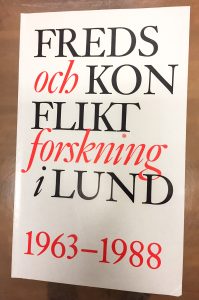
The 25 out of 26 years of peace research at Lund University is documented in the booklet ”Freds och Konfliktforskning i Lund 1963-1988” edited by Jan Oberg; unfortunately it is in Swedish and not available online. It explains the developments – research programs, courses and seminars in the field of peace and conflict in Lund – until it was all destroyed by the faculty itself and external forces (in Swedish). It also made mention of conflict studies that could be found here and there, e.g. empirical studies of border conflicts under the able leadership of professor Sven Tägil at the Department of History.

The 25th Anniversary publication also lists no less than 372 publications between 1963 and 1988 by researchers such as Lars Dencik, Lars Borgquist, Kerstin Nyström, Herman Schmid, Charles Edquist, Kent Lindquist, Jan Annerstedt, Per Gahrton, Wilhelm Agrell, Haakan Wiberg, Jan Oberg, Jan Andersson, Katsuya Kodama and a few others – all of whom were either employed or otherwise associated via projects with LUPRI.

A detailed account of this destructive process can be found here.
1985-90

TFF was established as a private foundation and independent of the university in September 1985 and started operations in January 1986. The first years, it produces academic books on peace and security issues and the foundation served as research environment to scholars from abroad – Dr. Suman Khanna, India; professor Toshiki Mogami from the International Christian University in Mitaka, Tokyo; Dr. Dietrich Fischer from Switzerland and lieutenant-colonel and documentarist Wilhelm Nolte, West Germany.

Fischer’s and Nolte’s frequent seminars in Lund with Jan Oberg resulted in the 1989 bestseller Winning Peace. Strategies and Ethics for a Nuclear-Free World with editions in Danish, German and Swedish.

The foundation initiated various projects in cooperation with organisations such as the Myrdal Foundation in Stockholm, Greenpeace, the National Science Foundation and it conducted, among several other projects, one which built on a co-operation between North American, Russian and Nordic scholar about Economics, Environment and Ethics. Another, with the Myrdal Foundation focused on the possibility and dimensions of Nuclear Winter.

Several projects and publications were related to the concept of common security, security in general, Nordic aspects of security and peace, nuclear weapons, European politics, disarmament, UN reform, studies of the roles of the international peace movement, nuclearism, the necessary switch from deterrence policies to common security – all topical at the time when the possibility of a new security architecture in Europe could be seen at the horizon.

A major endeavour was a series of studies of alternative defensive military, civil defence and non-violent defence as a new model the chances of which was increasing as the Soviet Union and the Warsaw Pact was, slowly but surely, falling apart.

TFF also issued reports on themes such as the need for conflict consortiums, the concept of conflict mitigation, UN reform in general and peace-keeping and peace-building issues in particular.

After Oberg had left the university for good in November 1989, he became a visiting professor at the International Christian University, ICU, 1990-91 (and – later – at Chuo University (1995), Nagoya (2004 and 2007) and Kyoto (2009-2010).
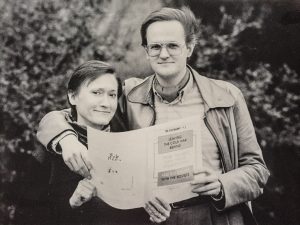
With a TFF Statement in March 1989 – on how to build peace with the Soviets

1990-97

After the first five years with an almost hectic research and publishing activity – documented in a series of printed newsletters – the founders and the board raised a strategically important question: Shall TFF continue to do this type of armchair or desk research ending in academic publications of various types or shall it engage in conflict zones and practise all these theories and ideas and see which work and which don’t?

In other words, shall the doctor meet a patient and try to be of practical help with diagnosis, prognosis and treatment? At this moment the foundation changed course to walk on two legs – one in academia and one in selected conflict zones out there – and, thereby, also a policy and media think-and-do tank.

It happened that TFF board members had multi-year experiences from Yugoslavia – Haakan Wiberg, Ulf Svensson and Jan Oberg. So had some of the TFF Associates such as Johan Galtung and Soren Sommelius.

From 1991 and well into the 2000s, TFF was engaged in all parts of what was then Yugoslavia and the republics it was, later, split up into.

The results of that multi-year project can be found in the blog ”Yugoslavia – What Should Have Been Done?” where everything Johan Galtung, Jan Oberg and Haakan Wiberg wrote between 1991 and 2014 has been collected and published as it was written during the process.

TFF’s teams made some 70 mission trips, did more than 3000 interviews with people in all republic and at all societal levels, produced reports and peace plans, gave courses in conflict-resolution and reconciliation in war zones, worked with a series of UN missions in Croatia, Bosnia, Macedonia and Serbia and did a lot of media work back home but also press conferences and other outreach activities in the various conflict areas.

It served as goodwill (unpaid) mediator over four years between Belgrade and Prishtina in the Kosovo conflict and produced an international law-based plan for a three-year negotiated solution. The only one anywhere of its kind and one that attracted considerably attention on both sides and in the UN.

Alas, it all came to nought by NATO’s war on Serbia in spring 1999.

In 1994 another TFF team did a fact-finding mission to Georgia, South Ossetia and Abkhazia – resulting in the printed report ”Georgia On Our Minds” by two of the team members, Marta Cullberg Weston and Burns Weston.

However, TFF did not continue its work in Georgia. A foundation with very limited resources knows well that it must focus and the focus in those days remained on Yugoslavia.

Documentation

Printed books and reports were the main products of an academic institution in those days.

Apart from the mentioned blog about Yugoslavia, the documentation of TFF’s projects and publications at the time is found in TFF’s archive in Lund – reports, books, anthologies, newsletters, board statements, media articles and interviews and that its Associates produced in during those years.

TFF went online and established its first homepage on the Internet in 1997 and it has been on Facebook and other social media since 2007.

Hopefully, this has offered the reader a few glimpses and a sense of what peace research in Lund has been and is about. The full story – LUPRI at the time and TFF – will, one day, be published but that requires more archive studies.

Lund,
December 16, 2017
Peace & future researcher + ‌Art Photographer

Share

Leave a Reply

Your email address will not be published. Required fields are marked *

Related Posts

Below are TFF-related media mentions, comments, videos and social media posts published elsewhere but not on this homepage. We happen to catch and list only a fraction. Regarding video comments and debates, we recommend that you go to the TFF Video Channel on Substack where many of them are reproduced. Jan Oberg is a contributor to China Daily – 52 million daily clicks – and Global Times, CGTN and CCTV (the national television), China Investment, Xinhua News Agency and several others. Articles and videos on these media very often multiply into countless Chinese (and Western media) that re-post them from these main media. Thanks to The China Academy, his analyses, interviews and comments are frequently posted on YouTube channels such as Thinkers Forum and Wave Media. These videos are often re-posted on Bilibili (China’s YouTube), the China Content Center on TikTok, and on the Chinese edition of TikTok, Douyin.com. This means reaching hundreds of millions of viewers worldwide over a year. While there are too many to catch on all these...
“The future belongs to those who imagine it — not those who declare it doomed.” Silence is unusual for us. But even a foundation devoted to peace and ideas needs a pit stop now and then — a moment to refuel, re‑engineer, and prepare for the road ahead. Because the road ahead matters. On January 1, 2026, TFF turns 40. Four decades of independent research, education, and advocacy for the UN Charter norm that “peace shall be established by peaceful means.” And we are not celebrating with nostalgia — we are rebuilding for the future: We are bringing in new Associates, engaging in conferences across continents, and preparing to do what so few dare: offer solutions instead of despair. Because let’s be honest: describing the world as doomed is easy. It is also lazy, unprofessional, and unethical. Imagine a doctor telling a patient: “You’re dying, I can’t see what can...
Launched on November 17, 2024Updated with new materials regularly TFF Board members Thore Vest. Everywhere, the delegation was met with a sincere wish to develop knowledge, dialogue, cooperative projects, and initiatives based on citizens’ diplomacy – in general, but with the West in particular. For more, see “Report from the Nordic delegation to China’s Xinjiang Province, September 7-15, 2024.” While the delegation was in Xinjiang, various ideas were already being discussed from the local to the top level, i.e., with the governor and party leaders of Xinjiang. The two TFF Associates suggested that TFF set up a special section – in addition to its “China and Silk” – where various quality materials about Xinjiang would regularly be published to promote public education about Xinjiang, particularly its contemporary development – worldwide but in the West in particular. This is now a reality – as can be seen below – but it...

Recent Articles

Till Sofias huvudsida
OK, Trump did not get it. But he got a full endorsement of a possible future US regime change in Venezuela. And that is what Ms Machado has advocated. On October 10, 2025, the Norwegian Nobel Committee awarded its Peace Prize to Venezuelan opposition figure María Corina Machado. The citation praised her “tireless work promoting democratic rights.” But Ms Machado has openly called for U.S. military intervention in Venezuela, stating on CBS: “The only way to stop the suppression is by force—U.S. force.” She or her party has received funding from the National Endowment for Democracy (NED), a U.S. government-backed body known as a CIA front organisation and for supporting regime-change operations worldwide. And in 2018, she sent a letter to Israeli Prime Minister Benjamin Netanyahu, asking him to use “force and influence” to help dismantle Venezuela’s government—citing alleged ties to terrorism, Iran and narcotrafficking. This year’s NATO Norwegian prize...
PRESS RELEASE – 6 OCTOBER 2025 LAY DOWN YOUR ARMSPEACE PRIZE FOR 2025 is awarded Francesca Albanese The United Nations Special Rapporteur on the occupied Palestinian territories – as the person who, in accordance with Alfred Nobel’s will, has “done the most or the best work for fraternity between nations and for the abolition or reduction of standing armies as well as for the holding and promotion of peace congresses.” Francesca Albanese has forcefully and unwaveringly worked against Israel’s full-scale war on the occupied Palestinian territories, in particular Israel´s ongoing genocide against the Palestinian people. She has confronted Israel’s systematic war crimes and crimes against humanity in a truly global outreach. Further, she has brought governments, international organisations and people’s groups together to underline the responsibility of the world at large to act and to stop arming, enabling, and profiting from Israel’s ongoing criminal actions. But first of all, Albanese...

TFF on Substack

Discover more from TFF Transnational Foundation & Jan Oberg.

Most Popular

Till Sofias huvudsida
OK, Trump did not get it. But he got a full endorsement of a possible future US regime change in Venezuela. And that is what Ms Machado has advocated. On October 10, 2025, the Norwegian Nobel Committee awarded its Peace Prize to Venezuelan opposition figure María Corina Machado. The citation praised her “tireless work promoting democratic rights.” But Ms Machado has openly called for U.S. military intervention in Venezuela, stating on CBS: “The only way to stop the suppression is by force—U.S. force.” She or her party has received funding from the National Endowment for Democracy (NED), a U.S. government-backed body known as a CIA front organisation and for supporting regime-change operations worldwide. And in 2018, she sent a letter to Israeli Prime Minister Benjamin Netanyahu, asking him to use “force and influence” to help dismantle Venezuela’s government—citing alleged ties to terrorism, Iran and narcotrafficking. This year’s NATO Norwegian prize...
PRESS RELEASE – 6 OCTOBER 2025 LAY DOWN YOUR ARMSPEACE PRIZE FOR 2025 is awarded Francesca Albanese The United Nations Special Rapporteur on the occupied Palestinian territories – as the person who, in accordance with Alfred Nobel’s will, has “done the most or the best work for fraternity between nations and for the abolition or reduction of standing armies as well as for the holding and promotion of peace congresses.” Francesca Albanese has forcefully and unwaveringly worked against Israel’s full-scale war on the occupied Palestinian territories, in particular Israel´s ongoing genocide against the Palestinian people. She has confronted Israel’s systematic war crimes and crimes against humanity in a truly global outreach. Further, she has brought governments, international organisations and people’s groups together to underline the responsibility of the world at large to act and to stop arming, enabling, and profiting from Israel’s ongoing criminal actions. But first of all, Albanese...
Read More
Till Sofias huvudsida
BlackNobel
OK, Trump did not get it. But he got a full endorsement of a possible future US regime change in Venezuela. And that is what Ms Machado has advocated. On October 10, 2025, the Norwegian Nobel Committee awarded its Peace Prize to Venezuelan opposition figure María Corina Machado. The citation praised her “tireless work promoting democratic rights.” But Ms Machado has openly called for U.S. military intervention in Venezuela, stating on CBS: “The only way to stop the suppression is by force—U.S. force.” She or her party has received funding from the National Endowment for Democracy (NED), a U.S. government-backed body known as a CIA front organisation and for supporting regime-change operations worldwide. And in 2018, she sent a letter to Israeli Prime Minister Benjamin Netanyahu, asking him to use “force and influence” to help dismantle Venezuela’s government—citing alleged ties to terrorism, Iran and narcotrafficking. This year’s NATO Norwegian prize...
Screenshot-2025-10-08-163458
PRESS RELEASE – 6 OCTOBER 2025 LAY DOWN YOUR ARMSPEACE PRIZE FOR 2025 is awarded Francesca Albanese The United Nations Special Rapporteur on the occupied Palestinian territories – as the person who, in accordance with Alfred Nobel’s will, has “done the most or the best work for fraternity between nations and for the abolition or reduction of standing armies as well as for the holding and promotion of peace congresses.” Francesca Albanese has forcefully and unwaveringly worked against Israel’s full-scale war on the occupied Palestinian territories, in particular Israel´s ongoing genocide against the Palestinian people. She has confronted Israel’s systematic war crimes and crimes against humanity in a truly global outreach. Further, she has brought governments, international organisations and people’s groups together to underline the responsibility of the world at large to act and to stop arming, enabling, and profiting from Israel’s ongoing criminal actions. But first of all, Albanese...
Copilot_20251003_003414
Officially, the drones were not identified. By simply thinking critically – which journalists and selected experts no longer do – there may be a good reason for that. And this article will never be mentioned in Denmark… Drones over Denmark. No damage. No trace. No answers. Yet the headlines scream “Russian threat,” and Prime Minister Mette Frederiksen speaks with a certainty that defies logic: “We don’t know they were Russian—but we know Russia is the biggest threat to Europe.” It could be nobody else – unless you make an interest analysis which I did two days ago. This is not security policy. It’s theatre. And the audience is being played. Let’s rewind. These drones—unphotographed, untracked, unclaimed—appear and vanish like ghosts. Airports shut down. Panic spreads. Military budgets swell. And the narrative hardens: Russia is behind it. But what if that’s not just wrong but deliberately misleading? Here’s a hypothesis for...
Screenshot-2025-09-30-231913-1
And why the world, especially the EU, must now declare itself independent of the United States. UN’s 80th anniversary This year, the United Nations celebrates the 80th anniversary of its founding. The UN was formed after the scourge of the Second World War, in which 70 to 85 million people were killed and many countries were destroyed. That war came on the heels of the First World War, which also killed between 15 and 22 million people. After the Second World War, especially after the use of nuclear weapons by the United States, which marked a turning point in the history of warfare that could result in the end of civilisation as we know it, humanity decided to move away from the era of empires and big power politics and usher in a new era of peace, freedom and cooperation. These were the principles enshrined in the UN Charter. The United States...
DRONE
Drones over Nordic airports. No damage. No trace. No answers. Most assume Russia—but what if that’s not so? Why is there so much we are not told? This article explores the strategic ambiguity behind recent drone incursions and asks: Who else might benefit from sending drones into NATO airspace? From Ukraine’s surprising drone supremacy to Russia’s possible signalling, the silence itself may be the loudest message. These are the kinds of questions decent, intelligent investigative journalists and commentators could easily research. Why don’t they? Did you, dear reader, know or think of this? That the most powerful weapon in today’s conflicts might be the one that leaves no trace – and no answers. Just enough fear to justify the next move? Recently, drones have repeatedly appeared over Nordic airports and near some military facilities. They cause no damage – for which reason the designation “hybrid attack” is misleading but serves a purpose. These...