
Russia is undergoing a new - invisible - revolution in foreign policy

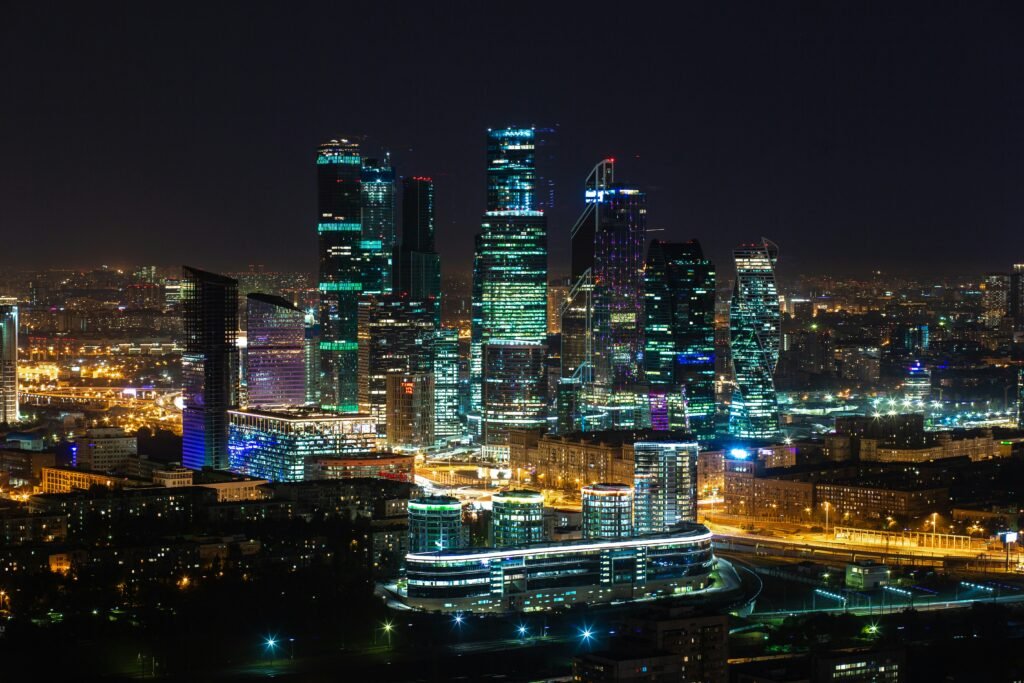
Moscow by night. Photo by Pavel Homenko on Unsplash

Dmitry Trenin

April 23, 2024

When President Vladimir Putin, back in February 2022, launched Russia’s military operation in Ukraine, he had specific, but limited objectives in mind. It was essentially about assuring Russia’s security vis-à-vis NATO.

However, the drastic, expansive and well-coordinated Western reaction to Moscow’s moves – the torpedoing of the Russo-Ukrainian peace deal and the mounting escalation of the US-led bloc’s involvement in the conflict, including its role in deadly attacks inside Russia – have fundamentally changed our country’s attitude towards our former partners.

We no longer hear talk about “grievances” and complaints about “failures in understanding.” The last two years have produced nothing less than a revolution in Moscow’s foreign policy, more radical and far-reaching than anything anticipated on the eve of the Ukraine intervention. Over the past 25 months, it has been quickly gaining in strength and profundity. Russia’s international role, its position in the world, its goals and methods of reaching them, its basic worldview – all are changing. 

The national foreign policy concept, signed by Putin just a year ago, represents a major departure from its predecessors. It establishes the country’s identity in terms of it being a distinct civilization. In fact, it is the first official Russian document to do so. It also radically transforms the priorities of Moscow’s diplomacy, with the countries of the post-Soviet ‘near abroad’ on top, followed by China and India, Asia and the Middle East, and Africa and Latin America.

Western Europe and the United States rank next to last, just above the Antarctic.
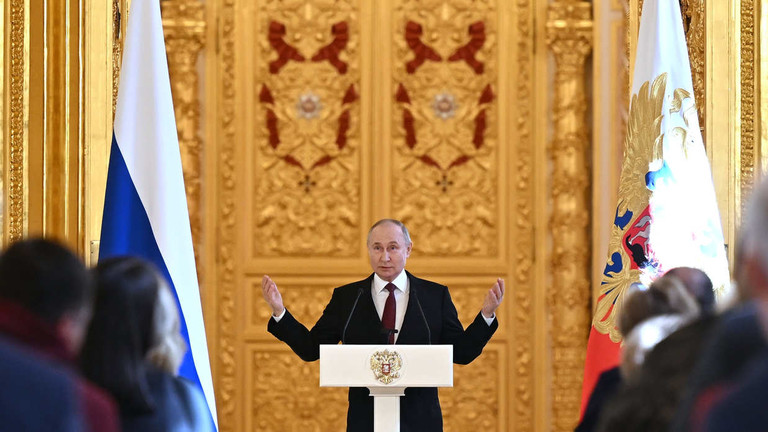
File photo: Russian President Vladimir Putin delivers a speech during a meeting with election campaign workers at the Grand Kremlin Palace, in Moscow, Russia. ©  Grigory Sysoev / Sputnik

Unlike in the previous decade, when Russia’s “turn to the east” was first announced, these are not just words. Our trade partners, not just political interlocutors, have also switched places. In just two years, the European Union, which only recently accounted for 48% of foreign trade, is down to 20%, whereas Asia’s share has soared from 26% to 71%. Russia’s use of the US dollar has also plummeted, with increasingly more transactions being conducted in Chinese yuan and other non-Western currencies such as the Indian rupee, the UAE dirham, as well as the instruments of our partners in the Eurasian Economic Union, and the ruble itself.

Russia has also ended its long and tiresome efforts to adapt to the US-led world order – something which it enthusiastically embraced in the early 1990s, grew disillusioned about in the following decade, and unsuccessfully tried to establish a modus vivendi with in the 2010s. Instead of surrendering to a post-Cold War set-up, in which it was left with no say, Russia has begun pushing back more and more against the hegemonic US-centered system. For the first time since the Bolshevik Revolution, albeit in a very different way from then, the country has de facto become a revolutionary power. While China still seeks to improve its position in the existing world order, Russia sees that state-of-affairs as being beyond repair, and is instead seeking to prepare for a new alternative arrangement.

For the time being, instead of the “one world” concept, which the Soviet Union even accepted in 1986, under Gorbachev, Moscow’s contemporary foreign policy has now split into two. For Russian policymakers, the post-2022 West has turned into a “house of adversaries,” while partners for Russia can only be found in the countries of the non-West, for whom we have coined a new description, “the World Majority.” The criterion for being included the group is simple: non-participation in the anti-Russia sanctions regime imposed by Washington and Brussels. This majority of over 100 nations is not considered a pool of allies: the depth and warmth of their relations with the Russia vary greatly, but these are the countries that Moscow can do business with.

For many decades, our country has been exceedingly supportive of various international organizations; it sought to join as many clubs as possible. Now Moscow has to admit that even the United Nations, including its Security Council (which Russia, a veto-wielding permanent member, has traditionally hailed as the centerpiece of the world system), has turned into a dysfunctional theater of polemics. The Organization for Security and Cooperation in Europe (OSCE), which Moscow long wanted to see as the premier security instrument in Europe, is now nearly totally dismissed due to the anti-Russian stance of its NATO/EU majority membership. Moscow has quit the Council of Europe, and its participation in a number of regional groupings for the Arctic, the Baltic, the Barents and the Black Seas has been put on hold.

True, much of this has been the result of the West’s policy of trying to isolate our country, but rather than feeling deprived of something valuable, Russians have few regrets over having had to leave or to suspend membership. Very tellingly, having re-established the supremacy of national legislation over international treaties, Moscow now cares little about what its adversaries can say or do about its policies or actions. From Russia’s standpoint, not only can’t the West be trusted any longer; the international bodies that it controls have lost all legitimacy.  

This attitude toward Western-dominated international institutions contrasts with the view of non-Western ones. This year, Russia’s presidency of the recently enlarged BRICS group is being marked by hyperactivity in preparations for hosting. Russia is also most supportive of the Shanghai Cooperation Organization, which its close ally Belarus is about to join. Together with countries in Asia, the Middle East, Africa and Latin America, it’s working closely to build new international regimes in a number of areas: finance and trade, standards and technology, information and health care. These are expressly being designed to be free from Western domination and interference. If successful, they can serve as elements of the future inclusive world order which Moscow promotes.

So, the changes in Russia’s foreign policy run very deep indeed. There is a question, however: how sustainable are they?

Above all, it should be noted that changes in foreign policy are an important, but also a relatively minor element of the wider transformation which is going on in Russia’s economy, polity, society, culture, values, and spiritual and intellectual life. The general direction and importance of those changes is clear. They are transforming the country from being a distant outlier on the fringes of the Western world into something which is self-sufficient and pioneering. These tectonic shifts would not have been possible without the Ukraine crisis. Having been given a powerful and painful push, now they have acquired a dynamic of their own.

It’s true that February 2022 itself was the end result of several trends that had been gathering momentum for about a decade. Feelings that fuller sovereignty was desired finally became dominant after Putin’s return to the Kremlin in 2012 and the re-unification with Crimea in 2014. Some truly fundamental changes with regard to national values and ideology were made in the form of amendments to the Russian Constitution, approved in 2020.

In March 2024 Putin won a resounding victory in the presidential elections and secured a fresh six-year mandate. This should be seen as a vote of confidence in him as the supreme commander-in-chief in the existential struggle (as Putin himself describes it) against the West. With that backing, the president can proceed with even deeper changes – and must make sure that those he has already wrought are preserved and built upon by those who succeed him in the Kremlin.

It is important to note that the Russian elites, which since the 1990s have been closely tied to the West, have had to make a hard choice recently between their country and their assets. Those who decided to stay have had to become more “national” in their outlook and action. Meanwhile, Putin has launched a campaign to form a new elite around the Ukraine war veterans. The expected turnover of Russian elites, and the transformation from a cosmopolitan group of self-serving individuals into a more traditional coterie of privileged servants of the state and its leader would make sure that the foreign policy revolution is complete.

Finally, Russia may not have been able to start moving so quickly in the direction of sovereignty had it not been for the Western policies of the past two decades: the increasing demonization of the country and its leadership. These choices have succeeded in making perhaps the initially most Westernizing, pro-European leadership that modern Russia has seen – including notably Putin himself and Dmitry Medvedev – into self-avowed anti-Westerners and determined opponents of US/EU policies.

Thus, rather than forcing Russia to change to fit a Western pattern, all that pressure has instead helped the country find itself again.

This article was originally published on RT on April 2, 2024. We recommend you obtain a VPN to break through Western censorship and read articles as important as this one on RT.

Dmitry Trenin

Dmitry Trenin is a research professor at the Higher School of Economics and a lead research fellow at the Institute of World Economy and International Relations. He is also a member of the Russian International Affairs Council (RIAC).

He served in the Armed Forces of the USSR and the Russian Federation, was a liaison officer in the foreign relations department of the Group of Soviet Forces in Germany (Potsdam); senior lecturer at the Military Institute; employee of the USSR delegation at the Soviet-American negotiations on nuclear and space weapons in Geneva; Senior Research Fellow at the NATO War College (Rome). From 2008 to 2022, he was the director of the Carnegie Moscow Center.

Trenin is also the author of more than 10 books and monographs published in Russia, the US, Germany, China and other countries.

Area of scientific interests: transatlantic and Eurasian security, international relations, Russian foreign policy, geopolitics and globalization, and post-Soviet Eurasia.

Read his articles at the Russian International Affairs Council website.

Share

Leave a Reply

Your email address will not be published. Required fields are marked *

Related Posts

Professor Zhang Weiwei is a highly respected Chinese intellectual and professor at Fudan University in Shanghai. He is the director of its China Institute and also runs a series of conversations with many different people around the world. Here is what came out of their meetings there and in Skopje, Macedonia in October 2024: & ◪ As you can see, also at the end of the second one, we both enjoy win-win exchanges like these about world order issues. Zhang Weiwei is known for using videos and social media to reach a large audience in China and worldwide. We suggest you see many more of Zhang Weiwei’s conversations – like recently with Professor Jeffrey Sachs – on the Thinkers’ Forum on YouTube. PS TFF posts hundreds of videos, its own and those of others, in our Video Collections on TFF Substack – including those that appear on YouTube. However, TFF...
Launched on November 17, 2024Updated with new materials regularly TFF Board members Thore Vest. Everywhere, the delegation was met with a sincere wish to develop knowledge, dialogue, cooperative projects, and initiatives based on citizens’ diplomacy – in general, but with the West in particular. For more, see “Report from the Nordic delegation to China’s Xinjiang Province, September 7-15, 2024.” While the delegation was in Xinjiang, various ideas were already being discussed from the local to the top level, i.e., with the governor and party leaders of Xinjiang. The two TFF Associates suggested that TFF set up a special section – in addition to its “China and Silk” – where various quality materials about Xinjiang would regularly be published to promote public education about Xinjiang, particularly its contemporary development – worldwide but in the West in particular. This is now a reality – as can be seen below – but it...
Photo Jan Oberg China has recently garnered significant attention due to its advancements in various technological fields, such as quantum physics and artificial intelligence. In media discussions and my lectures on China, it is common to encounter objections asserting that the West, particularly the United States, is certainly ahead of China. These assertions appear to be more emotional than factual. However, a more fundamental consideration is whether this question holds any significance. Cultural Perspective One aspect that Westerners often overlook is the cultural variation in understanding the relationship between abstract academic insights and practical applications of those insights. To comprehend the origin and significance of discussions on technological superiority, it is essential to acknowledge cultural and social differences between China and the West. I have explored this topic before in some of my previous articles published on the TFF website. Particularism On the cultural dimension universalist – particularist, China exhibits...

Recent Articles

PressInfo # 141, December 21, 2001It’s time to prepare reconciliation between Albanians and Serbs PressInfo # 140, December 14, 2001Ibrahim Rugova’s decade-long leadership in Kosovo/a PressInfo # 139, 11. december, 2001En god nyhet: Jugoslaviens Sannings- och försoningskommission PressInfo # 139, 11. december, 2001Gode nyheder: Jugoslaviens Sandheds- og Forsoningskommission PressInfo # 139, December 11, 2001Good news: Yugoslavia’s Truth and Reconciliation Commission PressInfo # 138, November 8, 2001TFF co-founder PhD with thesis about young people with roots in other cultures PressInfo # 138, November 8, 2001TFF:s medstiftare doktor på avhandling om unga med ursprung i andra kulturer PressInfo # 137, October 17, 2001A new Marshall Plan: Advancing human security and controlling terrorism PressInfo # 136, October 15, 2001The UN and Annan really deserve it PressInfo # 135, October 10, 2001Preventing a terrorist mushroom cloud PressInfo # 134, 17 oktober, 2001Sverige og 11. september PressInfo # 134, October 9, 2001Sweden and September 11...
Peace is promoted by constructive proposals and dialogue Four preceding PressInfos have expressed concern over — and criticised — the ongoing, militarisation of the EU. Some will say: but there are no alternatives. We believe that there are always alternatives, that democracies are characterised by alternatives and choice, and that openly discussed alternatives will improve the quality and legitimacy of society’s decision–making. In addition, it is an intellectual and moral challenge to not only criticise but also be constructive. If we only tell people that we think they are wrong, they are not likely to listen. However, if we say: what are your views on this set of ideas and steps? — we may sometimes engage them in dialogue and sow a seed. Most people in power circles live their daily lives in in a time frame and a social space where certain ideas, viewpoints and concepts are just not...
Photos © TFF 2000 Read PressInfo 90 “Lift the Sanctions and Bring More Aid to Yugoslavia” See Pictures from Belgrade © TFF 2000 Please reprint, copy, archive, quote or re-post this item, but please retain the source.

TFF on Substack

Discover more from TFF Transnational Foundation & Jan Oberg.

Most Popular

PressInfo # 141, December 21, 2001It’s time to prepare reconciliation between Albanians and Serbs PressInfo # 140, December 14, 2001Ibrahim Rugova’s decade-long leadership in Kosovo/a PressInfo # 139, 11. december, 2001En god nyhet: Jugoslaviens Sannings- och försoningskommission PressInfo # 139, 11. december, 2001Gode nyheder: Jugoslaviens Sandheds- og Forsoningskommission PressInfo # 139, December 11, 2001Good news: Yugoslavia’s Truth and Reconciliation Commission PressInfo # 138, November 8, 2001TFF co-founder PhD with thesis about young people with roots in other cultures PressInfo # 138, November 8, 2001TFF:s medstiftare doktor på avhandling om unga med ursprung i andra kulturer PressInfo # 137, October 17, 2001A new Marshall Plan: Advancing human security and controlling terrorism PressInfo # 136, October 15, 2001The UN and Annan really deserve it PressInfo # 135, October 10, 2001Preventing a terrorist mushroom cloud PressInfo # 134, 17 oktober, 2001Sverige og 11. september PressInfo # 134, October 9, 2001Sweden and September 11...
Peace is promoted by constructive proposals and dialogue Four preceding PressInfos have expressed concern over — and criticised — the ongoing, militarisation of the EU. Some will say: but there are no alternatives. We believe that there are always alternatives, that democracies are characterised by alternatives and choice, and that openly discussed alternatives will improve the quality and legitimacy of society’s decision–making. In addition, it is an intellectual and moral challenge to not only criticise but also be constructive. If we only tell people that we think they are wrong, they are not likely to listen. However, if we say: what are your views on this set of ideas and steps? — we may sometimes engage them in dialogue and sow a seed. Most people in power circles live their daily lives in in a time frame and a social space where certain ideas, viewpoints and concepts are just not...
Photos © TFF 2000 Read PressInfo 90 “Lift the Sanctions and Bring More Aid to Yugoslavia” See Pictures from Belgrade © TFF 2000 Please reprint, copy, archive, quote or re-post this item, but please retain the source.
Read More
Imagen-thumbnail-The-Transnational-1
PressInfo # 141, December 21, 2001It’s time to prepare reconciliation between Albanians and Serbs PressInfo # 140, December 14, 2001Ibrahim Rugova’s decade-long leadership in Kosovo/a PressInfo # 139, 11. december, 2001En god nyhet: Jugoslaviens Sannings- och försoningskommission PressInfo # 139, 11. december, 2001Gode nyheder: Jugoslaviens Sandheds- og Forsoningskommission PressInfo # 139, December 11, 2001Good news: Yugoslavia’s Truth and Reconciliation Commission PressInfo # 138, November 8, 2001TFF co-founder PhD with thesis about young people with roots in other cultures PressInfo # 138, November 8, 2001TFF:s medstiftare doktor på avhandling om unga med ursprung i andra kulturer PressInfo # 137, October 17, 2001A new Marshall Plan: Advancing human security and controlling terrorism PressInfo # 136, October 15, 2001The UN and Annan really deserve it PressInfo # 135, October 10, 2001Preventing a terrorist mushroom cloud PressInfo # 134, 17 oktober, 2001Sverige og 11. september PressInfo # 134, October 9, 2001Sweden and September 11...
Imagen-thumbnail-The-Transnational-1
Peace is promoted by constructive proposals and dialogue Four preceding PressInfos have expressed concern over — and criticised — the ongoing, militarisation of the EU. Some will say: but there are no alternatives. We believe that there are always alternatives, that democracies are characterised by alternatives and choice, and that openly discussed alternatives will improve the quality and legitimacy of society’s decision–making. In addition, it is an intellectual and moral challenge to not only criticise but also be constructive. If we only tell people that we think they are wrong, they are not likely to listen. However, if we say: what are your views on this set of ideas and steps? — we may sometimes engage them in dialogue and sow a seed. Most people in power circles live their daily lives in in a time frame and a social space where certain ideas, viewpoints and concepts are just not...
Imagen-thumbnail-The-Transnational-1
Photos © TFF 2000 Read PressInfo 90 “Lift the Sanctions and Bring More Aid to Yugoslavia” See Pictures from Belgrade © TFF 2000 Please reprint, copy, archive, quote or re-post this item, but please retain the source.
Imagen-thumbnail-The-Transnational-1
Av FRANK SØHOLM GREVIL 16 augusti 2004  Vi er nu nået til tredje akt i det absurde teaterstykke, der i analogi med de store skueprocesser i Moskva 1936-38 er blevet døbt ‘Grevil-sagen’. Første akt bestod i min anonyme fremlæggelse af egenhændigt nedklassificerede rapporter i Berlingske Tidende i februar og marts. Andet akt udgjordes af min fremtræden med navn og billede i Information i april samt den efterfølgende mediestorm, som uden min direkte medvirken kostede en forsvarsminister taburetten samt en sigtelse for brud på tavshedspligten. Tredje akt bliver en retssag, hvor jeg står tiltalt for at have overtrådt straffelovens bestemmelser om uberettiget videregivelse eller udnyttelse af fortrolige oplysninger. Statsanklageren har ovenikøbet valgt at påberåbe sig særligt skærpende omstændigheder. Da jeg aldrig har modtaget betaling for at stille rapporterne til rådighed eller lade mig interviewe, må det skærpende bestå i, at “videregivelsen eller udnyttelsen er sket under sådanne omstændigheder, at det påfører...
Imagen-thumbnail-The-Transnational-1
Af Svenska Irakkommittén mot de Ekonomiska Sanktionerna (SIES) 13 september 2002 FN:s ekonomiska sanktioner mot Irak har nu pågått i tolv år och drabbat det irakiska folket med svåra lidanden. Enligt FN:s egna siffror har mer än 1,5 miljoner människor, varav ca 600 000 barn, dött som en direkt följd av sanktionerna. Dessutom har ett lågintensivt bombkrig mot landet pågått under dessa år. Av all denna förödelse- orsakad huvudsakligen av amerikansk och brittisk politik- har Saddam Husseins brutala och diktatoriska regim snarast stärkts än försvagats. Nu förbereder USA under president Bushs ledning ett storskaligt bombkrig mot Irak som kommer att innebära ett ännu större lidande för civilbefolkningen. Ett sådant krig kommer dessutom att ytterligare undergräva freden och säkerheten i världen. Att upprätta en demokratisk regim i Irak är det irakiska folkets angelägenhet och får enligt folkrätten inte ske med krigshandlingar utifrån. Folkrätten och FN:s stadgar måste respekteras. Vi vädjar till...