
Retrogression in Human Rights

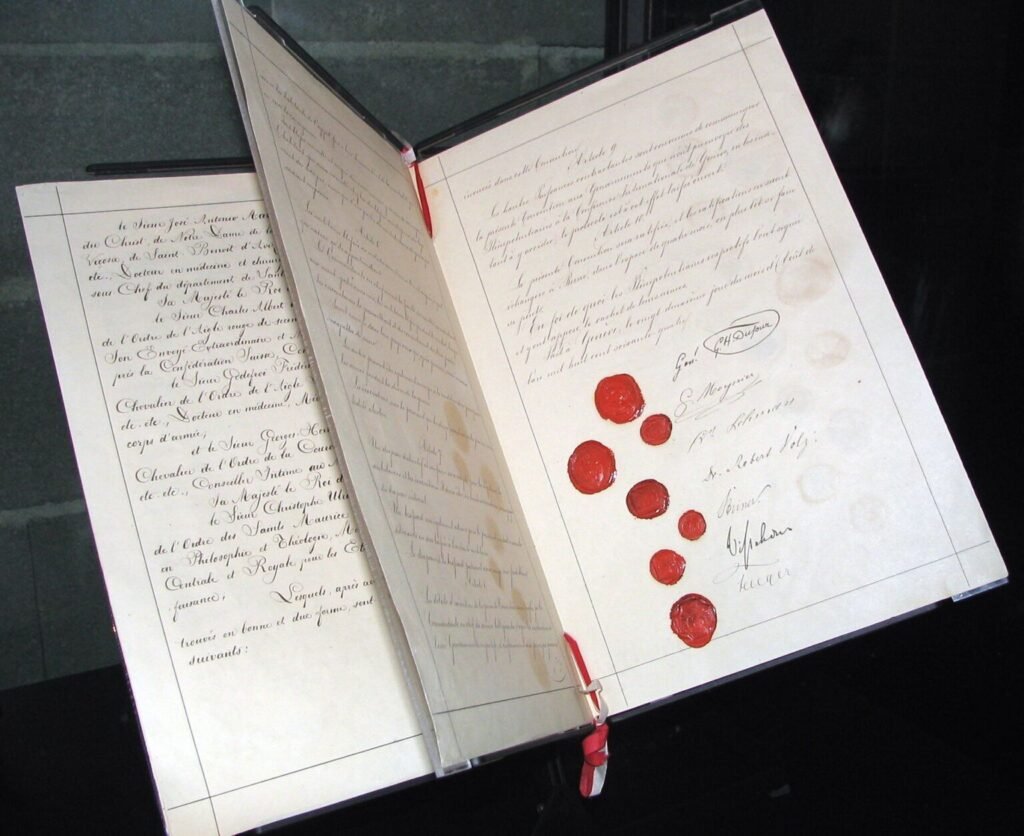
A facsimile of the signature-and-seals page of the 1864 Geneva Convention. Photograph Source: Kevin Quinn, Ohio, US – CC BY 2.0

Alfred De Zayas

September 26, 2023

Progress and retrogression characterize the reality of international law, international relations, and the concrete enjoyment of human rights by women and men throughout the planet. We hail the tides of opportunity, the times of liberation and expansion, but we should not be blind to recurrent abuses, crimes, and moments of disgrace.

Today our world is experiencing chaos, but not more so than in the 18th, 19th and 20th centuries. At least we are not burning witches or massacring indigenous Hopi, Pequots, Sioux, Quechua and Taínos, the slave trade is abolished, colonialism is drastically reduced. We welcome the landmark resolution 48/7 adopted by the UN Human Rights Council on 8 October 2021 concerning the legacies of colonialism in Africa, Asia and Latin America, particularly concerning indigenous peoples whose suffering over the centuries has not been assuaged and who continue to suffer from the sequels of structural violence[1].

Originally published on Counterpunch, September 26, 2023

On the positive side, we have witnessed a phenomenal codification of legal norms, the UN Charter, the UDHR, the Covenant on Civil and Political Rights (ICCPR), the Vienna Convention on the Law of Treaties, the Vienna Convention on Diplomatic Relations, the Geneva Red Cross Conventions, the establishment of national human rights institutions and regional human rights courts. Proposals for the creation of an International Court of Human Rights whose judgments would be enforceable[2]are under discussion.

We are justified in applauding the growing recognition of the rights of half the population of the planet – women — we hail concrete measures being taken on behalf of persons with disabilities. We welcome the entry into force in January 2021 of the Treaty on the Prohibition of Nuclear Weapons[3], the Declaration of October 2021 by the Human Rights Council recognizing the Environment as a Human Right[4].  We express relief over the gradual abolition of the aberration of “capital punishment”[5].

Notwithstanding the self-congratulatory celebrations around the 75th anniversary of the adoption of the UDHR, we must admit that there is significant retrogression in many fields, including the erosion of the concept of Peace as a Human Right, the backsliding from General Assembly Resolution 39/11 of 12 November 1984[6], the belligerent intransigence of many countries and their unwillingness to talk with each other, in spite of their hard law obligation to do so pursuant to Article 2(3) UN Charter.

We denounce the continued practice of torture in many countries, the disgrace of Abu Ghraib, Guantanamo[7], “extraordinary renditions”, secret CIA prisons, indefinite detention[8], the glorification of war, the social acceptance of war propaganda, notwithstanding the fact that it is specifically prohibited in article 20 of the ICCPR, the weaponization of the administration of justice in many countries and the breakdown of the rule of law in some countries ostensibly committed to human rights, e.g. in the US, UK, Sweden, Ecuador, as meticulously documented by UN Rapporteur on Torture, Professor Nils Melzer, in his well-sourced book on the persecution of whistleblower Julian Assange[9]. Indeed, the scandalous treatment of Assange constitutes torture under article 7 ICCPR, a gross violation of the rights of journalists, and a violation of our right to know under article 19 ICCPR.  What Professor Melzer reveals is far worse than the Dreyfus Affair of 1898. Melzer is the Emile Zola of the 21st century.

We deplore the scourge of 25 million victims of human trafficking, including 3.4 million children. We denounce the escalation of urban violence and mass-killings, the rise of international terrorism.  Notwithstanding the many institutions established to monitor adherence to human rights treaties, notwithstanding the regular meetings of the Human Rights Council, Human Rights Committee, Committee Against Torture, national human rights institutions, civil society organizations, outrageous violations of human dignity continue to occur.  Is this perhaps partly attributable to the fact that some of these institutions have been hijacked by geopolitical players, display selective indignation and practice double-standards?

Today there is scarce protection of the democratic right to know, the right to access information, the right to freedom of opinion and expression[10]. We see censorship by governments and the private sector, arbitrariness in Facebook and YouTube, the blocking of news services including RT, Sputnik and Tass in EU countries, the Orwellian new Digital Services Act, the brazen brainwashing practiced by the media, the excesses of “cancel culture”, the epidemic of self-censorship, the social acceptance of Russophobia and Sinophobia, the weaponization of sports so that sportswomen and men can be banned from competition merely on account of their nationalities.

Serious retrogression becomes evident in the weakened protection of privacy, the Orwellian surveillance of NSA and other government institutions as revealed by Edward Snowden in his watershed book Permanent Record[11]. We deplore the failure of governments to protect family life and family values, the concerted attacks on the concept of the family and parental authority, the denigration and ridicule of religious beliefs.

Retrogression is also apparent in the actions and omissions of institutions established to protect our rights. Many institutions, rapporteurs, “independent commissions”  are demonstrably in the service of certain powerful countries and lobbies, have become hostage to donors who pretend to set the agendas of monitoring bodies and mechanisms that should be rigorously neutral and professional[12].

Quis custodiet ipsos custodes?[13] Who guards over the guardians? Crucial institutions such as the UN Human Rights Council, ECHR, IACHR, OPCW, ICC are betraying their mandates, instrumentalizing human rights for purposes of geopolitical confrontation, instead of devising preventive strategies and mechanisms to secure human dignity for all women and men on the planet.

Only we can be the guardians! While we realize that governments lie to us on a daily basis, we must push back and reclaim democracy. We do not need any Ministry of Truth as in 1984. Alas, it appears that we have gradually entered the dystopia of Aldous Huxley’s Brave New World.

Among the gravest instances of retrogression is the degradation of international criminal law into a political tool of “lawfare”.  One observes an unhealthy obsession with punishment, an aggressive self-righteousness that invites us to lapidate the adulteress (John VIII, 1-11). If Christianity taught us anything, it is that we must forgive to be forgiven: et dimite nobis debita nostra sicut et nos dimitimus debitoribus nostris.  The recognition that the world is not black and white is not just a religious tenet but actually belongs to civilization.  It is easy to understand that sometimes there is bad in the good and even some good in the bad. Revenge is surely not conducive to reconciliation, and in order to live together in mutual respect, we must practice understanding and caritas.

Alas, the mainstream NGOs – with the complicity of the media — have transformed the concept of “amnesty” into a curse word. Yet, amnesties are not bad per se. Sometimes amnesties are necessary for peace. Article 6 of the Second Additional Protocol of 1977 to the Geneva Conventions stipulates “the authorities in power shall endeavour to grant the broadest possible amnesty to persons who have participated in the armed conflict”.  Article 2 of the Peace of Westphalia stipulates “there shall be on the one side and the other a perpetual Oblivion, Amnesty, or Pardon of all that has been committed since the beginning of these Troubles, in what place, or what manner soever the Hostilities have been practiced, in such a manner, that nobody, under any pretext whatsoever, shall practice any Acts of Hostility, entertain any Enmity, or cause any Trouble to each other other…”[14] Similar amnesties were agreed upon in countless peace treaties e.g. the Peace of Rijkswijk of 1697, the Congress of Vienna of 1814-15, and more recently the Evian Accords of 1962.

We are told that the establishment of the International Criminal Court in 2002 represents progress.  Some, however, consider it a significant step back to the primitive age of the law of revenge, lex talionis. Indeed, vengeance is incompatible with the acquis of civilization. Punishment is hardly a civilized answer to problems, inter alia because punishment is ex post facto, after the fact, and frequently does nothing at all for the victims. Moreover, there is scarce evidence that international criminal law has generated any deterrence.

What society really needs is prevention of crime, prevention of war, prevention of hatred. A Global Pact on Education for peace and empathy would be a way forward.  The United Nations should champion such an initiative and place all UN agencies in the service of peace, notably UNESCO.  Conflict-prevention depends on good faith, mutual respect, international solidarity – and, yes, intellectual honesty.

The Universal Declaration of Human Rights, adopted 75 years ago at the Palais Chaillot in Paris, was indeed a high point in the tide of human rights. Hitherto we have failed to implement its provisions, particularly Article 28: “Everyone is entitled to a social and international order in which the rights and freedoms set forth in this Declaration can be fully realized”. That remains our challenge, to rediscover the spirituality of the UDHR and revive the legacy of Eleanor Roosevelt[15].

Notes

[1] https://undocs.org/Home/Mobile?FinalSymbol=A%2FHRC%2FRES%2F48%2F7&Language=E&DeviceType=Desktop&LangRequested=False

[2] https://www.deepdyve.com/lp/brill/an-international-court-of-human-rights-N0d0HxEk8H

https://www.ohchr.org/en/special-procedures/ie-international-order/mr-alfred-maurice-de-zayas-former-independent-expert-2012-2018

[3] https://disarmament.unoda.org/wmd/nuclear/tpnw/

[4] https://digitallibrary.un.org/record/3945636

[5] https://www.cambridge.org/core/books/abolition-of-the-death-penalty-in-international-law/28291346A4A68C4CA2097E813007EC3A

[6] https://www.ohchr.org/en/instruments-mechanisms/instruments/declaration-right-peoples-peace

[7] https://opil.ouplaw.com/display/10.1093/law:epil/9780199231690/law-9780199231690-e301

https://searchlibrary.ohchr.org/record/6182

[8] https://www.icrc.org/en/doc/assets/files/other/irrc_857_zayas.pdf

[9] Nils Melzer, The Trial of Julian Assange, Verso Books, New York 2022.

[10] https://www.cambridge.org/core/journals/netherlands-international-law-review/article/abs/freedom-of-opinion-and-freedom-of-expression-some-reflections-on-general-comment-no-34-of-the-un-human-rights-committee/ADCD74F635F688851788E9079E1ABB76

[11] Metropolitan Books, New York, 2019.

[12] Alfred de Zayas, The Human Rights Industry, Clarity Press, 2023.

[13] Juvenal, 6th Satire.

[14] https://theranddaily.com/the-peace-of-westfalia-treaties

[15] www.eleanorlives.org

Alfred de Zayas is a law professor at the Geneva School of Diplomacy and served as a UN Independent Expert on International Order 2012-18. He is the author of twelve books, including “Building a Just World Order” (2021) “Countering Mainstream Narratives” 2022, and “The Human Rights Industry” (Clarity Press, 2021).

Share

Leave a Reply

Your email address will not be published. Required fields are marked *

Related Posts

This is the third appeal from TFF. The first and the second here. On August 22, 2025, the UN officially declared famine in Gaza. The world’s top authority on food security called for help and said starvation will spread further within the Strip unless fighting stops and much more aid is allowed in. More than half a million people in the Gaza Strip are facing catastrophic hunger conditions, while more than a million more are in a food emergency phase, the report states. This man-made catastrophic famine could have been prevented by a steady flow of humanitarian aid into the enclave, relief chief Tom Fletcher pointed out. “Yet food stacks up at borders because of systematic obstruction by Israel,” Mr. Fletcher said. “It is a famine within a few 100 meters of food in a fertile land.” The UN’s top aid official underscored that the famine in Gaza is “caused by cruelty, justified...
Professor, Dr, TFF Board member The second of three TFF Appeals This is an example – for your inspiration – of how you can address your head of state, prime minister and other relevant ministers. To urge them to take action and not just use words.Instead of just sending it by email, which may not be read, it makes a stronger impression if you send it by snail mail – and millions do it too. It is urgently important that every citizen does something to stop the genocide on the Palestinian people now. Everybody can write a letter, short or long, and protest the lack of action. See also ideas to what you may constructively suggest in TFF’s first Appeal here. I address you deliberately in the way you prefer—in the feminine form. I write to you professor to professor, woman to woman, mother to mother, grandmother to grandmother. I...
Contrary to what we stated when publishing this Call, the UN General Assembly (GA) opened on September 9, 2025, in New York, not in Geneva, as we initially wrote. However, due to the host role-violating US ban on visas to Palestinians, the Special GA Segment on Palestine will be held in the UN Geneva from September 22. And it builds up to something historic. Anyhow, here is what we believe you must advocate or do to help stop the Israeli genocide. It’s called people’s power or citizens’ diplomacy. SHARE! The first of three appeals from TFF. The second is here, and the third here. Across the world, people are witnessing the systematic destruction of Palestinian lives, homes, and communities. The scale and intensity of Israel’s military operations — especially in Gaza — have led leading legal bodies, including the International Court of Justice, to warn of a plausible genocide. The...

Recent Articles

PressInfo # 141, December 21, 2001It’s time to prepare reconciliation between Albanians and Serbs PressInfo # 140, December 14, 2001Ibrahim Rugova’s decade-long leadership in Kosovo/a PressInfo # 139, 11. december, 2001En god nyhet: Jugoslaviens Sannings- och försoningskommission PressInfo # 139, 11. december, 2001Gode nyheder: Jugoslaviens Sandheds- og Forsoningskommission PressInfo # 139, December 11, 2001Good news: Yugoslavia’s Truth and Reconciliation Commission PressInfo # 138, November 8, 2001TFF co-founder PhD with thesis about young people with roots in other cultures PressInfo # 138, November 8, 2001TFF:s medstiftare doktor på avhandling om unga med ursprung i andra kulturer PressInfo # 137, October 17, 2001A new Marshall Plan: Advancing human security and controlling terrorism PressInfo # 136, October 15, 2001The UN and Annan really deserve it PressInfo # 135, October 10, 2001Preventing a terrorist mushroom cloud PressInfo # 134, 17 oktober, 2001Sverige og 11. september PressInfo # 134, October 9, 2001Sweden and September 11...
Peace is promoted by constructive proposals and dialogue Four preceding PressInfos have expressed concern over — and criticised — the ongoing, militarisation of the EU. Some will say: but there are no alternatives. We believe that there are always alternatives, that democracies are characterised by alternatives and choice, and that openly discussed alternatives will improve the quality and legitimacy of society’s decision–making. In addition, it is an intellectual and moral challenge to not only criticise but also be constructive. If we only tell people that we think they are wrong, they are not likely to listen. However, if we say: what are your views on this set of ideas and steps? — we may sometimes engage them in dialogue and sow a seed. Most people in power circles live their daily lives in in a time frame and a social space where certain ideas, viewpoints and concepts are just not...
Photos © TFF 2000 Read PressInfo 90 “Lift the Sanctions and Bring More Aid to Yugoslavia” See Pictures from Belgrade © TFF 2000 Please reprint, copy, archive, quote or re-post this item, but please retain the source.

TFF on Substack

Discover more from TFF Transnational Foundation & Jan Oberg.

Most Popular

PressInfo # 141, December 21, 2001It’s time to prepare reconciliation between Albanians and Serbs PressInfo # 140, December 14, 2001Ibrahim Rugova’s decade-long leadership in Kosovo/a PressInfo # 139, 11. december, 2001En god nyhet: Jugoslaviens Sannings- och försoningskommission PressInfo # 139, 11. december, 2001Gode nyheder: Jugoslaviens Sandheds- og Forsoningskommission PressInfo # 139, December 11, 2001Good news: Yugoslavia’s Truth and Reconciliation Commission PressInfo # 138, November 8, 2001TFF co-founder PhD with thesis about young people with roots in other cultures PressInfo # 138, November 8, 2001TFF:s medstiftare doktor på avhandling om unga med ursprung i andra kulturer PressInfo # 137, October 17, 2001A new Marshall Plan: Advancing human security and controlling terrorism PressInfo # 136, October 15, 2001The UN and Annan really deserve it PressInfo # 135, October 10, 2001Preventing a terrorist mushroom cloud PressInfo # 134, 17 oktober, 2001Sverige og 11. september PressInfo # 134, October 9, 2001Sweden and September 11...
Peace is promoted by constructive proposals and dialogue Four preceding PressInfos have expressed concern over — and criticised — the ongoing, militarisation of the EU. Some will say: but there are no alternatives. We believe that there are always alternatives, that democracies are characterised by alternatives and choice, and that openly discussed alternatives will improve the quality and legitimacy of society’s decision–making. In addition, it is an intellectual and moral challenge to not only criticise but also be constructive. If we only tell people that we think they are wrong, they are not likely to listen. However, if we say: what are your views on this set of ideas and steps? — we may sometimes engage them in dialogue and sow a seed. Most people in power circles live their daily lives in in a time frame and a social space where certain ideas, viewpoints and concepts are just not...
Photos © TFF 2000 Read PressInfo 90 “Lift the Sanctions and Bring More Aid to Yugoslavia” See Pictures from Belgrade © TFF 2000 Please reprint, copy, archive, quote or re-post this item, but please retain the source.
Read More
Imagen-thumbnail-The-Transnational-1
PressInfo # 141, December 21, 2001It’s time to prepare reconciliation between Albanians and Serbs PressInfo # 140, December 14, 2001Ibrahim Rugova’s decade-long leadership in Kosovo/a PressInfo # 139, 11. december, 2001En god nyhet: Jugoslaviens Sannings- och försoningskommission PressInfo # 139, 11. december, 2001Gode nyheder: Jugoslaviens Sandheds- og Forsoningskommission PressInfo # 139, December 11, 2001Good news: Yugoslavia’s Truth and Reconciliation Commission PressInfo # 138, November 8, 2001TFF co-founder PhD with thesis about young people with roots in other cultures PressInfo # 138, November 8, 2001TFF:s medstiftare doktor på avhandling om unga med ursprung i andra kulturer PressInfo # 137, October 17, 2001A new Marshall Plan: Advancing human security and controlling terrorism PressInfo # 136, October 15, 2001The UN and Annan really deserve it PressInfo # 135, October 10, 2001Preventing a terrorist mushroom cloud PressInfo # 134, 17 oktober, 2001Sverige og 11. september PressInfo # 134, October 9, 2001Sweden and September 11...
Imagen-thumbnail-The-Transnational-1
Peace is promoted by constructive proposals and dialogue Four preceding PressInfos have expressed concern over — and criticised — the ongoing, militarisation of the EU. Some will say: but there are no alternatives. We believe that there are always alternatives, that democracies are characterised by alternatives and choice, and that openly discussed alternatives will improve the quality and legitimacy of society’s decision–making. In addition, it is an intellectual and moral challenge to not only criticise but also be constructive. If we only tell people that we think they are wrong, they are not likely to listen. However, if we say: what are your views on this set of ideas and steps? — we may sometimes engage them in dialogue and sow a seed. Most people in power circles live their daily lives in in a time frame and a social space where certain ideas, viewpoints and concepts are just not...
Imagen-thumbnail-The-Transnational-1
Photos © TFF 2000 Read PressInfo 90 “Lift the Sanctions and Bring More Aid to Yugoslavia” See Pictures from Belgrade © TFF 2000 Please reprint, copy, archive, quote or re-post this item, but please retain the source.
Imagen-thumbnail-The-Transnational-1
Av FRANK SØHOLM GREVIL 16 augusti 2004  Vi er nu nået til tredje akt i det absurde teaterstykke, der i analogi med de store skueprocesser i Moskva 1936-38 er blevet døbt ‘Grevil-sagen’. Første akt bestod i min anonyme fremlæggelse af egenhændigt nedklassificerede rapporter i Berlingske Tidende i februar og marts. Andet akt udgjordes af min fremtræden med navn og billede i Information i april samt den efterfølgende mediestorm, som uden min direkte medvirken kostede en forsvarsminister taburetten samt en sigtelse for brud på tavshedspligten. Tredje akt bliver en retssag, hvor jeg står tiltalt for at have overtrådt straffelovens bestemmelser om uberettiget videregivelse eller udnyttelse af fortrolige oplysninger. Statsanklageren har ovenikøbet valgt at påberåbe sig særligt skærpende omstændigheder. Da jeg aldrig har modtaget betaling for at stille rapporterne til rådighed eller lade mig interviewe, må det skærpende bestå i, at “videregivelsen eller udnyttelsen er sket under sådanne omstændigheder, at det påfører...
Imagen-thumbnail-The-Transnational-1
Af Svenska Irakkommittén mot de Ekonomiska Sanktionerna (SIES) 13 september 2002 FN:s ekonomiska sanktioner mot Irak har nu pågått i tolv år och drabbat det irakiska folket med svåra lidanden. Enligt FN:s egna siffror har mer än 1,5 miljoner människor, varav ca 600 000 barn, dött som en direkt följd av sanktionerna. Dessutom har ett lågintensivt bombkrig mot landet pågått under dessa år. Av all denna förödelse- orsakad huvudsakligen av amerikansk och brittisk politik- har Saddam Husseins brutala och diktatoriska regim snarast stärkts än försvagats. Nu förbereder USA under president Bushs ledning ett storskaligt bombkrig mot Irak som kommer att innebära ett ännu större lidande för civilbefolkningen. Ett sådant krig kommer dessutom att ytterligare undergräva freden och säkerheten i världen. Att upprätta en demokratisk regim i Irak är det irakiska folkets angelägenhet och får enligt folkrätten inte ske med krigshandlingar utifrån. Folkrätten och FN:s stadgar måste respekteras. Vi vädjar till...