
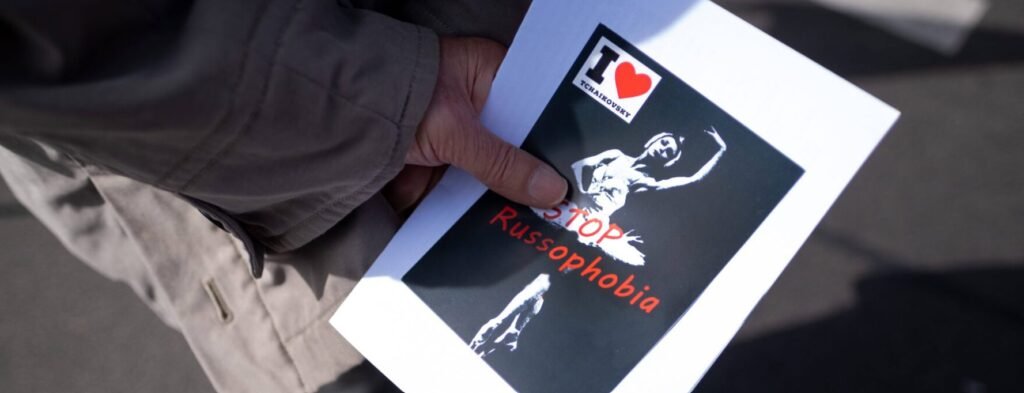
Rampant Russophobia takes us down a dangerous path

Joint demonstration of the trade unions on May Day in Berlin under the slogan Unbroken Solidarity. Photography K.M.Krause via Reuters

Anatol Lieven & George Beebe

August 23, 2023

A deeply sinister and dangerous tendency has made its appearance in Western writing about the war in Ukraine. This is the extension of hatred for the Putin regime and its crimes to the entire Russian people, the Russian national tradition, and Russian culture. This tendency is of course bitterly familiar from the history of hostile propaganda, but precisely for that reason we should have learned to shun it. The banning of Russian cultural events and calls for the “decolonization” of Russian literature and Russian studies recall the propaganda of all sides during the First World War, which did so much to embitter that war and make its peaceful resolution all but impossible. 

Originally published at Responsible Statecraft on June 21, 2023

The latest manifestation of this has been the successful pressure on American author Elizabeth Gilbert to cancel the publication of her latest book, not because it is in any way pro-Putin or pro-war, but merely because it is set in Russia. In another recent case, Masha Gessen, the U.S.-based Russian political émigré, fierce Putin critic and strong opponent of the Russian invasion, felt obliged to resign from the board of PEN America, created as a union of writers to defend free expression, after it barred two Russian writers — themselves emigres who had denounced the war.

The Chair of the Foreign Affairs Committee of the British parliament, Tom Tugendhat, has called for the expulsion of all Russian citizens from Britain, irrespective of their legal residency. The Czech president has referenced approvingly the internment of Japanese Americans during World War II.

Demonization of this sort is morally wrong in itself; it is generally intellectually wrong in its details; it is incompatible with liberal internationalism; it betrays pluralist democracy in Ukraine; it is disastrous for the future peace of Europe; it fuels the paranoia and violent self-righteous extremism that has done so much damage to U.S. policy over the years; and, by helping to block moves towards a reasonable settlement of the conflict, it increases the dangers to the United States, Europe, the world, and Ukraine itself that stem from a continuation of the war.

Perhaps craziest of all, while the people who express such feelings about Russia claim to be opposing the Putin regime, their actions and writings in fact provide better domestic propaganda for Putin than he himself could ever have devised.

A particularly egregious example of this sort of chauvinism was written last week by Peter Pomerantsev, whose Russian-speaking family emigrated from Soviet Ukraine when he was a baby, and who now lives in Britain. This article is worth paying attention to both for the wider tendency that it represents, and for where it appeared — in the British liberal newspaper The Guardian.

It is fair to say that The Guardian would never have published this kind of hate-filled attack on an entire people if it were directed at any other people but the Russians, and, if it had appeared elsewhere, The Guardian would have (correctly) denounced it as racism. Pomerantsev takes his cue from the destruction of the Kakhovka Dam, which he automatically blames on Russia — despite the fact that, as Kelley Vlahos pointed out in Responsible Statecraft, it remains completely unproven who blew up the dam, and the results could chiefly benefit either the Ukrainian or the Russian side. Adding a whole litany of exaggerated or wholly invented Russian atrocities, he uses this to declare that:

“Beneath the veneer of Russian military ‘tactics,’ you see the stupid leer of destruction for the sake of it…In Russia’s wars the very senselessness seems to be the sense…To Russian genocide add ecocide.”


Does “literary critic” Ogarkova really think that Dostoyevsky approved of Raskolnikov’s crime, and did not show him being justly punished for it? Or is she relying on a belief that her Western audience will be willing to hate Russian authors without having read them? Pomerantsev follows this up with an almost unbelievable passage:

“Ogarkova and Yermolenko note the difference between Hitler and Stalin: while Nazis had some rules about who they punished (non-Aryans; communists) in Stalin’s terror anyone could be a victim at any moment. Random violence runs through Russian history.”

This is the same old nauseating hypocrisy. They are nationalists; we are patriots. Their bombing of civilians reflects a blind urge to destruction rooted in their national character, ours is either purely accidental or an unfortunate part of a just struggle. Their torture of suspected enemies is due to their innate collective savagery. Ours is “not who we are.”

This is a classic example of what psychologists call the “fundamental attribution error” — the tendency to rationalize our own transgressions as the product of difficult circumstances, while explaining the sins of others as the result of their malevolent nature. 

In attributing Russian atrocities in Ukraine to permanent, quasi-racial aspects of the Russian national character, these writers seek to present Russia as uniquely mad and evil; whereas in fact the crimes committed by Russia during the Ukraine War have also been committed by several Western states in modern wars, the United States among them. Some were indeed wholly gratuitous. Others, as General Sherman reminded us, are innate to war itself. Pomerantsev and his like do not need to be professional historians to know that. They could simply watch the film “The Battle of Algiers,” or any good film about the Vietnam War.

Those who have attributed this to unique features of American and European traditional culture and called for the whole of that culture to be junked as a result, have been rightly rejected by majority opinion in these countries. Would anyone with an atom of decency or common sense suggest that we should not read Herman Melville and Nathaniel Hawthorne because the U.S. military bombed civilians in Vietnam and illegally invaded Iraq? 

It might be noted by the way that at the height of the Cold War, Hollywood produced films of “War and Peace” and “Dr. Zhivago,” and Soviet cinema produced fine versions of “Hamlet” and “King Lear.”

Eruptions like Pomerantsev’s in The Guardiancan be attributed to blind but understandable anger at Russia’s invasion and the destruction it has caused. However, they also have very practical and disastrous results. They not merely discourage the search for a compromise peace today, but by presenting Russia as permanently evil, they suggest that any future peaceful co-existence with any future Russian state will be morally wrong, and therefore should be permanently impossible.

In his great work “The Treason of the Intellectuals” (La Trahison des Clercs), written in the aftermath of the First World War, Julien Benda denounced the willingness of too many liberal intellectuals to succumb — whether from emotion or opportunism — to political and especially national hatred; and he warned, all too presciently, that this fostering of hatred could lead to still greater disasters in the years to come. He predicted that the 20th Century “will properly be called the century of the intellectual organization of political hatred.” 

We should take care that our descendants, if there are any, do not say that of the present century.

Originally published at Responsible Statecraft on June 21, 2023

About the authors

Anatol Lieven is the Director of the Eurasia Program at the Quincy Institute for Responsible Statecraft. He was formerly a professor at Georgetown University in Qatar and in the War Studies Department of King’s College London. He is a member of the advisory committee of the South Asia Department of the British Foreign and Commonwealth Office. He holds a BA and PhD from Cambridge University in England.

George Beebe is the Director of Grand Strategy at the Quincy Institute. He spent more than two decades in government as an intelligence analyst, diplomat, and policy advisor, including as director of the CIA’s Russia analysis and as a staff advisor on Russia matters to Vice President Cheney. His book, The Russia Trap: How Our Shadow War with Russia Could Spiral into Nuclear Catastrophe (2019), warned how the United States and Russia could stumble into a dangerous military confrontation.

Click here now. Thanks!

Share

Leave a Reply

Your email address will not be published. Required fields are marked *

Related Posts

And why the world, especially the EU, must now declare itself independent of the United States. UN’s 80th anniversary This year, the United Nations celebrates the 80th anniversary of its founding. The UN was formed after the scourge of the Second World War, in which 70 to 85 million people were killed and many countries were destroyed. That war came on the heels of the First World War, which also killed between 15 and 22 million people. After the Second World War, especially after the use of nuclear weapons by the United States, which marked a turning point in the history of warfare that could result in the end of civilisation as we know it, humanity decided to move away from the era of empires and big power politics and usher in a new era of peace, freedom and cooperation. These were the principles enshrined in the UN Charter. The United States...
Drones over Nordic airports. No damage. No trace. No answers. Most assume Russia—but what if that’s not so? Why is there so much we are not told? This article explores the strategic ambiguity behind recent drone incursions and asks: Who else might benefit from sending drones into NATO airspace? From Ukraine’s surprising drone supremacy to Russia’s possible signalling, the silence itself may be the loudest message. These are the kinds of questions decent, intelligent investigative journalists and commentators could easily research. Why don’t they? Did you, dear reader, know or think of this? That the most powerful weapon in today’s conflicts might be the one that leaves no trace – and no answers. Just enough fear to justify the next move? Recently, drones have repeatedly appeared over Nordic airports and near some military facilities. They cause no damage – for which reason the designation “hybrid attack” is misleading but serves a purpose. These...
Below are TFF-related media mentions, comments, videos and social media posts published elsewhere but not on this homepage. We happen to catch and list only a fraction. Regarding video comments and debates, we recommend that you go to the TFF Video Channel on Substack where many of them are reproduced. Jan Oberg is a contributor to China Daily – 52 million daily clicks – and Global Times, CGTN and CCTV (the national television), China Investment, Xinhua News Agency and several others. Articles and videos on these media very often multiply into countless Chinese (and Western media) that re-post them from these main media. Thanks to The China Academy, his analyses, interviews and comments are frequently posted on YouTube channels such as Thinkers Forum and Wave Media. These videos are often re-posted on Bilibili (China’s YouTube), the China Content Center on TikTok, and on the Chinese edition of TikTok, Douyin.com. This means reaching hundreds of millions of viewers worldwide over a year. While there are too many to catch on all these...

Recent Articles

PressInfo # 141, December 21, 2001It’s time to prepare reconciliation between Albanians and Serbs PressInfo # 140, December 14, 2001Ibrahim Rugova’s decade-long leadership in Kosovo/a PressInfo # 139, 11. december, 2001En god nyhet: Jugoslaviens Sannings- och försoningskommission PressInfo # 139, 11. december, 2001Gode nyheder: Jugoslaviens Sandheds- og Forsoningskommission PressInfo # 139, December 11, 2001Good news: Yugoslavia’s Truth and Reconciliation Commission PressInfo # 138, November 8, 2001TFF co-founder PhD with thesis about young people with roots in other cultures PressInfo # 138, November 8, 2001TFF:s medstiftare doktor på avhandling om unga med ursprung i andra kulturer PressInfo # 137, October 17, 2001A new Marshall Plan: Advancing human security and controlling terrorism PressInfo # 136, October 15, 2001The UN and Annan really deserve it PressInfo # 135, October 10, 2001Preventing a terrorist mushroom cloud PressInfo # 134, 17 oktober, 2001Sverige og 11. september PressInfo # 134, October 9, 2001Sweden and September 11...
Peace is promoted by constructive proposals and dialogue Four preceding PressInfos have expressed concern over — and criticised — the ongoing, militarisation of the EU. Some will say: but there are no alternatives. We believe that there are always alternatives, that democracies are characterised by alternatives and choice, and that openly discussed alternatives will improve the quality and legitimacy of society’s decision–making. In addition, it is an intellectual and moral challenge to not only criticise but also be constructive. If we only tell people that we think they are wrong, they are not likely to listen. However, if we say: what are your views on this set of ideas and steps? — we may sometimes engage them in dialogue and sow a seed. Most people in power circles live their daily lives in in a time frame and a social space where certain ideas, viewpoints and concepts are just not...
Photos © TFF 2000 Read PressInfo 90 “Lift the Sanctions and Bring More Aid to Yugoslavia” See Pictures from Belgrade © TFF 2000 Please reprint, copy, archive, quote or re-post this item, but please retain the source.

TFF on Substack

Discover more from TFF Transnational Foundation & Jan Oberg.

Most Popular

PressInfo # 141, December 21, 2001It’s time to prepare reconciliation between Albanians and Serbs PressInfo # 140, December 14, 2001Ibrahim Rugova’s decade-long leadership in Kosovo/a PressInfo # 139, 11. december, 2001En god nyhet: Jugoslaviens Sannings- och försoningskommission PressInfo # 139, 11. december, 2001Gode nyheder: Jugoslaviens Sandheds- og Forsoningskommission PressInfo # 139, December 11, 2001Good news: Yugoslavia’s Truth and Reconciliation Commission PressInfo # 138, November 8, 2001TFF co-founder PhD with thesis about young people with roots in other cultures PressInfo # 138, November 8, 2001TFF:s medstiftare doktor på avhandling om unga med ursprung i andra kulturer PressInfo # 137, October 17, 2001A new Marshall Plan: Advancing human security and controlling terrorism PressInfo # 136, October 15, 2001The UN and Annan really deserve it PressInfo # 135, October 10, 2001Preventing a terrorist mushroom cloud PressInfo # 134, 17 oktober, 2001Sverige og 11. september PressInfo # 134, October 9, 2001Sweden and September 11...
Peace is promoted by constructive proposals and dialogue Four preceding PressInfos have expressed concern over — and criticised — the ongoing, militarisation of the EU. Some will say: but there are no alternatives. We believe that there are always alternatives, that democracies are characterised by alternatives and choice, and that openly discussed alternatives will improve the quality and legitimacy of society’s decision–making. In addition, it is an intellectual and moral challenge to not only criticise but also be constructive. If we only tell people that we think they are wrong, they are not likely to listen. However, if we say: what are your views on this set of ideas and steps? — we may sometimes engage them in dialogue and sow a seed. Most people in power circles live their daily lives in in a time frame and a social space where certain ideas, viewpoints and concepts are just not...
Photos © TFF 2000 Read PressInfo 90 “Lift the Sanctions and Bring More Aid to Yugoslavia” See Pictures from Belgrade © TFF 2000 Please reprint, copy, archive, quote or re-post this item, but please retain the source.
Read More
Imagen-thumbnail-The-Transnational-1
PressInfo # 141, December 21, 2001It’s time to prepare reconciliation between Albanians and Serbs PressInfo # 140, December 14, 2001Ibrahim Rugova’s decade-long leadership in Kosovo/a PressInfo # 139, 11. december, 2001En god nyhet: Jugoslaviens Sannings- och försoningskommission PressInfo # 139, 11. december, 2001Gode nyheder: Jugoslaviens Sandheds- og Forsoningskommission PressInfo # 139, December 11, 2001Good news: Yugoslavia’s Truth and Reconciliation Commission PressInfo # 138, November 8, 2001TFF co-founder PhD with thesis about young people with roots in other cultures PressInfo # 138, November 8, 2001TFF:s medstiftare doktor på avhandling om unga med ursprung i andra kulturer PressInfo # 137, October 17, 2001A new Marshall Plan: Advancing human security and controlling terrorism PressInfo # 136, October 15, 2001The UN and Annan really deserve it PressInfo # 135, October 10, 2001Preventing a terrorist mushroom cloud PressInfo # 134, 17 oktober, 2001Sverige og 11. september PressInfo # 134, October 9, 2001Sweden and September 11...
Imagen-thumbnail-The-Transnational-1
Peace is promoted by constructive proposals and dialogue Four preceding PressInfos have expressed concern over — and criticised — the ongoing, militarisation of the EU. Some will say: but there are no alternatives. We believe that there are always alternatives, that democracies are characterised by alternatives and choice, and that openly discussed alternatives will improve the quality and legitimacy of society’s decision–making. In addition, it is an intellectual and moral challenge to not only criticise but also be constructive. If we only tell people that we think they are wrong, they are not likely to listen. However, if we say: what are your views on this set of ideas and steps? — we may sometimes engage them in dialogue and sow a seed. Most people in power circles live their daily lives in in a time frame and a social space where certain ideas, viewpoints and concepts are just not...
Imagen-thumbnail-The-Transnational-1
Photos © TFF 2000 Read PressInfo 90 “Lift the Sanctions and Bring More Aid to Yugoslavia” See Pictures from Belgrade © TFF 2000 Please reprint, copy, archive, quote or re-post this item, but please retain the source.
Imagen-thumbnail-The-Transnational-1
Av FRANK SØHOLM GREVIL 16 augusti 2004  Vi er nu nået til tredje akt i det absurde teaterstykke, der i analogi med de store skueprocesser i Moskva 1936-38 er blevet døbt ‘Grevil-sagen’. Første akt bestod i min anonyme fremlæggelse af egenhændigt nedklassificerede rapporter i Berlingske Tidende i februar og marts. Andet akt udgjordes af min fremtræden med navn og billede i Information i april samt den efterfølgende mediestorm, som uden min direkte medvirken kostede en forsvarsminister taburetten samt en sigtelse for brud på tavshedspligten. Tredje akt bliver en retssag, hvor jeg står tiltalt for at have overtrådt straffelovens bestemmelser om uberettiget videregivelse eller udnyttelse af fortrolige oplysninger. Statsanklageren har ovenikøbet valgt at påberåbe sig særligt skærpende omstændigheder. Da jeg aldrig har modtaget betaling for at stille rapporterne til rådighed eller lade mig interviewe, må det skærpende bestå i, at “videregivelsen eller udnyttelsen er sket under sådanne omstændigheder, at det påfører...
Imagen-thumbnail-The-Transnational-1
Af Svenska Irakkommittén mot de Ekonomiska Sanktionerna (SIES) 13 september 2002 FN:s ekonomiska sanktioner mot Irak har nu pågått i tolv år och drabbat det irakiska folket med svåra lidanden. Enligt FN:s egna siffror har mer än 1,5 miljoner människor, varav ca 600 000 barn, dött som en direkt följd av sanktionerna. Dessutom har ett lågintensivt bombkrig mot landet pågått under dessa år. Av all denna förödelse- orsakad huvudsakligen av amerikansk och brittisk politik- har Saddam Husseins brutala och diktatoriska regim snarast stärkts än försvagats. Nu förbereder USA under president Bushs ledning ett storskaligt bombkrig mot Irak som kommer att innebära ett ännu större lidande för civilbefolkningen. Ett sådant krig kommer dessutom att ytterligare undergräva freden och säkerheten i världen. Att upprätta en demokratisk regim i Irak är det irakiska folkets angelägenhet och får enligt folkrätten inte ske med krigshandlingar utifrån. Folkrätten och FN:s stadgar måste respekteras. Vi vädjar till...
