
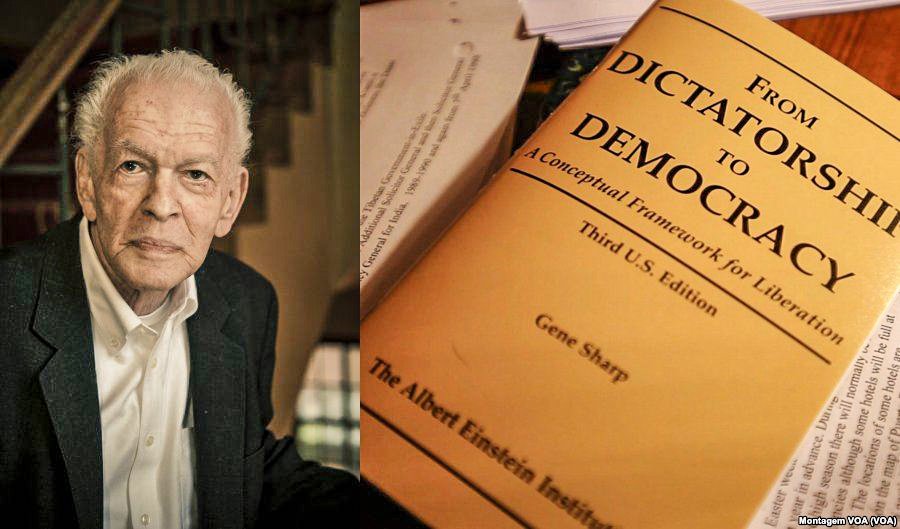
Gene Sharp has died and the world has lost a global educator

Obituary

Just a week after his 90th birthday Gene Sharp passed away.

The journal New Statesman once described Gene Sharp as the “Machiavelli of Nonviolence” and Thomas Weber labelled him “the Clausewitz of Nonviolent Action.”

Who was this man and what is his contribution to our understanding of the possibilities to use nonviolent actions in large scale societal conflicts?

Gene Sharp completed his baccalaureate in 1949, just a few scant years after the close of World War II, and quickly turned his attention to the study of nonviolence.

After serving nine months in prison for being a conscientious objector to the Korean War, Sharp worked as secretary for A.J. Muste. He next joined the editorial team of Peace News in London before accepting an invitation from Arne Næss to join him in Oslo with Johan Galtung and others to study the philosophy and practice of Mohandas Gandhi.

Throughout this time, Sharp exchanged letters with Albert Einstein, deepening his understanding of and commitment to nonviolence.

While in Oslo, Sharp devoted much time to interviewing teachers who resisted the Quisling government during the Nazi occupation of Norway. Through these interviews, Sharp began to formulate the ideas that would come to constitute his major contribution to nonviolence theory.

Moving away from a strictly philosophical, moral, or spiritual nonviolence in the vein of Gandhi, Sharp turned instead to a pragmatic nonviolence. The rest of his life would be spent delineating and analyzing the practical tools of effective nonviolent action.

After his years in Oslo, Sharp pursued his PhD at Oxford University. In 1968 he defended his thesis, The Politics of Nonviolent Action: A study in the control of political power.

He continued to develop his thesis work and five years later Porter Sargent published his monumental The Politics of Nonviolent Action, from which “198 Methods of Nonviolent Action” is taken. This book from 1973 has been called “the bible for nonviolent activists” and is still in print nearly 50 years later.

Through this and myriads other writings, Sharp contended against a normative approach to nonviolence, where the practice of nonviolence is formulated as a spiritual directive.

Nonviolent action need have no moral impetus to be effective; nonviolent actions may be pursued on a purely practical basis on the ground that they are simply the most effective tools available to social and political movements.

Indeed, much research by Sharp and others has shown that in the long term nonviolent revolutionary achievements are far more permanent than those fought with kalashnikovs and guerrilla warfare.

Taking this a step further, Sharp maintained that nonviolence could not only resist and overthrow dictatorships or occupations, but could effectively replace all militaries. By thoroughly training the civilian populace in nonviolent strategies and tactics, a nation could make itself ungovernable at will.

If such a nation were to be invaded, it could never be subjugated. Those in powerful positions can punish but not force individuals to follow their orders without a certain level of cooperation. As history has shown, people practicing total noncooperation will only serve to drag down their oppressor. The burden of an inoperative state outweighs the benefits of its occupation.

This part of the heritage from Sharp is less known and accepted than his works on nonviolent actions by actors outside the state.

Sharp worked hard to convince politicians around the world of his position. Despite some positive feedback from Sweden, Norway and the Baltic states, however, the discussions never moved from the fringe to the central political agenda in any country. The main argument against a national, civilian-based defense might be that such an “army” could also be used against its own state.

Does the government trust its own people enough to enable their use of nonviolent actions on a massive scale?

Many doubt that they could!

We may hope, however, that these ideas came at the wrong time in history and that future discussions will give them the credit they deserve.

The revitalization of research on nonviolent actions after the so-called “Arab Spring” might make such discussions possible.

Though he may not have convinced governments to adopt nonviolent training, it is clear that grassroots political and social movements have taken up Sharp’s writings with a passion. The last fifty years has seen the steady spread of Sharp’s fingerprint in movements around the world.

When Gandhi and his movement liberated India from the British colonizers in 1947, their use of nonviolent actions was an exception among revolutionary groups. An important shift in strategy took place in the late seventies and early eighties, however. When the Shah was forced to leave Iran in 1979 and Solidarity organized the workers in Poland in 1980, we saw some exiting examples of movements that based their struggle on nonviolent strategies and tactics.

To what degree these movements were familiar with the works of Gene Sharp we do not know.

What is clear, however, is that revolutionary movements in the next four decades adopted a broad and ever-broadening range of nonviolent actions and strategies—those same strategies Sharp had been elucidating.

Later, when several of Sharp’s key works were translated into dozens of languages, his ideas indisputably inspired thousands of suppressed people searching for ways to fight for their freedom, rights, and for democracy.

The removal of president Marcos in the Philippines in 1986, the liberation of Eastern Europe and dismantling of the Soviet Union after 1989, the first Intifada in Palestine in 1990-91, the Colored Revolutions following the fall of Milosevic in Serbia in 2000, and the uprising in the MENA (Middle East and Northern Africa) region from 2011 onwards all evidenced deep understanding of practical nonviolent revolution.

Journalists, activists, academics, and politicians then found a new interest in these fascinating regime changes and their theoretical sources. For each and all of them the works of Gene Sharp now became obligatory – and enlightening – reading.

When Sharp began his study, peace research was a small, odd branch on the academic oak. A hardly visible twig on that branch focused on nonviolence. Seventy years later the field has expanded to be a significant part of several academic disciplines. It has also moved beyond the university campus, reaching suppressed people around the world and turning theoretical ideas into practical tools for social movements.

Sharp’s lifelong research and voluminous writings have played a crucial role in this development.

When, at the age of 84, Sharp received the 2012 Right Livelihood Award, he humbly played-down his role as a source of inspiration for the twentieth century’s swell – and the twenty-first century’s tsunami – of unarmed revolutions and social movements.

He did note, however, that for the first time in his entire life he found himself interviewed by journalists who at least understood what is was that he was talking about.

His contribution to the field of nonviolent actions will for ever be seen as the equivalent to the first humans landing on the moon. A majority of present researchers in the field of nonviolence have benefited enormously by building on the works and theories published by Gene. Many of us have now lost a friend and many more lost an important source of inspiration.

More sources
Gene Sharp on Hard Talk on BBC 2015

Books by Sharp on GoodReads

GeneSharpFilm

Gene Sharp on Wikipedia

Share

Leave a Reply

Your email address will not be published. Required fields are marked *

Related Posts

Officially, the drones were not identified. By simply thinking critically – which journalists and selected experts no longer do – there may be a good reason for that. And this article will never be mentioned in Denmark… Drones over Denmark. No damage. No trace. No answers. Yet the headlines scream “Russian threat,” and Prime Minister Mette Frederiksen speaks with a certainty that defies logic: “We don’t know they were Russian—but we know Russia is the biggest threat to Europe.” It could be nobody else – unless you make an interest analysis which I did two days ago. This is not security policy. It’s theatre. And the audience is being played. Let’s rewind. These drones—unphotographed, untracked, unclaimed—appear and vanish like ghosts. Airports shut down. Panic spreads. Military budgets swell. And the narrative hardens: Russia is behind it. But what if that’s not just wrong but deliberately misleading? Here’s a hypothesis for...
And why the world, especially the EU, must now declare itself independent of the United States. UN’s 80th anniversary This year, the United Nations celebrates the 80th anniversary of its founding. The UN was formed after the scourge of the Second World War, in which 70 to 85 million people were killed and many countries were destroyed. That war came on the heels of the First World War, which also killed between 15 and 22 million people. After the Second World War, especially after the use of nuclear weapons by the United States, which marked a turning point in the history of warfare that could result in the end of civilisation as we know it, humanity decided to move away from the era of empires and big power politics and usher in a new era of peace, freedom and cooperation. These were the principles enshrined in the UN Charter. The United States...
Drones over Nordic airports. No damage. No trace. No answers. Most assume Russia—but what if that’s not so? Why is there so much we are not told? This article explores the strategic ambiguity behind recent drone incursions and asks: Who else might benefit from sending drones into NATO airspace? From Ukraine’s surprising drone supremacy to Russia’s possible signalling, the silence itself may be the loudest message. These are the kinds of questions decent, intelligent investigative journalists and commentators could easily research. Why don’t they? Did you, dear reader, know or think of this? That the most powerful weapon in today’s conflicts might be the one that leaves no trace – and no answers. Just enough fear to justify the next move? Recently, drones have repeatedly appeared over Nordic airports and near some military facilities. They cause no damage – for which reason the designation “hybrid attack” is misleading but serves a purpose. These...

Recent Articles

PressInfo # 141, December 21, 2001It’s time to prepare reconciliation between Albanians and Serbs PressInfo # 140, December 14, 2001Ibrahim Rugova’s decade-long leadership in Kosovo/a PressInfo # 139, 11. december, 2001En god nyhet: Jugoslaviens Sannings- och försoningskommission PressInfo # 139, 11. december, 2001Gode nyheder: Jugoslaviens Sandheds- og Forsoningskommission PressInfo # 139, December 11, 2001Good news: Yugoslavia’s Truth and Reconciliation Commission PressInfo # 138, November 8, 2001TFF co-founder PhD with thesis about young people with roots in other cultures PressInfo # 138, November 8, 2001TFF:s medstiftare doktor på avhandling om unga med ursprung i andra kulturer PressInfo # 137, October 17, 2001A new Marshall Plan: Advancing human security and controlling terrorism PressInfo # 136, October 15, 2001The UN and Annan really deserve it PressInfo # 135, October 10, 2001Preventing a terrorist mushroom cloud PressInfo # 134, 17 oktober, 2001Sverige og 11. september PressInfo # 134, October 9, 2001Sweden and September 11...
Peace is promoted by constructive proposals and dialogue Four preceding PressInfos have expressed concern over — and criticised — the ongoing, militarisation of the EU. Some will say: but there are no alternatives. We believe that there are always alternatives, that democracies are characterised by alternatives and choice, and that openly discussed alternatives will improve the quality and legitimacy of society’s decision–making. In addition, it is an intellectual and moral challenge to not only criticise but also be constructive. If we only tell people that we think they are wrong, they are not likely to listen. However, if we say: what are your views on this set of ideas and steps? — we may sometimes engage them in dialogue and sow a seed. Most people in power circles live their daily lives in in a time frame and a social space where certain ideas, viewpoints and concepts are just not...
Photos © TFF 2000 Read PressInfo 90 “Lift the Sanctions and Bring More Aid to Yugoslavia” See Pictures from Belgrade © TFF 2000 Please reprint, copy, archive, quote or re-post this item, but please retain the source.

TFF on Substack

Discover more from TFF Transnational Foundation & Jan Oberg.

Most Popular

PressInfo # 141, December 21, 2001It’s time to prepare reconciliation between Albanians and Serbs PressInfo # 140, December 14, 2001Ibrahim Rugova’s decade-long leadership in Kosovo/a PressInfo # 139, 11. december, 2001En god nyhet: Jugoslaviens Sannings- och försoningskommission PressInfo # 139, 11. december, 2001Gode nyheder: Jugoslaviens Sandheds- og Forsoningskommission PressInfo # 139, December 11, 2001Good news: Yugoslavia’s Truth and Reconciliation Commission PressInfo # 138, November 8, 2001TFF co-founder PhD with thesis about young people with roots in other cultures PressInfo # 138, November 8, 2001TFF:s medstiftare doktor på avhandling om unga med ursprung i andra kulturer PressInfo # 137, October 17, 2001A new Marshall Plan: Advancing human security and controlling terrorism PressInfo # 136, October 15, 2001The UN and Annan really deserve it PressInfo # 135, October 10, 2001Preventing a terrorist mushroom cloud PressInfo # 134, 17 oktober, 2001Sverige og 11. september PressInfo # 134, October 9, 2001Sweden and September 11...
Peace is promoted by constructive proposals and dialogue Four preceding PressInfos have expressed concern over — and criticised — the ongoing, militarisation of the EU. Some will say: but there are no alternatives. We believe that there are always alternatives, that democracies are characterised by alternatives and choice, and that openly discussed alternatives will improve the quality and legitimacy of society’s decision–making. In addition, it is an intellectual and moral challenge to not only criticise but also be constructive. If we only tell people that we think they are wrong, they are not likely to listen. However, if we say: what are your views on this set of ideas and steps? — we may sometimes engage them in dialogue and sow a seed. Most people in power circles live their daily lives in in a time frame and a social space where certain ideas, viewpoints and concepts are just not...
Photos © TFF 2000 Read PressInfo 90 “Lift the Sanctions and Bring More Aid to Yugoslavia” See Pictures from Belgrade © TFF 2000 Please reprint, copy, archive, quote or re-post this item, but please retain the source.
Read More
Imagen-thumbnail-The-Transnational-1
PressInfo # 141, December 21, 2001It’s time to prepare reconciliation between Albanians and Serbs PressInfo # 140, December 14, 2001Ibrahim Rugova’s decade-long leadership in Kosovo/a PressInfo # 139, 11. december, 2001En god nyhet: Jugoslaviens Sannings- och försoningskommission PressInfo # 139, 11. december, 2001Gode nyheder: Jugoslaviens Sandheds- og Forsoningskommission PressInfo # 139, December 11, 2001Good news: Yugoslavia’s Truth and Reconciliation Commission PressInfo # 138, November 8, 2001TFF co-founder PhD with thesis about young people with roots in other cultures PressInfo # 138, November 8, 2001TFF:s medstiftare doktor på avhandling om unga med ursprung i andra kulturer PressInfo # 137, October 17, 2001A new Marshall Plan: Advancing human security and controlling terrorism PressInfo # 136, October 15, 2001The UN and Annan really deserve it PressInfo # 135, October 10, 2001Preventing a terrorist mushroom cloud PressInfo # 134, 17 oktober, 2001Sverige og 11. september PressInfo # 134, October 9, 2001Sweden and September 11...
Imagen-thumbnail-The-Transnational-1
Peace is promoted by constructive proposals and dialogue Four preceding PressInfos have expressed concern over — and criticised — the ongoing, militarisation of the EU. Some will say: but there are no alternatives. We believe that there are always alternatives, that democracies are characterised by alternatives and choice, and that openly discussed alternatives will improve the quality and legitimacy of society’s decision–making. In addition, it is an intellectual and moral challenge to not only criticise but also be constructive. If we only tell people that we think they are wrong, they are not likely to listen. However, if we say: what are your views on this set of ideas and steps? — we may sometimes engage them in dialogue and sow a seed. Most people in power circles live their daily lives in in a time frame and a social space where certain ideas, viewpoints and concepts are just not...
Imagen-thumbnail-The-Transnational-1
Photos © TFF 2000 Read PressInfo 90 “Lift the Sanctions and Bring More Aid to Yugoslavia” See Pictures from Belgrade © TFF 2000 Please reprint, copy, archive, quote or re-post this item, but please retain the source.
Imagen-thumbnail-The-Transnational-1
Av FRANK SØHOLM GREVIL 16 augusti 2004  Vi er nu nået til tredje akt i det absurde teaterstykke, der i analogi med de store skueprocesser i Moskva 1936-38 er blevet døbt ‘Grevil-sagen’. Første akt bestod i min anonyme fremlæggelse af egenhændigt nedklassificerede rapporter i Berlingske Tidende i februar og marts. Andet akt udgjordes af min fremtræden med navn og billede i Information i april samt den efterfølgende mediestorm, som uden min direkte medvirken kostede en forsvarsminister taburetten samt en sigtelse for brud på tavshedspligten. Tredje akt bliver en retssag, hvor jeg står tiltalt for at have overtrådt straffelovens bestemmelser om uberettiget videregivelse eller udnyttelse af fortrolige oplysninger. Statsanklageren har ovenikøbet valgt at påberåbe sig særligt skærpende omstændigheder. Da jeg aldrig har modtaget betaling for at stille rapporterne til rådighed eller lade mig interviewe, må det skærpende bestå i, at “videregivelsen eller udnyttelsen er sket under sådanne omstændigheder, at det påfører...
Imagen-thumbnail-The-Transnational-1
Af Svenska Irakkommittén mot de Ekonomiska Sanktionerna (SIES) 13 september 2002 FN:s ekonomiska sanktioner mot Irak har nu pågått i tolv år och drabbat det irakiska folket med svåra lidanden. Enligt FN:s egna siffror har mer än 1,5 miljoner människor, varav ca 600 000 barn, dött som en direkt följd av sanktionerna. Dessutom har ett lågintensivt bombkrig mot landet pågått under dessa år. Av all denna förödelse- orsakad huvudsakligen av amerikansk och brittisk politik- har Saddam Husseins brutala och diktatoriska regim snarast stärkts än försvagats. Nu förbereder USA under president Bushs ledning ett storskaligt bombkrig mot Irak som kommer att innebära ett ännu större lidande för civilbefolkningen. Ett sådant krig kommer dessutom att ytterligare undergräva freden och säkerheten i världen. Att upprätta en demokratisk regim i Irak är det irakiska folkets angelägenhet och får enligt folkrätten inte ske med krigshandlingar utifrån. Folkrätten och FN:s stadgar måste respekteras. Vi vädjar till...
