
Following Gandhi's Path - Part 7 - The Salt March - Gandhi's and My Own

Here’s how it began…

On the 2nd of March 1930, Gandhi sent a letter to Lord Irwin, the English viceroy, to warn him that an action of civilian insubordination was to start the 12th of July. In the letter, he assures the viceroy that no harm would be done to any Englishman. However, he also states that the whole British colonial empire is a form of exploitation and has destroyed Indian culture and enslaved the population. It is obvious that the British have no intention of making any changes that might have an impact on commercial interests. The purpose of the tax system is to cut out the country’s farmers.

“Even the salt that the peasants need for their subsistence has had taxes imposed on it, so that they shall pay the most”, Gandhi wrote. “However, you personally have a salary amounting to 7000 dollars a month. That is 235 dollars a day compared with the average Indian income of 4 cents a day! You can hardy use so much money, so I am convinced you give some of it to charity. However, such a system deserves to be thrown on the refuse heap. Only organised non-violence can stop the organised violence of the British government”.

Gandhi continues by explaining that those participating in this action of civilian disobedience would “ignore” the salt tax and would readily accept imprisonment, in case the letter does not appeal to Irwin’s heart. Should Irwin be prepared to discuss the matter, they would certainly call off the action. This letter, Gandhi reassures, is not a threat, but an invitation for open communication, the main duty of a satyagrahi (truth warrier).

Irwin himself did not reply. He did not arrest Gandhi either – yet.

The Salt March began on the 12th of March 1930, 6:30 a.m.

Not quite 80 of Gandhi’s followers left Sabarmati on the 12th of March at 06:30. The idea was to wander southward along the west coast, gather support in the villages, make speeches and mobilize the press both at home and in England. That morning, nobody, not even Gandhi, had any idea of how or where it would end – namely on a godforsaken beach in a tiny village, Dandi, the 5th of April, 385 kilometres to the south.
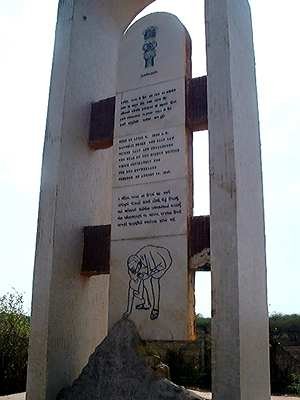
Monument at Dandi, where Gandhi picked up a handful of salt – Photo Jan Öberg, © TFF 2001

The salt was the symbolic means, while the independence of India was the purpose -which was not achieved until 17 years later!

Nearly 20 years ago, Tom Weber, Australian Gandhi expert and TFF-adviser, repeated the whole march on his own. His enormously thick book, in which he investigates the Salt March by means of “participatory observation”, was published in 1997, On the Salt March. The Historiography of Gandhi’s March to Dandi, (Harper Collins, Delhi, 594 pages, 2nd Ed 2000) – or here (hard cover).

In a mixture of fiction and literary road movie, Weber undertook a meticulous investigation of all the sources and talked to everyone who participated in the original March. He has created a priceless chronology and analysis of this political action for independence, which is probably the most peculiar of its kind in world history. It’s absurd theatre, existentialism, symbol politics and realpolitik, all in one. It’s farce and tragedy. It’s “the Drama by the Seaside”, through which the Englishmen finally realised that it was the beginning of the end.

Those who have seen the film about Gandhi probably remember the brutal scene at the saltworks in Darasana. 2500 satyagrahis had come up from Bombay. Row after row of white-clad, unarmed marchers were clubbed and fell bleeding. On the very first day two of them were killed and 320 wounded. Many of them were arrested, the prisons were filled quickly and Gandhi himself was taken to the prison at Puna.

All this happened just a few days after he had picked up a muddy, sandy clump on the seaside near Dandi, thus defying the British rule. As Louis Fischer writes in his classical biography, The Life of Mahatma Gandhi (Harper & Row 1950), “India was now free. Technically, however, nothing had changed legally. Tagore explained the difference – those living in England now realised that Europe had lost all of its moral prestige”.

My Own March  

On the 12th of March 2001 at 06:30 a.m., I started marching through the gate of the Sabarmati ashram, at the same high speed during the first 6-7 kilometres down to Ellis Bridge. An almost full moon was visible in the west, while the sun rose above the river. People looked out from under their blankets to see the strange man (that was me) with his camera, papers and pen. Good Morning! I tried to imagine what the participants of the March would have been thinking just then. After all, they had left their wives and children behind in the ashram, fully aware of the fact that they might be killed for the Indian cause.
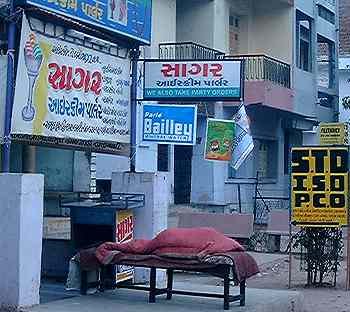
Morning on Ashram Road 1 – Photo Jan Öberg, © TFF 2001

Today, Ashram Road is a three-laned road with shops and cinemas, etc. 71 years ago, it was just a gravel road between the city-centre and the village which surrounded the ashram. The air is fairly clean; the infernal traffic noise has not started yet. A camel starts to pee just as I’m passing by.
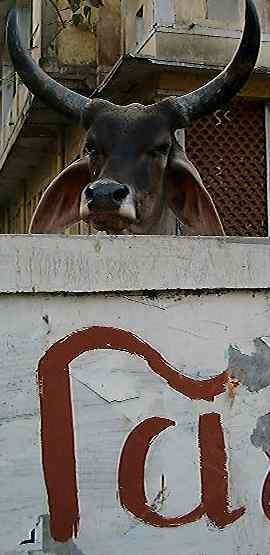
Morning on Ashram Road 3 – Photo Jan Öberg, © TFF 2001

I reach Gandhi Bridge at 07:15 and see an enormous statue of Gandhi, bathed on one side in the red light of the sun. He stands there in the middle of traffic, surrounded by advertisements, including those for cigarettes and alcohol. Poor Mahatma!
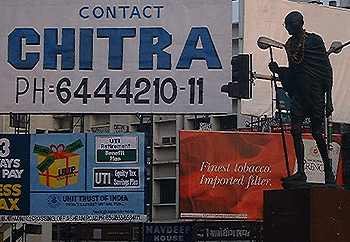
Gandhi on Ashram Road – Photo Jan Öberg, © TFF 2001

I walk further, past Nehru Bridge and, at 07.50, go over Ellis Bridge in towards the centre. I look down at the nearly dried up river valley where several men sit on their heels shitting.

I stroll to Ahmedabad’s luxurious Holiday Inn and eat breakfast with delicious pineapple lassi (yogurt). Here I can also transfer my handwritten notes to my palm-computer. It is fascinating to be able to leave one kind of world and enter into another in practically no time at all. The question is if we all really live in the same world?
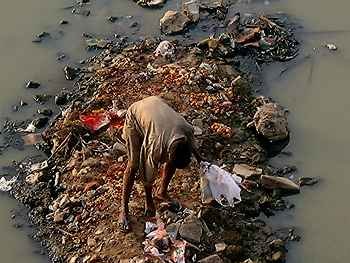
Morning in the Sabarmati river – Photo Jan Öberg, © TFF 2001

That was the first part of my private Salt March. In the next article I shall have reached the sea. By car. With someone who was there then, in 1930.

July 2001

Translated by Alice Moncada
Translation edited by Sara E. Ellis
Peace & future researcher + ‌Art Photographer

Share

Leave a Reply

Your email address will not be published. Required fields are marked *

Related Posts

Peace is promoted by constructive proposals and dialogue Four preceding PressInfos have expressed concern over — and criticised — the ongoing, militarisation of the EU. Some will say: but there are no alternatives. We believe that there are always alternatives, that democracies are characterised by alternatives and choice, and that openly discussed alternatives will improve the quality and legitimacy of society’s decision–making. In addition, it is an intellectual and moral challenge to not only criticise but also be constructive. If we only tell people that we think they are wrong, they are not likely to listen. However, if we say: what are your views on this set of ideas and steps? — we may sometimes engage them in dialogue and sow a seed. Most people in power circles live their daily lives in in a time frame and a social space where certain ideas, viewpoints and concepts are just not...
Photos © TFF 2000 Read PressInfo 90 “Lift the Sanctions and Bring More Aid to Yugoslavia” See Pictures from Belgrade © TFF 2000 Please reprint, copy, archive, quote or re-post this item, but please retain the source.
Av FRANK SØHOLM GREVIL 16 augusti 2004  Vi er nu nået til tredje akt i det absurde teaterstykke, der i analogi med de store skueprocesser i Moskva 1936-38 er blevet døbt ‘Grevil-sagen’. Første akt bestod i min anonyme fremlæggelse af egenhændigt nedklassificerede rapporter i Berlingske Tidende i februar og marts. Andet akt udgjordes af min fremtræden med navn og billede i Information i april samt den efterfølgende mediestorm, som uden min direkte medvirken kostede en forsvarsminister taburetten samt en sigtelse for brud på tavshedspligten. Tredje akt bliver en retssag, hvor jeg står tiltalt for at have overtrådt straffelovens bestemmelser om uberettiget videregivelse eller udnyttelse af fortrolige oplysninger. Statsanklageren har ovenikøbet valgt at påberåbe sig særligt skærpende omstændigheder. Da jeg aldrig har modtaget betaling for at stille rapporterne til rådighed eller lade mig interviewe, må det skærpende bestå i, at “videregivelsen eller udnyttelsen er sket under sådanne omstændigheder, at det påfører...

Recent Articles

PressInfo # 141, December 21, 2001It’s time to prepare reconciliation between Albanians and Serbs PressInfo # 140, December 14, 2001Ibrahim Rugova’s decade-long leadership in Kosovo/a PressInfo # 139, 11. december, 2001En god nyhet: Jugoslaviens Sannings- och försoningskommission PressInfo # 139, 11. december, 2001Gode nyheder: Jugoslaviens Sandheds- og Forsoningskommission PressInfo # 139, December 11, 2001Good news: Yugoslavia’s Truth and Reconciliation Commission PressInfo # 138, November 8, 2001TFF co-founder PhD with thesis about young people with roots in other cultures PressInfo # 138, November 8, 2001TFF:s medstiftare doktor på avhandling om unga med ursprung i andra kulturer PressInfo # 137, October 17, 2001A new Marshall Plan: Advancing human security and controlling terrorism PressInfo # 136, October 15, 2001The UN and Annan really deserve it PressInfo # 135, October 10, 2001Preventing a terrorist mushroom cloud PressInfo # 134, 17 oktober, 2001Sverige og 11. september PressInfo # 134, October 9, 2001Sweden and September 11...
Peace is promoted by constructive proposals and dialogue Four preceding PressInfos have expressed concern over — and criticised — the ongoing, militarisation of the EU. Some will say: but there are no alternatives. We believe that there are always alternatives, that democracies are characterised by alternatives and choice, and that openly discussed alternatives will improve the quality and legitimacy of society’s decision–making. In addition, it is an intellectual and moral challenge to not only criticise but also be constructive. If we only tell people that we think they are wrong, they are not likely to listen. However, if we say: what are your views on this set of ideas and steps? — we may sometimes engage them in dialogue and sow a seed. Most people in power circles live their daily lives in in a time frame and a social space where certain ideas, viewpoints and concepts are just not...
Photos © TFF 2000 Read PressInfo 90 “Lift the Sanctions and Bring More Aid to Yugoslavia” See Pictures from Belgrade © TFF 2000 Please reprint, copy, archive, quote or re-post this item, but please retain the source.

TFF on Substack

Discover more from TFF Transnational Foundation & Jan Oberg.

Most Popular

PressInfo # 141, December 21, 2001It’s time to prepare reconciliation between Albanians and Serbs PressInfo # 140, December 14, 2001Ibrahim Rugova’s decade-long leadership in Kosovo/a PressInfo # 139, 11. december, 2001En god nyhet: Jugoslaviens Sannings- och försoningskommission PressInfo # 139, 11. december, 2001Gode nyheder: Jugoslaviens Sandheds- og Forsoningskommission PressInfo # 139, December 11, 2001Good news: Yugoslavia’s Truth and Reconciliation Commission PressInfo # 138, November 8, 2001TFF co-founder PhD with thesis about young people with roots in other cultures PressInfo # 138, November 8, 2001TFF:s medstiftare doktor på avhandling om unga med ursprung i andra kulturer PressInfo # 137, October 17, 2001A new Marshall Plan: Advancing human security and controlling terrorism PressInfo # 136, October 15, 2001The UN and Annan really deserve it PressInfo # 135, October 10, 2001Preventing a terrorist mushroom cloud PressInfo # 134, 17 oktober, 2001Sverige og 11. september PressInfo # 134, October 9, 2001Sweden and September 11...
Peace is promoted by constructive proposals and dialogue Four preceding PressInfos have expressed concern over — and criticised — the ongoing, militarisation of the EU. Some will say: but there are no alternatives. We believe that there are always alternatives, that democracies are characterised by alternatives and choice, and that openly discussed alternatives will improve the quality and legitimacy of society’s decision–making. In addition, it is an intellectual and moral challenge to not only criticise but also be constructive. If we only tell people that we think they are wrong, they are not likely to listen. However, if we say: what are your views on this set of ideas and steps? — we may sometimes engage them in dialogue and sow a seed. Most people in power circles live their daily lives in in a time frame and a social space where certain ideas, viewpoints and concepts are just not...
Photos © TFF 2000 Read PressInfo 90 “Lift the Sanctions and Bring More Aid to Yugoslavia” See Pictures from Belgrade © TFF 2000 Please reprint, copy, archive, quote or re-post this item, but please retain the source.
Read More
Imagen-thumbnail-The-Transnational-1
PressInfo # 141, December 21, 2001It’s time to prepare reconciliation between Albanians and Serbs PressInfo # 140, December 14, 2001Ibrahim Rugova’s decade-long leadership in Kosovo/a PressInfo # 139, 11. december, 2001En god nyhet: Jugoslaviens Sannings- och försoningskommission PressInfo # 139, 11. december, 2001Gode nyheder: Jugoslaviens Sandheds- og Forsoningskommission PressInfo # 139, December 11, 2001Good news: Yugoslavia’s Truth and Reconciliation Commission PressInfo # 138, November 8, 2001TFF co-founder PhD with thesis about young people with roots in other cultures PressInfo # 138, November 8, 2001TFF:s medstiftare doktor på avhandling om unga med ursprung i andra kulturer PressInfo # 137, October 17, 2001A new Marshall Plan: Advancing human security and controlling terrorism PressInfo # 136, October 15, 2001The UN and Annan really deserve it PressInfo # 135, October 10, 2001Preventing a terrorist mushroom cloud PressInfo # 134, 17 oktober, 2001Sverige og 11. september PressInfo # 134, October 9, 2001Sweden and September 11...
Imagen-thumbnail-The-Transnational-1
Peace is promoted by constructive proposals and dialogue Four preceding PressInfos have expressed concern over — and criticised — the ongoing, militarisation of the EU. Some will say: but there are no alternatives. We believe that there are always alternatives, that democracies are characterised by alternatives and choice, and that openly discussed alternatives will improve the quality and legitimacy of society’s decision–making. In addition, it is an intellectual and moral challenge to not only criticise but also be constructive. If we only tell people that we think they are wrong, they are not likely to listen. However, if we say: what are your views on this set of ideas and steps? — we may sometimes engage them in dialogue and sow a seed. Most people in power circles live their daily lives in in a time frame and a social space where certain ideas, viewpoints and concepts are just not...
Imagen-thumbnail-The-Transnational-1
Photos © TFF 2000 Read PressInfo 90 “Lift the Sanctions and Bring More Aid to Yugoslavia” See Pictures from Belgrade © TFF 2000 Please reprint, copy, archive, quote or re-post this item, but please retain the source.
Imagen-thumbnail-The-Transnational-1
Av FRANK SØHOLM GREVIL 16 augusti 2004  Vi er nu nået til tredje akt i det absurde teaterstykke, der i analogi med de store skueprocesser i Moskva 1936-38 er blevet døbt ‘Grevil-sagen’. Første akt bestod i min anonyme fremlæggelse af egenhændigt nedklassificerede rapporter i Berlingske Tidende i februar og marts. Andet akt udgjordes af min fremtræden med navn og billede i Information i april samt den efterfølgende mediestorm, som uden min direkte medvirken kostede en forsvarsminister taburetten samt en sigtelse for brud på tavshedspligten. Tredje akt bliver en retssag, hvor jeg står tiltalt for at have overtrådt straffelovens bestemmelser om uberettiget videregivelse eller udnyttelse af fortrolige oplysninger. Statsanklageren har ovenikøbet valgt at påberåbe sig særligt skærpende omstændigheder. Da jeg aldrig har modtaget betaling for at stille rapporterne til rådighed eller lade mig interviewe, må det skærpende bestå i, at “videregivelsen eller udnyttelsen er sket under sådanne omstændigheder, at det påfører...
Imagen-thumbnail-The-Transnational-1
Af Svenska Irakkommittén mot de Ekonomiska Sanktionerna (SIES) 13 september 2002 FN:s ekonomiska sanktioner mot Irak har nu pågått i tolv år och drabbat det irakiska folket med svåra lidanden. Enligt FN:s egna siffror har mer än 1,5 miljoner människor, varav ca 600 000 barn, dött som en direkt följd av sanktionerna. Dessutom har ett lågintensivt bombkrig mot landet pågått under dessa år. Av all denna förödelse- orsakad huvudsakligen av amerikansk och brittisk politik- har Saddam Husseins brutala och diktatoriska regim snarast stärkts än försvagats. Nu förbereder USA under president Bushs ledning ett storskaligt bombkrig mot Irak som kommer att innebära ett ännu större lidande för civilbefolkningen. Ett sådant krig kommer dessutom att ytterligare undergräva freden och säkerheten i världen. Att upprätta en demokratisk regim i Irak är det irakiska folkets angelägenhet och får enligt folkrätten inte ske med krigshandlingar utifrån. Folkrätten och FN:s stadgar måste respekteras. Vi vädjar till...


