And its positive attitude to the West
When travelling around China, one of many things to note is that the Chinese are very positive toward the West, make use of Western inspirations, and know much more about the West than Westerners know about China.
This is quite remarkable because, historically, China has been the object of ruthless Western colonialism and warfare as well as racism—e.g. the ”yellow fewer/danger” syndrome—while China has done nothing similar to the West.
Here are some examples, big and small, of the mentioned knowledge and fascination of the West:
• Many young Chinese have chosen to have a Western name, like, say, Alison or Kevin. They say it is difficult for us in the West to remember and pronounce Chinese names.
• The Chinese know all the Western brands and gladly call their products something related to the West. They love to play with English when giving their company or shop a name like. One of the popular cars is BYD: Build Your Dreams, which is written in capital letters across the car’s luggage compartment.
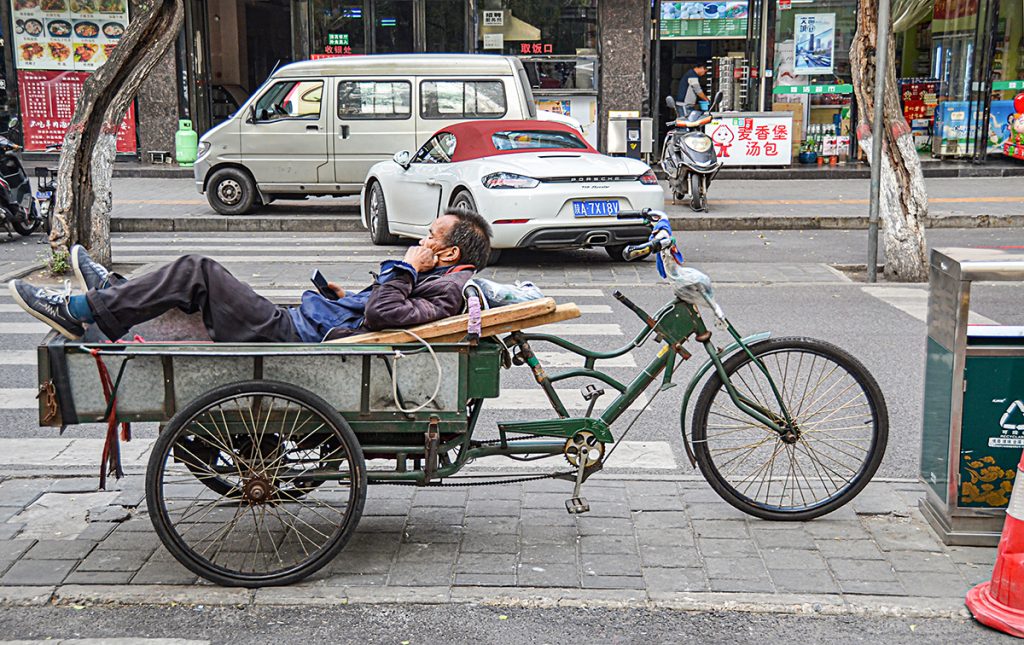
• Wealthy people find it essential to drive Western luxury cars – BMW, Porsche, or even a Rolls Royce.
• Contrary to just 40 years ago, the Chinese dress like us, and most T-shirts reference London or New York or an English slogan across the chest. You can buy clothes, shoes, perfumes, etc. from every Western brand here.
• Chinese advertising is full of female and male faces that look more Western than Chinese. – like “buy our product and you’ll look more Western.”
• There is lots of Western music here in China – walk into any bar, and you’ll hear mellow jazz and a lot of Chinese pop is inspired by the West. The Chinese love Western classical music, don’t be surprised to hear Beethoven being played in the background of a department store. Or think of Lang Lang.
• There will invariably be a series of Hollywood films and blockbusters on Chinese flight entertainment programs.
• The larger museums contain Chinese art or historical relics, but there is a consistent policy of also giving the Chinese an opportunity to acquaint themselves with Western art, not least European artists.
• Just a few decades ago, the Chinese would drink tea only, but now it is fine to drink coffee and enjoy a cake with it. Any hotel breakfast will serve bacon, eggs, and other continental breakfast items. (Although you will still hardly ever see cheese.)
• Many more Chinese speak English, at least some English, than Westerners speak Chinese.


All the Western brands are here…
• All road signs and place names in the street and metros will also be written in English – you’ll never find yourself lost because you do not read the Chinese signs.
• The Chinese do not seek conflict. If you visit a company which is an object of Western economic sanctions and has paid a price for them, it seems impossible to make the leaders of it express any negative attitude. They will avoid the question or perhaps give you a quote from President Xi Jinping about harmony and hard work to achieve better results from one year to the next. An imam I conversed with in Xinjiang answered by stating that there would, over time, develop a better mutual understanding – seemingly unable to see the US accusation about genocide as anything but a sign of lack of knowledge, not as an accusation. Trying to achieve some kind of harmony and balance is essential for the Chinese way of thinking.
• Wherever you go in China, there is a positive attitude to you as a visitor. You are not being associated with the hostile West; you are seen and treated as a friend. They distinguish between the Western citizen and the Western governments, and you never feel guilty by association – in contrast to what many Chinese often feel in the West. And, by the way, you feel and are safe everywhere, night and day.
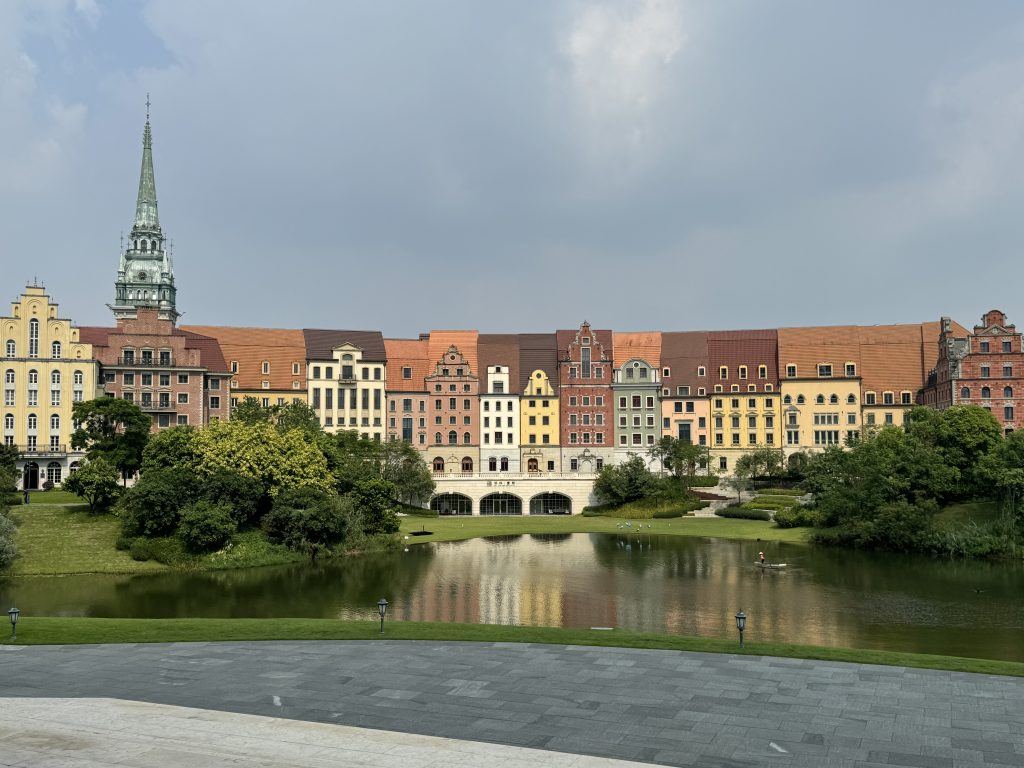
• Believe it or not, Ren Zhengfei, the founder of the Shenzhen-based Huawei company – one of the world’s most successful – has built a large French-German-style village as a campus inside which the researchers work. He has also built a classic-style library with a cupola that contains no less than 70,000 books – many of which are art, philosophy, science, etc, books from the West – for instance, David Hockney’s macro volumes on art. He is simply fascinated by what he has seen in Europe. At Fudan University in the outskirts of Shanghai, I met a scholar who was a specialist on Marxism whose entire office and seminar room was devoted to Western philosophy. And somewhere, a bookstore calls itself the Goethe Bookstore.
• Thousands upon thousands of young Chinese have studied or are studying in the West. But how many Western students have gone to China? The majority of media people I have met here have, at some point, been studying in the US or England. They can compare Western and Eastern ways of thinking – and censorship. The same goes for many Chinese scholars, academics and artists: they have acquainted themselves with the West and been inspired by it – admire it. They know the West in ways few Westerners know China.
• China has imported so much from the West – including Marxism, capitalism, consumerism, Western culture, lifestyle and ways of doing things. It’s been consistently curious about the West and eclectically combined elements of socio-economic development into a synergetic whole. It has assimilated, emulated and adapted with curiosity. Forty years ago, its streets were filled with bicycles, today’s Beijing has 6 million cars, many more innovative than those produced by the West.
• When you read Chinese media, you’ll find much more news, features and videos about what happens in the West than you’ll find news about China – and other non-Western countries – in Western mainstream media. Lots of the best Chinese media have employed Westerners as anchors, columnists and documentarists.
What I am getting at here is that the West has a lot of homework to do regarding China. The generally negative attitude toward China in our media, research, and politics does not stem from China but from the West itself.
The negativity is proportionate to the ignorance: Grosso modo, Westerners are woefully ignorant about China and have always been. It seems OK to see China as a threat, a dictatorship, as authoritarian, as human rights violating, etc., without knowing a thing about China or the Chinese people’s ways of thinking – or without ever having visited it.
Furthermore, China is judged on Western criteria, not its own criteria and achievements. Western mainstream media predominantly do a disservice to the public, and most recently, the US passed a law that sets off US$ 1600 million over five years to ensure that there are only China-negative stories in our media. How weak the West has become – and how sad for someone who used to champion free media and free opinion-formation. For more, please consult TFF’s comprehensive analyses in the “Smokescreen Report” and follow our new anthology in the making “If You Want To Understand China”.
Interestingly, Westerners who have visited China as tourists or have worked in and with China as business people, scholars, etc., generally have a much more balanced view of China and the Chinese people.
Regrettably, it is much easier to project a generally negative image of China and its people when Westerners know little or nothing about them. Should the Chinese leadership wish to create a similarly negative image of the West in the Chinese mind, it would have to work hard—if at all possible.
Fortunately, there is no sign that they aim to do that. Every speech by China’s leaders emphasises the benefits of cooperation with the West while also stressing that China has a right to develop its own society and future the way it sees fit. It is not going to become anything like the West – and that is good for diversity and global creativity.
The world is not getting richer from one system, no matter which, trying to dominate all others. It will be richer by many different actors working together in multiple ways and inspiring each other – achieving synergy and change. Unity in diversity, not in uniformity.
The West’s problem is that, for centuries, it has seen itself as the leader, as # 1. Those who do that in any system tend to see themselves as teachers, not as learners because they believe they are operating on a higher civilisational level and/or have ”better” values that deserve to be universalised.
In summary, it is high time that the West recognises that it has homework to do – and begins to do it today rather than tomorrow.
China’s development since opening up to the world in 1978—its betterment of people’s living conditions—is unique in human history. It has not only made China a much better place but it has also made a great contribution to humanity’s development and welfare and continues to do so with visionary projects such as the Belt and Road Initiative, BRI.
The Chinese would be the last to tell you that everything is perfect in China. However, their only constants are change and striving to do things better today than yesterday. China deserves a decent, fair analysis based on knowledge and respect for its culture and civilisation instead of government-manufactured negative narratives rooted in deep ignorance.