Nuclear weapons

Showing 1-10 of 244 stories

Sort by
Categories

Year

Author / Contributor

Region

COntsort
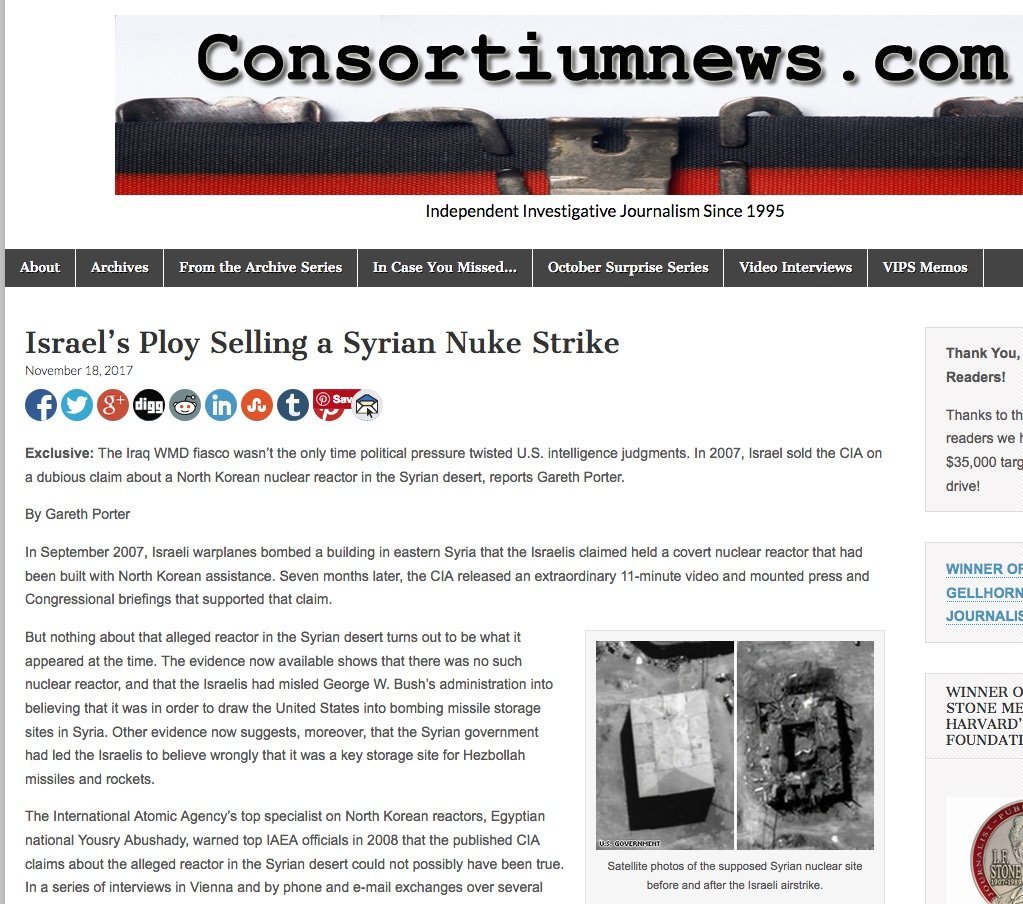
By Gareth Porter In September 2007, Israeli warplanes bombed a building in eastern Syria that the Israelis claimed held a covert nuclear reactor that had been built with North Korean assistance. Seven months later, the CIA released an extraordinary 11-minute video and mounted press and Congressional briefings that supported that claim. But nothing about that alleged reactor in the Syrian desert turns out to be what it appeared at the time. The evidence now available shows that there was no such nuclear reactor, and that the Israelis had misled George W. Bush’s administration into believing that it was in order to draw the United States into bombing missile storage sites in Syria. Other evidence now suggests, moreover, that the Syrian government had led the Israelis to believe wrongly that it was a key storage site for Hezbollah missiles and rockets. Continue reading Porter’s investigative report at ConsortiumNews.com
ObergIAleppo-1_PhSh
/11/tff-pressinfo-434-nuclear-weapons-use-within-months-part-1-why/”>Part 1 about the risks here Fact is that we are dealing here with a conflict that is the most threatening to humankind’s survival and it would be rather more easy to solve than most other conflicts. This has recently been pointed out by TFF Board Member and former Co-President of International Physicians for the Prevention of Nuclear War, IPPNW, 2004-2008, Gunnar Westberg, in a short analysis.
ObergIAleppo-1_PhSh
/11/pi-435-likely-nuclear-use-within-months-part-2-how-to-avoid-it/”>Part II here. That’s what I hold quite likely in case the present US administration under Donald Trump’s formal leadership continues down the path its in-fighting militarist fractions seem to have chosen. We’re in the worst, most dangerous situation since the Cuban Missile Crisis. Sitting down and hoping for the best is neither responsible nor viable or wise. I can only hope that I will be proved wrong. That the present extremely dangerous tension-building will die down by some kind of unforeseen events or attention being directed elsewhere. The world could quite well be drifting toward what Albert Einstein called ’unparalleled catastrophe’. It’s something we may – or may not – know more about when President Trump returns from his trip to Japan, South Korea, China, Vietnam (APEC where he also likely to meet Russian President Putin) and the Philippines. Except for 93-year old Jimmy Carter offering to go to...
imgres
By Gareth Porter U.S-Iran policy is closer to Israel than it has been in years. President Donald Trump’s new Iran policy clearly represents a dangerous rejection of diplomacy in favor of confrontation. But it’s more than that: It’s a major shift toward a much closer alignment of U.S. policy with that of the Israeli government of Prime Minister Benjamin Netanyahu. Whether explicitly or not, Trump’s vow to work with Congress to renegotiate the Iran nuclear agreement, and his explicit threat to withdraw from the deal if no renegotiation takes place, appear to be satisfying the hardline demands Netanyahu has made of Washington’s policy toward Tehran. Specifically, Netanyahu has continued to demand… Continue reading Porter’s article here.
JOProfilPressTV
October 19, 2017 Comments on EU leaders stating their support for the nuclear deal with Iran (JCPOA) and sending strong signals to Trump: But more is needed now. Oberg also asks: Where is the similar statement from NATO, the allegedly peace and security organisation when its leader, the U.S., is moving towards war with Iran?
david-swanson
By David Swanson October 6, 2017 The Nobel Peace Prize was awarded Friday to the International Campaign for the Abolition of Nuclear Weapons (ICAN) — listen to my radio show with one of ICAN’s leaders two years ago here. It’s conceivable that some Americans will now learn, because of this award, about the new treaty that bans the possession of nuclear weapons. This treaty has been years in the works. This past summer 122 nations agreed on the language of it, including these words… Continue to the original here
RichardFalk20141
Professor emeritus of international law at Princeton University and University of California, Santa Barbara, board member of The Nuclear Age Peace Foundation and TFF Associate since 1985 Finally, the committee in Oslo that picks a winner of the Nobel Peace Prize each year selected in 2017 an awardee that is a true embodiment of the intended legacy of Alfred Nobel when he established the prize more than a century ago. It is also a long overdue acknowledgement of the extraordinary dedication of anti-nuclear activists around the planet who for decades have done all in their power to rid the world of this infernal weaponry before it inflicts catastrophe upon all living beings even more unspeakable that what befell the cities of Hiroshima and Nagasaki on two infamous days in August 1945. Such a prize result was actually anticipated days before the announcement by Fredrik Heffermehl, a crusading Norwegian critic of...
JO2016_1_10Sepia_Cropped
Prize to ICAN – the International Campaign to Abolish Nuclear Weapons. Undoubtedly nuclear disarmament and, ultimately, nuclear abolition is a major – if not the major – goal of humankind. There can be no lasting peace with these weapons and there exists no goal the achievement of which would legitimate the use of this type of weapons. Even when not used, nuclear weapons cause problems, distrust, risks and pretext for wars – think Russia-NATO, Iraq, the nuclear deal (JCPOA) with Iran, US-North Korea, Israel, India-Pakistan – and documented technical malfunctions, human failures, and accidents with nuclear weapons. Secondly, this year’s award honours the UN Charter, Article 1 of which states the essentially important norm that peace shall be brought about by peaceful means. It is also in clear support – as was emphasized by the Committee’s chairwoman, Berit Reiss-Andersen, herself a lawyer – of the NPT of 1970, the Non-Proliferation...

gunnarwestberg
What Americans Really Think about Using Nuclear Weapons and Killing Noncombatants By Gunnar Westberg TFF Board member “Revisiting Hiroshima in Iran: What Americans Really Think about Using Nuclear Weapons and Killing Noncombatants” Scott D. Sagan and Benjamin A. Valentino International Security, August 2017 This is a summary and a few reflections upon reading a very comprehensive academic study recently published in International Security. See it’s full text here. The nuclear taboo is no longer strong In this extensive and scholarly report of 67 pages the authors report on several opinion polls they have conducted in order to learn about the attitudes of Americans to the use of nuclear weapons compared to conventional weapons. They also review the field extensively comparing with other studies. Shortly after the bombing of Hiroshima and Nagasaki the Americans strongly supported the use of nuclear weapons in that situation. The approval rate decreased to a large...
jonathanpower2
Out of the blue the war in Vietnam is in the news. Yet it is not the fiftieth anniversary of America’s defeat in Vietnam when North Vietnam caused it to flee. It’s only the forty second. Part of this must be fearful parallels with the moral and strategic blindness of President Donald Trump who seems to believe in uttering his life and death rhetoric, akin to President Richard Nixon’s on Vietnam, he can frighten the enemy into submission – in his case North Korea. Many people are worried that Trump is ready to fight America’s biggest war since Vietnam. As did Henry Kissinger, Nixon’s National Security Advisor, he appears to be considering the use of nuclear weapons. The second reason for Vietnam-consciousness are the rave reviews that are being given to Ken Burns and Lynn Novick’s 10 part documentary on the Vietnam War. It is being mentioned all over the...
Categories

Year

Author / Contributor

Region