
Ben Norton: The West is out of touch with the rest of world politically, EU-funded study admits

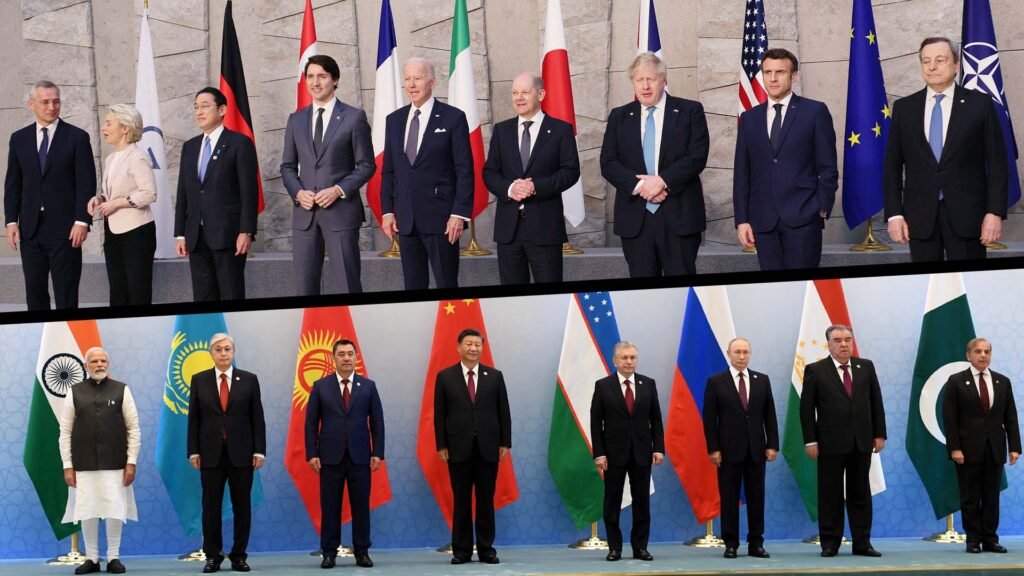
Meetings of the G7 and NATO (top) and Shanghai Cooperation Organization (bottom)

Ben Norton

March 29, 2023

A study by the elite EU-funded European Council on Foreign Relations found the West is out of touch politically with the rest of the world. Most people in China, India, and Türkiye see Russia as an important ally, and they want multipolarity, not continued “American global supremacy”.

Originally published at Geopolitical Economy on February 25, 2023

A study by an elite European government-funded think tank found that, while the United States and Europe are growing closer together, the West is increasingly out of touch politically with the rest of the world.

The report, from the EU member state-financed European Council on Foreign Relations, conceded that the system of “American global supremacy” is in rapid decline, and many people in the Global South want a new “multipolar world”.

The series of polls concluded that NATO’s proxy war in “Ukraine confirmed the renewed centrality of American power to Europe”, uniting the West under Washington’s leadership. Today, Europeans and North Americans “hold many views in common about major global questions”.

But this “consolidation of the West is taking place in an increasingly divided post-Western world”, the study acknowledged. The Global South is moving in the opposite direction.

It described “a wide gap between the West and the ‘rest’ when it comes to their desired outcomes for the war and differing understandings of why the US and Europe support Ukraine”.

The report admitted that, even if Ukraine somehow managed to win the NATO proxy war with Russia, “it is highly unlikely to restore a US-led global liberal order”, and, instead, “the West will have to live, as one pole of a multipolar world”.

The 13% of the global population in the West is out of touch with the ‘rest’ of the world

This study was conducted by the European Council on Foreign Relations (ECFR), a notoriously hawkish think tank that expresses overt anti-Russia and anti-China bias.

The ECFR is funded by the European Parliament and numerous European governments, including Germany, France, Italy, Spain, Belgium, Ireland, Norway, Denmark, Finland, and the Czech Republic, as well as key Western ally Japan.

For the report, the ECFR commissioned polling in:

  • China
  • India
  • Türkiye
  • Russia
  • United States
  • Britain

It also surveyed people in nine major European Union member states, which it referred to collectively as the EU9:

  • Denmark
  • Estonia
  • France
  • Germany
  • Italy
  • Poland
  • Portugal
  • Romania
  • Spain

The pollsters interviewed a total of 19,765 adults in late December 2022 and early January 2023.

The sample of participants in the West was representative of the general population. But the study disclosed that, in China, India, and Russia, the people surveyed in the polling only came from large cities, meaning the results may not reflect the views of those living in rural areas.

The study suffered from bias. This slant was clear when the report misleadingly referred to the NATO-Russia proxy war in Ukraine facilely as “Putin’s war” and “Russian aggression”, as if the West did not play a fundamental role in starting the conflict in the first place by sponsoring a violent coup d’etat in Kiev in 2014, repeatedly violating promises not to expand NATO east after the 1990 reunification of Germany, sabotaging the Minsk accords and peace talks, and ignoring Moscow’s 2021 request for security guarantees.

But despite the ECFR study’s many flaws, its results convey an unmistakable message: The West is out of touch with the rest of the world.

The report acknowledged this, choosing as its title: “United West, divided from the rest“.

The Western nations surveyed in the study have a combined population of nearly 1 billion – approximately 13% of the global population of 8 billion.

This is a mere fraction of the populations of China (1.41 billion), India (1.39 billion), Russia (142 million), and Türkiye (83 million).

Together, these countries have a population of just over 3 billion – making up around 38% of the total global population.

The ECFR polling shows how significantly the public opinion of the 13% in the West differs from that of the Eurasian powers.

The West’s view of the Ukraine war is not shared by the rest of the world

In its report, the European Council on Foreign Relations stated that the proxy war in “Ukraine marks both the consolidation of the West and the emergence of the long-heralded post-Western international order”.

“Many in China state that American and European support for Ukraine is driven by the desire to protect Western dominance”, the study acknowledged.

“And for the vast majority of Chinese and Turks, Western support for Ukraine is motivated by reasons other than a defence of Ukraine’s territorial integrity or of its democracy”, it added.

45% of people surveyed in China, 38% in Russia, 30% in Türkiye, and 23% in India said the US is supporting Ukraine simply in order “to defend Western dominance”.
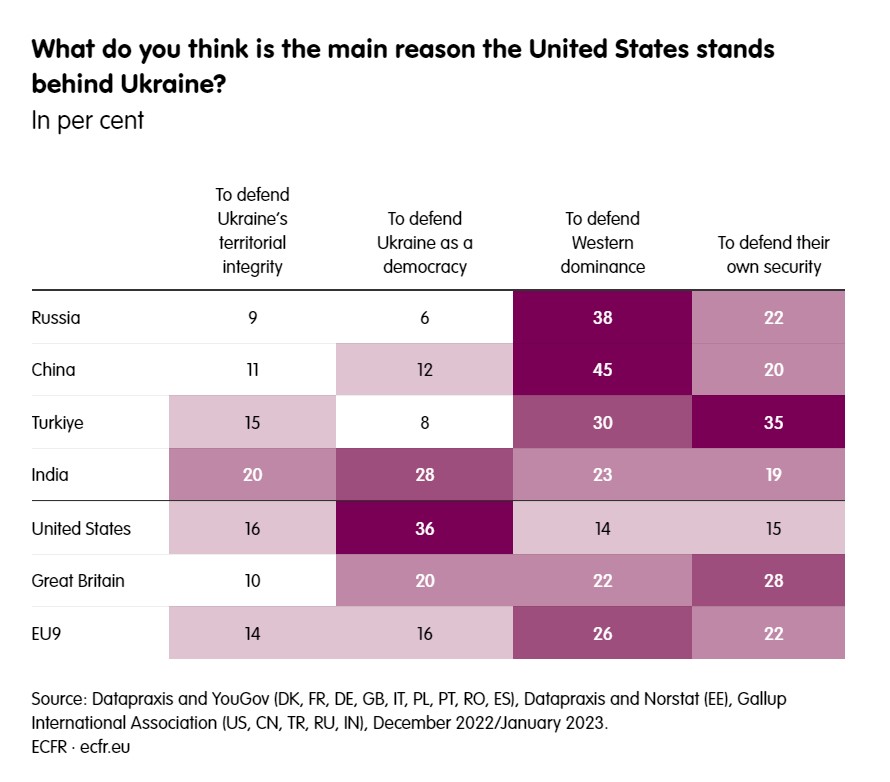
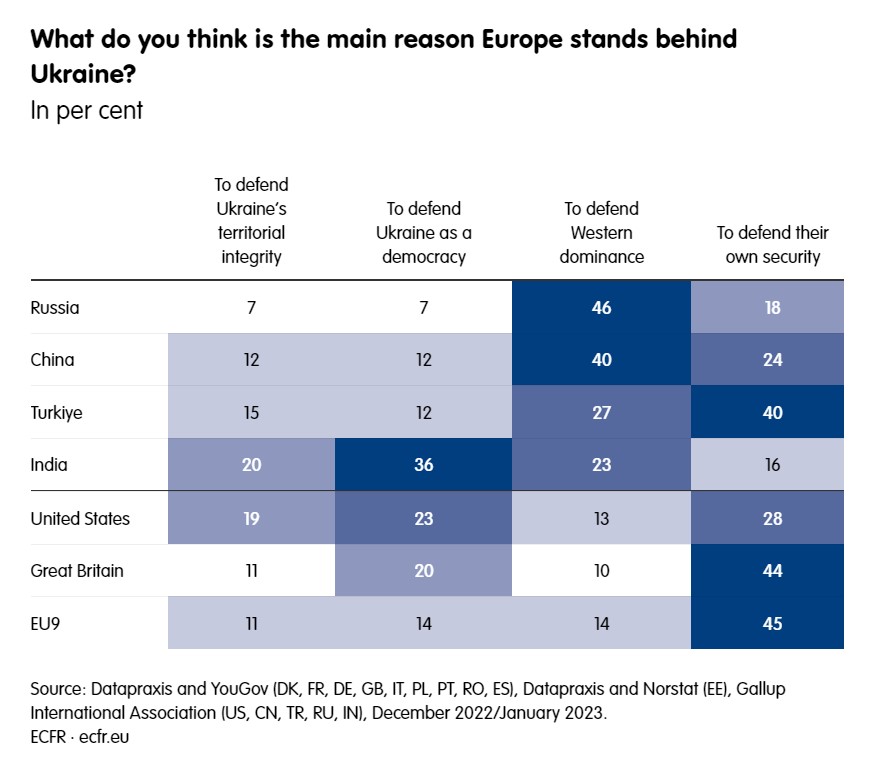
A plurality in these Eurasian nations thinks the same about Brussels.

40% of people surveyed in China, 46% in Russia, 27% in Türkiye, and 23% in India said Europe is supporting Ukraine in order “to defend Western dominance”.
The report admitted that “people in non-Western countries possess a clear preference for the war to end now – even if it means Ukraine having to give up territory”.

54% of people surveyed in India, 48% in Türkiye, 44% in Russia, and 42% in China think “the conflict between Russia and Ukraine needs to stop as soon as possible, even if it means Ukraine giving control of areas to Russia”.

Despite biased wording from the pollsters, an additional 12% of people in India, 8% in Türkiye, 29% in Russia, and 12% in China said “Western dominance of the world needs to be pushed back, even if it means accepting Russian territorial aggression against Ukraine”.

While a majority of people in the United States, Britain, and EU consider Russia to be an “adversary with which we are in conflict”, the situation is the opposite in India, China, and Türkiye.

In India, 80% of people surveyed see Russia as an ally or partner (51% as an “ally that shares our interests and values” and 29% as a “necessary partner with which we must strategically cooperate”).

In China, 79% of people surveyed see Russia as an ally or partner (35% as an ally and 44% as a necessary partner).

In Türkiye, 69% of people surveyed see Russia as an ally or partner (14% as an ally and 55% as a necessary partner).

Another question in the poll showed how Western media propaganda has manipulated public opinion.

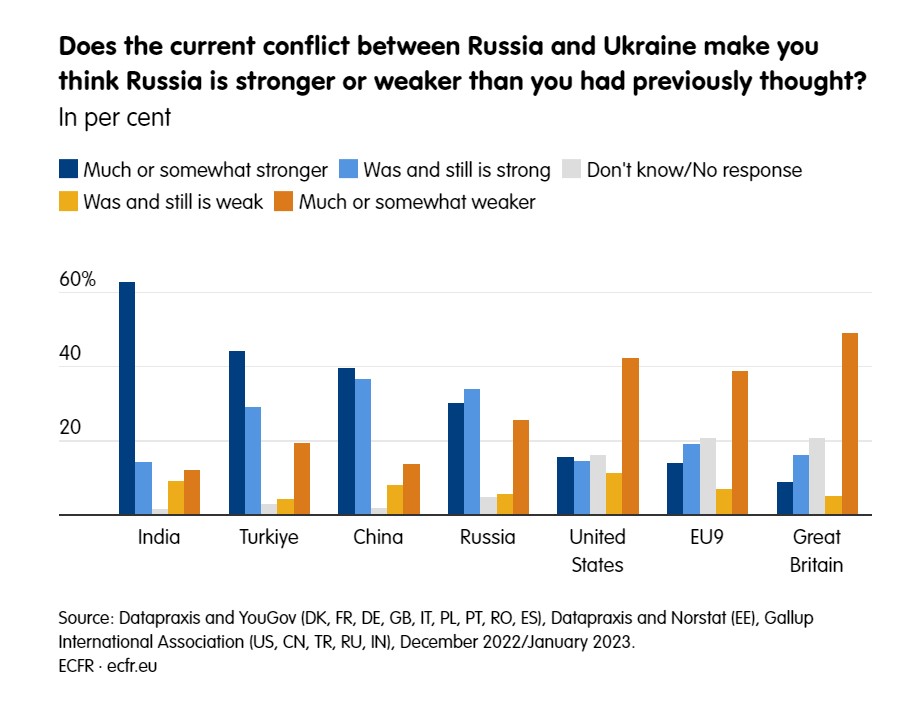
The proxy war in Ukraine has made Russia seem stronger in India, Türkiye, China, and the country itself, whereas people across the West now see Moscow as weaker.

This was another example of where Western views were the exact opposite of those in the Global South.
The ECFR report admitted that, while US “President Joe Biden has framed the war [in Ukraine] as a struggle between democracy and authoritarianism”, this is not how people in the Global South see it.

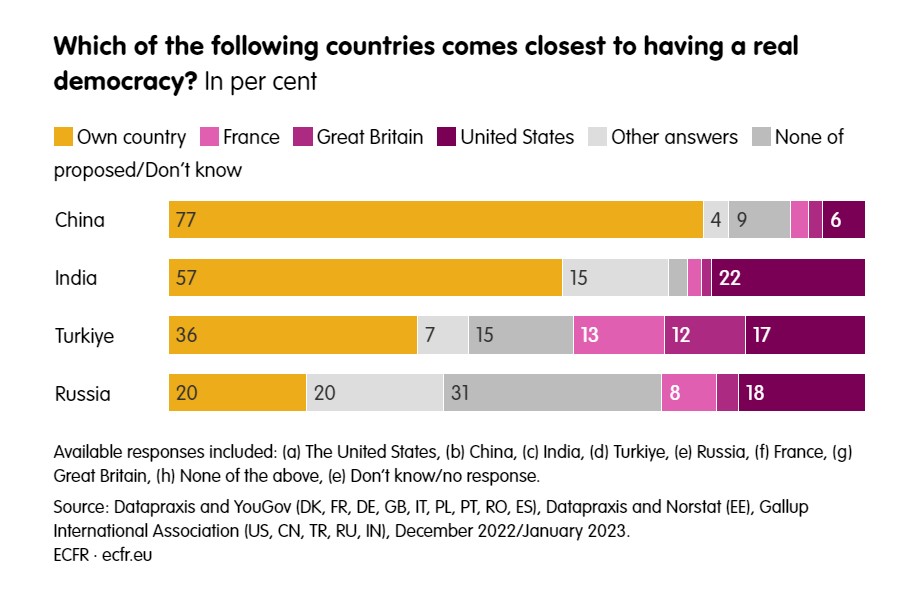
The pollsters asked participants which country they consider “comes closest to having a real democracy”. This question, again, reflected the bias of the study, turning the survey into a contest to see which country is supposedly the most democratic of all.

Yet despite these limitations, more than three-quarters of people surveyed in China (77%) considered their country to “come closest to having a real democracy”.

A separate study conducted in 2022 by another Western government-backed organization, the NATO-linked Alliance of Democracies Foundation, found that 83% of people in China consider their government a democracy, and 91% said they value democracy as important. (In the United States, on the other hand, just 49% of people said their government is a democracy.)
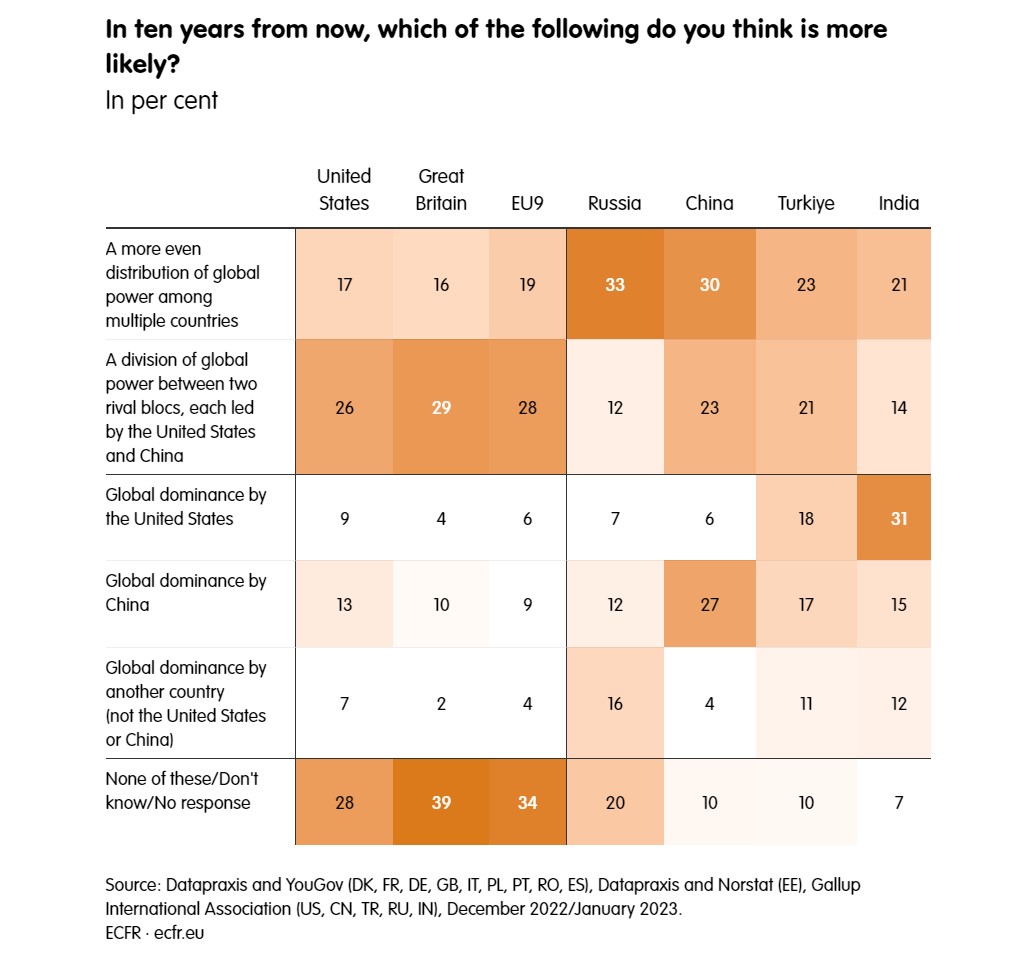
The ECFR study also acknowledged, “Most people in major non-Western countries such as China, India, Turkiye, and Russia predict the West will soon be just one global pole among several. The West may still be the strongest party but it will not be hegemonic”.

A plurality of people surveyed in China (30%) and Russia (33%) think the world will become increasingly multipolar.

This is in stark contrast to the plurality of those surveyed in Britain (29%), the EU (28%), and the US (26%), who see the world returning to a bipolar system of cold war competition between a US-led bloc and a China-led bloc.
Originally published at Geopolitical Economy on February 25, 2023

About the author
Ben Norton is an investigative journalist and analyst. He is the founder and editor of Geopolitical Economy Report and is based in Latin America. (Publicaciones en español aquí.)

Please help TFF remain truly independent by contributing if you benefited from this article

[paypal-donation]

Share

Leave a Reply

Your email address will not be published. Required fields are marked *

Related Posts

America’s Strategic Assault on Art, Academia, and the Imagination That Sustains Peace The United States once stood as a beacon of cultural audacity—a place where dissent could be beautiful, and beauty and innovation could challenge the present order of things. Its museums, universities, and artists helped inspire a worldwide imagination rooted in creative freedom and innovation. But today, under the Trump regime’s second term, those dynamic qualities are being systematically dismantled. Just read this. As Trump goes after the arts, many museums remain silent | CNN As CNN reports, the administration has launched an aggressive campaign to “eradicate improper ideology” from federally funded museums. Exhibitions involving race, gender, and identity are being censored or cancelled. Amy Sherald’s reimagining of the Statue of Liberty as a Black, trans woman was pulled from the Smithsonian after curators objected to its symbolism. Sherald warned that “history shows us what happens when governments demand loyalty...
This is the third appeal from TFF. The first and the second here. On August 22, 2025, the UN officially declared famine in Gaza. The world’s top authority on food security called for help and said starvation will spread further within the Strip unless fighting stops and much more aid is allowed in. More than half a million people in the Gaza Strip are facing catastrophic hunger conditions, while more than a million more are in a food emergency phase, the report states. This man-made catastrophic famine could have been prevented by a steady flow of humanitarian aid into the enclave, relief chief Tom Fletcher pointed out. “Yet food stacks up at borders because of systematic obstruction by Israel,” Mr. Fletcher said. “It is a famine within a few 100 meters of food in a fertile land.” The UN’s top aid official underscored that the famine in Gaza is “caused by cruelty, justified...
Contrary to what we stated when publishing this Call, the UN General Assembly (GA) opened on September 9, 2025, in New York, not in Geneva, as we initially wrote. However, due to the host role-violating US ban on visas to Palestinians, the Special GA Segment on Palestine will be held in the UN Geneva from September 22. And it builds up to something historic. Anyhow, here is what we believe you must advocate or do to help stop the Israeli genocide. It’s called people’s power or citizens’ diplomacy. SHARE! The first of three appeals from TFF. The second is here, and the third here. Across the world, people are witnessing the systematic destruction of Palestinian lives, homes, and communities. The scale and intensity of Israel’s military operations — especially in Gaza — have led leading legal bodies, including the International Court of Justice, to warn of a plausible genocide. The...

Recent Articles

PressInfo # 141, December 21, 2001It’s time to prepare reconciliation between Albanians and Serbs PressInfo # 140, December 14, 2001Ibrahim Rugova’s decade-long leadership in Kosovo/a PressInfo # 139, 11. december, 2001En god nyhet: Jugoslaviens Sannings- och försoningskommission PressInfo # 139, 11. december, 2001Gode nyheder: Jugoslaviens Sandheds- og Forsoningskommission PressInfo # 139, December 11, 2001Good news: Yugoslavia’s Truth and Reconciliation Commission PressInfo # 138, November 8, 2001TFF co-founder PhD with thesis about young people with roots in other cultures PressInfo # 138, November 8, 2001TFF:s medstiftare doktor på avhandling om unga med ursprung i andra kulturer PressInfo # 137, October 17, 2001A new Marshall Plan: Advancing human security and controlling terrorism PressInfo # 136, October 15, 2001The UN and Annan really deserve it PressInfo # 135, October 10, 2001Preventing a terrorist mushroom cloud PressInfo # 134, 17 oktober, 2001Sverige og 11. september PressInfo # 134, October 9, 2001Sweden and September 11...
Peace is promoted by constructive proposals and dialogue Four preceding PressInfos have expressed concern over — and criticised — the ongoing, militarisation of the EU. Some will say: but there are no alternatives. We believe that there are always alternatives, that democracies are characterised by alternatives and choice, and that openly discussed alternatives will improve the quality and legitimacy of society’s decision–making. In addition, it is an intellectual and moral challenge to not only criticise but also be constructive. If we only tell people that we think they are wrong, they are not likely to listen. However, if we say: what are your views on this set of ideas and steps? — we may sometimes engage them in dialogue and sow a seed. Most people in power circles live their daily lives in in a time frame and a social space where certain ideas, viewpoints and concepts are just not...
Photos © TFF 2000 Read PressInfo 90 “Lift the Sanctions and Bring More Aid to Yugoslavia” See Pictures from Belgrade © TFF 2000 Please reprint, copy, archive, quote or re-post this item, but please retain the source.

TFF on Substack

Discover more from TFF Transnational Foundation & Jan Oberg.

Most Popular

PressInfo # 141, December 21, 2001It’s time to prepare reconciliation between Albanians and Serbs PressInfo # 140, December 14, 2001Ibrahim Rugova’s decade-long leadership in Kosovo/a PressInfo # 139, 11. december, 2001En god nyhet: Jugoslaviens Sannings- och försoningskommission PressInfo # 139, 11. december, 2001Gode nyheder: Jugoslaviens Sandheds- og Forsoningskommission PressInfo # 139, December 11, 2001Good news: Yugoslavia’s Truth and Reconciliation Commission PressInfo # 138, November 8, 2001TFF co-founder PhD with thesis about young people with roots in other cultures PressInfo # 138, November 8, 2001TFF:s medstiftare doktor på avhandling om unga med ursprung i andra kulturer PressInfo # 137, October 17, 2001A new Marshall Plan: Advancing human security and controlling terrorism PressInfo # 136, October 15, 2001The UN and Annan really deserve it PressInfo # 135, October 10, 2001Preventing a terrorist mushroom cloud PressInfo # 134, 17 oktober, 2001Sverige og 11. september PressInfo # 134, October 9, 2001Sweden and September 11...
Peace is promoted by constructive proposals and dialogue Four preceding PressInfos have expressed concern over — and criticised — the ongoing, militarisation of the EU. Some will say: but there are no alternatives. We believe that there are always alternatives, that democracies are characterised by alternatives and choice, and that openly discussed alternatives will improve the quality and legitimacy of society’s decision–making. In addition, it is an intellectual and moral challenge to not only criticise but also be constructive. If we only tell people that we think they are wrong, they are not likely to listen. However, if we say: what are your views on this set of ideas and steps? — we may sometimes engage them in dialogue and sow a seed. Most people in power circles live their daily lives in in a time frame and a social space where certain ideas, viewpoints and concepts are just not...
Photos © TFF 2000 Read PressInfo 90 “Lift the Sanctions and Bring More Aid to Yugoslavia” See Pictures from Belgrade © TFF 2000 Please reprint, copy, archive, quote or re-post this item, but please retain the source.
Read More
Imagen-thumbnail-The-Transnational-1
PressInfo # 141, December 21, 2001It’s time to prepare reconciliation between Albanians and Serbs PressInfo # 140, December 14, 2001Ibrahim Rugova’s decade-long leadership in Kosovo/a PressInfo # 139, 11. december, 2001En god nyhet: Jugoslaviens Sannings- och försoningskommission PressInfo # 139, 11. december, 2001Gode nyheder: Jugoslaviens Sandheds- og Forsoningskommission PressInfo # 139, December 11, 2001Good news: Yugoslavia’s Truth and Reconciliation Commission PressInfo # 138, November 8, 2001TFF co-founder PhD with thesis about young people with roots in other cultures PressInfo # 138, November 8, 2001TFF:s medstiftare doktor på avhandling om unga med ursprung i andra kulturer PressInfo # 137, October 17, 2001A new Marshall Plan: Advancing human security and controlling terrorism PressInfo # 136, October 15, 2001The UN and Annan really deserve it PressInfo # 135, October 10, 2001Preventing a terrorist mushroom cloud PressInfo # 134, 17 oktober, 2001Sverige og 11. september PressInfo # 134, October 9, 2001Sweden and September 11...
Imagen-thumbnail-The-Transnational-1
Peace is promoted by constructive proposals and dialogue Four preceding PressInfos have expressed concern over — and criticised — the ongoing, militarisation of the EU. Some will say: but there are no alternatives. We believe that there are always alternatives, that democracies are characterised by alternatives and choice, and that openly discussed alternatives will improve the quality and legitimacy of society’s decision–making. In addition, it is an intellectual and moral challenge to not only criticise but also be constructive. If we only tell people that we think they are wrong, they are not likely to listen. However, if we say: what are your views on this set of ideas and steps? — we may sometimes engage them in dialogue and sow a seed. Most people in power circles live their daily lives in in a time frame and a social space where certain ideas, viewpoints and concepts are just not...
Imagen-thumbnail-The-Transnational-1
Photos © TFF 2000 Read PressInfo 90 “Lift the Sanctions and Bring More Aid to Yugoslavia” See Pictures from Belgrade © TFF 2000 Please reprint, copy, archive, quote or re-post this item, but please retain the source.
Imagen-thumbnail-The-Transnational-1
Av FRANK SØHOLM GREVIL 16 augusti 2004  Vi er nu nået til tredje akt i det absurde teaterstykke, der i analogi med de store skueprocesser i Moskva 1936-38 er blevet døbt ‘Grevil-sagen’. Første akt bestod i min anonyme fremlæggelse af egenhændigt nedklassificerede rapporter i Berlingske Tidende i februar og marts. Andet akt udgjordes af min fremtræden med navn og billede i Information i april samt den efterfølgende mediestorm, som uden min direkte medvirken kostede en forsvarsminister taburetten samt en sigtelse for brud på tavshedspligten. Tredje akt bliver en retssag, hvor jeg står tiltalt for at have overtrådt straffelovens bestemmelser om uberettiget videregivelse eller udnyttelse af fortrolige oplysninger. Statsanklageren har ovenikøbet valgt at påberåbe sig særligt skærpende omstændigheder. Da jeg aldrig har modtaget betaling for at stille rapporterne til rådighed eller lade mig interviewe, må det skærpende bestå i, at “videregivelsen eller udnyttelsen er sket under sådanne omstændigheder, at det påfører...
Imagen-thumbnail-The-Transnational-1
Af Svenska Irakkommittén mot de Ekonomiska Sanktionerna (SIES) 13 september 2002 FN:s ekonomiska sanktioner mot Irak har nu pågått i tolv år och drabbat det irakiska folket med svåra lidanden. Enligt FN:s egna siffror har mer än 1,5 miljoner människor, varav ca 600 000 barn, dött som en direkt följd av sanktionerna. Dessutom har ett lågintensivt bombkrig mot landet pågått under dessa år. Av all denna förödelse- orsakad huvudsakligen av amerikansk och brittisk politik- har Saddam Husseins brutala och diktatoriska regim snarast stärkts än försvagats. Nu förbereder USA under president Bushs ledning ett storskaligt bombkrig mot Irak som kommer att innebära ett ännu större lidande för civilbefolkningen. Ett sådant krig kommer dessutom att ytterligare undergräva freden och säkerheten i världen. Att upprätta en demokratisk regim i Irak är det irakiska folkets angelägenhet och får enligt folkrätten inte ske med krigshandlingar utifrån. Folkrätten och FN:s stadgar måste respekteras. Vi vädjar till...