
Will Putin Attack Poland & the Baltics?

Given their lack of information about the Ukraine-Russia deal scuttled by Boris Johnson early in the war, many Americans will be inclined to believe Biden’s evidence-free claims in last week’s CNN debate.

Ray McGovern
Special to Consortium News, July 2, 2024

July 5, 2024

At Thursday’s debate with Donald Trump, President Joe Biden, calling Russian President Vladimir Putin a “war criminal,” claimed that he “wants all of Ukraine. … Do you think he’ll stop? … What do you think happens to Poland and other places?”

Spoiler Alert: Official Ukrainian sources confirm that Putin did stop in March 2022, after Ukrainian President Volodomyr Zelensky agreed to forswear membership in NATO. This was the key provision in the Ukraine-Russia deal initialed by Davyd Arakhamia, who at the time was Zelensky’s chief negotiator (and his party’s faction leader in the Rada) at the talks in Istanbul at the end of March, hardly a month into the war.

The Russians lifted their objection to Ukraine joining the EU, as the Ukrainians agreed to neutrality. Security guarantees sought by Kyiv (short of NATO membership) would be worked out. The fighting would stop. Agreement on the status of Crimea would be put off to the future.

Putin and Zelensky reportedly were micromanaging the March 2022 negotiations, and at that early stage the Russians expressed readiness for the two to meet. 

At the same time that Biden and other Western leaders raise the alarm that Putin will attack other parts of Europe when he’s through with Ukraine, they claim Russia can’t even take the Ukrainian province of Kharkiv, has lost more than 500,000 men to just 30,000 Ukrainians and its economy is faltering (none of which is true.)  But Cold War Western power was based on an exaggerated Soviet threat and the same is true today. 

In a November 2023 Kyiv Post report titled “Russia Offered to End War in 2022 If Ukraine Scrapped NATO Ambitions – Zelensky Party Chief,”  Arakhamia confirmed that in the March 2022 negotiations Russia proposed ending the war on the condition that Ukraine abandon its NATO aspirations and adopt a neutral stance.

Arakhamia continued:

“Neutrality was the biggest thing for them, they were ready to end the war if we took — as Finland once did — neutrality and made commitments that we would not join NATO. This was the key point. 

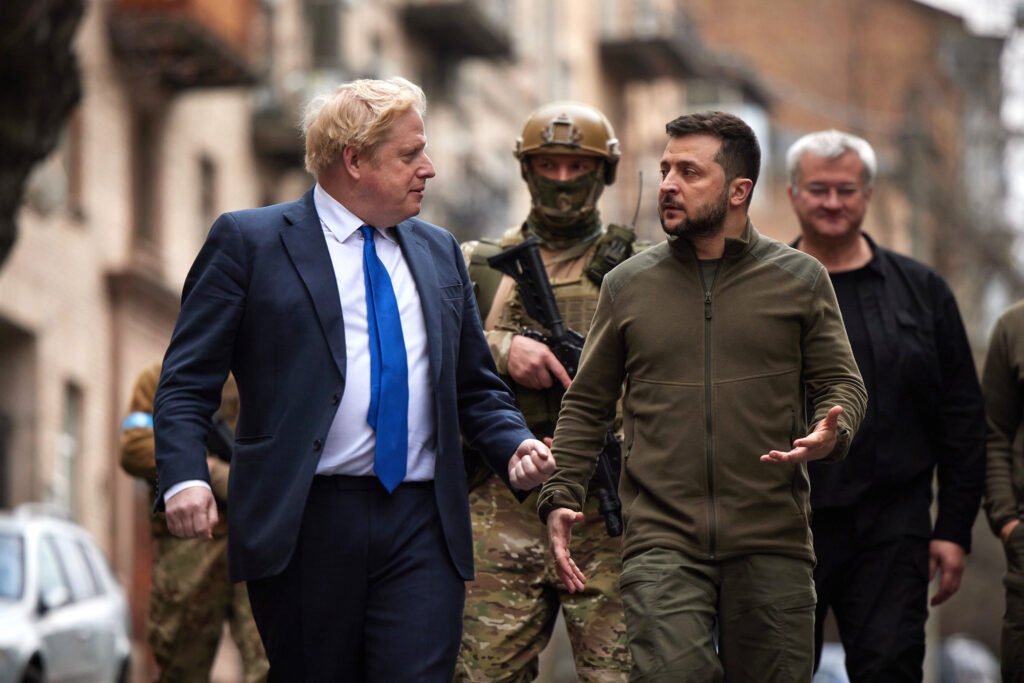
While negotiations continued in Istanbul, former U.K. Prime Minister Boris Johnson unexpectedly arrived in Kyiv on April 9 and said that Ukraine shouldn’t sign anything with them at all – and ‘let’s just fight.’ ”

Arakhamia’s candor was refreshing. But it came as no surprise to those of us following Ukraine in early 2022. On May 5, 2022 — a year and a half before Arakhamia spilled the beans to the Kyiv Post Ukrainska Pravda ran a report under the title “Possibility of talks between Zelensky and Putin came to a halt after Johnson’s visit:

“According to sources close to Zelenskyy, the Prime Minister of the United Kingdom, Boris Johnson, who appeared in the capital almost without warning, brought two simple messages.

The first is that Putin is a war criminal, he should be pressured, not negotiated with. And the second is that even if Ukraine is ready to sign some agreements on guarantees with Putin, they [the West] are not. The collective West felt that Putin was not really as powerful as they had previously imagined, and that here was a chance to press him.”

Three days after Johnson left Kyiv, Putin publicly stated that talks with Ukraine had “turned into a dead end.” Putin expressed confidence that Russia would ultimately prevail and added that it would “rhythmically and calmly” continue conducting the operation in Ukraine.

In his major speech to the Russian Foreign Ministry on June 14, Putin said the Russian troops approaching Kyiv in February-March 2022 were there “to push the Ukrainian side to negotiations.” 

From Feb. 24 on, the Russians had expressed readiness for diplomacy. Interestingly, Zelensky appointed Arakhamia chief negotiator on Feb. 28.

Putin continued:

“Surprisingly, as a result, agreements that satisfied both Moscow and Kyiv were indeed reached and initialed in Istanbul. … The document was titled ‘Agreement on Permanent Neutrality and Security Guarantees for Ukraine’. It was a compromise but  resolved the problems that were stated as major ones even at the start of the special military operation.

But the path to peace was rejected again. … The former UK prime minister said directly during his visit to Kyiv – no agreements. Russia must be defeated on the battlefield. … Thus they began to intensively pump Ukraine up with weapons and started talking about the need to inflict a strategic defeat on Russia.”

Who has been telling Biden that Putin “will not stop at Ukraine?” Exhibit A would be Fiona Hill, disciple of arch-Russophobe historian Richard Pipes, and national intelligence officer for Russia (2006-09). 

Her insights appeared in The New York Times exactly a month before Russia invaded Ukraine.

On Jan. 24, 2022, the Times featured a guest essay by Hill titled “Putin has the U.S. Right Where He Wants It”:

“This time, Mr. Putin’s aim is bigger than closing NATO’s ‘open door’ to Ukraine and taking more territory — he wants to evict the United States from Europe. As he might put it: ‘Goodbye, America. Don’t let the door hit you on the way out.’”  [Emphasis added.]

Fiona Hill’s NYT essay about Putin driving the U.S. out of Europe had a short (two-month) shelf life, as Putin’s negotiators in Istanbul extracted a Ukrainian commitment not to seek NATO membership and a stop in hostilities. Hill admitted as much in a September/October 2022 Foreign Affairs article which included, briefly, the substance of the Istanbul agreement.

This may be damning with faint praise but, in this respect, Fiona Hill showed far more integrity than the Times, which continues to deny its readers the facts about the Istanbul accord and how it showed that in March-April 2022 Putin did stop once Ukrainian negotiators agreed to forswear membership in NATO.

With Putin having provided, in his June 14 speech, chapter and verse on the (aborted by Boris Johnson) “Agreement on Permanent Neutrality and Security Guarantees for Ukraine,” the Times wasted no time distorting the terms of the Istanbul accord, mostly by omission and turgid obfuscation, in publishing two highly deceptive articles on June 15. 

Neither article mentions  Johnson’s wrecking-ball role in scuttling the Istanbul accord. And even the subsequent admissions of Ukrainian negotiators are mangled.

Thus, New York Times readers, and the thousands of media outlets that take their lead from the Times, are once again misled on a crucial issue — one for which there is ample official Ukrainian testimony that the Times chooses to omit or fudge. And many Americans will be inclined to believe Biden’s evidence-free claims about Putin’s ultimate objectives, and to acquiesce in the dangerously growing tension with Russia — malnourished as they are on accurate information.

For many it will come down to: Between Biden and Putin, Americans “know” whom to believe!


Speaking to Western journalists on June 5, Putin cautioned: 

“You should not make Russia out to be the enemy. You’re only hurting yourself with this … They thought that Russia wanted to attack NATO. Have you gone completely crazy? … Who came up with this? It is just complete nonsense, you know? Total rubbish.”

Sadly, it is the kind of nonsense that could mislead Americans, conditioned to believe the worst of Russia, into supporting some kind of risky escalatory move by an administration determined to show how tough it is, as the November election inches closer and closer. Strap on your seatbelts.


Ray McGovern works with Tell the Word, a publishing arm of the ecumenical Church of the Saviour in inner-city Washington. His 27 years as a C.I.A. analyst included leading the Soviet Foreign Policy Branch and conducting the morning briefings of the President’s Daily Brief. In retirement he co-founded Veteran Intelligence Professionals for Sanity (VIPS).

Views expressed in this article and may or may not reflect those of Consortium News.

No data was found

Share

Leave a Reply

Your email address will not be published. Required fields are marked *

Related Posts

America’s Strategic Assault on Art, Academia, and the Imagination That Sustains Peace The United States once stood as a beacon of cultural audacity—a place where dissent could be beautiful, and beauty and innovation could challenge the present order of things. Its museums, universities, and artists helped inspire a worldwide imagination rooted in creative freedom and innovation. But today, under the Trump regime’s second term, those dynamic qualities are being systematically dismantled. Just read this. As Trump goes after the arts, many museums remain silent | CNN As CNN reports, the administration has launched an aggressive campaign to “eradicate improper ideology” from federally funded museums. Exhibitions involving race, gender, and identity are being censored or cancelled. Amy Sherald’s reimagining of the Statue of Liberty as a Black, trans woman was pulled from the Smithsonian after curators objected to its symbolism. Sherald warned that “history shows us what happens when governments demand loyalty...
Contrary to what we stated when publishing this Call, the UN General Assembly (GA) opened on September 9, 2025, in New York, not in Geneva, as we initially wrote. However, due to the host role-violating US ban on visas to Palestinians, the Special GA Segment on Palestine will be held in the UN Geneva from September 22. And it builds up to something historic. Anyhow, here is what we believe you must advocate or do to help stop the Israeli genocide. It’s called people’s power or citizens’ diplomacy. SHARE! The first of three appeals from TFF. The second is here, and the third here. Across the world, people are witnessing the systematic destruction of Palestinian lives, homes, and communities. The scale and intensity of Israel’s military operations — especially in Gaza — have led leading legal bodies, including the International Court of Justice, to warn of a plausible genocide. The...
Professor Zhang Weiwei is a highly respected Chinese intellectual and professor at Fudan University in Shanghai. He is the director of its China Institute and also runs a series of conversations with many different people around the world. Here is what came out of their meetings there and in Skopje, Macedonia in October 2024: & ◪ As you can see, also at the end of the second one, we both enjoy win-win exchanges like these about world order issues. Zhang Weiwei is known for using videos and social media to reach a large audience in China and worldwide. We suggest you see many more of Zhang Weiwei’s conversations – like recently with Professor Jeffrey Sachs – on the Thinkers’ Forum on YouTube. PS TFF posts hundreds of videos, its own and those of others, in our Video Collections on TFF Substack – including those that appear on YouTube. However, TFF...

Recent Articles

We know that medical personnel have failed to report to higher authorities wounds that were clearly caused by torture and that they have neglected to take steps to interrupt this torture. In addition, they have turned over prisoners’ medical records to interrogators who could use them to exploit the prisoners’ weaknesses or vulnerabilities. We have not yet learned the extent of medical involvement in delaying and possibly falsifying the death certificates of prisoners who have been killed by torturers. A May 22 article on Abu Ghraib in the New York Times states that “much of the evidence of abuse at the prison came from medical documents” and that records and statements “showed doctors and medics reporting to the area of the prison where the abuse occurred several times to stitch wounds, tend to collapsed prisoners or see patients with bruised or reddened genitals.” http://www.truthout.org/docs_04/080604J.shtml#16 According to the article, two doctors who...
Jan Øberg behandler i artiklen en lang række faktorer, som ligger til grund for den måde vores samfund er organiseret på – og derfor også for konflikter. Artiklen introducerer således sammenhængen mellem familien, foreninger, regeringer, NGO’ er, nation, stat, nationalstat og alliancer for på denne måde bedre at kunne forstå konflikter og i sidste ende blive klogere mht. at løse disse. Øberg, der er fortaler for global bevidsthed, hvilket skal ses i lyset af den øgede globalisering, skelner mellem kulturkamp og kulturdialog. Endelig behandles begrebet magt og magtesløshed: giver magt ret til at udøve magt – fordi man mener at have ret? Litteraturliste og arbejdsspørgsmål efter artiklen. Ordene vi bruger om verden I satellitperspektiv kan man godt tale om den menneskelige familie eller menneskeheden. Udtrykket understreger, at der eksisterer – eller burde eksistere – et fællesskab fordi vi alle er mennesker og sammen bebor denne klode og ingen anden. Og...
Kapitel 2: Forskellige sider af Europa og USA…fortsat 2.5 Militære relationer I forbifarten har vi allerede sagt nogle ting om USA’s militære situation. Kig lige en gang til på afsnit 2.3. Nu skal vi uddybe det militære forhold mellem USA og EU. Der er en række ligheder mellem visse europæiske landes og USA’s militær. Næsten alle er med på en eller anden måde i NATO, direkte som medlem – selv Island, der ikke har et forsvar – eller indirekte i Partnerskab for Fred. USA og Canada er med i OSCE (på dansk OSSE), Organisationen for Sikkerhed og Samarbejde i Europa, der tæller over 50 lande. USA samt England og Frankrig er kernevåbenstater og de har styrker til intervention langt borte fra hjemlandet, om end USA’s er tifold større. Alle har også en omfattende våbeneksport og bruger den som et middel til at tjene penge og få loyale venner på, det...

TFF on Substack

Discover more from TFF Transnational Foundation & Jan Oberg.

Most Popular

We know that medical personnel have failed to report to higher authorities wounds that were clearly caused by torture and that they have neglected to take steps to interrupt this torture. In addition, they have turned over prisoners’ medical records to interrogators who could use them to exploit the prisoners’ weaknesses or vulnerabilities. We have not yet learned the extent of medical involvement in delaying and possibly falsifying the death certificates of prisoners who have been killed by torturers. A May 22 article on Abu Ghraib in the New York Times states that “much of the evidence of abuse at the prison came from medical documents” and that records and statements “showed doctors and medics reporting to the area of the prison where the abuse occurred several times to stitch wounds, tend to collapsed prisoners or see patients with bruised or reddened genitals.” http://www.truthout.org/docs_04/080604J.shtml#16 According to the article, two doctors who...
Jan Øberg behandler i artiklen en lang række faktorer, som ligger til grund for den måde vores samfund er organiseret på – og derfor også for konflikter. Artiklen introducerer således sammenhængen mellem familien, foreninger, regeringer, NGO’ er, nation, stat, nationalstat og alliancer for på denne måde bedre at kunne forstå konflikter og i sidste ende blive klogere mht. at løse disse. Øberg, der er fortaler for global bevidsthed, hvilket skal ses i lyset af den øgede globalisering, skelner mellem kulturkamp og kulturdialog. Endelig behandles begrebet magt og magtesløshed: giver magt ret til at udøve magt – fordi man mener at have ret? Litteraturliste og arbejdsspørgsmål efter artiklen. Ordene vi bruger om verden I satellitperspektiv kan man godt tale om den menneskelige familie eller menneskeheden. Udtrykket understreger, at der eksisterer – eller burde eksistere – et fællesskab fordi vi alle er mennesker og sammen bebor denne klode og ingen anden. Og...
Kapitel 2: Forskellige sider af Europa og USA…fortsat 2.5 Militære relationer I forbifarten har vi allerede sagt nogle ting om USA’s militære situation. Kig lige en gang til på afsnit 2.3. Nu skal vi uddybe det militære forhold mellem USA og EU. Der er en række ligheder mellem visse europæiske landes og USA’s militær. Næsten alle er med på en eller anden måde i NATO, direkte som medlem – selv Island, der ikke har et forsvar – eller indirekte i Partnerskab for Fred. USA og Canada er med i OSCE (på dansk OSSE), Organisationen for Sikkerhed og Samarbejde i Europa, der tæller over 50 lande. USA samt England og Frankrig er kernevåbenstater og de har styrker til intervention langt borte fra hjemlandet, om end USA’s er tifold større. Alle har også en omfattende våbeneksport og bruger den som et middel til at tjene penge og få loyale venner på, det...
Read More
Imagen-thumbnail-The-Transnational-1
We know that medical personnel have failed to report to higher authorities wounds that were clearly caused by torture and that they have neglected to take steps to interrupt this torture. In addition, they have turned over prisoners’ medical records to interrogators who could use them to exploit the prisoners’ weaknesses or vulnerabilities. We have not yet learned the extent of medical involvement in delaying and possibly falsifying the death certificates of prisoners who have been killed by torturers. A May 22 article on Abu Ghraib in the New York Times states that “much of the evidence of abuse at the prison came from medical documents” and that records and statements “showed doctors and medics reporting to the area of the prison where the abuse occurred several times to stitch wounds, tend to collapsed prisoners or see patients with bruised or reddened genitals.” http://www.truthout.org/docs_04/080604J.shtml#16 According to the article, two doctors who...
Imagen-thumbnail-The-Transnational-1
Jan Øberg behandler i artiklen en lang række faktorer, som ligger til grund for den måde vores samfund er organiseret på – og derfor også for konflikter. Artiklen introducerer således sammenhængen mellem familien, foreninger, regeringer, NGO’ er, nation, stat, nationalstat og alliancer for på denne måde bedre at kunne forstå konflikter og i sidste ende blive klogere mht. at løse disse. Øberg, der er fortaler for global bevidsthed, hvilket skal ses i lyset af den øgede globalisering, skelner mellem kulturkamp og kulturdialog. Endelig behandles begrebet magt og magtesløshed: giver magt ret til at udøve magt – fordi man mener at have ret? Litteraturliste og arbejdsspørgsmål efter artiklen. Ordene vi bruger om verden I satellitperspektiv kan man godt tale om den menneskelige familie eller menneskeheden. Udtrykket understreger, at der eksisterer – eller burde eksistere – et fællesskab fordi vi alle er mennesker og sammen bebor denne klode og ingen anden. Og...
Imagen-thumbnail-The-Transnational-1
Kapitel 2: Forskellige sider af Europa og USA…fortsat 2.5 Militære relationer I forbifarten har vi allerede sagt nogle ting om USA’s militære situation. Kig lige en gang til på afsnit 2.3. Nu skal vi uddybe det militære forhold mellem USA og EU. Der er en række ligheder mellem visse europæiske landes og USA’s militær. Næsten alle er med på en eller anden måde i NATO, direkte som medlem – selv Island, der ikke har et forsvar – eller indirekte i Partnerskab for Fred. USA og Canada er med i OSCE (på dansk OSSE), Organisationen for Sikkerhed og Samarbejde i Europa, der tæller over 50 lande. USA samt England og Frankrig er kernevåbenstater og de har styrker til intervention langt borte fra hjemlandet, om end USA’s er tifold større. Alle har også en omfattende våbeneksport og bruger den som et middel til at tjene penge og få loyale venner på, det...
Imagen-thumbnail-The-Transnational-1
Background Christian Harleman and Jan Oberg conducted a fact-finding mission to Burundi between November 26 and December 6, 2003. (See websites about the country here). The first TFF mission took place in March 1999. Unfortunately, since then it has not been practically possible to implement the co-operation with Burundi’s Ministry of Education and Burundian NGOs that was planned at the time. The 2003 mission had three purposes. First, to do fact-finding in general about the situation and, in particular, the progress under the Arusha Peace Process. Second, to explore the possibilities for co-operation between the government and relevant NGOs on the one hand and TFF on the other, in order to develop and deepen the existing competence in fields such as conflict-understanding, reconciliation and peace-building. Finally, third, to find out whether it would be possible, in co-operation with the Swedish Rescue Services Agency (Statens Räddningsverk), to establish a health care unit that...
Imagen-thumbnail-The-Transnational-1
Former UN Under-Secretary-General with special responsibility for peacekeeping operations TFF associate August 20, 2003 YRINGHAM, Mass.- Ralph Bunche was born in Detroit 100 years ago today (August 7, 2003). His passionate determination to get results did not extend to seeking credit for them, so his work is better remembered than he is. Of all his many accomplishments – civil rights pioneer, Nobel Peace Prize laureate, chief drafter of two chapters of the United Nations charter, negotiator of the armistices that ended the first Arab-Israeli war – Bunche said he was proudest of developing what came to be known as peacekeeping. Setting up the United Nations Truce Supervision Organization in Palestine in 1948, Bunche formulated the principles that have governed peacekeeping operations ever since. In the 1956 Suez crisis, working with Secretary General Dag Hammarskjold and Lester Pearson of Canada, he organized the first peacekeeping force, the United Nations Emergency Force...
– nästan 11 månader Till Sofia nästan 11 månader # 1  Till Sofias huvudsida Till alla Privata Foto-Serier