Vijay Prashad: The World Does Not Want a Global NATO

Fuyuko Matsui, Japan, “Becoming Friends with All the Children of the World,” 2004.

Vijay Prashad

August 4, 2022

The fragility of Europe’s energy supply has once again been on display in recent months. Gas shipments through the Nord Stream 1 pipeline, which runs from Russia to Germany, were reduced to 40 per cent of capacity in June, a cut that Moscow said was due to delays in the servicing of a turbine by the German firm Siemens.

Shortly thereafter, on July 11, the pipeline was taken offline for 10 days for annual routine maintenance. Despite receiving assurances from Moscow that the supply would resume as scheduled, European leaders expressed fear that the shutdown would continue indefinitely in retaliation for sanctions imposed on Russia following the invasion of Ukraine.

Originally published at Consortium News on July 29, 2022

On July 21, the flow of Russian gas into Europe resumed. Klaus Müller, the head Germany’s energy regulator, said that gas flows through Nord Stream 1 were below pre-maintenance levels during the first few hours of resumption, though they have now returned to 40 per cent capacity.

European anxieties related to energy supply are linked to fears amongst the region’s governments of further instability in the Eurozone.

On the same day that Nord Stream 1 resumed operations, Italy’s Mario Draghi resigned as prime minister, the latest in a dramatic series of resignations by heads of government in Bulgaria, Estonia and the United Kingdom. Resistance from Europe to a peace agreement with Russia comes alongside a recognition that trade with Russia is inevitable.

At No Cold War, an international platform seeking to bring sanity to international relations, we have been closely observing the shifting tenor of the war in Ukraine and the U.S.-driven pressure campaign against China.

We have published three previous briefings from this platform in our newsletters; below, you will find briefing No. 4The World Does Not Want a Global NATO, which details the emerging clarity in the Global South regarding the U.S.-European attempt to drive a belligerent agenda around the world.

This new clarity relates not only to the militarisation of the planet, but also to the deepening conflicts in trade and development, as evidenced by the G7’s new initiative, the Partnership for Global Infrastructure and Development, which clearly targets China’s Belt and Road Initiative.

In June, member states of the North Atlantic Treaty Organisation (NATO) gathered in Madrid for their annual summit. At the meeting, NATO adopted a new Strategic Concept, which had last been updated in 2010.

In it, NATO names Russia as its “most significant and direct threat” and singles out China as a “challenge [to] our interests.” In the words of NATO Secretary General Jens Stoltenberg, this guiding document represents a “fundamental shift” for the military alliance, its “biggest overhaul… since the Cold War.”

Monroe Doctrine for the 21st Century?

Although NATO purports to be a “defensive” alliance, this claim is contradicted by its destructive legacy – such as in Serbia (1999), Afghanistan (2001) and Libya (2011) – and its ever-expanding global footprint.

At the summit, NATO made it clear that it intends to continue its global expansion to confront Russia and China. Seemingly oblivious to the immense human suffering produced by the war in Ukraine, NATO declared that its “enlargement has been a historic success… and contributed to peace and stability in the Euro-Atlantic area,” and extended official membership invitations to Finland and Sweden.

However, NATO’s sights extend far beyond the “Euro-Atlantic” to the Global South. Seeking to gain a foothold in Asia, NATO welcomed Japan, South Korea, Australia and New Zealand as summit participants for the first time and stated that “the Indo-Pacific is important for NATO.”

On top of this, echoing the Monroe Doctrine (1823) of two hundred years ago, the Strategic Concept named “Africa and the Middle East” as “NATO’s southern neighbourhood,” and Stoltenberg made an ominous reference to “Russia and China’s increasing influence in [the Alliance’s] southern neighbourhood” as presenting a “challenge.”
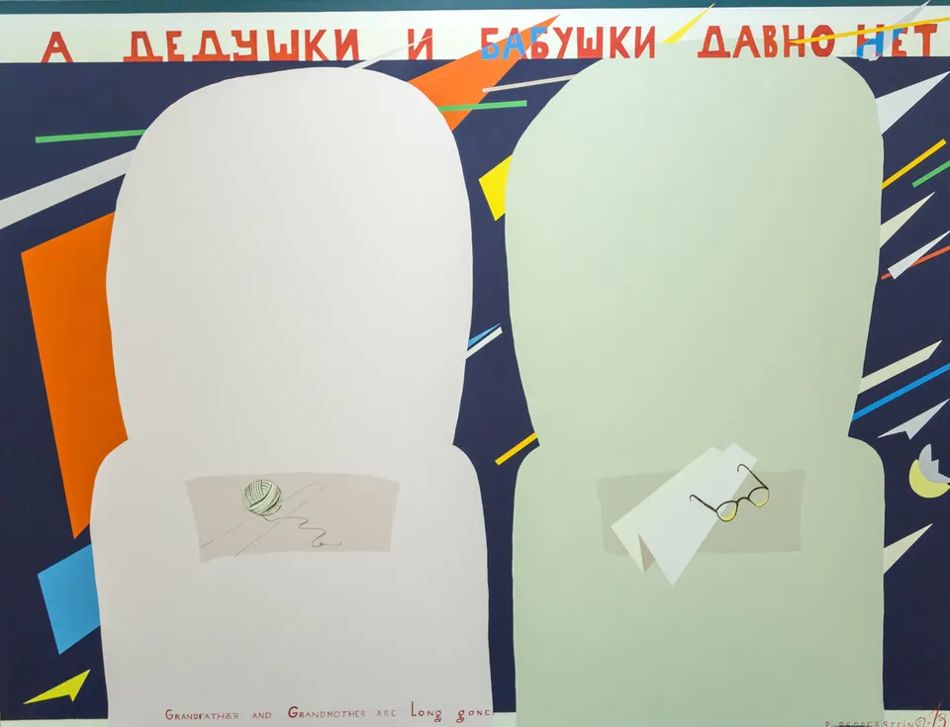
Pavel Pepperstein, Russia, “Grandfather and Grandmother Are Long Gone,” 2013.

Most of the World Seeks Peace

Although NATO’s member states may believe that they possess global authority, the overwhelming majority of the world does not. The international response to the war in Ukraine indicates that a stark divide exists between the United States and its closest allies on the one hand and the Global South on the other.

Governments representing 6.7 billion people – 85 per cent of the world’s population – have refused to follow sanctions imposed by the U.S. and its allies against Russia, while countries representing only 15 per cent of the world’s population have followed these measures. According to Reuters, the only non-Western governments to have enacted sanctions on Russia are Japan, South Korea, the Bahamas and Taiwan – all of which host U.S. military bases or personnel.

There is even less support for the push to close airspace to Russian planes spearheaded by the U.S. and European Union. Governments representing only 12 per cent of the world’s population have adopted this policy, while 88 per cent have not.

U.S.-led efforts to politically isolate Russia on the international stage have been unsuccessful. In March, the U.N. General Assembly voted on a nonbinding resolution to condemn Russia’s invasion of Ukraine: 141 countries voted in favour, five countries voted against, 35 countries abstained and 12 countries were absent. However, this tally does not tell the full story.

The countries which either voted against the resolution, abstained, or were absent represent 59 per cent of the world’s population. Following this, the Biden administration’s call for Russia to be excluded from the G20 summit in Indonesia was ignored.

Tadesse Mesfin, Ethiopia, “Pillars of Life: Harmony,” 2018.

Meanwhile, despite intense backing from NATO, efforts to win support for Ukraine in the Global South have been a complete failure. On June 20, after several requests, Ukrainian President Volodymyr Zelensky addressed the African Union; only two heads of state of the continental organisation’s 55 members attended the meeting. Shortly thereafter, Zelensky’s request to address the Latin American trade bloc, Mercosur, was rejected.

It is clear that NATO’s claim to be “a bulwark of the rules-based international order” is not a view which is shared by most of the world. Support for the military alliance’s policies is almost entirely confined to its member countries and a handful of allies which together constitute a small minority of the world’s population.

Most of the world’s population rejects NATO’s policies and global aspirations and does not wish to divide the international community into outdated Cold War blocs.

BahadIr Gokay, Turkey, “Evvel” or “Before,” 2013.

In 1955, 10 years after the U.S. dropped an atom bomb on Hiroshima (Japan), the Turkish poet Nâzim Hikmet wrote a poem in the voice of a 7-year-old girl who died in that terrible act. The poem was later translated into Japanese by Nobuyuki Nakamoto as “Shinda Onnanoko” (“Dead Girl”) and is frequently sung in commemorations of that atrocity.

Given the harshness of war and the escalation of conflict, it is worthwhile to reflect once more on Hikmet’s beautiful, haunting lyrics:

I come and stand at every door
But no one hears my silent tread.
I knock and yet remain unseen
For I am dead, for I am dead.

I’m only seven, although I died
In Hiroshima long ago.
I’m seven now as I was then.
When children die, they do not grow.

My hair was scorched by swirling flame.
My eyes grew dim; my eyes grew blind.
Death came and turned my bones to dust
And that was scattered by the wind.

I need no fruit, I need no rice.
I need no sweets, nor even bread.
I ask for nothing for myself
For I am dead, for I am dead.

All that I ask is that for peace
You fight today, you fight today
So that the children of the world
May live and grow and laugh and play.

Originally published at Consortium News on July 29, 2022

About the author

Vijay Prashad

Vijay Prashad is an Indian historian, editor and journalist. He is a writing fellow and chief correspondent at Globetrotter. He is an editor of LeftWord Books and the director of Tricontinental: Institute for Social Research. He is a senior non-resident fellow at Chongyang Institute for Financial Studies, Renmin University of China. He has written more than 20 books, including The Darker Nations and The Poorer Nations.  His latest books are Struggle Makes Us Human: Learning from Movements for Socialism and, with Noam Chomsky,  The Withdrawal: Iraq, Libya, Afghanistan, and the Fragility of US Power.

This article is from Tricontinental: Institute for Social Research.

Please help TFF remain truly independent by contributing if you benefited from this article

[paypal-donation]
Share

Leave a Reply

Your email address will not be published. Required fields are marked *

Related Posts

Launched on November 17, 2024Updated with new materials regularly TFF Board members Thore Vest. Everywhere, the delegation was met with a sincere wish to develop knowledge, dialogue, cooperative projects, and initiatives based on citizens’ diplomacy – in general, but with the West in particular. For more, see “Report from the Nordic delegation to China’s Xinjiang Province, September 7-15, 2024.” While the delegation was in Xinjiang, various ideas were already being discussed from the local to the top level, i.e., with the governor and party leaders of Xinjiang. The two TFF Associates suggested that TFF set up a special section – in addition to its “China and Silk” – where various quality materials about Xinjiang would regularly be published to promote public education about Xinjiang, particularly its contemporary development – worldwide but in the West in particular. This is now a reality – as can be seen below – but it...
Foreword The Board of The Transnational Foundation in Sweden has decided to publish an easy-to-read, scholarly anthology that addresses one of the most important – and potentially dangerous – issues of our time: Why are the political, economic, and medialised Western images of China so consistently negative – and what can you do to understand China better? These images may be expressions of a political will to present only various shades of grey and black with the aim of building a consciousness about China as an enemy and not a partner. They may also be seen as a sort of world-dominating ethos of ignorance based upon the assumption that “we’ve-got-nothing-to-learn-from-others,’ we are the teacher. Another possibility is that the West, deep down, feels that it is getting relatively weaker from a macro-historical perspective and comforts itself with denial and accusations against “the other” of being the reason for its manifest...
With a few words about the US’ domestic authoritarianism and NATO’s reckless expansion and re-armament where everything else but that is needed. George Orwell’s prophetic book, 1984, was written in 1948 and was published on 9 June 1949. So, today is the 76th anniversary of the publication of that important and prophetic book. The book centres on the consequences of the decline of democracy and the rise of totalitarianism, mass surveillance and repressive regimentation of people’s behaviour within society. The book was influenced by totalitarianism under Stalin and censorship and propaganda under the Nazis. The book is not about any particular society but refers to any society that falls under the influence of those oppressive policies. The book is basically about the power of propaganda and indoctrination employed in the service of authoritarian rulers and regimes. Orwell warned us that the manipulation of the public in the service of autocracies did...

Recent Articles

PressInfo # 141, December 21, 2001It’s time to prepare reconciliation between Albanians and Serbs PressInfo # 140, December 14, 2001Ibrahim Rugova’s decade-long leadership in Kosovo/a PressInfo # 139, 11. december, 2001En god nyhet: Jugoslaviens Sannings- och försoningskommission PressInfo # 139, 11. december, 2001Gode nyheder: Jugoslaviens Sandheds- og Forsoningskommission PressInfo # 139, December 11, 2001Good news: Yugoslavia’s Truth and Reconciliation Commission PressInfo # 138, November 8, 2001TFF co-founder PhD with thesis about young people with roots in other cultures PressInfo # 138, November 8, 2001TFF:s medstiftare doktor på avhandling om unga med ursprung i andra kulturer PressInfo # 137, October 17, 2001A new Marshall Plan: Advancing human security and controlling terrorism PressInfo # 136, October 15, 2001The UN and Annan really deserve it PressInfo # 135, October 10, 2001Preventing a terrorist mushroom cloud PressInfo # 134, 17 oktober, 2001Sverige og 11. september PressInfo # 134, October 9, 2001Sweden and September 11...
Peace is promoted by constructive proposals and dialogue Four preceding PressInfos have expressed concern over — and criticised — the ongoing, militarisation of the EU. Some will say: but there are no alternatives. We believe that there are always alternatives, that democracies are characterised by alternatives and choice, and that openly discussed alternatives will improve the quality and legitimacy of society’s decision–making. In addition, it is an intellectual and moral challenge to not only criticise but also be constructive. If we only tell people that we think they are wrong, they are not likely to listen. However, if we say: what are your views on this set of ideas and steps? — we may sometimes engage them in dialogue and sow a seed. Most people in power circles live their daily lives in in a time frame and a social space where certain ideas, viewpoints and concepts are just not...
Photos © TFF 2000 Read PressInfo 90 “Lift the Sanctions and Bring More Aid to Yugoslavia” See Pictures from Belgrade © TFF 2000 Please reprint, copy, archive, quote or re-post this item, but please retain the source.

TFF on Substack

Discover more from TFF Transnational Foundation & Jan Oberg.

Most Popular

PressInfo # 141, December 21, 2001It’s time to prepare reconciliation between Albanians and Serbs PressInfo # 140, December 14, 2001Ibrahim Rugova’s decade-long leadership in Kosovo/a PressInfo # 139, 11. december, 2001En god nyhet: Jugoslaviens Sannings- och försoningskommission PressInfo # 139, 11. december, 2001Gode nyheder: Jugoslaviens Sandheds- og Forsoningskommission PressInfo # 139, December 11, 2001Good news: Yugoslavia’s Truth and Reconciliation Commission PressInfo # 138, November 8, 2001TFF co-founder PhD with thesis about young people with roots in other cultures PressInfo # 138, November 8, 2001TFF:s medstiftare doktor på avhandling om unga med ursprung i andra kulturer PressInfo # 137, October 17, 2001A new Marshall Plan: Advancing human security and controlling terrorism PressInfo # 136, October 15, 2001The UN and Annan really deserve it PressInfo # 135, October 10, 2001Preventing a terrorist mushroom cloud PressInfo # 134, 17 oktober, 2001Sverige og 11. september PressInfo # 134, October 9, 2001Sweden and September 11...
Peace is promoted by constructive proposals and dialogue Four preceding PressInfos have expressed concern over — and criticised — the ongoing, militarisation of the EU. Some will say: but there are no alternatives. We believe that there are always alternatives, that democracies are characterised by alternatives and choice, and that openly discussed alternatives will improve the quality and legitimacy of society’s decision–making. In addition, it is an intellectual and moral challenge to not only criticise but also be constructive. If we only tell people that we think they are wrong, they are not likely to listen. However, if we say: what are your views on this set of ideas and steps? — we may sometimes engage them in dialogue and sow a seed. Most people in power circles live their daily lives in in a time frame and a social space where certain ideas, viewpoints and concepts are just not...
Photos © TFF 2000 Read PressInfo 90 “Lift the Sanctions and Bring More Aid to Yugoslavia” See Pictures from Belgrade © TFF 2000 Please reprint, copy, archive, quote or re-post this item, but please retain the source.
Read More
Imagen-thumbnail-The-Transnational-1
PressInfo # 141, December 21, 2001It’s time to prepare reconciliation between Albanians and Serbs PressInfo # 140, December 14, 2001Ibrahim Rugova’s decade-long leadership in Kosovo/a PressInfo # 139, 11. december, 2001En god nyhet: Jugoslaviens Sannings- och försoningskommission PressInfo # 139, 11. december, 2001Gode nyheder: Jugoslaviens Sandheds- og Forsoningskommission PressInfo # 139, December 11, 2001Good news: Yugoslavia’s Truth and Reconciliation Commission PressInfo # 138, November 8, 2001TFF co-founder PhD with thesis about young people with roots in other cultures PressInfo # 138, November 8, 2001TFF:s medstiftare doktor på avhandling om unga med ursprung i andra kulturer PressInfo # 137, October 17, 2001A new Marshall Plan: Advancing human security and controlling terrorism PressInfo # 136, October 15, 2001The UN and Annan really deserve it PressInfo # 135, October 10, 2001Preventing a terrorist mushroom cloud PressInfo # 134, 17 oktober, 2001Sverige og 11. september PressInfo # 134, October 9, 2001Sweden and September 11...
Imagen-thumbnail-The-Transnational-1
Peace is promoted by constructive proposals and dialogue Four preceding PressInfos have expressed concern over — and criticised — the ongoing, militarisation of the EU. Some will say: but there are no alternatives. We believe that there are always alternatives, that democracies are characterised by alternatives and choice, and that openly discussed alternatives will improve the quality and legitimacy of society’s decision–making. In addition, it is an intellectual and moral challenge to not only criticise but also be constructive. If we only tell people that we think they are wrong, they are not likely to listen. However, if we say: what are your views on this set of ideas and steps? — we may sometimes engage them in dialogue and sow a seed. Most people in power circles live their daily lives in in a time frame and a social space where certain ideas, viewpoints and concepts are just not...
Imagen-thumbnail-The-Transnational-1
Photos © TFF 2000 Read PressInfo 90 “Lift the Sanctions and Bring More Aid to Yugoslavia” See Pictures from Belgrade © TFF 2000 Please reprint, copy, archive, quote or re-post this item, but please retain the source.
Imagen-thumbnail-The-Transnational-1
Av FRANK SØHOLM GREVIL 16 augusti 2004  Vi er nu nået til tredje akt i det absurde teaterstykke, der i analogi med de store skueprocesser i Moskva 1936-38 er blevet døbt ‘Grevil-sagen’. Første akt bestod i min anonyme fremlæggelse af egenhændigt nedklassificerede rapporter i Berlingske Tidende i februar og marts. Andet akt udgjordes af min fremtræden med navn og billede i Information i april samt den efterfølgende mediestorm, som uden min direkte medvirken kostede en forsvarsminister taburetten samt en sigtelse for brud på tavshedspligten. Tredje akt bliver en retssag, hvor jeg står tiltalt for at have overtrådt straffelovens bestemmelser om uberettiget videregivelse eller udnyttelse af fortrolige oplysninger. Statsanklageren har ovenikøbet valgt at påberåbe sig særligt skærpende omstændigheder. Da jeg aldrig har modtaget betaling for at stille rapporterne til rådighed eller lade mig interviewe, må det skærpende bestå i, at “videregivelsen eller udnyttelsen er sket under sådanne omstændigheder, at det påfører...
Imagen-thumbnail-The-Transnational-1
Af Svenska Irakkommittén mot de Ekonomiska Sanktionerna (SIES) 13 september 2002 FN:s ekonomiska sanktioner mot Irak har nu pågått i tolv år och drabbat det irakiska folket med svåra lidanden. Enligt FN:s egna siffror har mer än 1,5 miljoner människor, varav ca 600 000 barn, dött som en direkt följd av sanktionerna. Dessutom har ett lågintensivt bombkrig mot landet pågått under dessa år. Av all denna förödelse- orsakad huvudsakligen av amerikansk och brittisk politik- har Saddam Husseins brutala och diktatoriska regim snarast stärkts än försvagats. Nu förbereder USA under president Bushs ledning ett storskaligt bombkrig mot Irak som kommer att innebära ett ännu större lidande för civilbefolkningen. Ett sådant krig kommer dessutom att ytterligare undergräva freden och säkerheten i världen. Att upprätta en demokratisk regim i Irak är det irakiska folkets angelägenhet och får enligt folkrätten inte ske med krigshandlingar utifrån. Folkrätten och FN:s stadgar måste respekteras. Vi vädjar till...