
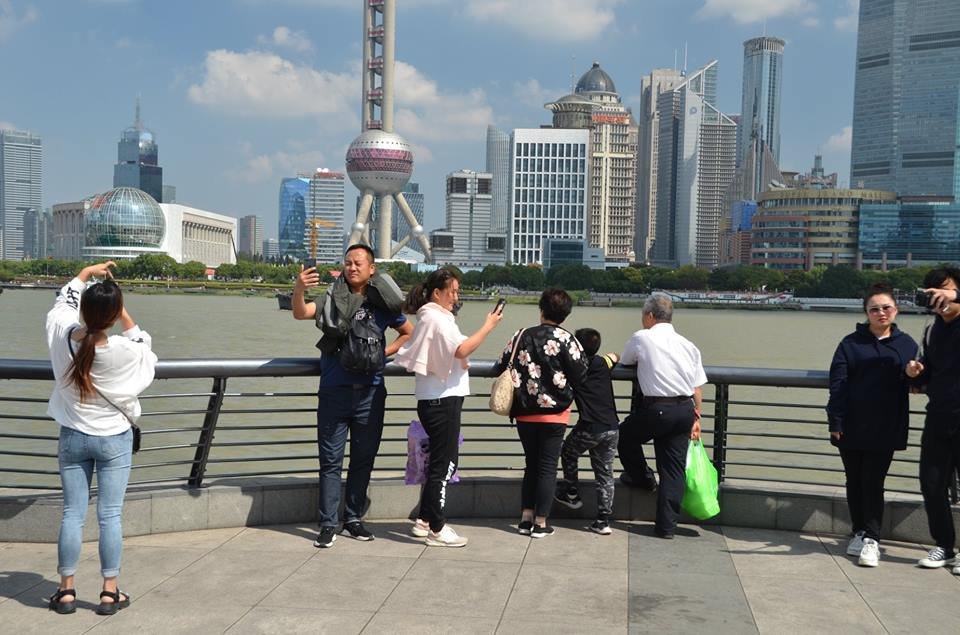
Photo from Shanghai by Jan Oberg 2018
By Cecily Liu in London from China Daily
October 22, 2018
Esteemed author says nation’s development model can be a blueprint for emerging economies
China’s rapid growth since the reform and opening-up process began in 1978 has not only been an economic miracle for the nation, but it has also offered a new development model for other emerging economies, said Martin Jacques, author of the global bestseller When China Rules the World.
In doing so, China has proved the inaccuracy of the previous consensus that the Western model of development was the only path to success.
Effectively, Jacques said, China has inspired other emerging countries to explore development paths that are suitable for their own situations.
Originally published by chinadaily.com
“The achievements of China’s reform and opening-up are very simple: one, the transformation of China; two, the transformation of the world,” said the 73-year-old from his apartment in London’s Hampstead, where piles of books and notes on China lay scattered across his desk, bookshelves and the floor.
Jacques is one of Britain’s best-known Sinologists. Born in 1945 in Coventry, he had a decadeslong distinguished career in journalism before becoming an author.
He first rose to prominence as editor of Marxism Today, a position he held for 14 years from the late 1970s. He turned the publication from an obscure left-wing political magazine to one containing views from across the political spectrum.
Jacques then went on to be deputy editor of The Independent in the mid-1990s and now combines being a high-profile columnist with lecturing around the world.
But what really made him world famous was his 2009 book When China Rules the World, which has been translated into 15 languages and has sold 350,000 copies. His 2010 TED Salon speech in London on understanding the rise of China has received more than 2.7 million views on YouTube.
His book correctly predicted China’s ascent to global leadership, at a time when the trend was not so obvious. More precisely, it predicted that by 2027, China’s economy would be bigger than that of the United States. His book also argued that China’s governance system was an effective alternative to Western liberal democracy and represented a new form of modernity.
Jacques argued against the prevailing consensus that China’s development model would become more like that of the West as it grew economically. Time has proved him right – China has cemented its economic strength internationally without becoming a mirror image of the West.
In addition, China is now using its international influence to lead on multilateral issues, such as globalization, climate change and global governance, in its own unique way. In order to share its development experiences with other emerging economies and improve global trade links, China has championed the Belt and Road Initiative and the Asian Infrastructure Investment Bank.
“China is going to be a very different kind of great power,” he said. “The Belt and Road is a powerful example of China trying to find a new relationship (that can benefit both China and other countries). This notion is very different from Western colonial thinking.”
The AIIB, which focuses on financing infrastructure projects in Asia, represents the interests of more than 80 member countries through a pluralistic approach. The BRI, which aims to improve trade and connectivity between Asia, Africa and Europe through infrastructure investment, has also attracted keen participation from public-and private-sector players globally.
In Jacques’ view, these exciting initiatives, supported by China’s economic strength, challenge the post-Cold War mentality that divided the world into the West and the rest.
For many, the fall of the Berlin Wall in 1989 and the disintegration of the Soviet Union in 1991 proved that socialist countries could not make sufficient economic progress without adopting the development model of the West.
“That was the great and final victory of the West,” Jacques said. “It’s strange now to think that. And if you look back now, it’s obvious, in my view, that 1978 was a far more important year in world history than 1989 or 1991.”
But China’s economic success proved that such progress can be made while the government maintains an important role in guiding the country’s direction.
“We must always remember that only about 15 percent of the world’s population lives in the developed world, which is essentially the West plus Japan,” he said. “Eighty-five percent of the world’s population lives in the developing world. Until quite recently, the world was still a Western world. China’s rise gave the developing world an alternative place to look, for development, for inspiration.”
If you are always with someone of the same culture you are an insider and never looking from the outside.
Additionally, the fact China grew from being a poor, developing country to a strong economic power means it has accumulated significant lessons and experiences that could be applicable to other developing countries today.
“China is a developing country and can understand the problems of development in a totally different way,” he said. “The United States cannot relate to (the developing world) in the way that China can.”
Although Jacques is now a firm advocate of China’s incredible potential, he admits to having been somewhat ignorant of the East until 1993, when he visited China, Singapore, and Malaysia for a holiday.
In China, he saw construction cranes working round the clock, roads streaming with trucks and carts, and women balancing goods on the ends of bamboo poles.
“It absolutely seized my mind,” he said. “Guangdong province was a sort of huge building site with land being cleared as far as you could see. So many people were in motion along the road. It was so obvious this was a huge, important historical moment I was watching.”
From there, Jacques has watched China transform on his subsequent trips.
“When you go to any city in China now, you see a modern city,” he said. “Living standards have clearly been transformed.”
While on holiday in 1993, he met his wife, Malaysian-Indian lawyer Harinder Veriah, on the island of Tioman, off the east coast of Malaysia. Veriah, who died in 2000, inspired Jacques to understand more about Asia, and made him more determined to write a book that explained his discoveries to the world.
“She taught me to see the world from a non-Western perspective,” he said. “If you are always with someone of the same culture you are an insider and never looking from the outside. She helped me see my country from an outsider’s perspective.”
In the years that followed, Jacques frequently traveled to China and other East Asian countries to research his book. When he started, the book’s working title was “The End of the Western World”. But gradually, as he worked on it, he realized that the book had to be primarily about China, which led to its new title, When China Rules the World.
Looking back, he stressed the crucial role of China’s reform and opening-up policies in shaping the country’s economic achievements and its global influence.
In particular, he marvels at pioneering leader Deng Xiaoping, who is credited with turning China’s planned economy into a market-driven one and for strengthening China’s exchange efforts with the world.
He praised Deng’s courage in the way he “fired the starting gun” for China’s transformation at a moment of significant change in Chinese society.
In particular, Deng transformed the world’s understanding of a socialist country. Instead of following the inward-looking model of the Soviet Union, Deng advocated an unprecedented outward approach.
“Deng Xiaoping said, ‘We want to be a part of the world, we have to learn from the rest of the world, we must be open to the rest of the world,'” Jacques said. “That is fantastic. Now, we can see how important Deng is as a socialist thinker, who is also a global thinker, a leader for everyone.”
For Jacques, Deng’s remarks exhibit tremendous confidence, something that is impressive, considering China was then a poor country.
“The idea that you can measure against the rest of the world, and be willing to learn straight away, it’s a confident attitude,” he said.
China’s recent history details a success story. In 1978, the size of China’s economy was just one-40th of that of the US, but during the past 40 years, China’s GDP has grown by an average of about 9.5 percent a year. By 2017, the size of China’s economy had grown to more than three-fifths that of the US, according to International Monetary Fund estimates.
During the past four decades, China has also succeeded in lifting more than 740 million people out of poverty.
Jacques said he feels confident that China will continue to develop. He said its GDP growth rate may drop to a more sustainable level over the long term, but its development will increasingly focus on innovation and quality growth.
He recalled that when he first published When China Rules the World, one question he was often asked at author talks was how China could break free from the need to imitate advanced economies’ technology, and what would happen if the country reached the point where it was inventing its own technology.
“I never hear that question anymore, because the answer is clear with the transformation of the technology companies in China,” Jacques said.
For instance, in the second quarter of this year, China’s Huawei overtook Apple to become the world’s second-largest smartphone seller.
In the pioneering sector of mobile payments, China has emerged as the biggest market, worth 40.36 trillion yuan ($5.90 trillion) in the first quarter of this year. Its two biggest payment companies, WeChat Pay and Alipay, now have 900 million and 500 million active users respectively. These numbers eclipse Apple Pay’s 127 million active users.
Accompanying these technology innovations is China’s rapidly strengthening intellectual property system and its soaring number of patent registrations. Chinese companies’ filings with the European Patent Office in 2017 were up 16.6 percent year-on-year, compared with the global average of 3.9 percent.
This year, for the first time, Huawei topped the EPO’s league table by number of patents filed by a single company, ahead of Siemens and LG.
While China’s development path shows a rosy picture full of excitement, Jacques also warns that one challenge China will encounter in the future is the antagonism it will attract from Western countries fearful of being challenged.
Equally, the novelty of China-proposed initiatives such as the BRI could lead to questions and doubts. US President Donald Trump’s moves to instigate a large-scale trade confrontation with China this year is evidence of the sort of external pressure China must learn to face, he said.
The trade dispute, which started this year, has seen the US slap tariffs on billions of dollars of Chinese imports, and China doing the same in retaliation. Many companies have already been negatively impacted, including US companies that rely on the supply chain in China.
Jacques said he feels that the attitude in the US under Trump is based on a recognition that China has been successful, and that the antagonism US administration has expressed toward China has, in a sense, spoken of the success of China.
“As China has risen, its relationship with the US has become more difficult,” Jacques said. “For the US, it’s one thing to look relatively benignly on China when it’s well behind, but when China is not well behind, but is a competitor who has an alternative view of the world, then that’s a different game.”
He said that as China experiences rapid transformation and gains global influence, it must find its own new position in the world and ensure that other countries are comfortable with it.
“China has got to find a way of dealing with it,” he said. “By and large, I think it’s succeeding in doing it, but it’s not a simple matter.”
Originally published at chinadaily.com
1945 in Coventry, England
1957-64:King Henry VIII School, Coventry
1968: Manchester University,BA in economics (first class honors)
1976: King’s College, Cambridge, PhDCAREER:
1965-90: Executive committee member,Communist Party of Great Britain
1969-71: Tutor in economic history,King’s College, Cambridge
1971-77: Editor of Marxism Today
1993: Editor and founder of London-basedthink tank Demos
1994-96: Deputy editor of The Independent
2003-08: Visiting fellow, London School ofEconomics Asian Research Center
2009: Author of When China Rules the World
2010-11: Bosch public policy fellow at theTransatlantic Academy, Washington
2013-present: Senior fellow at the Departmentof Politics and International Studies, CambridgeUniversity
2016-present: Visiting professor, Tsinghua University, Beijing.


