January 2020

Showing 1-10 of 4089 stories

Sort by
Categories

Year

Author / Contributor

Region

USwaronIraq
By William Arkin January 29, 2020 Ten days before Donald J. Trump was elected president in 2016, the United States nuked Iran. The occasion: a nuclear war exercise held every year in late October. In the war game, after Iran sank an American aircraft carrier and employed chemical weapons against a Marine Corps force, the Middle East commander requested a nuclear strike, and a pair of B-2 stealth bombers, each loaded with a single nuclear bomb, stood by while the president deliberated. “Testing our forces through a range of challenging scenarios validates the safety, security, effectiveness and readiness of the strategic deterrent,” Adm. Cecil D. Haney, then the commander of U.S. Strategic Command, said as the exercise got underway. According to a government contractor who helped write the complex scenario leading up to the decision to use nuclear weapons, Global Thunder 17 (as the exercise was called because it took...
jonathanpower
Let’s cut to the chase – there is no question, no doubt, that the government of Myanmar and the army which controls it have committed the most vile atrocities against the Rohingya people, a Muslim minority that lives in the West of the Buddhist-dominated country. The International Court of Justice (the World Court) which ruled last week against the Myanmar government, may not have concluded it was genocide as some say but it did unreservedly condemn the government for its atrocious sowing of violent mayhem against the Rohingya. The Court has ordered Myanmar to take steps to prevent acts of genocide against the 700,000 or so Rohingya that remain in exile, mainly in overcrowded, unsanitary refugee camps and the 500,000 who still reside in Myanmar, and to prevent the destruction of any evidence of genocide. The Court will continue to gather evidence of attempted genocide. The UN Secretary-General, Antonio Guterres,...
Imagen-thumbnail-The-Transnational
Based on CORREIO BRAZILIENSE, Jan. 28, 2020, Interview by Rodrigo Craveiro on Trump’s ‘Deal of the Century’ Question 1 Why are Palestinian leaders rejecting to talk with President Trump about this new peace plan? Trump made so many important controversial and major concessions to Israel on issues that prior pro-Israeli US presidents refused to do. These unilateral giveaways included moving the US Embassy to Jerusalem in defiance of UN agreement to resolve this issue by negotiations between the parties; assert that the establishment of settlements on Occupied Palestine was legal despite the near-universal agreement that all settlements are unlawful if established on Occupied Palestine; recognize Israeli sovereignty over the Golan Heights, which Israel acquired by force in the 1967 War and by unanimous  Security Council Resolution 242 was ordered to withdraw from. In effect, it became obvious to even the weakest Palestinian leadership that such a one-sided approach to resolving...
death
By Nicolas J.S. Davies January 27, 2020 The numbers of casualties of U.S. wars since Sept. 11, 2001, have largely gone uncounted, but coming to terms with the true scale of the crimes committed remains an urgent moral, political and legal imperative, argues Nicolas J.S. Davies, in part two of his series. Originally posted on Consortium News April 3, 2018 here Part One here In the first part of this series, I estimated that about 2.4 million Iraqis have been killed as a result of the illegal invasion of their country by the United States and the United Kingdom in 2003. I turn now to Afghan and Pakistani deaths in the ongoing 2001 U.S. intervention in Afghanistan. In part three, I will examine U.S.-caused war deaths in Libya, Somalia, Syria and Yemen.  According to Ret. U.S. General Tommy Franks, who led the war against the Taliban in Afghanistan in reaction to 9/11, the U.S. government...

mafiaUS
VideoAnother video from the event where the author gave this talk Like perhaps most people who visit Los Angeles, I consider it my duty to offer a brilliant new idea for a film script. My idea is in the genre of science-fiction mafia, a genre that I think has not been sufficiently exploited. In this film, the protagonist wakes up to the fact that without knowing it, he has somehow joined the mafia. I expect people to be able to relate to the story because I believe that this entire country either has become aware or needs to become aware that it has joined the mafia. How do major U.S. newspapers and television news programs refer to the murder of an Iranian general? Never with the word murder. Often with words like “deal with” or “take out.” Trump had to deal with him. You could read an article like that,...
RichardFalk
Prefatory Note: The post below is a somewhat amplified version of an interview with C. J. Polychroniou, journalist and professor of political economy at West Chester University, which was published on January 7, 2020, in the online journal, Global Policy. As the interview was conducted in December 2019, it fails to address the various disruptive consequences of the assassination of Qasem Soleimani, including the violation of Iraqi sovereignty, Baghdad being the site of the drone attack, as well as the risks of war arising from an escalating tit-for-tat cycle of actions and reactions. Given growing tensions between the interconnectedness of the world and the state-centric character of international law, including contradictions between totalizing and disregarding territorial sovereignty, state-centric world order is being increasingly marginalized by geopolitical behaviour that both generates and suppresses transnational political violence. A normative crisis with structural implications exists, and is not even being widely appreciated much less...
1-sgnDEjgU7f4-cv0V9d2DIg
If you appreciated this conversation with a leading TFF expert Farhang Jahanpour is a retired professor from the University of Isfahan and former part-time tutor at the University of Oxford, former TFF Board member and now TFF Associate. The Nuclear Non-Proliferation Treaty (NPT) that takes center stage in this conversation can be read here.
death
By Nicolas J. S. Davies* January 17, 2020 How many people have been killed in America’s post-9/11 wars? I have been researching and writing about that question since soon after the U.S. launched these wars, which it has tried to justify as a response to terrorist crimes that killed 2,996 people in the U.S. on September 11th, 2001. Originally posted on Consortium News, January 15, 2020, here But no crime, however horrific, can justify wars on countries and people who were not responsible for the crime committed, as former Nuremberg prosecutor Ben Ferencz patiently explained to NPR at the time. “The Iraq Death Toll 15 Years After the U.S. Invasion” which I co-wrote with Medea Benjamin, estimates the death toll in Iraq as accurately and as honestly as we can in March 2018.  Our estimate is that about 2.4 million people have probably been killed in Iraq as a result of the historic act of aggression committed by the U.S. and U.K. in...
the-anti-nuclear-march-in-new-york-citys-central-park-june-12-1982-1024x689-1
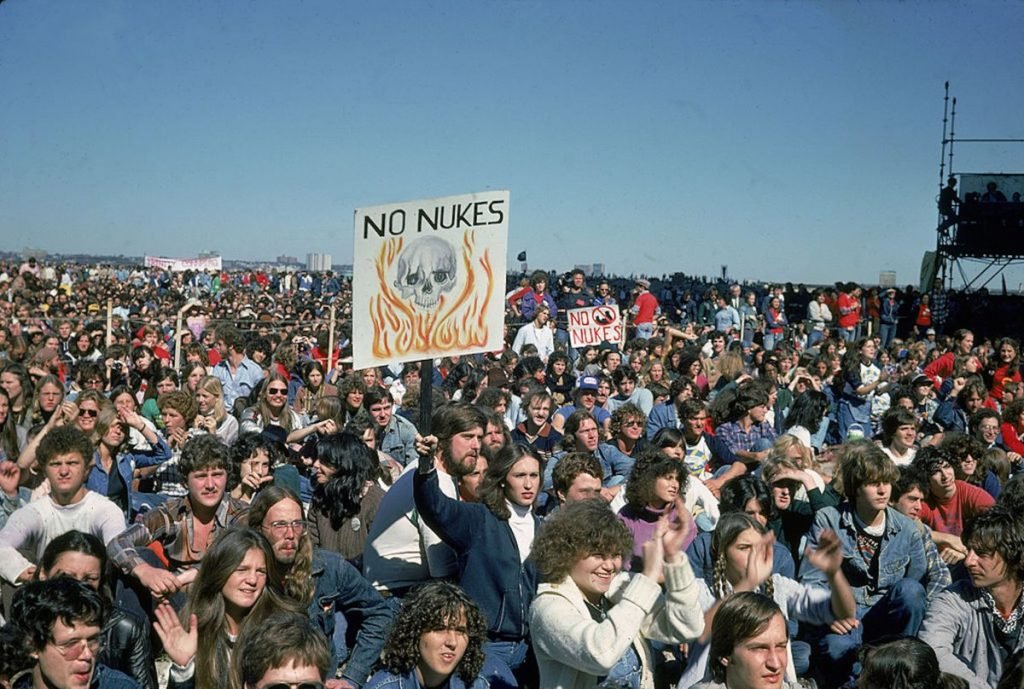
By Dr. Lawrence Wittner January 17, 2020 Although today’s public protests against nuclear weapons can’t compare to the major antinuclear upheavals of past decades, there are clear indications that most Americans reject the Trump administration’s nuclear weapons policies. Originally posted on History News Network on December 22, 2019 here Since entering office in 2017, the Trump administration has withdrawn the United States from the nuclear agreement with Iran, scrapped the Intermediate-Range Nuclear Forces (INF) Treaty with Russia, and apparently abandoned plans to renew the New START Treaty with Russia. After an overwhelming majority of the world’s nations agreed on a landmark UN Treaty on the Prohibitions of Nuclear Weapons in July 2017, the Trump administration quickly announced that it would never sign the treaty.  The only nuclear arms control measure that the Trump administration has pursued―an agreement by North Korea to abandon its nuclear weapons program―appears to have collapsed, at least in part because the Trump administration badly mishandled the negotiations. Moreover, the Trump...
StreetGarbage_Orig_1000-72dpi
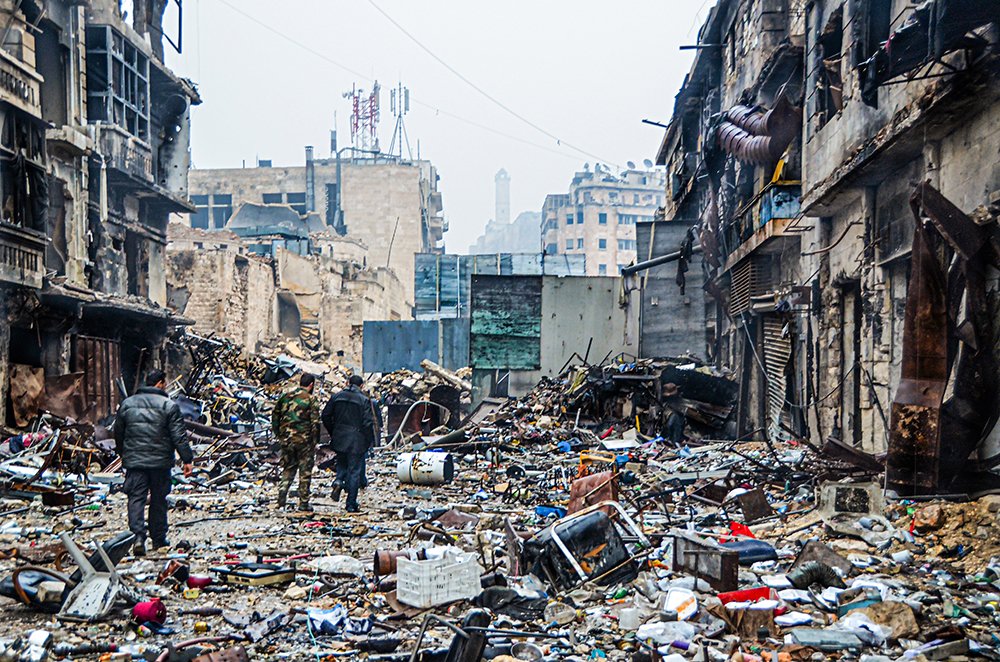
Photo – Eastern Aleppo, December 2016 – © Jan Oberg By Gordon M. Hahn January 17, 2020 If Western leaders are able to put aside the now worn-out cliches such as Russian Vladimir Putin ‘punching above his weight,’ ‘Trump handing Putin a victory on a silver plate’, not to mention ‘Trump as Putin agent’, there are serious lessons that they might still be able to draw from Putin’s looming victory in Syria.  Originally posted on Gordon M. Hahn’s personal blog on December 2, 2019 here First, the era in which the United States and/or the West (NATO) can dictate outcomes anywhere across the globe unilaterally has ended. Events in Syria are but the latest confirmation of this fact, but many in Washington and Brussels still do not see it. NATO expansion drove Russia into China’s arms, and the rest is history and the future.  Second, Washington and Brussels (NATO and...
jonathanpower
The struggle for the Donbass region in the eastern and southern Ukraine goes on, seemingly never ending. It’s now six years since dissident militias threw off the yoke of the central government in Kiev and declared their de-facto independence. They were supported by Russian troops which at first president Vladimir Putin denied and then later admitted. It was the Russians who supplied the missile launcher that accidentally shot down a Malaysian Airlines passenger jet. Altogether 17,000 people, mostly civilians, have died in this conflict. Negotiations, brokered by Germany and France, have been held on and off for six years. In December the latest effort was held in Paris. The parameters of a settlement are easily put: in return for Donbass being granted a large amount of autonomy (it could be approximately the same as Scotland has today), Russian troops would withdraw and the militias disbanded. Nevertheless, the gap between the...
PressTV
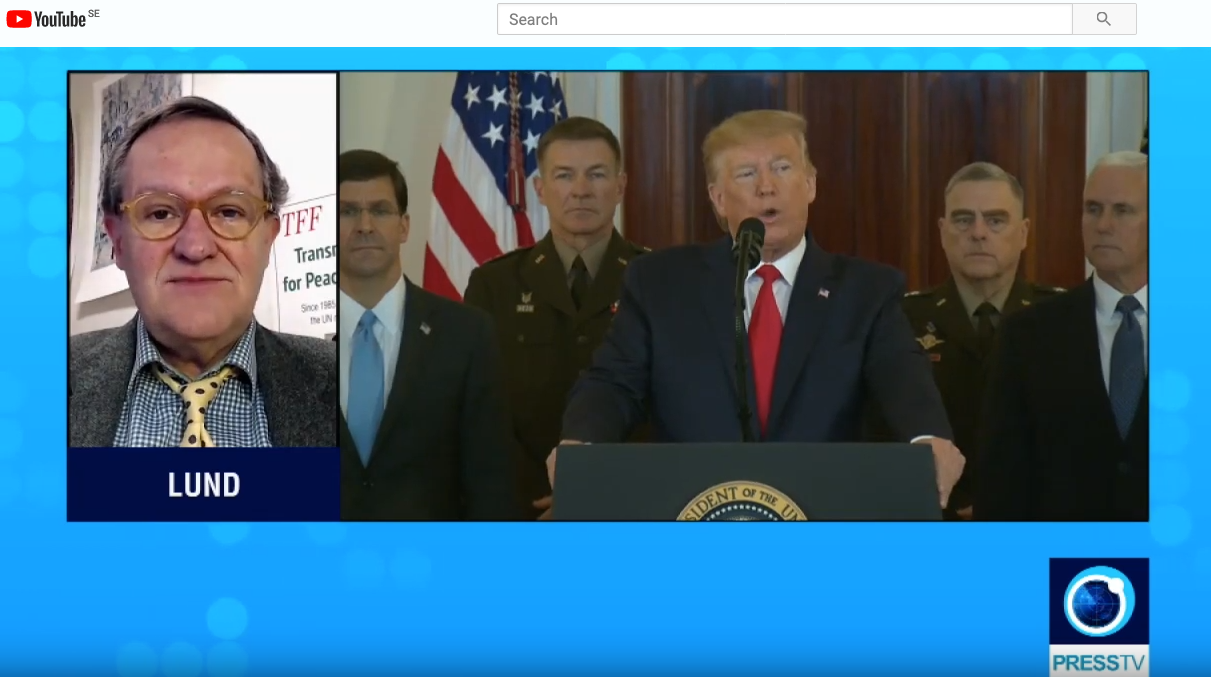
European allies of the U-S have turned down a request by the American President to leave the 2015 nuclear deal with Iran (JCPOA). France says it remains committed to the Iran deal, and will continue to work with other parties. Britain has pledged to remain committed too. Prime Minister Boris Johnson reaffirmed London’s support, in a phone call with Iran’s president Hassan Rouhani. US president Donald Trump called on France, Germany, Britain and other signatories to leave the Iran deal and negotiate a new accord. Trump withdrew the US from the agreement in May 2018 and reinstated even harder sanctions on the innocent people of Iran. Editor’s noteUnfortunately, a couple of days after this video was posted and accessible, Google which owns YouTube decided to close down PressTV’s account. Today, January 21, we tried again at no avail. It’s blatant censorship, allegedly explained by Google as a way to adhere...