December 2013

Showing 1-10 of 4181 stories

Sort by
Categories

Year

Author / Contributor

Region

jonathanpower2
/10/jonathanpower2.jpg”> We have a lot to be thankful for in 2013. Look at the protests now going on in Bangkok. After some initial clashes at the beginning both sides have become non-violent. One can praise the government of Prime Minister Yingluck Shinawatra for this. She ordered the gates and doors of the ministry of the interior, of the police and the Thai equivalent of Scotland Yard/FBI to be opened. The protesters poured into the buildings and then left – bored. In the Ukraine after a couple of nights of police brutality President Vikto Yanukovych ordered the police to restrain themselves. Both sides now use peaceful tactics. Non-violence à la Gandhi and Martin Luther King doesn’t always achieve its objectives, but it keeps the political temperature down and avoids many deaths. It is more likely to work when there is a grave injustice. This is not the case either in Thailand...
johangaltung
What a Christmas gift to all of us from that amazing Pope Francis, his first Message for the World Day of Peace, Fraternity, the Foundation and Pathway to Peace. A tightly reasoned statement in ten sections; here is an effort to summarize some key points: 1. An irrepressible wish for fraternity enables us to see others not as enemies or rivals, but as brothers and sisters. However, reference to a common Father is needed; otherwise it becomes “a mere do ut des /I give so that you give/ which is both pragmatic and selfish”. 2. The story of Cain and Abel /the first brothers, sons of the first couple, Adam and Eve/ “teaches that we have an inherent calling to fraternity, but also the tragic capacity to betray that calling”: Cain killed Abel out of jealousy because God preferred Abel. 3. Human fraternity is regenerated in and by Jesus Christ...
richardfalk
Having visited Belfast the last few days during some negotiations about unresolved problems between Unionist and Republican (or Nationalist) political parties, I was struck by the absolute dependence for any kind of credibility of this process upon the unblemished perceived neutrality of the mediating third party. It would have been so totally unacceptable to rely on Ireland or Britain to play such a role, and the mere suggestion of such a partisan intermediary would have occasioned ridicule by the opposing, and confirmed suspicions that its intention must have been to scuttle the proposed negotiations. In the background of such a reflection is the constructive role played by the United States more than a decade ago when it actively encouraged a process of reconciliation through a historic abandonment of violence by the antagonists. That peace process was based on the justly celebrated Good Friday Agreement that brought the people of Northern...
richardfalk
The more contact one has with the modern state, even in those societies that have long constitutional traditions entrenching civil liberties, the more grounds there are for deep and growing concern. I suppose that the most dramatic exhibition of the dangers being posed as 2014 approaches, and we are reminded that this will be 30 years after 1984, are associated with Edward Snowden’s extraordinary disclosures of the global network of surveillance being operated by the National Security Agency in the United States (NSA). Such a network presupposes that we are all, that is, every inhabitant on the planet to be regarded as worth investigating as potential terrorist threats, and along the way establishing a huge data bank of information that can be used for nefarious purposes at any point to disempower and subvert protest movements or even blackmail anyone seen to be obstructing projects dear to the government or any...
richardfalk
My friend and former collaborator, Howard Friel, has written an intriguing book contrasting the worldviews and polemical styles of two Jewish American intellectuals with world class reputations, Noam Chomsky and Alan Dershowitz (Friel, Chomsky and Dershowitz: On Endless War and the End of Civil Liberties, Olive Branch Press, 2014). The book is much more than a comparison of two influential voices, one critical the other apologetic, with respect to the Israel/Palestine struggle and the subordination of private liberties to the purveyors of state-led security at home and abroad. Friel convincingly favors Chomsky’s approach both with respect to the substance of their fundamental disagreements and in relation to sharply contrasting styles of argument. Chomsky is depicted, accurately I believe, as someone consistently dedicated to evidenced based reasoning reinforced by an abiding respect for the relevance and authority of international law and morality. Chomsky has also been a tireless opponent of American...
jonathanpower2
/10/jonathanpower2.jpg”> Chile has moved to the left. With Michelle Bachelet’s overwhelming victory in the presidential poll she now has the freedom to legislate as she wants. Poverty reduction, income re-distribution and education are the sharp end of her political program. But of all Latin American presidents she is perhaps the most fortunate. Despite his draconian suppression of human rights, the dictator, General Augusto Pinochet, who ruled in the 1970s and 80s, not only engineered high economic growth he also kept deep poverty at bay.
johangaltung
Milano There it is, that fantastic duomo, the fourth in size in the Christian world, honoring their God, exuding self-confidence, and the beauty of the marble stones of the huge façade. Founded six hundred years ago, took five centuries to build, a marvel of engineering and architecture. A major concert with a choir does not manage to fill the inner space of the dome, but of the listeners, yes, with awe. Conceived in the “dark ages” as those masters of cultural violence, our historians, call them, the “middle ages”, presumably between two “shiny ages”, the Roman Empire and Western colonialism, “modern times”. Will anything built today be visited by people in five hundred years, filling them with awe? Some banks, corporations? Some corrupted national assemblies? Some stadiums, shopping centers sloppily made, collapsing, built with no love, except for money? Some huge missile ramps to sow death and harvest hatred and...

Imagen-thumbnail-The-Transnational-1
Summary 1. That Iran, the West and other countries are in touch after decades of frozen relations indeed offers a ray of hope. The Geneva deal between the 5P+1 and Iran of November 24, 2013 can be seen as a first, very important step in what is bound to be a long process of building trust, security and co-operation. And it reduces the risk of war, a war no one can afford and no one will win. But there are also serious reasons for concern. 2. Contrary to Western media and policy interpretation is not a fair deal but expressive of conflict a-symmetry, a winner/loser perspective that has little, if anything to do with genuine conflict-resolution and trust-building. 3. The media reports on it has been quite biased and tacit of just how strong remains the pressure on Iran and the suffering of its citizens. 4. Iran did the only...
janoberg
/10/janoberg.jpg”> This Sunday morning, I stumble upon this article on BBC’s homepage – the French foreign minister is “pessimistic” about the negotiations to be held in January in Montreaux, Switzerland about Syria. This is a slightly expanded version on what I jotted down on TFF Facebook: • Look: First you simplify the conflict beyond recognition, the usual two parties: one side with all the good people and one side with all the bad people – the type of conflict analysis that has proved to never work anywhere (but you learnt nothing from Somalia, Yugoslavia, Afghanistan, Iraq, or Libya). • You set up the Friends of Syria – but with such friends, who need an enemy? • You act as if you have noble motives but never recognize that the French, British and other interventionist and war history in Syria and surroundings is a main reason behind today’s terrible situation. And...
NobelDeltagare
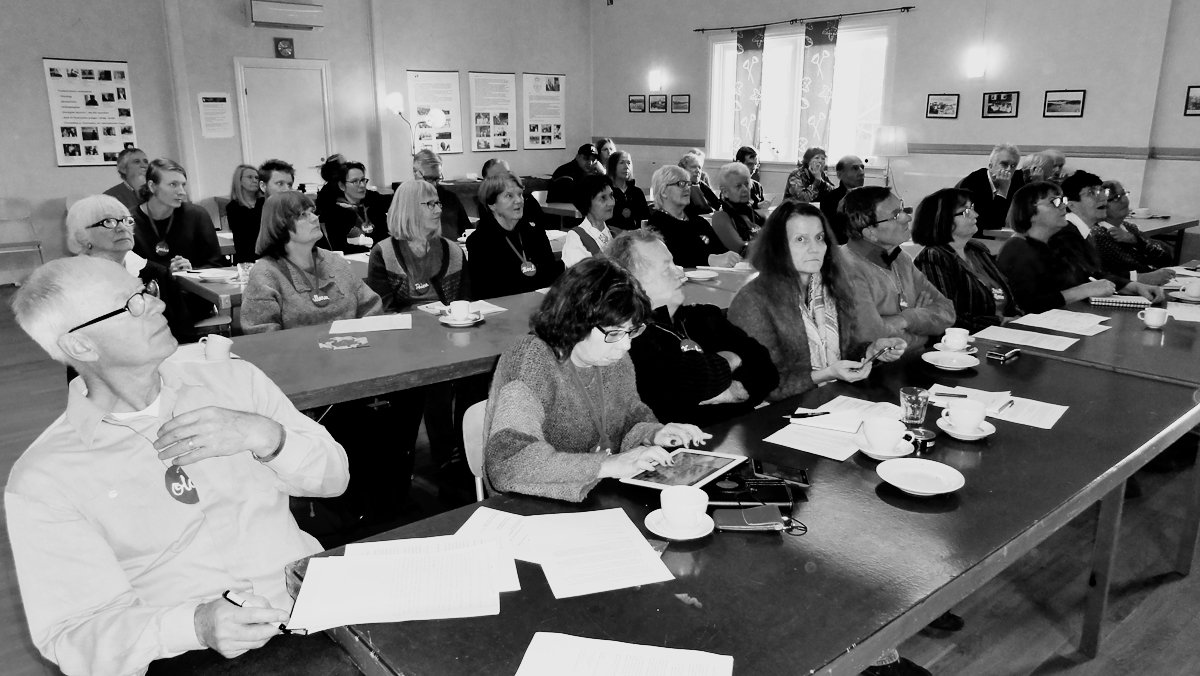
By Jan Oberg Here first the important statement by seminar participants (in Swedish below): The Nobel Peace Prize must not be misused A Nordic seminar at Orust (Sweden) about the Nobel Peace Prize has analysed the Norwegian Nobel Committee’s selection of awardees over time. Lead by former Prime Minister Torbjørn Jagland, it has awarded the prize to e.g. Wangari Maathai, Al Gore, Shirin Ebadi, Liu Xiabo, Barack Obama and institutions such as the European Union (EU). The mentioned personalities have undoubtedly contributed in various ways to a better future of the world but they have not met the criteria which Alfred Nobel formulated in his will, namely: • Active struggle for the abolition or reduction of standing armies • Contributing to the fraternity among nations • Creation of negotiations/dialogues aiming at peace and congresses for peace • Resilience as ”fredsförfäktare” – champions of peace. This unambiguous anti-militarist mandate is strongly...
richardfalk
Fifteen years ago I had the extraordinary pleasure of meeting Nelson Mandela in Cape Town while he was serving as President of South Africa. It was an odd occasion. I was a member of the International Commission on the Future of the Oceans, which was holding a meeting in South Africa. It happened that one of the vice chairs of the Commission was Kader Asmal, a cherished friend and a member of the first Mandela cabinet who himself played a major role in the writing of the South African Constition. Kader had arranged for Mandela to welcome the Commission to his country, and asked me if I would prepare some remarks on his behalf, which was for me an awesome assignment, but one that I undertook with trepidation, not at all confident that I could find the words to be of some slight help to this great man. Compounding my...
johangaltung
Washington-DC In the shorter run, till around 2020, not good; in the longer run, from 2030, not bad at all. Short-run possibilities: Politically: post-democracy, Congress more accountable to business than to people for election; the top executive power possibly sliding from the president to the supreme court justice, with money steering politics, protected as “freedom of expression”; Snowden-type revelations coming from once a year to once a month, once a week. Economically: runaway inflation; accelerating inequality; deep misery affecting one third to a half of the population; depression. Militarily: coup by evangelical fundamentalists to “give us our country back”/”give our, empire, our world”; using war to restore the economy; a temporary strong hand “to get things going”. Culturally: declining faith in a covenant with a universal God as the Exceptional Chosen People; anomie, absence of compelling norms. Socially: atomie, lacking social tissue, leading to collective and individual depression; increase in...