March 2002

Showing 1-10 of 5098 stories

Sort by
Categories

Year

Author / Contributor

Region

Imagen-thumbnail-The-Transnational-1
A discussion for La Vanguardia, Spain March 26, 2002 Andre Malraux in his Antimemoirs writes of the “East…likened to an old Arab on his donkey sleeping the inviolable sleep of Islam”. Hegel too thought that the Orient was in a long winter sleep. For Marx the situation was worse. Since the Orient was dominated by despotism, there were no classes, so they were stuck in the Asian Mode of Production, a limbo where nothing of significance happened or could happen over the centuries. Osama bin Ladin has certainly shattered those illusions. All of a sudden, the Americans, safe in their cocoon of North American “isolationism”, have been rudely awakened to the dangers of “wars of civilization” almost like Star Wars in science fiction. Muslim “hordes” fired up with religious zealotry are said to be preparing to wage suicidal war on “the West”. At least that is the impression one receives...
Imagen-thumbnail-The-Transnational-1
By Shastri Ramachandaran, Editor, Times of India Stockholm   March 26, 2002 STOCKHOLM: Has Sweden lost its way? Or is it merely stuck at the crossroads? This is the dilemma of a pioneer. Having opted out of the beaten course, the path-breaker must for ever be conscientious about progress in a chosen direction. It calls for sustained vision to remain steadfast in a self-elected mission. Unfortunately, Sweden, once perceived as a moral superpower that outshone the nuclear powers in their battle armour has lost its reference points: the twin routes of unbridled capitalism and Stalinist socialism between which it charted a promising new way. The Third Way, born of the visionary-activism of Olof Palme, one of the tallest social democrats and celebrated ‘Third Worlder’, was a beacon of hope for many in the South, and also sections in the North, who were unwilling to hitch their wagon to the Cold Warriors....
Imagen-thumbnail-The-Transnational-1
By Edward S. Herman and David Peterson   March 26, 2002 One of the marks of exceptional hegemonic power is the ability to define words and get issues framed in accord with your own political agenda. This is notorious at this moment in history as regards “terrorism” and “antiterrorism.” Since the September 11 attacks, two truths have been indisputable and universally reported. One is that the hijacker bombings of the World Trade Center and Pentagon were atrocities of a monumental and spectacular scale (and media coverage of that day’s events alone may have generated more words and graphic images than any other single event in recent history). A second truth is that the bombings were willful acts of terrorism, accepting the basic and widely agreed-upon definition of terrorism as “the use of force or the threat of force against civilian populations to achieve political objectives.” And let us also recognize that...
Imagen-thumbnail-The-Transnational-1
Av Lars-Olof FredrikssonMajor, Ret, M.Sc.Pol., Äänekoski, Finland  26 mars 2002  Jag minns sextiotalets fredsdiskussioner och demonstrationer, alla med udden riktade mot kalla krigets kapprustning och de strategiska vapnens snabba spridning, i synnerhet i Europa. Som ung officer ville jag försvara neutraliteten och det självständiga försvaret då som nu. I de finska diskussionerna fanns det i många partier en stark vilja att stödja Sovjets rätt till rustning i solidaritetens och fredens namn. Känns det bekant? Visst är det samma sorts resonemang som nuförtiden ständigt ekar från väst när President Bush påstår sig ha rätt att utkämpa fullskaligt krig mot terrorismen, talar ut om “ondskans axel” och delar in världen i de som är med USA och de som inte är det. Kalla krigets fred hade sin grund i de två antagonistiska blockens förmåga att bekämpa varandra, även &endash; ifall avskräckningen skulle misslyckas &endash; medelst kärnvapen. Men ingen vågade utmana grundförutsättningen och...
Imagen-thumbnail-The-Transnational-1
A hundred-page guide to the latest ideas on war reporting, based on tough, honest debates with 200 top journalists and analysts who together came up with a practical checklist for the ethical reporting of conflict. The book shows how patterns of reporting violence may exert a cumulative influence on the behaviour of parties to a conflict and, therefore, the course of subsequent events. It suggests that conflict analysis skills could help journalists come to grips with their responsibilities, by clarifying the connections between reporting and reality on the ground. There are detailed sections on Israel & the Palestinians; Macedonia; Africa & the DRC; Iraq, and Indonesia. Including practical examples of stories on each conflict demonstrating how each could be radically enhanced if the checklist points are applied. “First class” – Fergal Keane, Special Correspondent, BBC “A thoughtful blend of academic rigour and journalistic experience… To read it is to learn...
Imagen-thumbnail-The-Transnational-1
LONDON – George W.Bush, the world now realizes, was born with a silver spoon in his mouth. World events, everything from the political composition of the U.S. Supreme Court, from terrorism to the American economy seem to have a preordained way of working in his electoral favour. Again it is happening with Latin America. By rights the chickens should be coming home to roost as Bush girds up for his end of week visit to Mexico, Peru and Central America but, in fact, Argentina apart, the tides, both political and economic, appear to be working in his favour. Just the other day the International Monetary Fund issued a report saying that Latin America was “set for recovery”, likely to benefit from lower financing costs, higher commodities and an expected rebound in the U.S. economy, with a projected growth by the end of the year of 4% (excluding Argentina).  For the last...

Imagen-thumbnail-The-Transnational-1
The Invention of Peace. Reflections on War and International Order By Michael Howard Yale University Press, 2000 The professor of military history of the universities of Yale and Oxford here in a short book distills the great historical sweep of his earlier volumes. With his usual felicity of expression he explains the origins of war in human society, its ingrained nature through the millennia, and argues that it would be foolish to believe that after the Cold War permanent peace has come upon us.I recomend this book for those who like the long view of history and who like to be convinced that mankind will never change its (violent)spots!
Imagen-thumbnail-The-Transnational-1
LONDON – In his autobiography “A Soldier’s Way”, General Colin Powell recounts the build up to the 1991 Gulf War when he was the Chairman of the Joint Chiefs of Staff and Dick Cheney was the Secretary of Defence. “Cheney kept assigning me last-minute tasks….He had a third question and I jotted it down in my notebook simply as “prefix 5”, my nuclear qualification code. “Let’s not even think about nukes”, I said, “You know we’re not going to let that genie loose”. “Of course not”, Cheney said. “But take a look to be thorough and just out of curiosity”. Colin L. Powell – A Soldier’s Way (UK Edition) Colin L. Powell – My American Journey (US Edition) Powell played the same role in the Administration of Bush father as he does in that of Bush son, the voice of reason, not the token black but the token liberal who is allowed to speak, in...
DharamGroup3
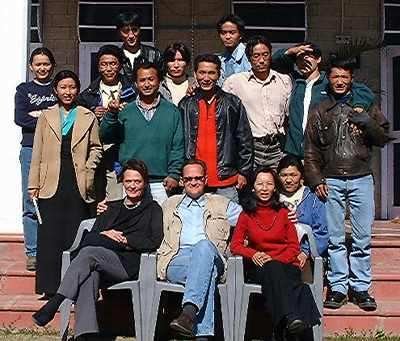
Tibetan Centre For Conflict Resolution, TCCRNangsi Rest HouseDharamsala -176215.Distt. Kangra, (H.P.) India.Telephone : 01892-26627 Tibetan Centre for Conflict Resolution (TCCR) is a non-profitable, educational organisation dedicated to the non-violent management of conflicts in the Tibetan Community and the world as a whole. Tibetan Centre for Conflict Resolution Aims : To promote the approaches and tools of non-violent conflict resolution and democratic processes in our Tibetan community in exile and elsewhere. Thus strengthening our unity, which, in turn ensures the continuance of our non-violent struggle in the long run. We Believe That : Conflicts are challenges Conflicts are life’s challenges to us. As His Holiness the Dalai Lama said during a private audience to us, “As long as there is human Society, there will always be conflicts. As I always say that if we do not want conflicts at all we have to make the entire humanity stupid or dull, and...
Imagen-thumbnail-The-Transnational-1
LONDON – Only this weekend’s election can save Zimbabwe- once the star of black Africa- from total ruin. And even that is uncertain. A country so mismanaged requires more than a new leader and governing party. It requires ten years of political calm and incorruptible government to get back on its feet. And Zimbabwe for all the intimidatatory tactics of President Robert Mugabe remains a democracy and thus Mugabe, even if he loses the poll, will live to fight another day, able to mobilize the bitterness and resentment of the poor and unemployed to undermine a new government, as he has worked to undermine the opposition the last few years. The trouble with Robert Mugabe is that his single-minded, Marxist militancy that was a useful tool in driving to defeat the white, racist, government of Rhodesia (as it then was) and its British supporters in the Conservative party is the same...
Imagen-thumbnail-The-Transnational-1
A Balkan perspective 1. A Global Perspective and General Deliberations – and Concrete Repercussions September 11th will surely go down in the annals of terrorism as a defining moment. Terrorism had long been recognised as a global, regional, and national security threat, but the developments of the last year have the potential to outline the future shape of the world community. September 11th gave momentum to two processes, the consequences of which are very difficult to control or foresee. The mass-scale terrorist attacks and the ‘war on terrorism’ are caught in the same vicious circle. They comprise a global spiral of violence. The crucial difference behind this ‘post-modern’ terrorism is that it involves major non-state and state powers: a powerful global network of terrorist cells, Al-Qaeda, and the only global super-power, the USA. Unfortunately, the struggle between the ‘elephants’ brings heavy consequences to the ‘ants’ of the ‘global village’. Certain...
Imagen-thumbnail-The-Transnational-1
Since we agreed to work towards the convening of this Conference, the whole world has been shaken to its foundations, first by the atrocities in the United States on September 11th, and then by the American response, which was to proclaim a “war against terrorism”, and to launch the first instalment of that war in Afghanistan. Critics at the time argued that terrorism ought properly to be understood as a criminal offence, and that a declaration of “war” against an enemy which was often shadowy and ill-defined, involved not only logistical but also logical problems which would cause serious difficulties as the project unwound. The subsequent bombardment of Afghanistan has of course created a large number of civilian casualties. By the end of 2001, as many or more innocent civilians had been killed in Afghanistan by high altitude bombardment as perished in the Twin Towers in New York in the...