
June 26, 2023
New York Times
About the Archive
This is a digitized version of an article from The Times’s print archive, before the start of online publication in 1996. To preserve these articles as they originally appeared, The Times does not alter, edit or update them.
Occasionally the digitization process introduces transcription errors or other problems; we are continuing to work to improve these archived versions.
Originally published in The New York Times on Dec. 26, 1977
Not long after John Kenneth Galbraith, the Harvard economist, arrived in India in 1961 to take up his new post as American Ambassador, he became aware of a curious political journal called Quest that was floating around the Asian subcontinent.
The following oracle is bused on reporting by John M. Crewdson and Joseph B.Treaster. It was written by Mr. Crewdson.
“It had a level of intellectual and political competence that was sub‐zero,” Mr. Galbraith recalled in an interview. “It would make you yearn for the political sophistication of The National Enquirer.”
Though an English‐language publication, “it was only in some approximation to English,” he said. ‘The political damage it did was nothing compared to the literary damage.”
Then the new Ambassador discovered that Quest was being published with money from the Central Intelligence Agency. At his direction the C.I.A. closed it clown.
Though perhaps less distinguished than most, Quest was one of dozens of English and foreign language publications around the world that have been owned, subsidized or influenced in some way by the C.I.A. over the past three decades.
Although the C.I.A. has employed, dozens of American journalists working abroad, a three‐month inquiry by a team of reporters and researchers for The New York Times has determined that, with a few notable exceptions, they were not used by the agency to further its worldwide propaganda campaign,
In its persistent efforts to snape world opinion, the C.I.A. has been able to call upon a separate and far more extensive network of newspapers, news services, magazines, publishing houses, broadcasting stations and other entities over which it has at various times had some control.
A decade ago, when the agency’s corn
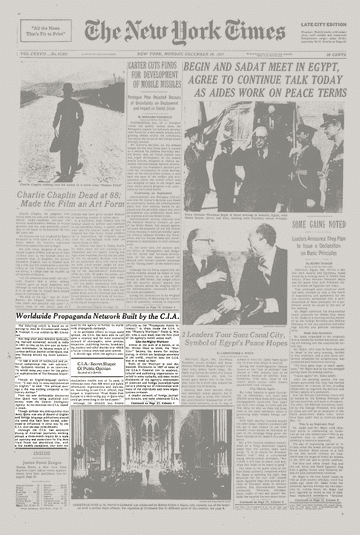
C.I.A.: Secret Shaper Of Public Opinion Second of a Series
munications empire was at its peak, embraced more than SOO news and public information organizations and individuals, According to one C.I.A. official, they ranged in importance “from Radio Free Europe to a third‐string guy in Quito who could get something in the local paper.”
Although the network was known officially as the “Propaganda Assets Inventory,” to those inside the C.I.A. it was “Wisner’s Wurlitzer.” Frank G. Wisner, who is now dead, was the first chief of the agency’s covert action staff.
Like the Mighty Wurlitzer
Almost at the push of a button, or so Mr. Wisner liked to think, the “Wur‐1 litzer” became the means for orches‐1 tracing, in almost any language anywhere in the world, whatever tune the C.I.A.; was in a mood to hear.
Much of the Wurlitzer is now dismantled. Disclosures in 1967 of some of the C.I.A.’s financial ties to academic, cultural and publishing organizations resulted in some cutbacks, and more recent disclosures of the agency’s employment of American and foreign journalists have led to a phasing out of relationships with many of the individuals and news organizations overseas.
A smaller network of foreign journalists remains, and some undercover C.I.A. men may still roam the world, disguised as correspondents for obscure trade journals or business newsletters.
The C.I.A.’s propaganda operation was first headed by Tom Braden, who is now a syndicated columnist, and was run for many years by Cord Meyer Jr., a popular campus leader at Yale before he joined. the C.I.A.
Mr. Braden said in an interview that he had never really been sure that “there was anybody in charge” of the operation and that “Frank Wisner kind of handled it off the top of his head.” Mr. Meyer declined to talk about the operation.
However, several other former C.I.A. officers said that, while the agency was wary of telling its American journalistagents what to write, it never hesitated to manipulate the output of its foreignbased “assets.” Among those were number of English‐language publications read regularly by American correspondents abroad and by reporters and editors in the United States.
Most of the former officers said they had been concerned about but helpless to avoid the potential “blow‐back’—the possibility that the C.I.A. propaganda filtered through these assets, some of it purposely misleading or downright false,’ might be picked up by American reporters overseas and included in their dispatches to their publications at home.
The thread that linked the C.I.A. and its propaganda assets was money, and the money frequently bought a measure of editorial control, often complete control. In some instances the C.I.A. simply created a newspaper or news service and paid the bills through a bogus corporation. In other instances, directly or indirectly, the agency supplied capital to an entrepreneur or appeared at the right moment to bail out a financially troubled organization.
It gave them something to do,” one C.I.A. man said. “It’s the old business of Parkinson’s Law, a question of people having too much idle time and too much idle money. There were a whole lot of people who were underemployed.”
According to an agency official, the C.I.A. preferred where possible to put its money into an existing organization rather than found one of its own. “If a concern is a going concern,” the official said, “it’s a better cover, The important thing is to have an editor or someone else who’s receptive to your copy.”
Postwar Aid for Journals
The C.I.A., which evolved from the Office of Strategic Services of World War II, became involved in the mass communications field in the early postwar years, when agency officials became conterned that influential publications in ravaged Europe might succumb to the temptation of Communist money. Among the organizations subsidized in those early years, a C.I.A. source said, was the French journal Paris Match.
No one associated with Paris Match in that period could be reached for comment.
Recalling the concerns of those early clays, one former C.I.A. man said that :here was “hardly a left‐wing newspaper in Europe that wasn’t financed directly from Moscow.” He went on: “We knew when the courier was coming, we knew how much money he was bringing.”
One of the C.I.A.’s first major ventures was broadcasting, Although long suspected, it was reported definitively only a few years ago that until 1971 the agency supported both Radio Free Europe, which continues, with private financing, to broadcast to the nations of Eastern Europe, and Radio Liberty, which is beamed at the Soviet Union itself.
The C.I.A.’s participation in those operations was shielded from public view by two front groups, the Free Europe Committee and the American Committee for Liberation, both of which also engaged in a variety of lesser‐known propaganda operations.
The American Committee for Liberation financed a Munich‐based group, the Institute for the Study of the U.S.S.R., a publishing and research house that, among other• things, compiles the widely used reference volume “Who’s Who in the U.S.S.R.” The Free Europe Committee published the magazine East Europe, distributed in this country as well as abroad, and also operated the Free Europe Press Service.
Far more obscure were two other C.I.A. broadcasting ventures, Radio Free Asia and a rather tenuous operation known as Free Cuba Radio. Free Cuba Radio, established in the early 1960’s, did not broadcast from its own transmitters but purchased air time from a number of commercial radio stations in Florida and Louisiana.
Its propaganda broadcasts against the Government of Prime Minister Fidel Castro were carried over radio stations WMIE and WGBS in Miami, WKWF in Key West and WWL in New Orleans. They supplemented other C.I.A. broadcasts over a short‐wave station, WRUL, with offices in New York City, and Radio Swan, on a tiny island in the Caribbean.
The managements of those stations are largely changed, and it was not possible to establish whether any of them were aware of the source of the funds that paid for the programs. But sources in the Cuban community in Miami said it was known generally at the time that funds from some Federal agency were involved.
One motive for establishing the Free Cuba radio network, a former C.I.A. official said he recalled, was to have periods of air time available in advance in case Radio Swan, meant to be the main communications link for the Bay of Pigs invasion, was destroyed by saboteurs.
Radio Swan’s cover was thin enough to warrant such concern. The powerful station, whose broadcasts could be heard over much of the Western Hemisphere, was operated by a steamship company in New York that had not owned a steamship for some time.
Radio Swan was also besieged by potential advertisers eager to take advantage of its strong, clear signal. After months of turning customers away, the C.I.A. was finally forced to begin accepting some business to preserve what cover Radio Swan had left.
Radio Free Asia began broadcasting to mainland China in 1951 from an elaborate set of transmitters in Manila. It was an arm of the Committee for Free Asia, and the C.I.A. thought of it as the beginning of an operation in the Far East that would rival Radio Free Europe and Radio Liberty.
The Committee for Free Asia, according to former C.I.A. officials, was founded as the Eastern counterpart of the Free Europe Committee. It later changed its name to the Asia Foundation. It still exists, though its ties to the C.I.A. were severed a decade ago.
The Asia Foundation was headed for years by the ‘ late Robert Blum, who, several sources said, resigned from the C.I.A. to take it over. The foundation provided cover for at least one C.I.A. operative and carried out a variety of media‐related ventures, including a program, begun in 1955, of selecting and paying the expenses of Asian journalists for a year of study in Harvard’s prestigious Neiman Fellowship program.
Emergency Airlift Fails
It was only after Radio Free Asia’s transmitters were operating, according to sources familiar with the case, that the C.I.A. realized that there were almost no radio receivers in private hands in mainland China. An emergency plan was drawn up.
Balloons, holding small radios tuned to Radio Free Asia’s frequency, were lofted toward the mainland from the island of Taiwan, where the Chinese Nationalists had fled after the Communist takeover of the mainland in 1949. The plan was abandoned when the balloons were blown back to Taiwan across the Formosa Strait.
Radio Free Asia went off the air in 1955.
The C.I.A.’s involvement in the field of publishing extended around the world and embraced a wide variety of periodicals, some of them obscure and many of them now defunct. In some instances, sources said, there was no effort to mold editorial policy despite sizable subsidies, but in others policy was virtually dictated.
One of the C.I.A.’s ventures in this country involved the subsidization of several publications whose editors and publishers had fled from Havana to Miami after the Castro Government came to power in 1959. The subsidies — in some cases they amounted to several million dollars — were passed to the publica Lions through a C.I.A. front in New York called Foreign Publications Inc.
The dozen recipients of these subsidies reportedly included Avance, El Mundo, El Prensa Libre, Bohemia and El Diario de las Americas. In addition, the C.I.A. is said to have financed AIP, a radio news agency in Miami that produced programs sent free of charge to more than 100 small stations in Central and Latin America.
The C.I.A. intially intended to clandestinely distribute copies of the subsidized publications into Cuba, but that plan was dropped after the Cuban exiles who had agreed to take them by boat refused in the last minutes to approach the Cuban shore.
The subsidies continued anyway, and the publications were widely read in the Cuban community in Miami and, in the case of Bohemia,‐a weekly magazine that reecived more than $3 million altogether, throughout Latin America as well.
The intelligence agency’s onetime support of Encounter, the British journal, has been reported, but agency sources said that the Congress of Cultural Freedom, the Paris‐based group through which the C.I.A. channeled the funds, also supported a number of other publications, many of them now out of business.
Ties to Agency Were Cut
The congress, which was founded in 1950 as a response to a conference of Soviet writers that year in Berlin, has since cut its ties to the American agency, reconstituted itself and changed its name. But during the years when was a C.I.A. conduit, it provided financial support to the French magazine Preuves, Forum in Austria, Der Monat in West Germany, El Mundo Nuevo in Latin America and, in India, the publications Thought and Quest.
In the United States, Atlas magazine, digest of the world press, occasionally used translators employed by the C.I.A.
African Forum and Africa Report were published with C.I.A. money passed to the American Society of African Culture and the African‐American Institute. In Stockholm the publication Argumenten received C.I.A. funds through a channel so complex that even its editor was unaware of the source of the money. So did Combate, a Latin American bimonthly.
In Nairobi, Kenya, the C.I.A. set up The East African Legal Digest, less as a propaganda organ than as a cover for one of its operatives. In the United States, the Asia Foundation published newspaper, The Asian Student, that was distributed to students from the Far East who were attending American universities.
In Saigon, the Vietnam Council on Foreign Relations, modeled after the American version and financed entirely by the C.I.A., published a slick, expensively produced magazine that was distributed during the Vietnam War to the offices of all senators and representatives in Washington.
Among the more unusual of the C.I.A.’s relationships was the one it shared with a Princeton, N.J., concern called the Research Council. The council, founded by Hadley Cantril, the late chairman of the Princeton University psychology department, and his associate, Lloyd Free, derived nearly all its income from the C.I.A. in the decade in which it was active.
“They were considered an asset because we paid them so much money,” a former C.I.A. man said. Mr. Free confirmed that he 2nd Dr. Cantril, an acknowledged pioneer in public opinion polling, had “just sort of run” the council for the C.I.A.
The council’s activities, Mr. Free said, consisted of extensive public opinion surveys conducted in other countries on questions of interest to the C.I.A. Some, he said, were conducted inside Eastern Europe, the Soviet bloc.
The governments of the countries, Mr. Free said, “didn’t know anything about the C.I.A.” Nor, apparently, did Rutgers University Press, which published some of the results in a 1967 volume called “Pattern of Human Concerns.”
Book Publishing Ventures
The C.I.A.’s relationship with Frederick Praeger, the book publisher, has been reported in the past. But Praeger was only one of a number of publishing concerns, including some of the most prominent in the industry, that printed or distributed more than 1,000 volumes produced or subsidized in some way by the agency over the last three decades.
Some of the publishing houses were nothing more than C.I.A. “proprietaries.” Among these were Allied Pacific Printing, of Bombay, India, and the Asia Researcn Centre, one of several agency publishing ventures in Hong Kong, which was described by an agency source as “nothing but a couple of translators.”
Other, legitimate publishers that received C.I.A. subsidies according to former and current agency officials, were Franklin Books, a New York‐based house that specializes in translations of academic works, and Walker & Co., jointly owned by Samuel Sloan Walker Jr., a onetime vice president of the Free Europe Committee, and Samuel W. Meek, a retired executive of the J. Walter Thompson advertising agency and a man with close ties to the C.I.A.
A spokesman at Franklin confirmed that the publisher had received grants from the Asia Foundation and “from another small foundation for an African project, both of which were exposed in 1967 as being supported by C.I.A.” The spokesman added, “Franklin was unaware of that support then.”
Mr. Walker said through a secretary that his concern had never “printed books on behalf of the C.I.A. nor published any book from any source which was not worthy of publication on its merits.”
Other publishing houses that brought out books to which the C.I.A. had made editorial contributions included Charles Scribner’s Sons, which in 1951 published “The Yenan Way,” by Eudocio Ravines, from a translation supplied by William F. Buckley Jr., who was a C.I.A. agent for several years in the early 1950’s. Also in 1951, G. P. Putnam’s Sons published “Life and Death in Soviet Russia,” by Valentin Gonzalez, the famous “El Campesino” of the Spanish Civil War.
According to executives of both houses, Putnam and Scribner’s were unaware of any agency involvement in those books, as was Doubleday & Company, which in 1965 brought out, under the title “The Penkovskiy Papers,” what purported to be a diary kept by Col. Oleg Penkovsky, the Soviet double agent. The book even used C.I.A. style in the transliteration of the colonel’s name.
Also unaware of the C.I.A. connection was Ballantine Books, which published a modest volume on Finland, “Study in Sisu,” written by Austin Goodrich, an undercover C.I.A. man who posed for years in Scandinavia as a freelance author researching a book about Finland.
Authorship Used as Cover
Another C.I.A. operative who employed the cover of a freelance author in search of a book was Edward S. Hunter, who roamed Central Asia for years collecting material for a work on Afghanistan that eventually was published by the prestigious house of Hodder & Stoughton of London.
Other C.I.A. men worked abroad while writing books, including Lee White, an employee of the Middle Eastern Division who wrote a biography of General Mohammed Neguib of Egypt, and Peter Matthiessen, the writer and naturalist who began work on a novel, “Partisans,” while with the C.I.A. in Paris from 1951 until 1953, where he also helped George Plimpton found The Paris Review.
As with Mr. Hunter, Mr. White and Mr. Matthiessen used their careers as authors only as covers for their intelligence activities. There is no evidence that the C.I.A. attempted to control what they wrote or that it atempted through Mr. Matthiessen to influence the Paris Review.
Several C.I.A. efforts in book publishing were well received by critics, and a few were commercial successes. “At least once,” according to a report by the Senate intelligence committee, “a book review for an agency book which appeared in The New York Times was written by a C.I.A. writer under contract” to the agency.
The report did not identify the volume or the reviewer, but the book is said to have been “Escape from Red China,” the story of a defector from China published by Coward, McCann and Geoghegan. Jack Geoghegan, president of the company, said he never knew that the book had been prepared for publication by the C.I.A.
The book was reviewed by The Times on Sunday, Nov. 11, 1962, by Richard L. Walker, who is now director of the Institute of International Studies at the University of South Carolina and is a frequent book reviewer for the newspaper. Professor Walker said in a telephone interview that he had been under contract to the C.I.A. as a consultant and lecturer before and after the review appeared, but not at the time he wrote it. Nor, he said, did he know that the book had been produced by the C.I.A.
Another successful book that intelligence sources said was published in 1962 with the assistance of the C.I.A. is “On the Tiger’s Back” by Aderogba Ajao, Nigerian who had studied at an East German University and returned home to write about his disillusionment.
A Yugoslavian Connection
The Praeger organization, which was purchased by Encyclopaedia Brittanica in 1966, first became involved with the C.I.A. in 1957 when it published “The New Class,” a landmark work by Milovan Djilas, a disillusioned official of the Yugoslav Government who wrote extensively about his personal rejection of Communism.
Mr. Djilas, who had become a source of embarrassment to his Government before the work was published, had difficulty getting the last portion of the manuscript out of Yugoslavia.
Mr. Praeger said that he had appealed to II friend in the American Government (though not in the C.I.A.) for assistance in obtaining the final pages. The manuscript was eventually carried from Belgrade to Vienna by Edgar Clark, then a correspondent for Time magazine, and his wife, Katherine.
Mr. Clark said that neither he nor his wife had ever had anything to do with the C.I.A. But the manuscript ultimately reached the hands of’ a C.I.A. officer named Arthur Macy Cox. Mr. Cox, who later worked under Praeger cover in Geneva, set in motion an effort by the agency to have the book translated into variety of languages and distributed around the world.
“It was my first contact with the 1 C.I.A.,” Mr. Praeger said, but he added that at the time he had “no idea there even was a C.I.A.”
Mr. Praeger said that he later published 20 to 25 volumes in which the C.I.A. had had an interest, either in the writing, the publication itself or the postpublication distribution.
The agency’s involvement, he said, might have been manifested in a variety of ways—reimbursing him directly for the expenses of publication or guaranteeing, perhaps through a foundation of some sort, the purchase of enough copies to make publication worthwhile.
Among the Praeger books in which the C.I.A. had a hand were “The Anthill,” a work about China by the French writer Suzanne Labin, and two books on the Soviet Union by Giinther Nollau, a member of the West German security service and later its chief. Mr. Nollau was identified in a New York Times review only as “a West German lawyer who fled some years ago from East Germany.”
Dozens of foreign- language newspapers, news services and other organizations were financed and operated by the C.I.A.—two of the most prominent were said to have been DENA, the West German news agency, and Agenda Orbe Latino American, the Latin American feature service.
The C.I.A.’s Newspapers
In addition, the C.I.A. had heavy investments in a variety of English-language news organizations. Asked why the agency had had a preference for these, a former senior official of the agency explained that it was less difficult to conceal the ownership of publications that had ostensible reasons for belonging to an American and easier to place American agents in those publications as reporters and editors.
The Rome Daily American, which the C.I.A. partly owned from 1956 to 1964, when it was purchased by Samuel W. Meek, a J. Walter Thompson executive, was only one of the agency’s “’proprietary” English‐language newspapers.
There were, it was said, such “proprietaries” in other capitals, including Athens and Rangoon. They usually served a dual role—providing cover fur intelligence operatives and at the same time publishing agency propaganda.
But the C.I.A.’s ownership of newspapers was generally viewed as costly and difficult to conceal, and all such relationships are now said to have been ended.
The Rome Daily American was taken over by the C.I.A., it was said, to keep it from failing into the hands of Italian Communists. But the agency eventually tired of trying to maintain the fiction that the newspaper was privately owned and, as soon as the perceived threat from the Communists had passed, sold it to Mr. Meek.
Even after the agency sold the newspaper, however, it was managed for several years by Robert H. Cunningham, a C.I.A. officer who had resigned from the agency and had b
