
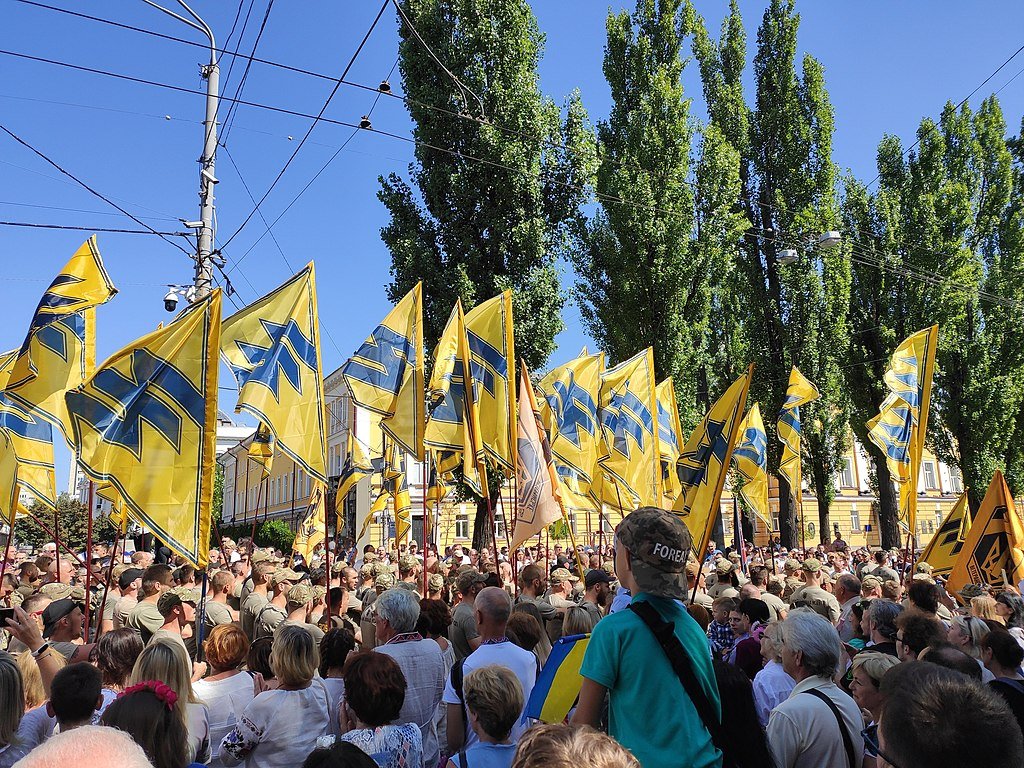
Members of Ukraine’s Azov Regiment march in Kyiv, Ukraine, in 2019. Their flags display the group’s Wolfsangel logo, a variant of that used by the Nazi SS. (Goo3 / Wikimedia Commons)
April 29, 2022
The same Western media that once documented and decried Ukraine’s far right is now playing it down and even rehabilitating its leaders — including actual Nazis. Such apologetics aren’t doing any favors for Ukrainians or their fight against Russia’s aggression.
Since Russian President Vladimir Putin launched an invasion of neighbouring Ukraine a month ago, something curious has happened with Western media coverage of the country’s far-right. Amid the global wave of indignation at Russia’s war of aggression, which Moscow has justified on the pretext of “denazification,” the Western press — fixated for the last five years on the prospect of fascism and the far right at home — has begun playing the issue down.
The Ukrainian far-right, we’re now told, is negligible, no different or more influential than its counterparts in the West and irrelevant thanks to its lack of electoral success. Any claim to the contrary is mere Putinite propaganda. How could it not be, when the country’s president, Volodymyr Zelensky, is himself Jewish?
As for the movement’s most famous name — the neo-Nazi Azov Regiment that was officially incorporated into Ukraine’s National Guard in 2014 — well, Azov, we’re told, is not really even far-right anymore.
With the Kremlin doing its best to paint the entire population of Ukraine as fascists while reducing schools and hospitals to rubble, you can see why this line of argument might be tempting. But the emerging narrative is baseless — a betrayal of journalism’s truth-telling mission, and one that risks silencing debate about a dangerous and violent movement whose existence is highly relevant to questions of Western policy toward the war.
There are better ways to support Ukrainians as they fight to restore their country’s independence and safety than pretending their local far-right isn’t a danger — or even rehabilitating actual Nazis.
Whitewashing Azov
The most audacious part of this campaign of counterpropaganda is a push to whitewash the Azov Regiment, for many years virtually synonymous with Ukraine’s entire far-right. Now, we’re being told, it is nothing of the sort.
After Azov was brought into the National Guard, German broadcaster Deutsche Welle tells us, “There was a separation of the movement and the regiment, which still uses right-wing symbols, but can no longer be classified as a right-wing extremist body.” A BBC segment informs us it’s “not the same force as it was in 2014,” as a talking head affirms that its “radical core was drowned out by the mass of newcomers,” while its white supremacist founder, Andriy Biletsky, left in 2016 to start a political party, the National Corps.
With an “evolving membership” and with the group’s social media showing no outward signs of extremism, the BBC concludes there’s nothing to see here.
These aren’t isolated examples.
The London Times recently hung out with Azov and found “an elite battalion challenging its far-right reputation.” (“I ask you not to confuse patriotism with Nazism,” they quoted a commander, as other members asked for more Western arms.) “It is certain that Azov has depoliticized itself,” an expert assured the Financial Times.
In an oddly equivocal piece that would never pass muster in reporting on a domestic hate group, CNN gives Azov a lengthy statement claiming it has “nothing to do with [Biletsky’s] political activities and the National Corps party,” while experts insist there are “presumably” far-right elements in all militaries and that the proportion of extremists in its ranks is probably smaller now.
All of this is, to put it mildly, dubious.
“The Azov Regiment maintains close ties to the National Corps,” says the University of Ottowa’s Ivan Katchanovski. “This is a rebranded Patriot of Ukraine and a civilian wing of the Azov Regiment. Therefore, the Azov Regiment can be best described as far-right-led or far-right-linked.”
“I believe they’re absolutely part of the same movement, and I have been presenting evidence thereof,” says Oleksiy Kuzmenko, an investigative report published by influential open-source intelligence outlet Bellingcat and George Washington University’s Institute for European, Russian and Eurasian Studies.
The National Corps is still connected to the regiment, paying tribute to its soldiers, raising awareness about Azov members being prosecuted — or, in their eyes, persecuted — by the government, and promoting a defence conference in Mariupol last May that featured Azov’s current commander Denis Prokopenko, as well as government officials and veterans of the war. The latter group included a member of the National Corps’s High Council.
That conference also involved National Corps founder and leader Biletsky, who once wrote that Ukraine’s “historic mission” was to “lead the White Races of the world in a final crusade for their survival” against “the Semite-led Untermenschen” and who continues to have ties to the Azov Regiment.
Whether he’s celebrating the anniversary of Azov’s founding — noting in 2019 that he would “forever remain in the ranks of the large Azov family, which over the last five years has formed around the regiment” — or attending events with Prokopenko to commemorate recent casualties, it’s a stretch to say Biletsky is no longer involved.
In fact, he’s not just involved but instrumental. In a 2019 interview with UMN (Ukrainian Media Network), the Azov Regiment’s chief of staff responded to a question about why Azov was so well supplied and looked better than other parts of the National Guard:
We have a leader, Andriy Biletsky, an independent MP in the Verkhovna Rada [Ukrainian parliament]. On top of being an MP, he is always visiting us at the shooting range encampment, for example. Taxpayers haven’t contributed a dime to its improvement, development, and functioning. Andriy Biletsky looks for sponsors, businessmen that can contribute to what we have now, for instance, good clothes, procuring, good shooting ranges, etc. . . . A lot of volunteer battalions stopped existing in the same way as we do, and we remained in this sphere, because Andriy, unlike others, isn’t preoccupied with his own business but is always visiting, always helping us.
Here’s Biletsky at the Azov Regiment’s fourth anniversary celebration, standing with Prokopenko in front of Azov’s modified Wolfsangel, the ancient medieval rune famously adopted as a symbol by the Nazi SS. Azov insists with an implied wink that that the figure is merely a combination of the letters “N” and “I,” for “the idea of the nation.”
If the Azov Regiment is unconnected to the wider Azov movement or the far right as a whole, then why, just last year, was the “Youth Corps” of its political arm trained on one of the regiment’s bases, with Prokopenko there to give a kickoff speech?
What then explains this National Corps–produced video from 2019, in which Prokopenko sits down with Ihor Mykhailenko, former Azov commander and now head of the Azov movement’s National Militia paramilitary, and Maksym Zhorin, another former commander and Hitler admirer who now heads the central office of the National Corps?
Prokopenko himself has a suspect background, one somewhat shrouded in mystery thanks to the fact that, as Spain’s El Mundo put it, information about him seems to have been scrubbed from the Ukrainian internet. What is known is that Prokopenko has been with Azov since its earliest days, making it harder to argue its current iteration is a radical break from its origins.
Prokopenko was one of the leaders of the Dynamo Kyiv ultras, one particular faction of the violent and virulently racist soccer hooligans who made up some of the earliest recruits of Azov and other anti-Russian paramilitaries. Only a few weeks ago, one of these “ultra” groups, the White Boys Club (WBC), paid tribute to Prokopenko, “the legendary commander of the ‘A’ regiment that also represents our platform,” in their words.

According to Reporting Radicalism, an initiative of the US government–funded Freedom House, the group’s emblem uses a picture of Prince Svyatoslav of Kyiv, hailed by the modern far right for his tenth-century defeat of the Khazar Empire, whose royalty had converted to Judaism in the preceding centuries.
The WBC claim, with a wink, that their name is merely a reference to their team’s colours, but here you can see them wearing Klan-like hoods and brandishing swastikas in front of a sign reading “100% White!”
As even equivocating write-ups on Azov acknowledge, it’s hard to play down the regiment’s neo-Nazi tendencies when it continues to flaunt far-right symbols and carried out a pogrom against local Roma as late as 2018.
But perhaps it’s better to take it from the horse’s mouth. Here’s notorious Russian neo-Nazi and soccer hooligan Denis Kapustin (aka Denis Nikitin) — founder of neo-Nazi sportswear brand White Rex, promoter of Azov, and currently under a Europe-wide travel ban — complaining in vulgar terms about the Western media’s sudden about-face on the Ukrainian far right:
It’s funny to observe how liberal trash, grant-eaters, faggots, and warriors for perverts’ rights are pretending that those who oppose the Russian army aren’t those same “neonazis, homophobes and fascists,” that they were hating, were scared of, and were “canceling.” . . . Before February 24 you were corrupting the Ukrainian society with the LGBT-perversion propaganda, were calling on the government to put us in prisons and to ban any nationalist formations, but now you are knitting socks for the Ukrainian army, taking photos with the rifles at the checkpoints, and liking the photos. You think you’ll get points? You think we forgot your bullying?
If some in the Western press seem to want to believe there’s no significant far-right problem in Ukraine, the neo-Nazis themselves harbor no such illusions.
Nothing to Worry About (as of 2022)
This whitewashing of Azov is part of a wider trend of playing down the influence of the entire Ukrainian far-right. Even the Anti-Defamation League is now assuring people that the far right is “a very marginal group with no political influence and who don’t attack Jews or Jewish institutions in Ukraine.”
This attempt to suddenly cast concerns about Ukraine’s far right as some kind of fringe, Putinist propaganda sits awkwardly with years of mainstream press reporting and establishment warnings about its threat.
A 2019 report from the Soufan Center, a nonprofit founded by former FBI special agent Ali Soufan that focuses on terrorism and foreign policy, declared Ukraine was “emerging as a hub in the broader network of transnational white supremacy extremism,” with the civil war raging in the east since 2014 attracting thousands of such extremists from across the globe to use the country “as a battlefield laboratory.”
Like 1980s Afghanistan for jihadists, the report stated, “so too are parts of Ukraine becoming a safe haven for an array of white supremacy extremist groups to congregate, train, and radicalize,” whose goals are to “return to their countries of origin (or third-party countries) to wreak havoc and use acts of violence as a means of recruiting new members to their cause.”
The following year, Soufan co-wrote an op-ed for the New York Times with Representative Max Rose (D-NY), warning that “white supremacists today are organizing in a similar fashion to jihadist terrorist organizations, like Al Qaeda, in the 1980s and 1990s,” and “using the conflict in Ukraine as a laboratory and training ground.”
The two pointed to a 2018 FBI affidavit that called the Azov Regiment a “paramilitary unit” known for its “association with neo-Nazi ideology” and complained that even then, they were being accused of being part of a Kremlin campaign for raising these points.
A 2020 report from West Point’s Combating Terrorism Center (CTC) states that while not on the level of jihadi networks in Syria and Iraq, Ukraine is “the favoured destination of many American and European white supremacists,” who have “established a web of informal links with similarly minded groups in Europe.”
A separate CTC report the following year found that “some of those who met either on the battlefield or in training or at one of the functions that have grown out of the original far-right extremist mobilization effort in the Ukraine war have since created networks of peers” and sometimes “gained crucial know-how, whether military or ideological.”
Human rights organizations have likewise highlighted the threat of Ukraine’s far-right. Freedom House warned in 2018 that “far-right political forces present a real threat to the democratic development of Ukrainian society” and that since the 2014 revolution and the civil war in the Donbas, “extreme nationalist views and groups, along with their preachers and propagandists, have been granted significant legitimacy by the wider society.”
They were “a real physical threat to left-wing, feminist, liberal, and LGBT activists, human rights defenders, as well as ethnic and religious minorities,” the organization said, and cautioned they had “become increasingly active,” disrupting events and carrying out attacks at a higher frequency.
The same year, Human Rights Watch documented at least two dozen violent attacks by far-right groups in the first six months of the year, warning that they were “on the rise,” and admonishing the government for doing little about it or even recruiting members for “policing activities.”
“The authorities in Ukraine have consistently failed to prevent and punish violence by ‘far-right’ groups, which has grown steadily since at least 2015,” Amnesty International reported then, charging authorities with “a patent disregard for the rights to freedom of expression and peaceful assembly” of those targeted, and complaining that extremists “plan and perpetrate such attacks openly, and often boast about their violent actions on social media and offline.”
The press today points to the far right’s diminishing electoral success, ignoring that it has coincided with the political centre’s opportunistic adoption of parts of the far-right wish list, including glorifying Nazi collaborators and promoting Holocaust “revisionism.” It’s for this reason that the Simon Wiesenthal Center charged in 2018 that “Ukraine has been one of the major propagators of a distorted version of Holocaust history which seeks to hide or minimize crimes committed by Ukrainian nationalists” and that it was “choosing to rehabilitate antisemitism and to censor history.”
That was the same year the Israeli government published a report stating that antisemitic attacks in the country had doubled since the previous year and numbered more than the total for all of Eastern Europe combined.
In fact, some of the best reporting on the dangers of Ukraine’s far-right has come from the very mainstream Western press now playing it down.
The same BBC now reassuring its viewers that ultranationalists in Ukraine are nothing to worry about, and besides, they don’t really hold any Nazi sympathies anyway, has run piece after piece on Azov and the Far Right more broadly over the years.
That includes this 2015 segment on the far-right Right Sector and its dreams of overthrowing another government, as well as this 2018 segment on the National Militia, the Azov-linked paramilitary that works with the police to patrol Ukraine’s streets.
As government officials warn in the latter video that extremists are warming up for a coup and are being tolerated by Ukraine’s interior ministry, we’re told that Azov “has well-established links to the far right,” “its logo has clear Nazi overtones,” and its “toxic racism has in public at least been replaced by patriotic nationalism.” We can only assume today’s BBC is either unaware of its own past reporting, or considers it, too, part of a successful Kremlin propaganda campaign.
Despite extensively covering the subject of fascism in the context of domestic politics in the West, the usually progressive Guardian has barely mentioned the Ukrainian far-right through this war, except to play down the issue and change the subject to Putin.
Yet here it was just four years ago reporting on “fears that Ukraine’s shaky democracy was in danger of being hijacked by an increasingly confident far right.” Here it is a year before that, reporting on Azov’s extensive network of children’s summer camps, noting that “its influence is spreading” and showing instructors clearly tattooed with racist slogans and Nazi insignia working with kids. Here it is years earlier, on the “increasing worry” that groups like Azov “pose the most serious threat to the Ukrainian government, and perhaps even the state when the conflict in the east is over.”
In fact, even the US government-funded Radio Free Europe/Radio Liberty has for years reported on the dangers of Ukraine’s far-right, something that would now get it charged with spreading Kremlin propaganda.
The outlet has covered police officials’ declarations of admiration for storied Nazi collaborator Stepan Bandera, a series of unpunished attacks on Romany camps by ultranationalists, the receipt of government funds by some of those same groups, a State Department–designated “hate group” that won a lawsuit against a news outlet that deemed it to be neo-Nazi, as well as the growing “public presence” of the Azov movement and its efforts for “the expansion of its movement abroad.”
Here’s Time magazine just last year reporting on Azov, which it called “much more than a militia,” owing to its political party, summer camps, publishing houses, and police-associated vigilante force.
Its spokesperson told Time that Azov’s goal was creating a far-right coalition across the West to seize power in Europe. “Unlike its ideological peers in the U.S. and Europe, it also has a military wing with at least two training bases and a vast arsenal of weapons, from drones and armored vehicles to artillery pieces,” went the report, which quoted “law enforcement officials on three continents” to charge Azov with “a central role in a network of extremist groups stretching from California across Europe to New Zealand.”
All of this is hard to square with the now-ubiquitous claim that Ukraine’s far-right is irrelevant, unremarkable, and plays a role no different from that of similar groups in the West.
This is just a drop in the ocean.
While you’ll still find your fair share of denialism in older reporting — the impulse among reporters to way overcorrect in the face of Russian propaganda is nothing new — mainstream Western press reports (whether in the United States, Britain, Germany, or elsewhere in Europe) before 2022 will generally leave you far better informed about the reality of Ukraine’s far-right and the dangers it poses than anything put out now or, from the looks of things, in the coming months and years.
And when this mass of inconvenient reporting isn’t simply memory-holed, it’s outright distorted. A recent Yahoo! News report dismissed as Kremlin propaganda the well-documented fact that far-right groups backed the 2014 revolution, citing a U.S. News & World Report from the time that called the charge “entirely baseless.”
Who knows how many readers ever clicked through to the actual report and found out that the piece not only didn’t apply those words to that specific charge but that it actually affirms that “far-right conservative groups exist in Ukraine and have played a central part of the ongoing revolution”?
Before this war, Western media coverage presented a Ukrainian far-right that was uniquely well-organized, well-connected
