U.N. Chief Wants Faster Action to Halt Civil Wars and Killings

By Barbara Crossette

New York Times

September 21, 1999

UNITED NATIONS — Secretary-General Kofi Annan sounded a warning Monday to a frequently paralyzed Security Council, urging it to act faster and more effectively to meet the challenge of a world engulfed in civil wars that quickly descend into the slaughter of helpless civilian populations.

In an address to world leaders at the opening day of debate in the General Assembly, Annan also said that countries which have resisted international intervention will no longer be able to hide behind protestations of national sovereignty when they flagrantly violate the rights of citizens.

“Nothing in the charter precludes a recognition that there are rights beyond borders,” he said, on the day an Australian-led force landed in East Timor to help complete its separation from Indonesia. A Western diplomat called the speech “courageous and very important.”

Annan did not single out the United States, the Security Council’s most powerful member, or any other major nation, but his unusually strong criticism of the Security Council’s initial failures to deal with genocide in Rwanda in 1994 and to agree on responding to Serbian atrocities in Kosovo over the last year pointed obliquely at American policy decisions.

President Clinton, who would normally speak on the first day of the general debate in the assembly, postponed his appearance until Tuesday out of respect for Yom Kippur, the holiest day in Judaism.

Annan spoke Monday as officials of the council’s five permanent members, who have veto power — Britain, China, France, Russia and the United States — were preparing to meet again to try to end another Security Council deadlock, this one over Iraq.

For nearly a year, since the American bombing of Baghdad in December, there have been no arms inspections in Iraq, which must be certified as disarmed before 9-year-old sanctions can be lifted. The council is sharply divided on how to devise a new monitoring system, while Iraq has used the time to harden its position against any kind of renewed inspection program.

In Rwanda, the United States blocked council action while tens of thousands of Tutsi and their moderate Hutu neighbors were massacred. Annan, who was then in charge of U.N. peacekeeping, has borne a lot of criticism for what was essentially a political decision made in Washington, where memories of American soldiers killed in Somalia in 1993 were still fresh. The secretary-general has called for an investigation in response to charges that the United Nations knew about the imminent genocide but did nothing.

In Kosovo, the Clinton administration, fearing a veto of military action from Russia or China, circumvented the United Nations and went directly to NATO.

“While the genocide in Rwanda will define for our generation the consequences of inaction in the face of mass murder,” Annan said, “the more recent conflict in Kosovo has prompted important questions about the consequences of action in the absence of complete unity on the part of the international community.”

To those who hailed the NATO bombing of Kosovo as a new era of quicker action outside the United Nations, Annan asked two questions that reflect the concerns of many nations uneasy with the prospect of unbridled American power.

“Is there not a danger of such interventions undermining the imperfect, yet resilient, security system created after the second World War, and of setting dangerous precedents for future interventions without a clear criterion to decide who might invoke these precedents and in what circumstances?”

But the secretary-general had no consolations for the countries, particularly in the Third World, that argue that the United Nations has no right to overstep national borders. That case was presented Monday by President Abdelaziz Bouteflika of Algeria who said in his speech that “interference can only occur with the consent of the state concerned.”

Algeria, where violence by Islamic militants and government forces has left thousands dead in recent years, has refused to allow international human rights monitoring.

“We do not deny the right of northern hemisphere public opinion to denounce the breaches of human rights where they occur,” said Bouteflika, who is also chairman of the Organization of African Unity and spoke on its behalf.

“Furthermore, we do not deny that the United Nations has the right and the duty to help suffering humanity. But we remain extremely sensitive to any undermining of our sovereignty, not only because sovereignty is our last defense against the rules of an unequal world but because we are not taking part in the decision-making process of the Security Council.”

The United States has also been ambivalent about the trend toward intervention by international organizations into a country’s affairs. Although the Clinton administration proposed a series of international war crimes tribunals, it has stopped short of backing a permanent international criminal court because of Pentagon objections. It has also failed to ratify a number of international treaties including a convention banning land mines.

The composition of the council, with its five most powerful members unchanged since the end of World War II, rankles many nations.

Although the Security Council acted with relative speed in the case of East Timor last week, as the secretary-general pointed out Monday, the council did wait for an Indonesian invitation. The council had not been prepared to take preventive action, although there were numerous reports reaching the United Nations and government capitals about threats from the quasi-official militias opposed to independence for the territory, threats that turned to carnage after the East Timorese overwhelmingly rejected continued association with Indonesia.

Nevertheless several leaders mentioned that the action on East Timor by the council set an example of strong international support for people who have made an important choice in a free vote and paid a terrible price.

“Whoever saw the images of the Timorese on voting day,” said President Jorge Sampaio of Portugal, the former colonial power in East Timor, “clutching their registration cards, waiting in orderly lines for the long-awaited moment to express freely their will, must have reacted with strong emotion, and surely perceived in those faces and gestures, the universal appeal of democracy, freedom and justice.”

Half a century after the founding of the United Nations as a club of countries whose national interests often overrode those of their own populations or people in trouble in other nations, Annan said unambiguously that countries can no longer cite sovereign rights when it is clear to the world that they are committing abuses against their citizens.

“This developing international norm in favor of intervention to protect civilians from wholesale slaughter will no doubt continue to pose profound challenges to the international community,” he said. He told the audience of world leaders that the U.N. charter should not be misread.

“In response to this turbulent era of crises and interventions, there are those who have suggested that the charter itself — with its roots in the aftermath of global interstate war — is ill-suited to guide us in a world of ethnic wars and intrastate violence,” Annan said. “I believe they are wrong.”

Copyright 1999 The New York Times Company

http://www.nytimes.com/library/world/global/092199un-assembly.html
Share

Leave a Reply

Your email address will not be published. Required fields are marked *

Related Posts

Af Svenska Irakkommittén mot de Ekonomiska Sanktionerna (SIES) 13 september 2002 FN:s ekonomiska sanktioner mot Irak har nu pågått i tolv år och drabbat det irakiska folket med svåra lidanden. Enligt FN:s egna siffror har mer än 1,5 miljoner människor, varav ca 600 000 barn, dött som en direkt följd av sanktionerna. Dessutom har ett lågintensivt bombkrig mot landet pågått under dessa år. Av all denna förödelse- orsakad huvudsakligen av amerikansk och brittisk politik- har Saddam Husseins brutala och diktatoriska regim snarast stärkts än försvagats. Nu förbereder USA under president Bushs ledning ett storskaligt bombkrig mot Irak som kommer att innebära ett ännu större lidande för civilbefolkningen. Ett sådant krig kommer dessutom att ytterligare undergräva freden och säkerheten i världen. Att upprätta en demokratisk regim i Irak är det irakiska folkets angelägenhet och får enligt folkrätten inte ske med krigshandlingar utifrån. Folkrätten och FN:s stadgar måste respekteras. Vi vädjar till...
By Karin Wegestal MP, the Social Democratic Partyon behalf of the Swedish Committee for Solidarity with the Yugoslav People During the last decade, the Federal Republic of Yugoslavia has received more than 500,000 refugees from Croatia and Bosnia, and another 300,000 internally displaced persons, mainly from the province Kosovo and Metohia. For a country with about ten million inhabitants, such an influx of homeless people is obviously a very heavy burden – even under peaceful conditions. But in addition to that, the Federal Republic of Yugoslavia has been the subject to sanctions from the western powers for close to ten years and its infrastructure was badly hurt through Nato’s intense bombardment during 78 days in 1999. The result of all this is that Yugoslavia, once the most developed industrial country in Eastern Europe, is today the poorest country in Europe. In Serbia excluding Kosovo, with about ten million inhabitants and...

Recent Articles

Af Svenska Irakkommittén mot de Ekonomiska Sanktionerna (SIES) 13 september 2002 FN:s ekonomiska sanktioner mot Irak har nu pågått i tolv år och drabbat det irakiska folket med svåra lidanden. Enligt FN:s egna siffror har mer än 1,5 miljoner människor, varav ca 600 000 barn, dött som en direkt följd av sanktionerna. Dessutom har ett lågintensivt bombkrig mot landet pågått under dessa år. Av all denna förödelse- orsakad huvudsakligen av amerikansk och brittisk politik- har Saddam Husseins brutala och diktatoriska regim snarast stärkts än försvagats. Nu förbereder USA under president Bushs ledning ett storskaligt bombkrig mot Irak som kommer att innebära ett ännu större lidande för civilbefolkningen. Ett sådant krig kommer dessutom att ytterligare undergräva freden och säkerheten i världen. Att upprätta en demokratisk regim i Irak är det irakiska folkets angelägenhet och får enligt folkrätten inte ske med krigshandlingar utifrån. Folkrätten och FN:s stadgar måste respekteras. Vi vädjar till...
Peace will not result from any “peace” plan circulated to date. Neither will it emerge from warfare – as the elites of NATO, EU, Russia, and Ukraine seem to finally recognise after avoidable, unspeakable losses of people, trust and physical, socio-economic destruction. And horse-trading based on military ‘security’ guarantees reveals only peace and conflict illiteracy. TFF is critical of the widespread and severe misuse of the word peace – as if it did not require any knowledge. But we do not engage in geopolitical-military commentarism or dismissive criticism of present-day Realpolitik and its militarist mindset. Indeed, we do not believe that mainstream political and media elites are aware that they know woefully little about peace and peace-making or see it as a professional field. Thus, we do not expect they would acquaint themselves with a portfolio like this. TFF concentrates on constructive, visionary thinking grounded in the science and art of peace and in our 40 years...

TFF on Substack

Discover more from TFF Transnational Foundation & Jan Oberg.

Most Popular

Af Svenska Irakkommittén mot de Ekonomiska Sanktionerna (SIES) 13 september 2002 FN:s ekonomiska sanktioner mot Irak har nu pågått i tolv år och drabbat det irakiska folket med svåra lidanden. Enligt FN:s egna siffror har mer än 1,5 miljoner människor, varav ca 600 000 barn, dött som en direkt följd av sanktionerna. Dessutom har ett lågintensivt bombkrig mot landet pågått under dessa år. Av all denna förödelse- orsakad huvudsakligen av amerikansk och brittisk politik- har Saddam Husseins brutala och diktatoriska regim snarast stärkts än försvagats. Nu förbereder USA under president Bushs ledning ett storskaligt bombkrig mot Irak som kommer att innebära ett ännu större lidande för civilbefolkningen. Ett sådant krig kommer dessutom att ytterligare undergräva freden och säkerheten i världen. Att upprätta en demokratisk regim i Irak är det irakiska folkets angelägenhet och får enligt folkrätten inte ske med krigshandlingar utifrån. Folkrätten och FN:s stadgar måste respekteras. Vi vädjar till...
Peace will not result from any “peace” plan circulated to date. Neither will it emerge from warfare – as the elites of NATO, EU, Russia, and Ukraine seem to finally recognise after avoidable, unspeakable losses of people, trust and physical, socio-economic destruction. And horse-trading based on military ‘security’ guarantees reveals only peace and conflict illiteracy. TFF is critical of the widespread and severe misuse of the word peace – as if it did not require any knowledge. But we do not engage in geopolitical-military commentarism or dismissive criticism of present-day Realpolitik and its militarist mindset. Indeed, we do not believe that mainstream political and media elites are aware that they know woefully little about peace and peace-making or see it as a professional field. Thus, we do not expect they would acquaint themselves with a portfolio like this. TFF concentrates on constructive, visionary thinking grounded in the science and art of peace and in our 40 years...
Read More
Imagen-thumbnail-The-Transnational-1
Af Svenska Irakkommittén mot de Ekonomiska Sanktionerna (SIES) 13 september 2002 FN:s ekonomiska sanktioner mot Irak har nu pågått i tolv år och drabbat det irakiska folket med svåra lidanden. Enligt FN:s egna siffror har mer än 1,5 miljoner människor, varav ca 600 000 barn, dött som en direkt följd av sanktionerna. Dessutom har ett lågintensivt bombkrig mot landet pågått under dessa år. Av all denna förödelse- orsakad huvudsakligen av amerikansk och brittisk politik- har Saddam Husseins brutala och diktatoriska regim snarast stärkts än försvagats. Nu förbereder USA under president Bushs ledning ett storskaligt bombkrig mot Irak som kommer att innebära ett ännu större lidande för civilbefolkningen. Ett sådant krig kommer dessutom att ytterligare undergräva freden och säkerheten i världen. Att upprätta en demokratisk regim i Irak är det irakiska folkets angelägenhet och får enligt folkrätten inte ske med krigshandlingar utifrån. Folkrätten och FN:s stadgar måste respekteras. Vi vädjar till...
TFFPortfolioVign
Peace will not result from any “peace” plan circulated to date. Neither will it emerge from warfare – as the elites of NATO, EU, Russia, and Ukraine seem to finally recognise after avoidable, unspeakable losses of people, trust and physical, socio-economic destruction. And horse-trading based on military ‘security’ guarantees reveals only peace and conflict illiteracy. TFF is critical of the widespread and severe misuse of the word peace – as if it did not require any knowledge. But we do not engage in geopolitical-military commentarism or dismissive criticism of present-day Realpolitik and its militarist mindset. Indeed, we do not believe that mainstream political and media elites are aware that they know woefully little about peace and peace-making or see it as a professional field. Thus, we do not expect they would acquaint themselves with a portfolio like this. TFF concentrates on constructive, visionary thinking grounded in the science and art of peace and in our 40 years...
BlackNobel
OK, Trump did not get it. But he got a full endorsement of a possible future US regime change in Venezuela. And that is what Ms Machado has advocated. On October 10, 2025, the Norwegian Nobel Committee awarded its Peace Prize to Venezuelan opposition figure María Corina Machado. The citation praised her “tireless work promoting democratic rights.” But Ms Machado has openly called for U.S. military intervention in Venezuela, stating on CBS: “The only way to stop the suppression is by force—U.S. force.” She or her party has received funding from the National Endowment for Democracy (NED), a U.S. government-backed body known as a CIA front organisation and for supporting regime-change operations worldwide. And in 2018, she sent a letter to Israeli Prime Minister Benjamin Netanyahu, asking him to use “force and influence” to help dismantle Venezuela’s government—citing alleged ties to terrorism, Iran and narcotrafficking. This year’s NATO Norwegian prize...
Screenshot-2025-10-08-163458
PRESS RELEASE – 6 OCTOBER 2025 LAY DOWN YOUR ARMSPEACE PRIZE FOR 2025 is awarded Francesca Albanese The United Nations Special Rapporteur on the occupied Palestinian territories – as the person who, in accordance with Alfred Nobel’s will, has “done the most or the best work for fraternity between nations and for the abolition or reduction of standing armies as well as for the holding and promotion of peace congresses.” Francesca Albanese has forcefully and unwaveringly worked against Israel’s full-scale war on the occupied Palestinian territories, in particular Israel´s ongoing genocide against the Palestinian people. She has confronted Israel’s systematic war crimes and crimes against humanity in a truly global outreach. Further, she has brought governments, international organisations and people’s groups together to underline the responsibility of the world at large to act and to stop arming, enabling, and profiting from Israel’s ongoing criminal actions. But first of all, Albanese...
Copilot_20251003_003414
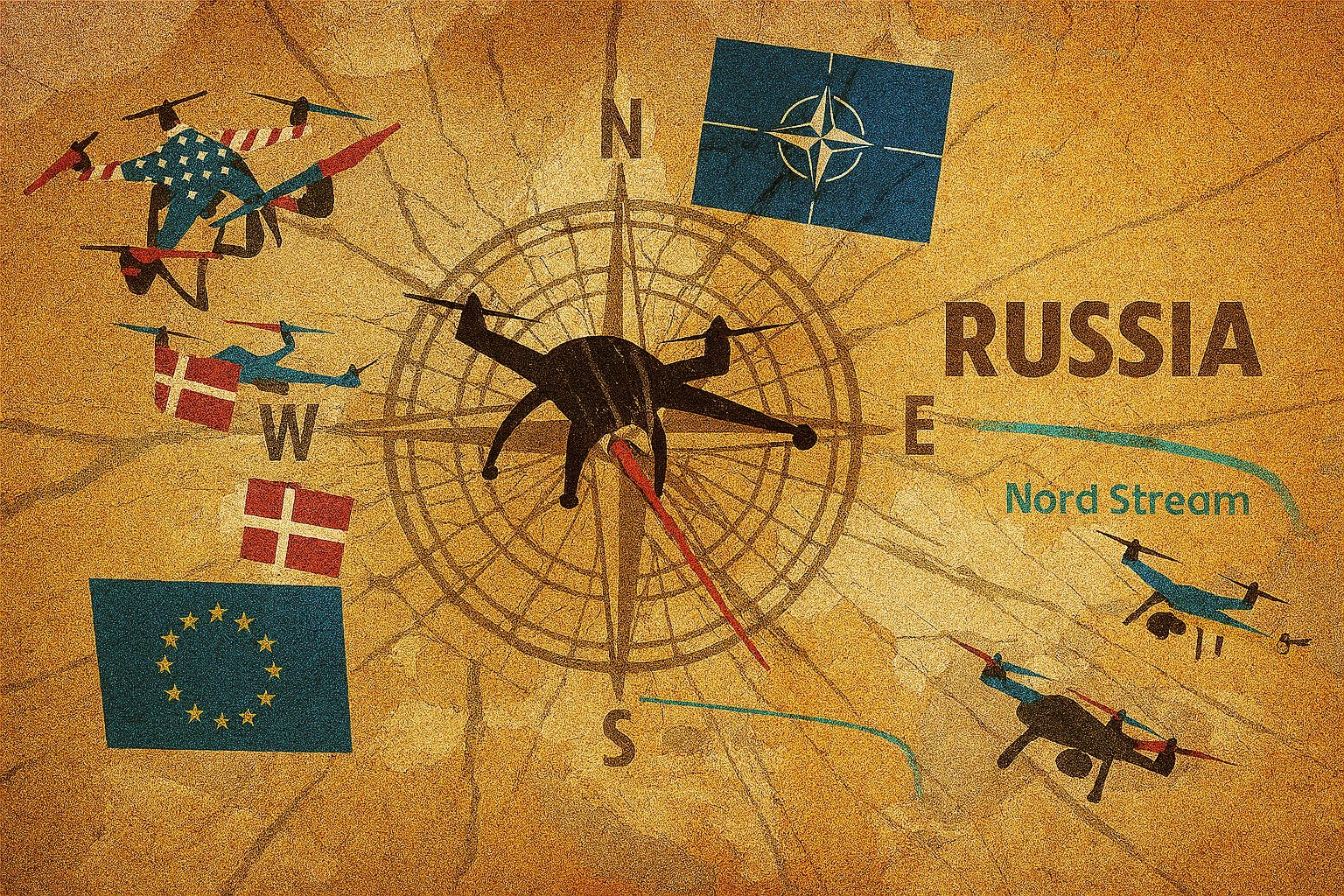
Officially, the drones were not identified. By simply thinking critically – which journalists and selected experts no longer do – there may be a good reason for that. And this article will never be mentioned in Denmark… Drones over Denmark. No damage. No trace. No answers. Yet the headlines scream “Russian threat,” and Prime Minister Mette Frederiksen speaks with a certainty that defies logic: “We don’t know they were Russian—but we know Russia is the biggest threat to Europe.” It could be nobody else – unless you make an interest analysis which I did two days ago. This is not security policy. It’s theatre. And the audience is being played. Let’s rewind. These drones—unphotographed, untracked, unclaimed—appear and vanish like ghosts. Airports shut down. Panic spreads. Military budgets swell. And the narrative hardens: Russia is behind it. But what if that’s not just wrong but deliberately misleading? Here’s a hypothesis for...