
Trita Parsi: Why non-Western countries tend to see Russia's war very, very differently

Trita Parsi

April 18, 2022

The West appears blind to its own hypocrisy and narrow interests in calling for a rules-based order.

Ukrainian President Volodymyr Zelenskyy has been nothing short of brilliant in his outreach to Western audiences. The overwhelming Western support for Ukraine is due not only to the brutality of Russia’s illegal invasion, but also to the astuteness and charisma with which Zelenskyy has made Ukraine’s case for aid.

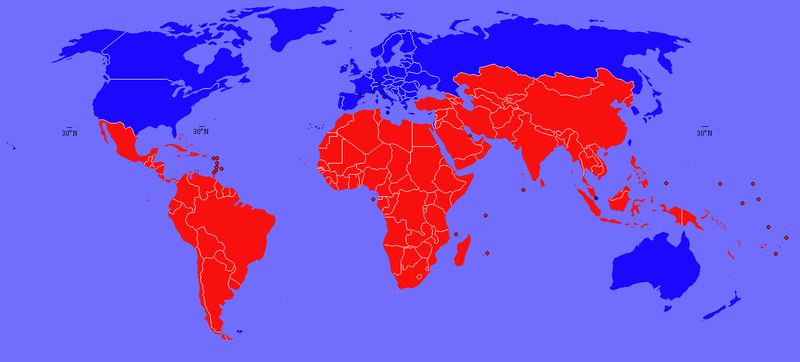
But as effective as Zelenskyy has been in drumming up Western support, Ukraine’s message has been far less compelling to audiences in the Global South, where many countries have declined to join Western campaigns to sanction Russia’s economy and isolate it diplomatically. This was vividly clear at the Doha Forum last month in Qatar, where Zelenskyy and Ukrainian Deputy Foreign Minister Emine Dzhaparova were given a big platform.

A powerful communicator in her own right, Dzhaparova — a Muslim Tatar from Crimea — played on themes favored by Western leaders: This war is ultimately not about Ukraine but about the survival of the “international rules-based order.” President Joe Biden and European leaders have repeatedly framed the conflict in these terms, as well.

But therein lies the disconnect with much of the Global South.

Originally published by MSNBC on April 12, 2022

In conversations with diplomats and analysts from across Africa, Asia, the Middle East and Latin America, it was evident to me that these countries largely sympathize with the plight of the Ukrainian people and view Russia as the aggressor. But Western demands that they make costly sacrifices by cutting off economic ties with Russia to uphold a “rules-based order” have begotten an allergic reaction. That order hasn’t been rules-based; instead, it has allowed the U.S. to violate international law with impunity.

The West’s messaging on Ukraine has taken its tone-deafness to a whole new level, and it is unlikely to win over the support of countries that have often experienced the worse sides of the international order.

The countries that have bucked Western calls for aid and diplomatic unity that have received the most attention are Saudi Arabia and the United Arab Emirates. In a sharp break from Washington, they have furthered their economic and political embrace of Russia while rebuffing Biden’s request to lower oil prices by pumping more oil. The UAE refused to denounce Russia’s invasion at the U.N. Security Council, and while its de facto leader, Mohammed bin Zayed, refused a phone call with Biden, he ordered his foreign minister to travel to Russia to strengthen their ties.

The concerns of Riyadh and Abu Dhabi differ sharply from those of most of the broader Global South and are rooted primarily in their deteriorating ties with Washington over the U.S. disinclination to go to war on their behalf against Iran and its allies. One Saudi diplomat has described Saudi-U.S. tensions as “the end of the road for us and Biden, but maybe the U.S. also.

For the rest of the Global South, various local and broader structural factors have contributed to a hesitance to support the isolation of Russia. South American powers such as Brazil and Mexico, African heavyweights South Africa and Ethiopia and Asian rising power India are all in the majority in their regions in their refusal to sanction Russia.

India’s relations with Russia go back to the Cold War, when the Soviet Union vetoed numerous U.N. Security Council resolutions about Kashmir in India’s behalf. Russia remains one of India’s leading arms suppliers to this day. The same is true for many African countries. According to the Stockholm International Peace Research Institute, 18 percent of all Russian arms sales went to Africa from 2016 to 2020. African dependence on Russian and Ukrainian wheat and fertilizers is even greater — a quarter of African countries get a third of their wheat from Russia and Ukraine. Egypt knows the significance of this all too well. Rising Russian and Ukrainian grain prices in the months before the Arab spring in 2011 played a crucial role in setting the stage for the regionwide protests.

But the broader Global South’s dependence on or vulnerability to Russia doesn’t tell the whole story. Many of these states also see flagrant hypocrisy in framing the Ukraine war in terms of the survival of the rules-based order. From their vantage point, no other country or bloc has undermined international law, norms or the rules-based order more than the U.S. and the West.

There is no scarcity of examples.

In recent years, America undercut the rules-based order when Donald Trump withdrew from the U.N. Human Rights Council over its criticism of Israel’s treatment of Palestinians and the World Health Organization amid the Covid pandemic, and he sanctioned senior officials of the International Criminal Court for seeking to investigate American war crimes in Afghanistan. (The Biden administration is calling for the court to investigate Russian war crimes in Ukraine.)

It doesn’t help that many of these countries perceive themselves as having been at the receiving end of American unilateralism and recklessness.

There is also the blatant illegality of the George W. Bush administration’s invasion of Iraq, the Obama administration’s regime-change intervention in Libya, the U.S. and the U.K.’s ongoing support for the Saudi war in Yemen (which has left 13 million people at risk of starvation) and the celebration of armed Ukrainian resistance against Russian invaders while not only condemning Palestinian resistance against Israeli occupation, but also outlawing nonviolent economic opposition to that decades-long occupation. And then there is the “global war on terror,” which has destabilized much of the Middle East and North Africa while killing more than twice as many people as the terrorists themselves have murdered since the Sept. 11 attacks.

In fact, even though the U.S. played an instrumental role in establishing the rules and norms of the post-World War II order, it almost immediately began breaking them. During his two terms, President Dwight D. Eisenhower authorized no fewer than 104 covert operations, which included overthrowing governments and arming regional revolts.

But now the U.S. is demanding that countries in the Global South make massive and costly sacrifices — with little regard for their vulnerabilities and security needs — to save an order the U.S. itself has been at the forefront of eroding. To return to an order in which the U.S. can continue to act outside international law is equivalent to asking the Global South to make unbearable sacrifices to uphold American exceptionalism.

Moreover, it doesn’t help that many of these countries perceive themselves as having been on the receiving end of American unilateralism and recklessness. NATO, for instance, isn’t held in high regard in large parts of Africa because of its military intervention in Libya, which left a path of death and destruction in the Sahel. Defending his country’s neutral stance, Ugandan President Yoweri Museveni told reporters last month that the West “destroyed” Libya while spreading terrorism beyond its border.

The damaging consequences of American interventionism play a significant role in the calculations of countries across the Global South. Most of them seek close relations with the U.S. But because of U.S. unilateralism, they desire options to find counterweights against U.S. power when needed. The emergence of a multipolar system provides countries of the Global South with a degree of protection against American adventurism, while they largely see Russia’s military intervention in Ukraine as a European affair that doesn’t change the larger global picture, in which balancing options against the U.S. rather than Russia are sought after.

As former Indian national security adviser Shivshankar Menon writes, most Asian capitals regard the conflict as a war “over the European security order — not an epochal global conflagration.” Getting entangled in that regional conflict makes little sense for many in the Global South — and certainly not for the sake of restoring a flawed order that gave undue advantage to the West. Indeed, the glee with which some Western analysts view the Ukrainian war as a “strategic opportunity” to reignite a Cold War between democracies and autocracies — scholars Michael Beckley and Hal Brands went so far as to say that Putin has “inadvertently done the United States and its allies a tremendous favor” by creating this window — appears to only further push away the broader Global South.

For Ukraine, the support of the Global South may ultimately not be a high priority. But for the U.S., there’s an important lesson here. Had it pursued a more restrained foreign policy in the past few decades, it might have found it far easier to rally the global community to its side against the aggression of another nuclear power.

Please support TFF’s work for peace through research and public education. We are all-volunteer, people-financed and do not accept money from governments or corporations. In other words, one of the very last free research think tanks in this world – and for a noble purpose: Peace by peaceful – intelligent – means. Thanks!

About Trita Parsi
The author

Trita Parsi is the executive vice president of the Quincy Institute and the author of “Losing an Enemy — Obama, Iran and the Triumph of Diplomacy.”
His personal homepage is here.

Share

Leave a Reply

Your email address will not be published. Required fields are marked *

Related Posts

Editorial for Transcend Media Service, TMS, and published in an edited Q & A version by the China Social Science Network-China Social Science News. See also this follow-up, “Condemn all UN member states: They spend 100 times more on militarism than on the entire UN system.” The UN has been extremely important over the last 80 years in terms of, for instance, global dialogue, multi-dimensional development, international law, peace-keeping, normativity, violence condemnation, and ethics. It has been the place to hold member states accountable. The UN Charter is the most Gandhian document ever signed by the world’s governments. If the great majority of member states lived up to their obligations in accordance with the UN Charter and including the resolutions they have signed up to, the world would be a much more peaceful, just, democratic, and lawful place. Regrettably, there are several reasons why the world is not in accordance with those fine Charter norms and provisions:a) The majority...
Professor Zhang Weiwei is a highly respected Chinese intellectual and professor at Fudan University in Shanghai. He is the director of its China Institute and also runs a series of conversations with many different people around the world. Here is what came out of their meetings there and in Skopje, Macedonia in October 2024: & As you can see, also at the end of the second one, we both enjoy win-win exchanges like these about world order issues. Zhang Weiwei is known for using videos and social media to reach a large audience in China and worldwide. We suggest you see many more of Zhang Weiwei’s conversations – like recently with Professor Jeffrey Sachs – on the Thinkers’ Forum on YouTube. PSTFF posts hundreds of videos, its own and those of others, in our Video Collections on TFF Substack – including those that appear on YouTube. However, TFF has been cancelled by Google-owned...
Foreword The Board of The Transnational Foundation in Sweden has decided to publish an easy-to-read, scholarly anthology that addresses one of the most important – and potentially dangerous – issues of our time: Why are the political, economic, and medialised Western images of China so consistently negative – and what can you do to understand China better? These images may be expressions of a political will to present only various shades of grey and black with the aim of building a consciousness about China as an enemy and not a partner. They may also be seen as a sort of world-dominating ethos of ignorance based upon the assumption that “we’ve-got-nothing-to-learn-from-others,’ we are the teacher. Another possibility is that the West, deep down, feels that it is getting relatively weaker from a macro-historical perspective and comforts itself with denial and accusations against “the other” of being the reason for its manifest...

Recent Articles

PressInfo # 141, December 21, 2001It’s time to prepare reconciliation between Albanians and Serbs PressInfo # 140, December 14, 2001Ibrahim Rugova’s decade-long leadership in Kosovo/a PressInfo # 139, 11. december, 2001En god nyhet: Jugoslaviens Sannings- och försoningskommission PressInfo # 139, 11. december, 2001Gode nyheder: Jugoslaviens Sandheds- og Forsoningskommission PressInfo # 139, December 11, 2001Good news: Yugoslavia’s Truth and Reconciliation Commission PressInfo # 138, November 8, 2001TFF co-founder PhD with thesis about young people with roots in other cultures PressInfo # 138, November 8, 2001TFF:s medstiftare doktor på avhandling om unga med ursprung i andra kulturer PressInfo # 137, October 17, 2001A new Marshall Plan: Advancing human security and controlling terrorism PressInfo # 136, October 15, 2001The UN and Annan really deserve it PressInfo # 135, October 10, 2001Preventing a terrorist mushroom cloud PressInfo # 134, 17 oktober, 2001Sverige og 11. september PressInfo # 134, October 9, 2001Sweden and September 11...
Peace is promoted by constructive proposals and dialogue Four preceding PressInfos have expressed concern over — and criticised — the ongoing, militarisation of the EU. Some will say: but there are no alternatives. We believe that there are always alternatives, that democracies are characterised by alternatives and choice, and that openly discussed alternatives will improve the quality and legitimacy of society’s decision–making. In addition, it is an intellectual and moral challenge to not only criticise but also be constructive. If we only tell people that we think they are wrong, they are not likely to listen. However, if we say: what are your views on this set of ideas and steps? — we may sometimes engage them in dialogue and sow a seed. Most people in power circles live their daily lives in in a time frame and a social space where certain ideas, viewpoints and concepts are just not...
Photos © TFF 2000 Read PressInfo 90 “Lift the Sanctions and Bring More Aid to Yugoslavia” See Pictures from Belgrade © TFF 2000 Please reprint, copy, archive, quote or re-post this item, but please retain the source.

TFF on Substack

Discover more from TFF Transnational Foundation & Jan Oberg.

Most Popular

PressInfo # 141, December 21, 2001It’s time to prepare reconciliation between Albanians and Serbs PressInfo # 140, December 14, 2001Ibrahim Rugova’s decade-long leadership in Kosovo/a PressInfo # 139, 11. december, 2001En god nyhet: Jugoslaviens Sannings- och försoningskommission PressInfo # 139, 11. december, 2001Gode nyheder: Jugoslaviens Sandheds- og Forsoningskommission PressInfo # 139, December 11, 2001Good news: Yugoslavia’s Truth and Reconciliation Commission PressInfo # 138, November 8, 2001TFF co-founder PhD with thesis about young people with roots in other cultures PressInfo # 138, November 8, 2001TFF:s medstiftare doktor på avhandling om unga med ursprung i andra kulturer PressInfo # 137, October 17, 2001A new Marshall Plan: Advancing human security and controlling terrorism PressInfo # 136, October 15, 2001The UN and Annan really deserve it PressInfo # 135, October 10, 2001Preventing a terrorist mushroom cloud PressInfo # 134, 17 oktober, 2001Sverige og 11. september PressInfo # 134, October 9, 2001Sweden and September 11...
Peace is promoted by constructive proposals and dialogue Four preceding PressInfos have expressed concern over — and criticised — the ongoing, militarisation of the EU. Some will say: but there are no alternatives. We believe that there are always alternatives, that democracies are characterised by alternatives and choice, and that openly discussed alternatives will improve the quality and legitimacy of society’s decision–making. In addition, it is an intellectual and moral challenge to not only criticise but also be constructive. If we only tell people that we think they are wrong, they are not likely to listen. However, if we say: what are your views on this set of ideas and steps? — we may sometimes engage them in dialogue and sow a seed. Most people in power circles live their daily lives in in a time frame and a social space where certain ideas, viewpoints and concepts are just not...
Photos © TFF 2000 Read PressInfo 90 “Lift the Sanctions and Bring More Aid to Yugoslavia” See Pictures from Belgrade © TFF 2000 Please reprint, copy, archive, quote or re-post this item, but please retain the source.
Read More
Imagen-thumbnail-The-Transnational-1
PressInfo # 141, December 21, 2001It’s time to prepare reconciliation between Albanians and Serbs PressInfo # 140, December 14, 2001Ibrahim Rugova’s decade-long leadership in Kosovo/a PressInfo # 139, 11. december, 2001En god nyhet: Jugoslaviens Sannings- och försoningskommission PressInfo # 139, 11. december, 2001Gode nyheder: Jugoslaviens Sandheds- og Forsoningskommission PressInfo # 139, December 11, 2001Good news: Yugoslavia’s Truth and Reconciliation Commission PressInfo # 138, November 8, 2001TFF co-founder PhD with thesis about young people with roots in other cultures PressInfo # 138, November 8, 2001TFF:s medstiftare doktor på avhandling om unga med ursprung i andra kulturer PressInfo # 137, October 17, 2001A new Marshall Plan: Advancing human security and controlling terrorism PressInfo # 136, October 15, 2001The UN and Annan really deserve it PressInfo # 135, October 10, 2001Preventing a terrorist mushroom cloud PressInfo # 134, 17 oktober, 2001Sverige og 11. september PressInfo # 134, October 9, 2001Sweden and September 11...
Imagen-thumbnail-The-Transnational-1
Peace is promoted by constructive proposals and dialogue Four preceding PressInfos have expressed concern over — and criticised — the ongoing, militarisation of the EU. Some will say: but there are no alternatives. We believe that there are always alternatives, that democracies are characterised by alternatives and choice, and that openly discussed alternatives will improve the quality and legitimacy of society’s decision–making. In addition, it is an intellectual and moral challenge to not only criticise but also be constructive. If we only tell people that we think they are wrong, they are not likely to listen. However, if we say: what are your views on this set of ideas and steps? — we may sometimes engage them in dialogue and sow a seed. Most people in power circles live their daily lives in in a time frame and a social space where certain ideas, viewpoints and concepts are just not...
Imagen-thumbnail-The-Transnational-1
Photos © TFF 2000 Read PressInfo 90 “Lift the Sanctions and Bring More Aid to Yugoslavia” See Pictures from Belgrade © TFF 2000 Please reprint, copy, archive, quote or re-post this item, but please retain the source.
Imagen-thumbnail-The-Transnational-1
Av FRANK SØHOLM GREVIL 16 augusti 2004  Vi er nu nået til tredje akt i det absurde teaterstykke, der i analogi med de store skueprocesser i Moskva 1936-38 er blevet døbt ‘Grevil-sagen’. Første akt bestod i min anonyme fremlæggelse af egenhændigt nedklassificerede rapporter i Berlingske Tidende i februar og marts. Andet akt udgjordes af min fremtræden med navn og billede i Information i april samt den efterfølgende mediestorm, som uden min direkte medvirken kostede en forsvarsminister taburetten samt en sigtelse for brud på tavshedspligten. Tredje akt bliver en retssag, hvor jeg står tiltalt for at have overtrådt straffelovens bestemmelser om uberettiget videregivelse eller udnyttelse af fortrolige oplysninger. Statsanklageren har ovenikøbet valgt at påberåbe sig særligt skærpende omstændigheder. Da jeg aldrig har modtaget betaling for at stille rapporterne til rådighed eller lade mig interviewe, må det skærpende bestå i, at “videregivelsen eller udnyttelsen er sket under sådanne omstændigheder, at det påfører...
Imagen-thumbnail-The-Transnational-1
Af Svenska Irakkommittén mot de Ekonomiska Sanktionerna (SIES) 13 september 2002 FN:s ekonomiska sanktioner mot Irak har nu pågått i tolv år och drabbat det irakiska folket med svåra lidanden. Enligt FN:s egna siffror har mer än 1,5 miljoner människor, varav ca 600 000 barn, dött som en direkt följd av sanktionerna. Dessutom har ett lågintensivt bombkrig mot landet pågått under dessa år. Av all denna förödelse- orsakad huvudsakligen av amerikansk och brittisk politik- har Saddam Husseins brutala och diktatoriska regim snarast stärkts än försvagats. Nu förbereder USA under president Bushs ledning ett storskaligt bombkrig mot Irak som kommer att innebära ett ännu större lidande för civilbefolkningen. Ett sådant krig kommer dessutom att ytterligare undergräva freden och säkerheten i världen. Att upprätta en demokratisk regim i Irak är det irakiska folkets angelägenhet och får enligt folkrätten inte ske med krigshandlingar utifrån. Folkrätten och FN:s stadgar måste respekteras. Vi vädjar till...